Data sources:
PubChem, NIST Chemistry WebBook, CRC Handbook of Chemistry and Physics (103rd ed.)
Last updated: 2026-06-25
Status regulacyjny substancji
Brak wpisow dla tego CAS w sprawdzonych wykazach ograniczen (lista kandydacka SVHC, REACH Zalacznik XVII; zbiory niepelne - nie jest to potwierdzenie zgodnosci). Klasyfikacja CLP i status transportowy (ADR): patrz sekcja GHS oraz karta charakterystyki (SDS).
📚 Bibliografia książkowa oczekuje na wygenerowanie. Kuratowane podręczniki ogólne są dostępne poniżej; specyficzne dla CAS książki Google Books można pobrać z panelu administratora.
National Institute of Standards and Technology. 2024. "NIST Chemistry WebBook, SRD 69." Gaithersburg, MD: NIST. Accessed 2025-01-01. ↗
Spectral Database for Organic Structure Determination (SDBS). 2024. National Institute of Advanced Industrial Science and Technology (AIST), Japan. Accessed 2025-01-01. ↗
Ulrich, Eldon L., Hideo Akutsu, John F. Doreleijers, Yoko Harano, Yannis E. Ioannidis, Jundong Lin, Miron Livny, et al. 2008. "BioMagResBank." Nucleic Acids Research 36 (D1): D402–D408. [DOI ↗]
Horai, Hisayuki, Masanori Arita, Shigehiko Kanaya, Yoshito Nihei, Tasuku Ikeda, Kazuhiro Suwa, Yuya Ojima, et al. 2010. "MassBank: A Public Repository for Sharing Mass Spectral Data for Life Sciences." Journal of Mass Spectrometry 45 (7): 703–714. [DOI ↗]
Linstrom, P.J., and W.G. Mallard, eds. 2024. NIST Chemistry WebBook, NIST Standard Reference Database Number 69. Gaithersburg, MD: National Institute of Standards and Technology. ↗
McDonald, M. Shane, Mike McAvoy, and Ajit Bhalerao. 1988. "JCAMP-DX: A Standard Form for Exchange of Infrared Spectra in Computer Readable Form." Applied Spectroscopy 42 (1): 151–162. [DOI ↗]
PubChem. 2024. "PubChem Compound Database." National Library of Medicine, National Institutes of Health. Accessed 2025-01-01. ↗
MolGod_SPECDB_SP2
📊Bazy widm spektroskopowych — dane inline9 źródełMolGod_SPECDB_2
Widma pobierane na żądanie z 9 źródeł. Każde widmo jest zapisywane w naszej bazie — kolejne otwarcie = zero zapytania do zewnętrznego API. Pobierz JCAMP-DX / CSV / PNG przy każdym widmie bez szukania.
Dane pobierane przez MolGod_Spectra_Remote_Fetcher (JCAMP-DX parser) i zapisywane w tabeli wp_molgod_spectra_cache. Zero duplikatów pobrań, zero zapytań do NIST przy kolejnych otwarciach. Licencje przestrzegane (publikowany tylko deep-link + własna wizualizacja).
Dane pobierane na żywo z wielu źródeł (priority-chain). JCAMP-DX / CSV / PNG dostępne do pobrania pod każdym widmem. ⓘ Jedno źródło ★★☆☆☆
IR — Fourier-transform infrared
Ładowanie IR — Fourier-transform infrared…
MS — Mass spectrometry (EI 70eV)
Ładowanie MS — Mass spectrometry (EI 70eV)…
MolGod_DFT_SP5
🧮 Porównanie DFT vs eksperyment (IR)
Nakładka eksperymentalnego widma IR na obliczone teoretycznie metodą B3LYP/6-31G* (czynnik skalujący 0.9614, Scott & Radom 1996).
Eksperyment DFT (theoretical)
Pełne dane teoretyczne (geometria, częstości): NIST CCCBDB ↗
📚 Bibliografia (Chicago)
Becke, Axel D. 1993. "Density-Functional Thermochemistry. III. The Role of Exact Exchange." Journal of Chemical Physics 98 (7): 5648–5652. Definicja funkcjonału B3LYP.
Scott, Anthony P., and Leo Radom. 1996. "Harmonic Vibrational Frequencies: An Evaluation of Hartree–Fock, Møller–Plesset, Quadratic Configuration Interaction, Density Functional Theory, and Semiempirical Scale Factors." Journal of Physical Chemistry 100 (41): 16502–16513. Współczynniki skalujące dla DFT (np. 0.9614 dla B3LYP/6-31G*).
Merrick, Jeffrey P., Damian Moran, and Leo Radom. 2007. "An Evaluation of Harmonic Vibrational Frequency Scale Factors." Journal of Physical Chemistry A 111 (45): 11683–11700. Aktualizacja Scott & Radom — scale factors dla nowszych funkcjonałów DFT.
Lee, Chengteh, Weitao Yang, and Robert G. Parr. 1988. "Development of the Colle-Salvetti Correlation-Energy Formula into a Functional of the Electron Density." Physical Review B 37 (2): 785–789. Korelacja LYP — uzupełnienie Becke 1993 dla B3LYP.
Hehre, Warren J., Robert Ditchfield, and John A. Pople. 1972. "Self-Consistent Molecular Orbital Methods. XII. Further Extensions of Gaussian-Type Basis Sets." Journal of Chemical Physics 56 (5): 2257–2261. Definicja bazy 6-31G* (split-valence + polaryzacja).
Johnson, Russell D., III, ed. 2022. "NIST Computational Chemistry Comparison and Benchmark Database (CCCBDB)." NIST Standard Reference Database 101, Release 22. https://cccbdb.nist.gov. Benchmark dla wartości teoretycznych — fallback link w widget.
Cramer, Christopher J. 2004. "Essentials of Computational Chemistry: Theories and Models." 2nd ed. Chichester: Wiley. Podręcznik metod DFT i obliczeń częstości drgań.
Jensen, Frank. 2017. "Introduction to Computational Chemistry." 3rd ed. Chichester: Wiley. Modern computational chemistry — bazy + metody dla widm wibracyjnych.
Foresman, James B., and Æleen Frisch. 2015. "Exploring Chemistry with Electronic Structure Methods." 3rd ed. Wallingford, CT: Gaussian, Inc. Praktyczny przewodnik Gaussian — IR + Raman + NMR z DFT.
MolGod_SPECGUIDE_SP6
🎓 Przewodnik interpretacji widm (dla studentów)
Auto-wygenerowane wyjaśnienia każdego pasma w widmie — dlaczego pojawia się tam, gdzie się pojawia, i co świadczy o strukturze.
IR (infrared) (411 pików)
Widmo IR (infrared) zawiera 411 zidentyfikowanych pasm. Poniższa analiza tłumaczy, co każde z nich znaczy strukturalnie i dlaczego pojawia się w danym zakresie.
Brak rozpoznanych grup — pasma poza standardowymi zakresami.
📚 Bibliografia (Chicago)
Field, Leslie D., Sev Sternhell, and John R. Kalman. 2013. "Organic Structures from Spectra." 5th ed. Chichester: Wiley. Studencki problem-set podręcznik (interpretation guide companion).
Williams, Dudley H., and Ian Fleming. 2008. "Spectroscopic Methods in Organic Chemistry." 6th ed. London: McGraw-Hill. Klasyk narratywnej interpretacji widm — wyjaśnia "dlaczego pik tu".
Crews, Phillip, Jaime Rodríguez, and Marcel Jaspars. 2009. "Organic Structure Analysis." 2nd ed. New York: Oxford University Press. Workflow strukturalnej interpretacji wieloparametrycznej.
McLafferty, Fred W., and František Tureček. 1993. "Interpretation of Mass Spectra." 4th ed. Mill Valley, CA: University Science Books. Mechanizmy fragmentacji MS — McLafferty rearrangement, m/z 29 = CHO.
Reusch, William. 2013. "Virtual Textbook of Organic Chemistry: Spectroscopy." East Lansing, MI: Michigan State University. https://www2.chemistry.msu.edu/faculty/reusch/VirtTxtJml/Spectrpy/spectro.htm. Otwarty dydaktyczny przewodnik po IR/NMR/MS/UV — ideal do wyjaśnień grup funkcyjnych.
Hesse, Manfred, Herbert Meier, and Bernd Zeeh. 2007. "Spektroskopische Methoden in der organischen Chemie." 8th ed. Stuttgart: Thieme. Niemiecki standardowy podręcznik interpretacji widm.
Lampman, Gary M., Donald L. Pavia, George S. Kriz, and James R. Vyvyan. 2010. "Spectroscopy." 4th ed. Belmont, CA: Cengage Learning. Workbook ze sklejonymi narracjami interpretacyjnymi.
Kalsi, P. S. 2010. "Spectroscopy of Organic Compounds." 6th ed. New Delhi: New Age International. Kompletny podręcznik interpretacji widm IR/NMR/MS/UV.
MolGod_MS_SP7
🔎 Wyszukiwanie po widmie (JCAMP-DX)
Wgraj plik JCAMP-DX (.jdx, .dx, .jcm) — system policzy podobieństwo cosinusowe do wszystkich widm w bazie i pokaże TOP 10 dopasowań.
📚 Bibliografia (Chicago)
McLafferty, Fred W., ed. 2018. Wiley Registry of Mass Spectral Data. 11th ed. Hoboken, NJ: Wiley. Referencyjna biblioteka MS (~775k widm).
Stein, Stephen E., and Donald R. Scott. 1994. "Optimization and Testing of Mass Spectral Library Search Algorithms for Compound Identification." Journal of the American Society for Mass Spectrometry 5 (9): 859–866. Algorytm cosine + dot-product NIST MS Search.
McDonald, Robert S., and Paul A. Wilks Jr. 1988. "JCAMP-DX: A Standard Form for Exchange of Infrared Spectra in Computer Readable Form." Applied Spectroscopy 42 (1): 151–162. Specyfikacja JCAMP-DX (rozszerzona do 5.01 dla NMR/MS).
McLafferty, Fred W., and František Tureček. 1993. "Interpretation of Mass Spectra." 4th ed. Mill Valley, CA: University Science Books. Cosine similarity matching i fragmentacja MS — fundament algorytmu wyszukiwania.
Sumner, Lloyd W., Alexander Amberg, Dave Barrett, Michael H. Beale, Richard Beger, Clare A. Daykin, Teresa W.-M. Fan, et al. 2007. "Proposed Minimum Reporting Standards for Chemical Analysis." Metabolomics 3 (3): 211–221. MSI Level 1-4 — standardy poziomu pewności dopasowania widmowego.
Stein, Stephen E. 1999. "An Integrated Method for Spectrum Extraction and Compound Identification from Gas Chromatography/Mass Spectrometry Data." Journal of the American Society for Mass Spectrometry 10 (8): 770–781. Algorytm AMDIS — dekonwolucja + library match (NIST).
Lindon, John C., George E. Tranter, and David W. Koppenaal, eds. 2017. "Encyclopedia of Spectroscopy and Spectrometry." 3rd ed. Amsterdam: Academic Press. Encyklopedyczne hasła dot. spectral library searching.
Smith, Brian C. 2011. "Fundamentals of Fourier Transform Infrared Spectroscopy." 2nd ed. Boca Raton, FL: CRC Press. FT-IR i format JCAMP-DX dla widm transmisyjnych.
Larkin, Peter. 2017. "Infrared and Raman Spectroscopy: Principles and Spectral Interpretation." 2nd ed. Amsterdam: Elsevier. Principles of IR/Raman library matching i preprocessing peakow.
📐Physical & Chemical Properties (DB)
5 fields MolGod Score: Wiarygodne
Haynes, William M., ed. 2024. CRC Handbook of Chemistry and Physics. 105th ed. Boca Raton: CRC Press/Taylor & Francis. ISBN 978-1-032-55554-4. ↗
National Institute of Standards and Technology. 2024. "NIST Chemistry WebBook, SRD 69." Gaithersburg, MD: NIST. Accessed 2025-01-01. ↗
Yaws, Carl L. 2014. The Yaws Handbook of Physical Properties for Hydrocarbons and Chemicals. 2nd ed. Oxford: Gulf Professional Publishing.
PubChem. 2024. "PubChem Compound Database." National Library of Medicine, National Institutes of Health. Accessed 2025-01-01. ↗
Marrero, J., and R. Gani. 2001. "Group-Contribution Based Estimation of Pure Component Properties." Fluid Phase Equilibria 183–184: 183–208. ↗
Joback, K. G., and R. C. Reid. 1987. "Estimation of Pure-Component Properties from Group-Contributions." Chemical Engineering Communications 57 (1–6): 233–243. ↗
Sangster, J. 1997. Octanol-Water Partition Coefficients: Fundamentals and Physical Chemistry. Chichester: Wiley. ISBN 978-0-471-97397-3.
Mannhold, Raimund, and Han van de Waterbeemd. 2001. "Substructure and Whole Molecule Approaches for Calculating Log P." Journal of Computer-Aided Molecular Design 15 (4): 337–354. ↗
Perrin, Ditlev D., Boyd Dempsey, and E. P. Serjeant. 1981. pKa Prediction for Organic Acids and Bases. London: Chapman and Hall. ISBN 0-412-21090-5.
Constantinou, Leonidas, and Rafiqul Gani. 1994. "New Group Contribution Method for Estimating Properties of Pure Compounds." AIChE Journal 40 (10): 1697–1710. ↗
Ertl, Peter, Bernhard Rohde, and Paul Selzer. 2000. "Fast Calculation of Molecular Polar Surface Area as a Sum of Fragment-Based Contributions and Its Application to the Prediction of Drug Transport Properties." Journal of Medicinal Chemistry 43 (20): 3714–3717. ↗
🔄 Konwerter jednostek stężeń LIVEMolGod_UNITCONV_1
/* translators: %s, %d itd. to wartosci dynamiczne wstawiane do komunikatu. */
Wpisz stężenie methylene blue w dowolnej jednostce — reszta obliczy się automatycznie.
Cohen ER, Cvitaš T, Frey JG, Holmström B, Kuchitsu K, Marquardt R, Mills I, Pavese F, Quack M, Stohner J, Strauss HL, Takami M, Thor AJ (2007)
g/L ↔ molarity
c (mol/L) = (g/L) / MW
±0.1% (depends on MW precision)
Cohen ER, Cvitaš T, Frey JG, Holmström B, Kuchitsu K, Marquardt R, Mills I, Pavese F, Quack M, Stohner J, Strauss HL, Takami M, Thor AJ (2007)
mmol/L ↔ molarity
c (mol/L) = mmol/L × 10⁻³
Exact
Cohen ER, Cvitaš T, Frey JG, Holmström B, Kuchitsu K, Marquardt R, Mills I, Pavese F, Quack M, Stohner J, Strauss HL, Takami M, Thor AJ (2007)
Celsius ↔ Kelvin
T(K) = t(°C) + 273.15
±0.01 K (ITS-90 scale)
BIPM (Bureau International des Poids et Mesures) (2019)
Celsius ↔ Fahrenheit
T(°F) = T(°C) × 9/5 + 32
±0.1 °F
Thompson A, Taylor BN (2008)
density-corrected % ↔ molarity
c (mol/L) = (%w/w × ρ × 10) / MW, ρ in g/mL
±0.1% when ρ known to 3 decimals
Cohen ER, Cvitaš T, Frey JG, Holmström B, Kuchitsu K, Marquardt R, Mills I, Pavese F, Quack M, Stohner J, Strauss HL, Takami M, Thor AJ (2007)
📚 Bibliografia (8 źródeł autorytatywnych)
Thompson A, Taylor BN (2008). Guide for the Use of the International System of Units (SI). NIST Special Publication 811 · DOI: 10.6028/NIST.SP.811-2008 → Primary SI standard for US scientific usage
Cohen ER, Cvitaš T, Frey JG, Holmström B, Kuchitsu K, Marquardt R, Mills I, Pavese F, Quack M, Stohner J, Strauss HL, Takami M, Thor AJ (2007). Quantities, Units and Symbols in Physical Chemistry — The IUPAC Green Book. RSC Publishing, 3rd ed. · DOI: 10.1039/9781847557889 · ISBN: 978-0-85404-433-7 → Canonical IUPAC guide for chemistry quantities/units
BIPM (Bureau International des Poids et Mesures) (2019). The International System of Units (SI), 9th edition. BIPM · ↗ → International SI definitions (incl. redefined kilogram 2019)
ISO/IEC (2022). Quantities and units — Part 1: General. International Organization for Standardization — ISO 80000-1:2022 · ↗ → General rules for physical quantities and units
ISO/IEC (2019). Quantities and units — Part 9: Physical chemistry and molecular physics. International Organization for Standardization — ISO 80000-9:2019 · ↗ → Concentration / molality / amount-of-substance conventions
Tiesinga E, Mohr PJ, Newell DB, Taylor BN (2021). CODATA recommended values of the fundamental physical constants: 2018. Rev. Mod. Phys. 93(2):025010 · DOI: 10.1103/RevModPhys.93.025010 → Avogadro, gas constant, molar volume (2019 SI revision)
IUPAC (2019). Compendium of Chemical Terminology — the IUPAC Gold Book (online). IUPAC · DOI: 10.1351/goldbook → Definitions of mass fraction, molality, normality, ppm, activity
Mills IM, Cvitaš T, Homann K, Kallay N, Kuchitsu K (1988). Quantities, Units and Symbols in Physical Chemistry. Blackwell Scientific Publications, 1st ed. · ISBN: 0-632-01773-5 → Historical predecessor of IUPAC Green Book
🛡️ Bezpieczeństwo — CAS 61-73-4MolGod_SAFEHUB_MAIN
Informacja o ograniczeniach danych. Informacje dotyczące bezpieczeństwa zawarte na tej stronie mają charakter informacyjny i nie zastępują pełnej karty charakterystyki (SDS). Przed użyciem produktu zapoznaj się z aktualną kartą charakterystyki producenta oraz wytycznymi GHS/CLP. Klasyfikacja CLP dotyczy czystej substancji bulk, nie preparatów handlowych.
MolGod_GHS_SF1
Klasyfikacja GHS/CLP — Rozporządzenie (WE) nr 1272/2008 + UN GHS Rev. 9 (2021).
⚠️ Niebezpieczeństwo (Danger)
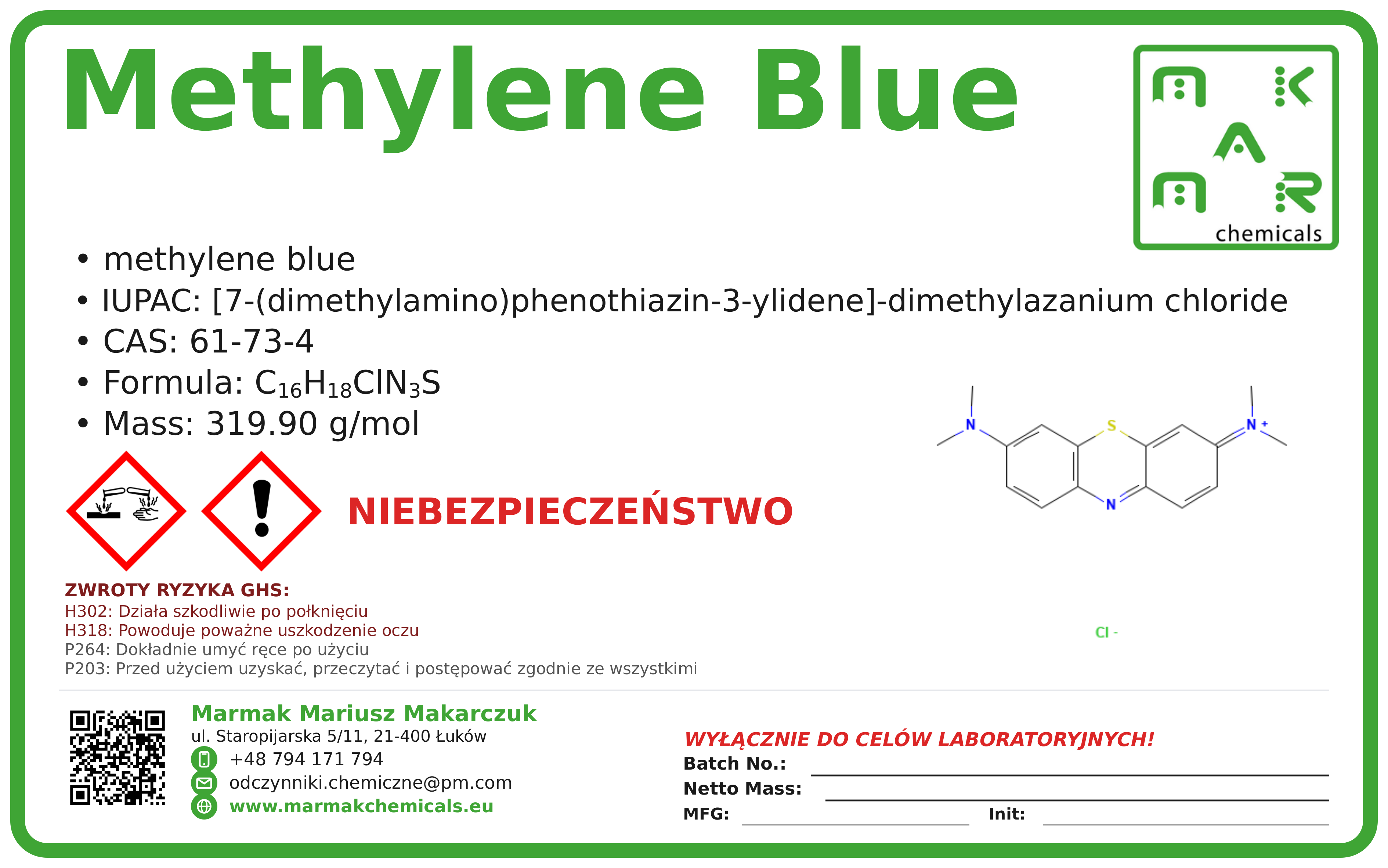
🧪GHS05Żrące❗GHS07Drażniące / szkodliwe🫁GHS08Zagrożenie dla zdrowia
🚨 Zwroty wskazujące rodzaj zagrożenia (H)
H302 — Działa szkodliwie po połknięciu
H318 — Powoduje poważne uszkodzenie oczu
H361 — Podejrzewa się, że działa szkodliwie na płodność lub na dziecko w łonie matki
H370 — Powoduje uszkodzenie narządów
H372 — Powoduje uszkodzenie narządów poprzez długotrwałe lub powtarzane narażenie
🛡 Zwroty określające środki ostrożności (P)
P264 — Dokładnie umyć ręce po użyciu
P203 — Przed użyciem uzyskać, przeczytać i postępować zgodnie ze wszystkimi instrukcjami dotyczącymi bezpieczeństwa
⚠ Klasyfikacja na podstawie konsensusu źródeł (PubChem / zgłoszenia dostawców) — nie zweryfikowano względem zharmonizowanej klasyfikacji w załączniku VI (CLP). Zakres zagrożeń może być szerszy niż klasyfikacja urzędowa; przed zastosowaniem zweryfikować z aktualną kartą charakterystyki dostawcy.
Tłumaczenia: Rozporządzenie CLP (WE) 1272/2008, Załącznik III i IV. Dane: PubChem/NLM.
MolGod_TOX_SF2
☢️ Dane toksykologiczne (IARC + EPA CTX)
🧬 Klasyfikacja rakotwórczości IARC
Klasyfikacja IARC:
☢️ Klasyfikacja IARC (PubChem)
Klasyfikacja IARC:
Grupa 3
IARC Monographs Volume 108: (2016) Some Drugs and Herbal Products
Brak zharmonizowanej klasyfikacji CLP (Annex VI) dla tego CAS. Poniższe kody to zagregowane zgłoszenia własne dostawców (notyfikacje ECHA C&L udostępniane przez PubChem) — NIE są klasyfikacją zharmonizowaną i bywają nadmiarowe. Wiążącym źródłem jest karta charakterystyki (SDS) dostawcy.
Najwyższy zgłoszony sygnał ostrzegawczy: Danger
(wg zgłoszeń notyfikujących, niewiążące)
📚 Źródła · Bibliografia (Chicago Notes-Bibliography)
International Agency for Research on Cancer (IARC). 2024. "IARC Monographs on the Identification of Carcinogenic Hazards to Humans." Lyon: IARC. 🔗
U.S. EPA. 2024. "ECOTOX Knowledgebase." Washington, DC: U.S. Environmental Protection Agency. 🔗
ECHA. 2024. "Chemical Safety Assessment." European Chemicals Agency. 🔗
U.S. National Toxicology Program. 2024. Report on Carcinogens. 15th ed. Research Triangle Park, NC: National Institute of Environmental Health Sciences. 🔗
GESTIS. 2024. "GESTIS Substance Database." Institute for Occupational Safety and Health of the German Social Accident Insurance (DGUV). 🔗
U.S. EPA. 2024. "CompTox Chemicals Dashboard." Washington, DC: U.S. Environmental Protection Agency. 🔗
ECHA. 2023. "Regulation (EC) No 1272/2008 on Classification, Labelling and Packaging of Substances and Mixtures (CLP), Annex VI — Harmonised Classification." European Chemicals Agency. 🔗
Leist, Marcel, et al. 2014. "Consensus Report on the Future of Animal-Free Systemic Toxicity Testing." ALTEX 31 (3): 341–356. [DOI]
Hartung, Thomas. 2009. "Toxicology for the Twenty-First Century." Nature 460 (7252): 208–212. [DOI]
Lenga, Robert E., ed. 2008. The Sigma-Aldrich Library of Chemical Safety Data. 2nd ed. Milwaukee: Sigma-Aldrich.
Slikker, William Jr., et al. 2004. "Dose-Dependent Terminal and Tissue Residues After Chronic Exposure." Toxicological Sciences 81 (2): 253–279. [DOI]
Calabrese, Edward J., and Linda A. Baldwin. 2003. "Toxicology Rethinks Its Central Belief." Nature 421 (6924): 691–692. [DOI]
Hodge, Harold C., and J. Harvey Sterner. 1949. "Tabulation of Toxicity Classes." American Industrial Hygiene Association Quarterly 10 (4): 93–96. [DOI]
⚠️ Procedura GENERYCZNA wyprowadzona z klasyfikacji GHS (brak danych kuratorskich dla tego CAS). Zawsze stosuj aktualną Kartę Charakterystyki (SDS) dostawcy.

1. Wentyluj — pary/aerozole mogą być żrące.
2. Otamuj i posyp obojętnym absorbentem; ostrożnie zobojętnij (kwas → słaba zasada NaHCO3/Ca(OH)2; zasada → słaby kwas), kontroluj pH 6–9.
3. Zbieraj do pojemnika odpornego chemicznie (HDPE/PP).
4. Przemyj teren wodą; pozostałości i absorbent traktuj jak odpad niebezpieczny.

Dodatkowe właściwości z GHS:
• działanie na zdrowie (CMR / STOT / aspiracja) — minimalizuj ekspozycję
• drażniące — unikaj kontaktu ze skórą/oczami i wdychania pyłu
🛢️ Duże rozlanie (>1L) ⚠️ HAZMAT
1. Ewakuuj strefę; pełne PPE kwaso/ługoodporne + ochrona twarzy.
2. Zobojętniaj POWOLI z dystansu (reakcja egzotermiczna); NIE używaj wody pod ciśnieniem (rozprysk).
3. Zbierz mechanicznie do oznakowanego pojemnika UN; przekaż uprawnionej firmie (BDO).
4. Zgłoś incydent zgodnie z procedurą BHP; przy uwolnieniu do środowiska powiadom WIOŚ.
🩹 Pierwsza pomoc
🧴 Skóra
1. Zdejmij zanieczyszczoną odzież.
2. Spłucz skórę dużą ilością wody przez ≥15 min.
3. NIE neutralizuj na skórze; oparzenia → szpital.
3. Substancja może wchłaniać się przez skórę — obserwuj objawy / lekarz.
👁️ Oczy
1. Płucz NATYCHMIAST ≥30 min, powieki rozwarte; soczewki wyjmij.
2. ZAWSZE okulista.
1. Wypłucz usta wodą; NIE wywołuj wymiotów.
2. Centrum Zatruć: +48 42 631 46 24.
3. Wypij wodę/mleko; NIE podawaj NaHCO3 (CO2 → ryzyko perforacji).
🌍 Środowisko:
Woda: MEDIUM; Gleba: LOW; ❌ Nie wpuszczać do kanalizacji; Kod odpadu: 16 05 06*
📚 Naukowe referencje (Chicago Author-Date) — 8
European Chemicals Agency (ECHA). 2020. Guidance on the Compilation of Safety Data Sheets — Section 6: Accidental Release Measures. ECHA.
[link ↗]
European Parliament and Council. 2008. Regulation (EC) No 1272/2008 (CLP) — Hazard classes and H-statements. Official Journal of the European Union L 353.
[link ↗]
National Institute for Occupational Safety and Health (NIOSH). 2023. Pocket Guide to Chemical Hazards — NIOSH Pocket Guide to Chemical Hazards. CDC.
[link ↗]
U.S. Occupational Safety and Health Administration. 2024. 29 CFR 1910.120 — Hazardous Waste Operations and Emergency Response (HAZWOPER). U.S. Code of Federal Regulations.
[link ↗]
National Fire Protection Association. 2018. NFPA 472: Standard for Competence of Responders to Hazardous Materials/Weapons of Mass Destruction Incidents. NFPA.
[link ↗]
European Parliament and Council. 2012. Directive 2012/18/EU on the Control of Major-Accident Hazards Involving Dangerous Substances (Seveso III). Official Journal of the European Union L 197: 1–37.
[link ↗]
U.S. National Institute for Occupational Safety and Health. 2024. NIOSH Pocket Guide to Chemical Hazards. Centers for Disease Control and Prevention.
[link ↗]
European Chemicals Agency. 2020. Guidance on the Compilation of Safety Data Sheets (SDS), Version 3.1. ECHA.
[link ↗]
Źródła: Klasyfikacja GHS/CLP (PubChem/SDS) — fallback generyczny · ECHA Guidance on SDS (sek. 6) · NIOSH Pocket Guide.
Dane orientacyjne — w sytuacji awaryjnej zawsze stosuj instrukcje dostawcy + lokalne przepisy BHP.
📋 Pełna lista BDO:bdo.mos.gov.pl ↗
— oficjalny rejestr Ministerstwa Klimatu i Środowiska. Karta Przekazania Odpadu (KPO):wzór BDO
obowiązkowy dla każdej dostawy odpadów niebezpiecznych.
📚 Naukowe referencje (Chicago Author-Date)
European Commission. 2014. Commission Decision 2014/955/EU on the list of waste pursuant to Directive 2008/98/EC. Official Journal of the European Union. Decyzja 2014/955/UE. [link ↗] — European List of Waste (LoW) — kody EWC 6-cyfrowe + gwiazdka dla hazardous
Ministerstwo Klimatu i Środowiska Rzeczypospolitej Polskiej. 2020. Rozporządzenie Ministra Klimatu z dnia 2 stycznia 2020 r. w sprawie katalogu odpadów. Dziennik Ustaw RP 2020 poz. 10. [link ↗] — Polski katalog odpadów — implementacja Decyzji 2014/955/UE
Główny Inspektorat Ochrony Środowiska (GIOŚ). 2024. Baza Danych O Odpadach (BDO) — System rejestracji firm utylizacyjnych. Ministerstwo Klimatu i Środowiska. [link ↗] — Centralny rejestr BDO — pełna lista firm uprawnionych do gospodarki odpadami
Polska — Sejm RP. 2012. Ustawa z dnia 14 grudnia 2012 r. o odpadach. Dz.U. 2013 poz. 21 (z późn. zm.). [link ↗] — Ustawa krajowa — definiuje obowiązki wytwórcy odpadów + BDO registration
Furr, A. Keith, ed.. 2000. CRC Handbook of Laboratory Safety. CRC Press. — Klasyfikacja odpadów lab + procedury segregacji (rozdz. Waste Management); EN 374:2013 standardów rękawic dla osób manipulujących odpadem niebezpiecznym.
Pohanish, Richard P.. 2017. Sittig's Handbook of Toxic and Hazardous Chemicals and Carcinogens. Elsevier. — Per-CAS waste classification + incompatibilities — input do mapowania EWC.
Lewis, Richard J.. 2012. Sax's Dangerous Properties of Industrial Materials. Wiley. — Reaktywność + zgodność magazynowa odpadów (oxidizers vs flammables — separate streams).
NIOSH. 2024. Pocket Guide to Chemical Hazards. U.S. Department of Health and Human Services. [link ↗] — PEL/REL/IDLH per CAS — basis dla wymaganego PPE przy transporcie odpadu (KPO).
OSHA. 2024. Occupational Chemical Database — Hazardous Waste Operations (HAZWOPER). Occupational Safety and Health Administration. [link ↗] — 29 CFR 1910.120 — szkolenia + PPE dla obsługi odpadów niebezpiecznych.
European Parliament and Council. 2008. Directive 2008/98/EC on waste (Waste Framework Directive). Official Journal of the European Union L 312/3. [link ↗] — Hierarchia gospodarki odpadami (prevention → recovery → disposal); definiuje "hazardous waste".
European Parliament and Council. 2009. Regulation (EC) No 1272/2008 (CLP) on classification, labelling and packaging of substances and mixtures. Official Journal of the European Union L 353. [link ↗] — Klasyfikacja CLP H-statements → mapping do EWC * (asterisk = hazardous).
United Nations Economic Commission for Europe (UNECE). 2023. European Agreement concerning the International Carriage of Dangerous Goods by Road (ADR 2023). UNECE. [link ↗] — ADR — wymagania transportu odpadów niebezpiecznych (KPO + UN-numer + klasy 1–9).
IPCS INCHEM. 2024. International Programme on Chemical Safety — Waste Management Guidelines. WHO/UNEP/ILO. [link ↗] — Międzynarodowe wytyczne neutralizacji + utylizacji per CAS.
European Parliament and Council. 2006. Regulation (EC) No 1013/2006 on Shipments of Waste. Official Journal of the European Union L 190: 1–98. [link ↗] — Transgraniczny transfer odpadów niebezpiecznych — wymogi notyfikacji + zgody przed eksportem
MolGod_REG_SF8
📋 Zgodność regulacyjna (compliance checklist)CORROSIVE7 wymagane12 pozycji
ℹ️ Lista kontrolna obowiązków regulacyjnych dla CAS 61-73-4.
Status oparty na: ADR 2023 (Tabela A), REACH Załącznik XVII, CLP Załącznik VI (klasyfikacja zharmonizowana), hazard class z m14-spill DB, SVHC, GIS oraz NDS PL. Zasada: brak danych = brak twierdzenia (NIE deklarujemy „braku ograniczeń" bez podstawy).
❌SDS (Karta Charakterystyki) dostępnawymagane
Jak zapewnić zgodność: Wymóg: aktualna SDS zgodna z Rozp. 1907/2006 (REACH) Aneks II, format 16-sekcyjny.
Jak zapewnić zgodność: Etykieta musi zawierać: piktogramy GHS, słowo sygnałowe (Niebezpieczeństwo/Uwaga), zwroty H (zagrożenia) i P (środki ostrożności), dane producenta. Wymagane od 2010 (substancje) i 2015 (mieszaniny).
Jak zapewnić zgodność: Pracownicy laboratoryjni: szkolenie wstępne (instruktaż ogólny + stanowiskowy) + okresowe co 5 lat (lub co 3 dla pracowników na stanowiskach inżynieryjno-technicznych). Dokumentacja w aktach osobowych.
Jak zapewnić zgodność: Rejestracja w BDO obowiązkowa dla wytwórców odpadów niebezpiecznych. Karta Przekazania Odpadu (KPO) dla każdej dostawy. Sprawozdanie roczne do 15 marca następnego roku.
Podstawa prawna: Ustawa z 14 grudnia 2012 r. o odpadach (Dz.U. 2013 poz. 21)
❓ADR transport (umowa międzynarodowa)do weryfikacji
Jak zapewnić zgodność: Brak danych ADR w zbiorze MOL-GOD dla tego numeru CAS. NIE zakładaj braku ograniczeń — przed wysyłką zweryfikuj klasyfikację transportową w ADR 2023 (Tabela A) oraz w sekcji 14 karty charakterystyki (SDS).
Podstawa prawna: Umowa europejska ADR 2023 + Ustawa z 19 sierpnia 2011 r. o przewozie towarów niebezpiecznych
Jak zapewnić zgodność: Importerzy/producenci ≥1 tony/rok muszą zarejestrować substancję w ECHA (dossier techniczne + Chemical Safety Report jeśli ≥10 t). Sprawdź ECHA Annex VI / registered substances list.
⚪Zgłoszenie SVHC (Substancje wzbudzające szczególnie duże obawy)nie dotyczy
Jak zapewnić zgodność: Nie potwierdzono na liście kandydackiej SVHC (REACH art. 59) w zbiorze MOL-GOD (zbiór niepełny). Nieobecność NIE jest potwierdzeniem — sprawdź aktualną listę kandydacką ECHA. Lista kandydacka to NIE załącznik XIV.
⚪REACH Załącznik XIV (lista autoryzacyjna)nie dotyczy
Jak zapewnić zgodność: Nie potwierdzono na liście autoryzacyjnej REACH Załącznik XIV w zbiorze MOL-GOD (zbiór niepełny). Nieobecność NIE jest potwierdzeniem — sprawdź listę autoryzacyjną ECHA.
Podstawa prawna: Rozporządzenie (WE) 1907/2006 (REACH) Załącznik XIV — autoryzacja
⚪REACH Załącznik XVII (ograniczenia stosowania/marketingu)nie dotyczy
Jak zapewnić zgodność: Nie figuruje w zbiorze ograniczeń REACH Załącznik XVII MOL-GOD (zbiór niepełny). Nieobecność NIE jest potwierdzeniem braku ograniczeń — przy wątpliwości sprawdź skonsolidowany Załącznik XVII na stronach ECHA.
❓NDS — Najwyższe Dopuszczalne Stężenie w środowisku pracydo weryfikacji
Jak zapewnić zgodność: Brak danych NDS w zbiorze MOL-GOD (zbiór niepełny — ~41 z ~600 substancji wykazu). Nieobecność NIE oznacza braku NDS — sprawdź pełny wykaz Dz.U. 2024 poz. 1017 (Rozp. MRiPS z 4 września 2024 r.), a w razie braku stosuj OEL z dyrektyw EU lub zalecane przez NIOSH/ACGIH.
Podstawa prawna: Rozp. MRiPS z 4 września 2024 r. (Dz.U. 2024 poz. 1017) — NDS i NDSCh
⚪Rejestr GIS (prekursory / psychotropy)nie dotyczy
Jak zapewnić zgodność: Nie figuruje w dostępnym zbiorze roboczym prekursorów (lista niepełna). Nieobecność NIE jest potwierdzeniem — zweryfikuj wobec zał. I Rozp. (WE) 273/2004 i wykazu GIS przed obrotem.
Podstawa prawna: Rozp. (WE) 273/2004 + Ustawa o przeciwdziałaniu narkomanii (Dz.U. 2005 nr 179 poz. 1485)
European Parliament and Council. 2008. Regulation (EC) No 1272/2008 on classification, labelling and packaging of substances and mixtures (CLP). Official Journal of the European Union L 353/1. CLP Regulation 1272/2008. [link ↗] — Klasyfikacja, oznakowanie i pakowanie substancji + mieszanin (GHS implementation w UE)
European Parliament and Council. 2006. Regulation (EC) No 1907/2006 concerning the Registration, Evaluation, Authorisation and Restriction of Chemicals (REACH). Official Journal of the European Union L 396/1. REACH Regulation 1907/2006. [link ↗] — REACH — rejestracja, ocena i autoryzacja chemikaliów; SVHC; SDS Aneks II
Ministerstwo Rodziny i Polityki Społecznej Rzeczypospolitej Polskiej. 2024. Rozporządzenie Ministra Rodziny i Polityki Społecznej z dnia 4 września 2024 r. w sprawie najwyższych dopuszczalnych stężeń i natężeń czynników szkodliwych dla zdrowia w środowisku pracy. Dziennik Ustaw RP 2024 poz. 1017. [link ↗] — NDS i NDSCh dla ~600 substancji chemicznych — aktualne polskie limity ekspozycji zawodowej
United Nations Economic Commission for Europe (UNECE). 2023. European Agreement concerning the International Carriage of Dangerous Goods by Road (ADR), 2023 Edition. United Nations, Geneva. ADR 2023. [link ↗] — Międzynarodowa umowa drogowego transportu towarów niebezpiecznych — UN numbers, klasy, opakowania
📚 Skonsolidowane referencje naukowe — Chicago Author-Date 10 źródeł
Referencje zebrane ze wszystkich zakładek Safety Hub. CAS: 61-73-4 ·
PubChem ↗
Parlament Europejski i Rada UE. 2008. "Rozporządzenie (WE) nr 1272/2008 w sprawie klasyfikacji, oznakowania i pakowania substancji (CLP)." Dz.Urz. UE L 353. [↗]
GHS, Regulacje
United Nations Economic Commission for Europe (UNECE). 2021. "Globally Harmonized System of Classification and Labelling of Chemicals (GHS), Ninth Revised Edition." United Nations, Geneva. [↗]
GHS
Goldfrank, Lewis R., Robert S. Hoffman, Mary Ann Howland, et al.. 2019. "Goldfrank's Toxicologic Emergencies, 11th ed.." McGraw-Hill Education, New York. ISBN 978-1-25-985961-8.
Pierwsza pomoc, Toksykologia
National Institute for Occupational Safety and Health (NIOSH). 2023. "NIOSH Pocket Guide to Chemical Hazards (DHHS Publ. 2005-149)." U.S. Department of Health and Human Services / CDC, Cincinnati, OH. [↗]
Pierwsza pomoc, PPE, Toksykologia
European Committee for Standardization (CEN). 2016. "EN 374-1:2016 — Protective gloves against dangerous chemicals and micro-organisms." CEN, Brussels. [↗]
PPE
UNECE. 2023. "European Agreement Concerning the International Carriage of Dangerous Goods by Road (ADR 2023)." United Nations, Geneva. [↗]
Utylizacja, Regulacje
National Fire Protection Association (NFPA). 2022. "NFPA 400 — Hazardous Materials Code." NFPA, Quincy, MA. [↗]
Magazynowanie
Urben, P.G. (ed.). 2017. "Bretherick's Handbook of Reactive Chemical Hazards, 8th ed.." Butterworth-Heinemann / Elsevier, Oxford. [↗]
Magazynowanie
Ministerstwo Klimatu i Środowiska RP. 2023. "Baza danych o produktach i opakowaniach oraz o gospodarce odpadami (BDO)." Ministerstwo Klimatu i Środowiska, Warszawa. [↗]
Utylizacja
International Agency for Research on Cancer (IARC / WHO). 2024. "IARC Monographs on the Identification of Carcinogenic Hazards to Humans — List of Classifications." WHO, Lyon. [↗]
Toksykologia
Zakładki z własnymi referencjami (Emergency, PPE, Storage, Waste) zawierają dodatkowe pozycje bibliograficzne wewnątrz swoich sekcji.
Wklej serię powtórzeń pomiarów (CSV lub po jednej liczbie w linii). Kalkulator policzy średnią, odchylenie, 95% CI, wykryje outliery (Grubbs + Dixon Q).
Separator: przecinek, spacja, tab, nowa linia. Min 3 pomiary.
Wybierz bufor z listy 20 popularnych systemów → wprowadź docelowe pH → otrzymasz dokładny przepis z masami do odważenia.
Krok 1: Wybierz system buforowy
Krok 2: Parametry buforu
Krok 3: Twój przepis
Procedura krok po kroku:
📐 Szczegóły obliczeń (Henderson-Hasselbalch)
📜 Historia przepisów (ostatnie 10)
📅Project Planner — Lab experiment managerNOWOŚĆ
MolGod_PLANNER_1
Zaplanuj cały projekt laboratoryjny: dodaj eksperymenty z reagentami, powtórzeniami i czasem trwania. Otrzymasz wykres Gantta, listę zakupów (linki do sklepu!), budżet z 10% marginesem i macierz ryzyka GHS.
💡 Zaloguj się, aby zapisywać projekty.
Bez logowania możesz kalkulować, ale nie zapisać.
🔬 Metody HPLC/GC (3 metoda)
📄
Differential Induction of Astaxanthin, Lutein, and Canthaxanthin with Altered Fatty Acid Profiles in Chromochloris zofingiensis via a Two-Stage Cultivation Approach Using Different Chemical Modulators
Faza: mobile phase consisted of solvent A (dichloromethane/methanol/acetonitrile/water, 5:85:5
Detekcja: UV 700 nm
Przepływ: 1.00 mL/min
Temp.: 25.0 °C
Inj.: 10 \u03bcL
Gradient: was performed as follows: 0% B for 8 min, a…
Niyompanich S, Kusolkumbot P, Kunyalung W, Watthammawut A, Powtongsook S. Differential Induction of Astaxanthin, Lutein, and Canthaxanthin with Altered Fatty Acid Profiles in Chromochloris zofingiensis via a Two-Stage Cultivation Approach Using Different Chemical Modulators. Life. 2026;16:799. doi:10.3390/life16050799
Chromochloris zofingiensis is a promising source of high-value bioproducts, particularly carotenoids and fatty acids. In this study, three selected chemical agents, including methylene blue (MB), salicylic acid (SA), and zinc sulfate heptahydrate (ZN), representing their roles as an oxidant, a signal transducer, and a metal ion, respectively, were applied at 96 h post-inoculation to stimulate metabolite accumulation via a two-stage cultivation approach. None of the treatments significantly affected algal growth. Among the treatments, HPLC analysis showed that 2.5 mM ZN significantly exhibited a dual stimulatory effect on astaxanthin (1.679 ± 0.122 mg g−1) and lutein (4.257 ± 0.183 mg g−1) accumulation, which were 2.28- and 2.91-fold higher than the control, respectively. The 1 µM MB significantly enhanced the canthaxanthin content to 2.382 ± 0.210 mg g−1 (a 3.57-fold increase). Different SA concentrations selectively induced the target pigments of astaxanthin and lutein. APCI-QTOF analysis enabled the detection of echinenone in the microalgal extracts. Its identity and quantification were subsequently validated by HPLC, with the highest content detected under the 0.2 mM SA treatment. GC-FID analysis revealed changes in the composition of six major fatty acids, with C18:1 n-9 representing 50.01% of the total fatty acids under the 2.5 mM ZN treatment. These findings suggest that the two-stage approach could offer a practical and feasible strategy for microalgal biorefineries.
chemical modulatorsastaxanthinluteincanthaxanthinfatty acidstwo-stage cultivation approach
📄
Macro-micromorphological, anatomical, and phytochemical characterization of Cucumis melo var. agrestis Naudin: a potential source of natural antioxidants
Faza: mobile phase was composed of water (A) and 0
Detekcja: UV 750 nm
Przepływ: 0.90 mL/min
Temp.: 25.0 °C
Inj.: 200 \u03bcL
Gradient: , as follows: 0 min (82% A); 0–1 min (82% A); 1–11 min…
Shehata F, Hamdy R, Garf I, Megahed E. Macro-micromorphological, anatomical, and phytochemical characterization of Cucumis melo var. agrestis Naudin: a potential source of natural antioxidants. Scientific Reports. 2026;16:12711. doi:10.1038/s41598-026-47246-7
A comprehensive study of macro-micro-morphological and anatomical seed and pollen characteristics of Cucumis melo var. agrestis (Cucurbitaceae) using plant materials gathered during field visits, the results showed that the plant is annual, pubescent, prostrate with a single hairy unbranched tendril, andro-monoecious; yellow perfect flowers and large male flowers on separate branches. Fruit yellowish green to yellow, fleshy, globular to ellipsoid, berry-like, indehiscent, pubescent when young, turns glabrous at maturity, many-seeded. Pollen grains are monads, sub-triangular, polar-shaped with tri-zonoporate aperture, reticulate texture, and foveolate ornamentation. Seed pale cream, obovoid with apical hilum, reticulate sculpture with hexagonal cells. The stem is circular with ridges; vascular bundles are arranged in two alternate rings. The petiole has an oval outline with a groove along its the narrow side. The leaf has a U-shaped midrib region, and the mesophyll is differentiated into palisade and spongy. The leaf and fruit phenolic profiles, antioxidant actavity, and free radical scavenging activity were studied. A qualitative phytochemical screening procedure was performed on the 70% ethanolic extract. The Phytochemical study revealed the presence of tannins, flavonoids, alkaloids, saponins, steroids, fatty acids, coumarins, terpenoids, and glycosides. Total phenolic and flavonoid content in the leaves and fruit was determined. The data showed that the ethanolic extract of leaves records the highest concentration of 55.71 mg GAE/g and 9.013 mg QE/g. Antioxidant activity was evaluated using different assays, including KMnO₄, methylene blue, DCPIP, and DPPH. In vitro methods using leaf and fruit extracts, the leaf extract showed significant action towards free radicals in all methods. The ethanolic extract was analyzed by using high-performance liquid chromatography (HPLC) to identify its phenolic constituents. HPLC analysis of the ethanolic extract of Cucumis me...
Faza: Mobile phase A was ammonium acetate buffer (0
Detekcja: MS/MS
Przepływ: 0.30 mL/min
Temp.: 30.0 °C
Inj.: 25 \u03bcL
Gradient: program is listed in Table 5
Zhang X, Hui Y, Fang C, Wang Y, Han F, Lou X, et al. Determination of Methylene Blue and Its Metabolite Residues in Aquatic Products by High-Performance Liquid Chromatography–Tandem Mass Spectrometry. Molecules. 2021;26:4975. doi:10.3390/molecules26164975
A sensitive and reliable method was developed to determine methylene blue (MB) and its metabolite residues, including azure A (AZA), azure B (AZB), and azure C (AZC) in aquatic products by HPLC–MS/MS. The samples were extracted by acetonitrile and cleaned up by alumina-neutral (ALN) cartridges. The analytes were separated on a Sunfire C18 column (150 mm × 2.1 mm, 5 µm). The method was validated according to the European criteria of Commission Decision 2002/657/CE. Good linearity between 1–500 µg/L was obtained with correlation coefficients (R2) greater than 0.99. The limit of quantification (LOQ) was 1.0 µg/kg. The average recoveries at three levels of each compound (1, 5, and 10 µg/kg) were demonstrated to be in the range of 71.8–97.5%, with relative standard deviations (RSDs) from 1.05% to 8.63%. This method was suitable for the detection of methylene blue and its metabolite residues in aquatic products.
high-performance liquid chromatography–tandem mass spectrometrymethylene bluedisinfectantaquatic products
📈 Walidacja metody (ICH Q2)
Brak danych walidacyjnych. Skontaktuj się z autorem metody.
Teoria rozpuszczalności (zastosowane w przewidywaniu kompatybilności):
Yalkowsky, Samuel H., and Shri C. Valvani. 1980. "Solubility and Partitioning I: Solubility of Nonelectrolytes in Water." Journal of Pharmaceutical Sciences 69 (8): 912–922. https://doi.org/10.1002/jps.2600690814 — General Solubility Equation (GSE): logS = 0.5 − logP − 0.01(MP−25).
Hansen, Charles M. 2007. Hansen Solubility Parameters: A User's Handbook. 2nd ed. CRC Press. https://doi.org/10.1201/9781420006834 — HSP triplet (dD, dP, dH) + wzór Ra.
Stefanis, E., and C. Panayiotou. 2008. "Prediction of Hansen Solubility Parameters with a New Group-Contribution Method." Int J Thermophys 29: 568–585. https://doi.org/10.1007/s10765-008-0415-z
Reichardt, Christian, and Thomas Welton. 2011. Solvents and Solvent Effects in Organic Chemistry. 4th ed. Wiley-VCH. https://doi.org/10.1002/9783527632220 — E_T(30) polarity scale, solwatochromia.
Snyder, Lloyd R., Joseph J. Kirkland, and John W. Dolan. 2010. Introduction to Modern Liquid Chromatography. 3rd ed. Wiley. https://doi.org/10.1002/9780470508183 — Eluotropic series, polarity index.
Van Krevelen, D. W., and K. Te Nijenhuis. 2009. Properties of Polymers. 4th ed. Elsevier. https://doi.org/10.1016/B978-0-08-054819-7.X0001-5 — Hoftyzer–Van Krevelen group contribution dla dD/dP/dH z SMILES.
Marcus, Yizhak. 1998. The Properties of Solvents. Wiley Series in Solution Chemistry, Vol. 4. ISBN 9780471983699 — Kompletny tabularny zestaw 250+ rozpuszczalników (ε, μ, donicity, acceptor numbers).
PubChem Compound Database — CAS 61-73-4 lookup ↗ — logP (XLogP3), water solubility experimental + predicted.
Kompletna bibliografia w akordeonie REFERENCJE (na dole strony) — Chicago Manual of Style 17th ed., Author-Date.
🧮 Kalkulator rozpuszczalności
Rozpuszczalność:—
logS:—
Metoda:—
⚠️ —
Rozpuszczalność vs Temperatura
🌐 Hansen Solubility Sphere (3D)
Im bliżej molekuły (czerwona kula), tym lepszy solwent. · Zaawansowany: etykiety + siatka + osie + pulsacja.
Twoja molekuła
Dobre (Ra < 5)
Średnie (Ra 5-10)
Słabe (Ra > 10)
📚 Źródła danych HSP + Ra
Van Krevelen, D. W., and K. Te Nijenhuis. 2009. Properties of Polymers: Their Correlation with Chemical Structure; Their Numerical Estimation and Prediction from Additive Group Contributions. 4th ed. Amsterdam: Elsevier. [DOI ↗]
Stefanis, Eirini, and Costas Panayiotou. 2008. "Prediction of Hansen Solubility Parameters with a New Group-Contribution Method." International Journal of Thermophysics 29 (2): 568–585. [DOI ↗]
Hansen, Charles M. 2007. Hansen Solubility Parameters: A User's Handbook. 2nd ed. Boca Raton: CRC Press. [DOI ↗]
Martin, Andre, Joel Newburger, and Alan Adjei. 1993. "Extended Hildebrand Solubility Approach: Solubility of Caffeine in Dioxane–Water Mixtures." Journal of Pharmaceutical Sciences 82 (3): 248–252. [DOI ↗]
Barton, Allan F. M. 1991. CRC Handbook of Solubility Parameters and Other Cohesion Parameters. 2nd ed. Boca Raton: CRC Press. ↗
Fedors, R. F. 1974. "A Method for Estimating Both the Solubility Parameters and Molar Volumes of Liquids." Polymer Engineering and Science 14 (2): 147–154. [DOI ↗]
Metoda: Group Contribution (GC) — szybka estymacja δD/δP/δH z logP gdy brak danych eksperymentalnych. Dokładność ±2 MPa^½. Dla precyzji → HSPiP software.
📚 FAQ techniczne — methylene blue (5)MolGod_TECHFAQ_1
❓ Jak przygotować roztwór standardowy Methylene Blue o stężeniu 10^-4 mol/L?
MolGod_TECHFAQ_1_Q0
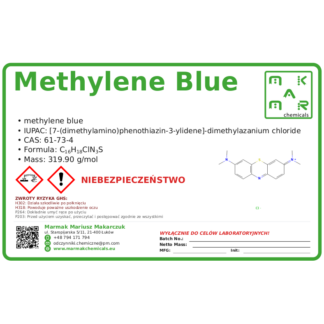
Aby przygotować roztwór standardowy Methylene Blue (C₁₆H₁₈ClN₃S, m.cz. 319.9 g/mol) o stężeniu 10^-4 mol/L: 1. Oblicz masę potrzebną na 1 L roztworu: n = C × V = 10^-4 mol/L × 1 L = 10^-4 mol. Masa = n × m.cz. = 10^-4 mol × 319.9 g/mol = 0.03199 g. 2. Odważ 0.03199 g Methylene Blue i rozpuść w minimalnej objętości wody destylowanej. 3. Uzupełnij do 1 L wodą destylowaną.
Pomocne?
❓ W jakich warunkach należy przechowywać Methylene Blue, aby zachować jego stabilność?
MolGod_TECHFAQ_1_Q1
Methylene Blue należy przechowywać: 1. W temperaturze pokojowej (15-25°C). 2. W ciemności (chronić przed światłem, szczególnie UV), gdyż jest wrażliwy na fotodegradację. 3. W suchym miejscu, z dala od wilgoci i substancji utleniających. Zaleca się przechowywanie w ciemnych butelkach szklanych.
Pomocne?
❓ Jaka metoda analityczna jest najbardziej odpowiednia do oznaczania Methylene Blue, biorąc pod uwagę jego logP i masę molową?
MolGod_TECHFAQ_1_Q2
Dla Methylene Blue (logP ≈ -1.5, m.cz. 319.9 g/mol) zalecana jest: 1. HPLC (High-Performance Liquid Chromatography) z detektorem UV (λ = 610 nm), ponieważ substancja ma umiarkowaną polarność i wysoką masę molową, co czyni ją odpowiednią dla tej techniki. GC (Gas Chromatography) nie jest zalecane ze względu na niskie logP i wysoką masę molową.
Pomocne?
❓ Jakie są główne reaktywności i niezgodności chemiczne Methylene Blue?
MolGod_TECHFAQ_1_Q3
Methylene Blue: 1. Reaguje z silnymi utleniaczami (np. KMnO₄, H₂O₂), tworząc kompleksy lub ulegając degradacji. 2. Jest wrażliwy na kwasy i zasady - może ulegać hydrolizie. 3. Niezgodności: unikać kontaktu z substancjami silnie kwasowymi/zasadowymi oraz utleniającymi. Zaleca się stosowanie buforów o pH ~7.
Pomocne?
❓ W jakich praktycznych zastosowaniach laboratoryjnych wykorzystuje się Methylene Blue?
MolGod_TECHFAQ_1_Q4
Methylene Blue jest używany m.in.: 1. Jako wskaźnik pH (zakres: kwaśny do lekko zasadowego, zmiana koloru od żółtego do niebieskiego). 2. W analizie biochemicznej do oznaczania zawartości białek lub lipidów (np. w testach jakościowych). 3. Jako barwnik w mikroskopii komórkowej do barwienia mitochondriów.
HINSELMANN H (1950) · Anais brasileiros de ginecologia
Dlaczego ważne:
Must-cite (kanon) · praca historyczna (1950)
SCORE 2.25HistorycznaMUST-CITE
MolGod_RTOPIC_LT2
🎯 Powiązane tematy badawcze (TF-IDF)10 tagów
📊 Automatycznie wyodrębnione tematy z abstraktów 10 publikacji dla CAS 61-73-4.
Algorytm: TF-IDF (Salton & Buckley 1988) — częstość terminu × odwrotna częstość dokumentowa.
Przemysłowe zastosowania: Barwnik w przemyśle tekstylnym, farbiarstwo, produkcja lakierów, tworzyw sztucznych
Akwarystyka: Służy do regulacji pH i absorpcji azotanów w akwariach słodkowodnych
Laboratoryjne zastosowania: Wskaźnik redoks, reakcje chemiczne w laboratorium
Bezpieczeństwo
Methylene Blue jest stosunkowo bezpiecznym związkiem chemicznym, ale pewne środki ostrożności powinny być przestrzegane. Unikaj kontaktu z oczami i skórą. W przypadku kontaktu, natychmiast spłucz dużą ilością wody. Methylene Blue może reagować z kwasami i zasadami, tworząc niebezpieczne opary. Pracuj w dobrze wentylowanym pomieszczeniu, używaj odpowiednich środków ochrony osobistej, takich jak rękawice i okulary ochronne. Skonsultuj się z lokalnym centrum kontroli zatruć w przypadku podejrzenia zatrucia.
Przechowywanie
Methylene Blue należy przechowywać w szczelnie zamkniętym pojemniku, w suchym i chłodnym miejscu. Unikaj ekspozycji na bezpośrednie światło słoneczne. Trzy
Additional information
Gramatura
1 g — zł34.91
Reviews
There are no reviews yet.
Be the first to review “Methylene Blue” Cancel reply
📈 Gradient HPLC — optymalizator (LSS)SZABLON
logP nieznane — PubChem nie zwrócił XLogP. Poniższy gradient to ogólny szablon 5–95% MeCN/H2O w 15 min; zweryfikuj parametry przed użyciem.
⚠ logP unavailable.
PubChem nie zwrócił właściwości XLogP3 dla tego CAS. Wartości gradientu poniżej to ogólny szablon — nie LSS dopasowany do związku.
Kolumna: C18
Bufor: phosphate
Przepływ: 1 mL/min
logP:
logP unavailable
Rampa: 21% → 95% B, 15 min
Całkowity czas analizy: 28 min
t (min)
%A
%B
flow (mL/min)
Komentarz
0
79
21
1
start (równowaga)
2
79
21
1
koniec hold init
17
5
95
1
koniec rampy LSS
22
5
95
1
mycie kolumny
23
79
21
1
powrót do init
28
79
21
1
reekwilibracja
📚 Naukowe referencje (Chicago Author-Date)
Snyder, Lloyd R., John W. Dolan, and Joseph J. Kirkland. 2010. Introduction to Modern Liquid Chromatography. Wiley. — Chapter 9 — gradient elution, LSS theory (cited as Snyder et al. 2010 in tool description).
Schoenmakers, Peter J. 1986. Optimization of Chromatographic Selectivity: A Guide to Method Development. Elsevier. — Numerical optimization of gradient programs.
Snyder, L. R., and J. W. Dolan. 2007. High-Performance Gradient Elution: The Practical Application of the Linear-Solvent-Strength Model. Wiley. — Foundational LSS reference for the %B_init = 5 + 8·logP heuristic implemented here.
Nikitas, Pavlos, and Adrian Pappa-Louisi. 2009. "Retention models for isocratic and gradient elution in reversed-phase liquid chromatography." Journal of Chromatography A 1216: 1737-1755. [DOI ↗] — Modern review of gradient retention models — basis for non-LSS extensions.
Carr, Peter W.. 2009. "The new physical chemistry of HPLC." Journal of Chromatography A 1216: 1764-1772. [DOI ↗]
Dong, Michael W. 2019. HPLC and UHPLC for Practicing Scientists. Wiley. https://doi.org/10.1002/9781119313793. — Modern UHPLC gradient programming, sub-2 µm scaling rules.
Wu, Naijun, and Anton M. Clausen. 2007. "Fundamental and practical aspects of ultrahigh pressure liquid chromatography for fast separations." Journal of Separation Science 30: 1167-1182. [DOI ↗]
Stoll, Dwight R., and Peter W. Carr. 2017. "Two-Dimensional Liquid Chromatography: A State of the Art Tutorial." Analytical Chemistry 89: 519-531. [DOI ↗] — Reference for orthogonal gradient design (2D-LC second dimension).
Dolan, John W.. 2013. "When to Modify Method Conditions." LCGC North America 31: 192-199.
Meyer, Veronika R. 2010. Practical High-Performance Liquid Chromatography. Wiley. — Chapter 7 — practical gradient design with isokratyczny scouting.
Stoll, Dwight R., and Peter W. Carr. 2017. "Two-Dimensional Liquid Chromatography: A State of the Art Tutorial." Analytical Chemistry 89: 519-531. [DOI ↗]
Carr, Peter W.. 2009. "The new physical chemistry of HPLC." Journal of Chromatography A 1216: 1764-1772. [DOI ↗]
Wu, Naijun, and Anton M. Clausen. 2007. "Fundamental and practical aspects of ultrahigh pressure liquid chromatography for fast separations." Journal of Separation Science 30: 1167-1182. [DOI ↗]
Engelhardt, Heinz. 2014. 100 Years of Chromatography. Wiley-VCH.
Vivó-Truyols, Gabriel, and Hans-Gerd Janssen. 2010. "Probabilistic approach to peak deconvolution in chromatography." Analytical Chemistry 82: 8525-8531. [DOI ↗]
Oblicz współczynnik ogonowości USP (T) oraz asymetrię (As) z połówkowych szerokości piku. Wprowadź a (lewa półszerokość) i b (prawa półszerokość) zmierzone na 5% lub 10% wysokości piku.
📚 References (Chicago Author-Date)
USP General Chapter <621>. 2024. "Chromatography." United States Pharmacopeial Convention. [link ↗] — Defines USP Tailing Factor T = (a+b)/(2a) measured at 5% peak height.
International Council for Harmonisation (ICH). 2023. "Validation of Analytical Procedures Q2(R2)." ICH Expert Working Group. [link ↗] — Tailing factor is a system suitability parameter (Section 6).
Foley, Joe P., and John G. Dorsey. 1983. "Equations for calculation of chromatographic figures of merit for ideal and skewed peaks." Analytical Chemistry 55: 730-737 https://doi.org/10.1021/ac00255a033 [link ↗] — Original asymmetry factor As = b/a at 10% height (Foley & Dorsey 1983).
Snyder, Lloyd R., Joseph J. Kirkland, and John W. Dolan. 2010. "Introduction to Modern Liquid Chromatography." Wiley. https://doi.org/10.1002/9780470508183 [link ↗] — Chapter 2.4 — peak shape diagnostics and remedies.
Dolan, John W.. 2003. "Peak tailing and resolution." LCGC North America 21: 610-614 [link ↗] — How tailing factor degrades effective resolution.
Vivó-Truyols, Gabriel, and Hans-Gerd Janssen. 2010. "Probabilistic approach to peak deconvolution in chromatography." Analytical Chemistry 82: 8525-8531 https://doi.org/10.1021/ac101742z [link ↗] — Modern numerical deconvolution for asymmetric peaks.
Kromidas, Stavros. 2017. "HPLC Made to Measure: A Practical Handbook for Optimization." Wiley-VCH. — Practical Tf and As thresholds for routine QC.
Dong, Michael W.. 2019. "HPLC and UHPLC for Practicing Scientists." Wiley. https://doi.org/10.1002/9781119313793 [link ↗]
Heyden, Yvan Vander, et al.. 2009. "Robustness of pharmaceutical liquid chromatographic methods." Journal of Chromatography B 877: 2120-2129 https://doi.org/10.1016/j.jchromb.2008.10.052 [link ↗]
Stoll, Dwight R., and Peter W. Carr. 2017. "Two-Dimensional Liquid Chromatography: A State of the Art Tutorial." Analytical Chemistry 89: 519-531 https://doi.org/10.1021/acs.analchem.6b03506 [link ↗]
Carr, Peter W.. 2009. "The new physical chemistry of HPLC." Journal of Chromatography A 1216: 1764-1772 https://doi.org/10.1016/j.chroma.2008.11.094 [link ↗]
Wu, Naijun, and Anton M. Clausen. 2007. "Fundamental and practical aspects of ultrahigh pressure liquid chromatography for fast separations." Journal of Separation Science 30: 1167-1182 https://doi.org/10.1002/jssc.200700026 [link ↗]
Engelhardt, Heinz. 2014. "100 Years of Chromatography." Wiley-VCH.
Vivó-Truyols, Gabriel, and Hans-Gerd Janssen. 2010. "Probabilistic approach to peak deconvolution in chromatography." Analytical Chemistry 82: 8525-8531 https://doi.org/10.1021/ac101742z [link ↗]
📊 Kalkulator rozdzielczości i liczby półek (Rs, N, H)FEATURE K
Oblicz rozdzielczość Rs, liczbę półek teoretycznych N oraz HETP (H) dla pary pików HPLC. Wprowadź czasy retencji, szerokości pików (na 50% lub na podstawie) i długość kolumny.
📚 References (Chicago Author-Date)
Snyder, Lloyd R., Joseph J. Kirkland, and John W. Dolan. 2010. "Introduction to Modern Liquid Chromatography." 3rd ed. John Wiley & Sons. ISBN 978-0-470-16754-0. https://doi.org/10.1002/9780470508183 [link ↗] — Chapter 2 covers resolution, plate count and HETP fundamentals (Snyder et al. 2010).
USP General Chapter <621>. 2024. "Chromatography." USP-NF 2024 ed. United States Pharmacopeial Convention. [link ↗] — Defines Rs >= 1.5 acceptance criterion and N calculation methods.
Dolan, John W.. 2003. "How much resolution is enough?." LCGC North America 21: 350-353 [link ↗] — Practical guidance on Rs targets for routine method development.
Van Deemter, J. J., F. J. Zuiderweg, and A. Klinkenberg. 1956. "Longitudinal diffusion and resistance to mass transfer as causes of nonideality in chromatography." Chemical Engineering Science 5: 271-289 https://doi.org/10.1016/0009-2509(56)80003-1 [link ↗] — Origin of N = 5.54·(tr/w0.5)² half-height plate count formulation.
Giddings, J. Calvin. 1965. "Dynamics of Chromatography, Part I: Principles and Theory." Marcel Dekker. ISBN 978-0-8247-1357-7. — Resolution equation Rs = (1/4)·√N·(α-1)/α·k/(1+k) (master equation).
Foley, Joe P., and John G. Dorsey. 1983. "Equations for calculation of chromatographic figures of merit for ideal and skewed peaks." Analytical Chemistry 55: 730-737 https://doi.org/10.1021/ac00255a033 [link ↗] — Skewed-peak corrections to apparent N.
Knox, John H.. 1977. "Practical aspects of LC theory." Journal of Chromatographic Science 15: 352-364 https://doi.org/10.1093/chromsci/15.9.352 [link ↗]
Carr, Peter W.. 2009. "The new physical chemistry of HPLC." Journal of Chromatography A 1216: 1764-1772 https://doi.org/10.1016/j.chroma.2008.11.094 [link ↗]
Dong, Michael W.. 2019. "HPLC and UHPLC for Practicing Scientists." 2nd ed. Wiley. ISBN 978-1-119-31378-3. https://doi.org/10.1002/9781119313793 [link ↗]
Stoll, Dwight R., and Peter W. Carr. 2017. "Two-Dimensional Liquid Chromatography: A State of the Art Tutorial." Analytical Chemistry 89: 519-531 https://doi.org/10.1021/acs.analchem.6b03506 [link ↗]
Carr, Peter W.. 2009. "The new physical chemistry of HPLC." Journal of Chromatography A 1216: 1764-1772 https://doi.org/10.1016/j.chroma.2008.11.094 [link ↗]
Wu, Naijun, and Anton M. Clausen. 2007. "Fundamental and practical aspects of ultrahigh pressure liquid chromatography for fast separations." Journal of Separation Science 30: 1167-1182 https://doi.org/10.1002/jssc.200700026 [link ↗]
Engelhardt, Heinz. 2014. "100 Years of Chromatography." 2nd ed. Wiley-VCH. ISBN 978-3-527-33473-5.
Vivó-Truyols, Gabriel, and Hans-Gerd Janssen. 2010. "Probabilistic approach to peak deconvolution in chromatography." Analytical Chemistry 82: 8525-8531 https://doi.org/10.1021/ac101742z [link ↗]
zł9.05Select options
This product has multiple variants. The options may be chosen on the product page
🧪 System Suitability — kalkulator live (USP <621>)FEATURE L
Wprowadź dane z 5-6 wstrzyknięć (areas, tr, tailing, plates) — kalkulator policzy %RSD, średnie i sprawdzi zgodność z USP <621>. Możesz wkleić CSV (po przecinku) lub edytować pojedyncze wartości.
📚 References (Chicago Author-Date)
USP General Chapter <621>. 2024. "Chromatography (System Suitability section)." USP-NF 2024 ed. United States Pharmacopeial Convention. [link ↗] — Defines RSD area < 2%, tailing < 2.0, N > 2000 acceptance criteria.
International Council for Harmonisation (ICH). 2023. "Validation of Analytical Procedures Q2(R2)." ICH Expert Working Group. [link ↗] — Section 5.4 — system suitability is part of method validation.
US Food and Drug Administration (FDA). 2018. "Reviewer Guidance: Validation of Chromatographic Methods." US Food and Drug Administration. [link ↗] — CDER reviewer perspective on chromatographic validation expectations.
Snyder, Lloyd R., Joseph J. Kirkland, and John W. Dolan. 2010. "Introduction to Modern Liquid Chromatography." 3rd ed. Wiley. — Chapter 2 — system suitability fundamentals (RSD, Tf, N).
Heyden, Yvan Vander, et al.. 2009. "Robustness of pharmaceutical liquid chromatographic methods." — Robustness vs. system suitability — design-of-experiments framework.
Rozet, Eric, et al.. 2013. "Analysis of recent pharmaceutical regulatory documents on analytical method validation."
European Medicines Agency (EMA). 2011. "Guideline on bioanalytical method validation EMEA/CHMP/EWP/192217/2009." EMA. [link ↗] — EMA companion guideline with bioanalytical SS criteria.
Dong, Michael W.. 2019. "HPLC and UHPLC for Practicing Scientists." 2nd ed. Wiley. — UHPLC-specific suitability adjustments (n=5 vs. n=6).
Kazakevich, Yuri V., and Rosario LoBrutto, eds.. 2007. "HPLC for Pharmaceutical Scientists." Wiley-Interscience.
AOAC International. 2016. "Appendix F: Guidelines for Standard Method Performance Requirements." AOAC INTERNATIONAL. [link ↗] — Alternative SS thresholds for food/dietary samples.
Stoll, Dwight R., and Peter W. Carr. 2017. "Two-Dimensional Liquid Chromatography: A State of the Art Tutorial."
Carr, Peter W.. 2009. "The new physical chemistry of HPLC."
Wu, Naijun, and Anton M. Clausen. 2007. "Fundamental and practical aspects of ultrahigh pressure liquid chromatography for fast separations."
Engelhardt, Heinz. 2014. "100 Years of Chromatography." 2nd ed. Wiley-VCH.
Vivó-Truyols, Gabriel, and Hans-Gerd Janssen. 2010. "Probabilistic approach to peak deconvolution in chromatography."
📤 Osadź tę molekułę na swojej stronie
MolGod_EMBED_1
Masz bloga, forum lub serwis naukowy? Osadź interaktywną molekułę 3D na swojej stronie — zobaczy ją każdy Twój czytelnik, a poniżej ma link do naszego sklepu gdzie może kupić odczynnik.
🔗 Kod HTML iframe (najłatwiejsze — działa wszędzie)
Skopiuj i wklej w edytorze HTML swojej strony:
Dostosuj width i height do swojego layoutu.
⚙ WordPress Shortcode (dla innych sklepów z MOL-GOD)
🌐 Bezpośredni link (do emaili, czatów, LinkedIn, Twitter)
📋 Licencja: Embed zachowuje link zwrotny do Marmak Chemicals (wymagane — sklep jest źródłem danych). Dane chemiczne pochodzą z PubChem (CC0 — domena publiczna). Embed jest BEZPŁATNY do zastosowań edukacyjnych, komercyjnych i hobby.
📚 REFERENCJE (Bibliografia zbiorcza, Chicago Author-Date) 104 items
MolGod_REFS_1
Wszystkie źródła naukowe cytowane w akordeonach powyżej dla CAS 61-73-4. Format: Chicago Manual of Style 17th ed., Author-Date system.
🗄️ Bazy danych naukowych
PubChem. 2026. PubChem Compound Summary: CAS 61-73-4. Bethesda, MD: National Center for Biotechnology Information (NCBI), National Library of Medicine. (Accessed 2026-08-01.)
AIST. 2026. Spectral Database for Organic Compounds (SDBS): CAS 61-73-4. Tsukuba, Japan: National Institute of Advanced Industrial Science and Technology. https://sdbs.db.aist.go.jp/. (Accessed 2026-08-01.)
European Chemicals Agency (ECHA). 2024. "Annex VI to Regulation (EC) No 1272/2008 (CLP) — Harmonised Classification and Labelling." ECHA, Helsinki / Official Journal of the European Union. https://echa.europa.eu/regulations/clp/clp-classification.
National Institute for Occupational Safety and Health (NIOSH). 2017. "Recommendations for Chemical Protective Clothing: A Companion to the NIOSH Pocket Guide." U.S. Department of Health & Human Services / CDC. https://www.cdc.gov/niosh/ncpc/default.html.
Connors, Kenneth A., Gordon L. Amidon, and Valentino J. Stella. 1986. Chemical Stability of Pharmaceuticals: A Handbook for Pharmacists, 2nd ed.. New York: Wiley. https://doi.org/10.1002/0471734683.
Rumble, John R., ed. 2019. CRC Handbook of Chemistry and Physics: 100th Edition. Boca Raton, FL: CRC Press. https://hbcp.chemnetbase.com/.
IARC. 2026. IARC Monographs on the Identification of Carcinogenic Hazards to Humans: CAS 61-73-4. Lyon, France: International Agency for Research on Cancer, World Health Organization. (Accessed 2026-08-01.)
📄 Artykuły naukowe (peer-reviewed)
Stefanis, Emmanuel, and Costas Panayiotou. 2008. "Prediction of Hansen Solubility Parameters with a New Group-Contribution Method." International Journal of Thermophysics 29: 568-585. https://doi.org/10.1007/s10765-008-0415-z.
Stoll, Vincent S., and John S. Blanchard. 1990. "Buffers: Principles and Practice: In Methods in Enzymology, vol. 182." San Diego: Academic Press. https://doi.org/10.1016/0076-6879(90)82008-P.
European Parliament. 2008. "Regulation (EC) No 1272/2008 on Classification, Labelling and Packaging of Substances and Mixtures (CLP)." Official Journal of the European Union L 353: 1–1355.
United Nations. 2021. Globally Harmonized System of Classification and Labelling of Chemicals (GHS). 9th revised ed. ST/SG/AC.10/30/Rev.9. New York and Geneva: United Nations. https://unece.org/ghs-rev9-2021.
Snyder, Lloyd R., John W. Dolan, and Joseph J. Kirkland. 2010. Introduction to Modern Liquid Chromatography. Wiley.
Schoenmakers, Peter J.. 1986. Optimization of Chromatographic Selectivity: A Guide to Method Development. Elsevier.
Snyder, L. R., and J. W. Dolan. 2007. High-Performance Gradient Elution: The Practical Application of the Linear-Solvent-Strength Model. Wiley.
Nikitas, Pavlos, and Adrian Pappa-Louisi. 2009. "Retention models for isocratic and gradient elution in reversed-phase liquid chromatography." Journal of Chromatography A 1216: 1737-1755. https://doi.org/10.1016/j.chroma.2008.10.005.
Wu, Naijun, and Anton M. Clausen. 2007. "Fundamental and practical aspects of ultrahigh pressure liquid chromatography for fast separations." Journal of Separation Science 30: 1167-1182. https://doi.org/10.1002/jssc.200700026.
Engelhardt, Heinz. 2014. 100 Years of Chromatography. Wiley-VCH.
Vivó-Truyols, Gabriel, and Hans-Gerd Janssen. 2010. "Probabilistic approach to peak deconvolution in chromatography." Analytical Chemistry 82: 8525-8531. https://doi.org/10.1021/ac101742z.
Van Deemter, J. J., F. J. Zuiderweg, and A. Klinkenberg. 1956. "Longitudinal diffusion and resistance to mass transfer as causes of nonideality in chromatography." https://doi.org/10.1016/0009-2509(56)80003-1.
Giddings, J. Calvin. 1965. "Dynamics of Chromatography, Part I: Principles and Theory." Marcel Dekker.
Wu, Naijun, and Anton M. Clausen. 2007. "Fundamental and practical aspects of ultrahigh pressure liquid chromatography for fast separations." https://doi.org/10.1002/jssc.200700026.
Snyder, L. R., J. J. Kirkland, and J. L. Glajch. 1997. "Practical HPLC Method Development." Wiley.
Vivó-Truyols, Gabriel, and Hans-Gerd Janssen. 2010. "Probabilistic approach to peak deconvolution in chromatography." https://doi.org/10.1021/ac101742z.
Sadek, Paul C.. 2002. "The HPLC Solvent Guide." Wiley-Interscience.
Foley, Joe P., and John G. Dorsey. 1983. "Equations for calculation of chromatographic figures of merit for ideal and skewed peaks." https://doi.org/10.1021/ac00255a033.
Snyder, Lloyd R., Joseph J. Kirkland, and John W. Dolan. 2010. "Introduction to Modern Liquid Chromatography." Wiley. https://doi.org/10.1002/9780470508183.
United States Pharmacopeial Convention. 2024. "USP <621> Chromatography." In United States Pharmacopeia and National Formulary, USP 47-NF 42. Rockville, MD: USP. https://www.uspnf.com/.
International Organization for Standardization. 2017. "ISO/IEC 17025:2017 General Requirements for the Competence of Testing and Calibration Laboratories." Geneva: ISO. https://www.iso.org/standard/66912.html.
Kolthoff, Izaak Maurits, and Philip J. Elving, eds. 1978. Treatise on Analytical Chemistry, Part I: Theory and Practice. 2nd ed. New York: Wiley-Interscience.
Skoog, Douglas A., F. James Holler, and Stanley R. Crouch. 2018. Principles of Instrumental Analysis. 7th ed. Boston: Cengage Learning.
Christian, Gary D., Purnendu K. Dasgupta, and Kevin A. Schug. 2014. Analytical Chemistry. 7th ed. Hoboken, NJ: Wiley.
Snyder, Lloyd R., Joseph J. Kirkland, and John W. Dolan. 2010. "Introduction to Modern Liquid Chromatography." John Wiley & Sons. https://doi.org/10.1002/9780470508183.
U.S. FDA. 2026. "FDA Guidance and Resources: CAS 61-73-4." Silver Spring, MD: U.S. Food and Drug Administration. https://www.fda.gov/media/74954/download. (Accessed 2026-08-01.)
International Organization for Standardization. 1994. "ISO 5725-2:1994 Accuracy (Trueness and Precision) of Measurement Methods and Results — Part 2: Basic Method for the Determination of Repeatability and Reproducibility of a Standard Measurement Method." Geneva: ISO. https://www.iso.org/standard/11834.html.
Grubbs, Frank E. 1950. "Sample Criteria for Testing Outlying Observations." Annals of Mathematical Statistics 21 (1): 27–58.
Dixon, Wilfrid J. 1950. "Analysis of Extreme Values." Annals of Mathematical Statistics 21 (4): 488–506.
Snedecor, George W., and William G. Cochran. 1989. Statistical Methods. 8th ed. Ames, IA: Iowa State University Press.
Student [William Sealy Gosset]. 1908. "The Probable Error of a Mean." Biometrika 6 (1): 1–25.
International Organization for Standardization. 2005. "ISO 3534-1:2006 Statistics — Vocabulary and Symbols — Part 1: General Statistical Terms and Terms Used in Probability." Geneva: ISO. https://www.iso.org/standard/40145.html.
Thompson, Michael, Stephen L. R. Ellison, and Roger Wood. 2002. "Harmonized Guidelines for Single-Laboratory Validation of Methods of Analysis." Pure and Applied Chemistry 74 (5): 835–855.
Ministerstwo Klimatu i Srodowiska. 2026. "Baza Danych o Odpadach (BDO): CAS 61-73-4." Warszawa: Ministerstwo Klimatu i Srodowiska. https://bdo.mos.gov.pl/. (Accessed 2026-08-01.)
Pohanish, Richard P.. 2017. "Sittig's Handbook of Toxic and Hazardous Chemicals and Carcinogens." Elsevier.
Lewis, Richard J.. 2012. "Sax's Dangerous Properties of Industrial Materials." Wiley.
NIOSH. 2024. "Pocket Guide to Chemical Hazards." U.S. Department of Health and Human Services. https://www.cdc.gov/niosh/npg/.
U.S. OSHA. 2026. "Occupational Safety and Health Guidance: CAS 61-73-4." Washington, DC: U.S. Occupational Safety and Health Administration. https://www.osha.gov/chemicaldata. (Accessed 2026-08-01.)
IPCS INCHEM. 2024. "International Programme on Chemical Safety — Waste Management Guidelines." WHO/UNEP/ILO. https://www.inchem.org/.
International Organization for Standardization. 2017. "ISO/IEC 17025:2017 General requirements for the competence of testing and calibration laboratories." ISO. https://www.iso.org/standard/66912.html.
World Health Organization. 2010. "WHO Good Manufacturing Practices for Pharmaceutical Products: Main Principles (WHO Technical Report Series No. 957, Annex 3)." WHO Press. https://www.who.int/publications/m/item/trs957-annex3.
Pharmaceutical Inspection Co-operation Scheme (PIC/S). 2021. "Guide to Good Manufacturing Practice for Medicinal Products PE 009-15." PIC/S Secretariat, Geneva. https://picscheme.org/en/publications.


Reviews
There are no reviews yet.