Datenquellen:
PubChem, NIST Chemistry WebBook, CRC Handbook of Chemistry and Physics (103rd ed.)
Zuletzt aktualisiert: 2026-06-25
Regulatorischer Status der Substanz
Keine Einträge für diese CAS-Nummer in den geprüften Beschränkungslisten (SVHC-Kandidatenliste, REACH Anhang XVII; Datensätze unvollständig – dies ist keine Konformitätsbestätigung). CLP-Einstufung und Transportstatus (ADR): siehe Abschnitt GHS und Sicherheitsdatenblatt (SDS).
📚 Bibliografia książkowa oczekuje na wygenerowanie. Kuratowane podręczniki ogólne są dostępne poniżej; specyficzne dla CAS książki Google Books można pobrać z panelu administratora.
National Institute of Standards and Technology. 2024. "NIST Chemistry WebBook, SRD 69." Gaithersburg, MD: NIST. Accessed 2025-01-01. ↗
Spectral Database for Organic Structure Determination (SDBS). 2024. National Institute of Advanced Industrial Science and Technology (AIST), Japan. Accessed 2025-01-01. ↗
Ulrich, Eldon L., Hideo Akutsu, John F. Doreleijers, Yoko Harano, Yannis E. Ioannidis, Jundong Lin, Miron Livny, et al. 2008. "BioMagResBank." Nucleic Acids Research 36 (D1): D402–D408. [DOI ↗]
Horai, Hisayuki, Masanori Arita, Shigehiko Kanaya, Yoshito Nihei, Tasuku Ikeda, Kazuhiro Suwa, Yuya Ojima, et al. 2010. "MassBank: A Public Repository for Sharing Mass Spectral Data for Life Sciences." Journal of Mass Spectrometry 45 (7): 703–714. [DOI ↗]
Linstrom, P.J., and W.G. Mallard, eds. 2024. NIST Chemistry WebBook, NIST Standard Reference Database Number 69. Gaithersburg, MD: National Institute of Standards and Technology. ↗
McDonald, M. Shane, Mike McAvoy, and Ajit Bhalerao. 1988. "JCAMP-DX: A Standard Form for Exchange of Infrared Spectra in Computer Readable Form." Applied Spectroscopy 42 (1): 151–162. [DOI ↗]
PubChem. 2024. "PubChem Compound Database." National Library of Medicine, National Institutes of Health. Accessed 2025-01-01. ↗
Spektren werden bei Bedarf aus 9 Quellen abgerufen. Jedes Spektrum wird in unserer Datenbank gespeichert — beim nächsten Öffnen erfolgt keine Anfrage an die externe API. Laden Sie JCAMP-DX / CSV / PNG zu jedem Spektrum herunter, ohne zu suchen.
Daten werden über MolGod_Spectra_Remote_Fetcher (JCAMP-DX-Parser) abgerufen und in der Tabelle wp_molgod_spectra_cache gespeichert. Keine doppelten Downloads, keine erneuten Anfragen an NIST bei späteren Aufrufen. Lizenzen werden eingehalten (veröffentlicht wird nur ein Deep-Link plus eigene Visualisierung).
Daten werden live aus mehreren Quellen abgerufen (Priority-Chain). JCAMP-DX / CSV / PNG stehen unter jedem Spektrum zum Download bereit. ⓘ Eine Quelle ★★☆☆☆ⓘ Eine Quelle ★★☆☆☆
IR — Fourier-Transform-Infrarot
IR — Fourier-Transform-Infrarot wird geladen…
MS — Massenspektrometrie (EI 70eV)
MS — Massenspektrometrie (EI 70eV) wird geladen…
MolGod_DFT_SP5
🧮 Vergleich DFT vs. Experiment (IR)
Überlagerung des experimentellen IR-Spektrums mit dem theoretisch berechneten Spektrum nach der B3LYP/6-31G*-Methode (Skalierungsfaktor 0.9614, Scott & Radom 1996).
Becke, Axel D. 1993. "Density-Functional Thermochemistry. III. The Role of Exact Exchange." Journal of Chemical Physics 98 (7): 5648–5652. Definition des B3LYP-Funktionals.
Scott, Anthony P., and Leo Radom. 1996. "Harmonic Vibrational Frequencies: An Evaluation of Hartree–Fock, Møller–Plesset, Quadratic Configuration Interaction, Density Functional Theory, and Semiempirical Scale Factors." Journal of Physical Chemistry 100 (41): 16502–16513. Skalierungsfaktoren für DFT (z. B. 0.9614 für B3LYP/6-31G*).
Merrick, Jeffrey P., Damian Moran, and Leo Radom. 2007. "An Evaluation of Harmonic Vibrational Frequency Scale Factors." Journal of Physical Chemistry A 111 (45): 11683–11700. Aktualisierung von Scott & Radom — Skalierungsfaktoren für neuere DFT-Funktionale.
Lee, Chengteh, Weitao Yang, and Robert G. Parr. 1988. "Development of the Colle-Salvetti Correlation-Energy Formula into a Functional of the Electron Density." Physical Review B 37 (2): 785–789. LYP-Korrelation — Ergänzung zu Becke 1993 für B3LYP.
Hehre, Warren J., Robert Ditchfield, and John A. Pople. 1972. "Self-Consistent Molecular Orbital Methods. XII. Further Extensions of Gaussian-Type Basis Sets." Journal of Chemical Physics 56 (5): 2257–2261. Definition des 6-31G*-Basissatzes (Split-Valence + Polarisation).
Johnson, Russell D., III, ed. 2022. "NIST Computational Chemistry Comparison and Benchmark Database (CCCBDB)." NIST Standard Reference Database 101, Release 22. https://cccbdb.nist.gov. Benchmark für theoretische Werte — Ausweichlink im Widget.
Cramer, Christopher J. 2004. "Essentials of Computational Chemistry: Theories and Models." 2nd ed. Chichester: Wiley. Lehrbuch zu DFT-Methoden und der Berechnung von Schwingungsfrequenzen.
Jensen, Frank. 2017. "Introduction to Computational Chemistry." 3rd ed. Chichester: Wiley. Moderne Computerchemie — Basissätze und Methoden für Schwingungsspektren.
Foresman, James B., and Æleen Frisch. 2015. "Exploring Chemistry with Electronic Structure Methods." 3rd ed. Wallingford, CT: Gaussian, Inc. Praktischer Gaussian-Leitfaden — IR + Raman + NMR mittels DFT.
MolGod_SPECGUIDE_SP6
🎓 Leitfaden zur Spektreninterpretation (für Studierende)
Automatisch generierte Erläuterungen zu jeder Bande im Spektrum — warum sie dort auftritt, wo sie auftritt, und was sie über die Struktur aussagt.
IR (infrared) (486 Peaks)
Das IR (infrared)-Spektrum enthält 486 identifizierte Banden. Die nachstehende Analyse erläutert, was jede davon strukturell bedeutet und warum sie im jeweiligen Bereich auftritt.
C=O stretch (carboxylic acid)COOH● high
Die Bande "C=O stretch (carboxylic acid)" tritt in folgenden Fällen auf: 1,724.0 cm⁻¹ (stark (s)), 2,501.0 cm⁻¹ (stark (s)), 2,508.0 cm⁻¹ (stark (s)). Eine sehr breite O–H-Bande (~2500–3300) zusammen mit C=O (~1710) ist die klassische Signatur einer Carbonsäure (Dimer).
O–H stretch (H-bonded, alcohol/acid)OH● high
Die Bande "O–H stretch (H-bonded, alcohol/acid)" tritt in folgenden Fällen auf: 3,201.0 cm⁻¹ (stark (s)), 3,208.0 cm⁻¹ (stark (s)), 3,215.0 cm⁻¹ (stark (s)). Weist auf das Vorhandensein von O–H-Bindungen hin (Alkohol/Säure/Wasser). Die breite Bande resultiert aus der Bildung von Wasserstoffbrücken im flüssigen/festen Zustand.
C–H bend (CH3, CH2 — methyl/methylene)CH3/CH2● high
Die Bande "C–H bend (CH3, CH2 — methyl/methylene)" tritt in folgenden Fällen auf: 1,430.0 cm⁻¹ (stark (s)), 1,437.0 cm⁻¹ (stark (s)), 1,444.0 cm⁻¹ (stark (s)). Dies ist die Streckschwingung aliphatischer sp³-C–H-Bindungen. Praktisch in jeder organischen Verbindung mit Alkylkette vorhanden.
C–H stretch (=C–H, aromatic/vinyl)CH_arom● high
Die Bande "C–H stretch (=C–H, aromatic/vinyl)" tritt in folgenden Fällen auf: 3,033.0 cm⁻¹ (stark (s)), 3,040.0 cm⁻¹ (stark (s)), 3,047.0 cm⁻¹ (stark (s)). Aromatische (sp²) C–H — stets oberhalb 3000 cm⁻¹, im Unterschied zu Alkyl-C–H.
C=O stretch (amide I)CONH2● high
Die Bande "C=O stretch (amide I)" tritt in folgenden Fällen auf: 1,633.0 cm⁻¹ (stark (s)), 1,640.0 cm⁻¹ (stark (s)), 1,647.0 cm⁻¹ (stark (s)). Amid I (C=O) und Amid II (N–H-Deformation) ergeben zusammen ein charakteristisches Duo um 1660 + 1550 cm⁻¹.
C≡N stretch (nitrile)CN● high
Die Bande "C≡N stretch (nitrile)" tritt in folgenden Fällen auf: 2,214.0 cm⁻¹ (stark (s)), 2,221.0 cm⁻¹ (stark (s)), 2,228.0 cm⁻¹ (stark (s)). Die C≡N-Bande des Nitrils ergibt eine schmale, scharfe Bande bei ~2250 cm⁻¹ — leicht von C≡C zu unterscheiden, die schwächer und mitunter abwesend ist (Symmetrie).
📚 Bibliografie (Chicago)
Field, Leslie D., Sev Sternhell, and John R. Kalman. 2013. "Organic Structures from Spectra." 5th ed. Chichester: Wiley. Ein studentisches Übungsbuch (Begleiter zum Interpretationsleitfaden).
Williams, Dudley H., and Ian Fleming. 2008. "Spectroscopic Methods in Organic Chemistry." 6th ed. London: McGraw-Hill. Ein Klassiker der narrativen Spektreninterpretation — erklärt, "warum der Peak hier liegt".
Crews, Phillip, Jaime Rodríguez, and Marcel Jaspars. 2009. "Organic Structure Analysis." 2nd ed. New York: Oxford University Press. Ein Workflow für die mehrparametrige strukturelle Interpretation.
McLafferty, Fred W., and František Tureček. 1993. "Interpretation of Mass Spectra." 4th ed. Mill Valley, CA: University Science Books. MS-Fragmentierungsmechanismen — McLafferty-Umlagerung, m/z 29 = CHO.
Reusch, William. 2013. "Virtual Textbook of Organic Chemistry: Spectroscopy." East Lansing, MI: Michigan State University. https://www2.chemistry.msu.edu/faculty/reusch/VirtTxtJml/Spectrpy/spectro.htm. Ein offener didaktischer Leitfaden zu IR/NMR/MS/UV — ideal zur Erläuterung funktioneller Gruppen.
Hesse, Manfred, Herbert Meier, and Bernd Zeeh. 2007. "Spektroskopische Methoden in der organischen Chemie." 8th ed. Stuttgart: Thieme. Das deutsche Standardlehrbuch zur Spektreninterpretation.
Lampman, Gary M., Donald L. Pavia, George S. Kriz, and James R. Vyvyan. 2010. "Spectroscopy." 4th ed. Belmont, CA: Cengage Learning. Ein Arbeitsbuch mit integrierten interpretativen Erläuterungen.
Kalsi, P. S. 2010. "Spectroscopy of Organic Compounds." 6th ed. New Delhi: New Age International. Ein vollständiges Lehrbuch zur Interpretation von IR/NMR/MS/UV-Spektren.
MolGod_MS_SP7
🔎 Spektrensuche (JCAMP-DX)
Laden Sie eine JCAMP-DX-Datei (.jdx, .dx, .jcm) hoch — das System berechnet die Cosine-Ähnlichkeit zu allen Spektren in der Datenbank und zeigt die TOP 10 Treffer an.
📚 Bibliografie (Chicago)
McLafferty, Fred W., ed. 2018. Wiley Registry of Mass Spectral Data. 11th ed. Hoboken, NJ: Wiley. Eine MS-Referenzbibliothek (~775k Spektren).
Stein, Stephen E., and Donald R. Scott. 1994. "Optimization and Testing of Mass Spectral Library Search Algorithms for Compound Identification." Journal of the American Society for Mass Spectrometry 5 (9): 859–866. Der Cosine- und Dot-Product-Algorithmus von NIST MS Search.
McDonald, Robert S., and Paul A. Wilks Jr. 1988. "JCAMP-DX: A Standard Form for Exchange of Infrared Spectra in Computer Readable Form." Applied Spectroscopy 42 (1): 151–162. Die JCAMP-DX-Spezifikation (erweitert auf 5.01 für NMR/MS).
McLafferty, Fred W., and František Tureček. 1993. "Interpretation of Mass Spectra." 4th ed. Mill Valley, CA: University Science Books. Cosine-Similarity-Matching und MS-Fragmentierung — die Grundlage des Suchalgorithmus.
Sumner, Lloyd W., Alexander Amberg, Dave Barrett, Michael H. Beale, Richard Beger, Clare A. Daykin, Teresa W.-M. Fan, et al. 2007. "Proposed Minimum Reporting Standards for Chemical Analysis." Metabolomics 3 (3): 211–221. MSI Level 1-4 — Standards für die Konfidenzstufe des spektralen Matchings.
Stein, Stephen E. 1999. "An Integrated Method for Spectrum Extraction and Compound Identification from Gas Chromatography/Mass Spectrometry Data." Journal of the American Society for Mass Spectrometry 10 (8): 770–781. Der AMDIS-Algorithmus — Dekonvolution + Library-Match (NIST).
Lindon, John C., George E. Tranter, and David W. Koppenaal, eds. 2017. "Encyclopedia of Spectroscopy and Spectrometry." 3rd ed. Amsterdam: Academic Press. Enzyklopädische Einträge zum Thema Spectral Library Searching.
Smith, Brian C. 2011. "Fundamentals of Fourier Transform Infrared Spectroscopy." 2nd ed. Boca Raton, FL: CRC Press. FT-IR und das JCAMP-DX-Format für Transmissionsspektren.
Larkin, Peter. 2017. "Infrared and Raman Spectroscopy: Principles and Spectral Interpretation." 2nd ed. Amsterdam: Elsevier. Grundlagen des IR/Raman-Library-Matchings und der Peak-Vorverarbeitung.
📐Physikalische & chemische Eigenschaften (DB)
6 Felder MolGod-Score: Keine Quelle
Haynes, William M., ed. 2024. CRC Handbook of Chemistry and Physics. 105th ed. Boca Raton: CRC Press/Taylor & Francis. ISBN 978-1-032-55554-4. ↗
National Institute of Standards and Technology. 2024. "NIST Chemistry WebBook, SRD 69." Gaithersburg, MD: NIST. Accessed 2025-01-01. ↗
Yaws, Carl L. 2014. The Yaws Handbook of Physical Properties for Hydrocarbons and Chemicals. 2nd ed. Oxford: Gulf Professional Publishing.
PubChem. 2024. "PubChem Compound Database." National Library of Medicine, National Institutes of Health. Accessed 2025-01-01. ↗
Marrero, J., and R. Gani. 2001. "Group-Contribution Based Estimation of Pure Component Properties." Fluid Phase Equilibria 183–184: 183–208. ↗
Joback, K. G., and R. C. Reid. 1987. "Estimation of Pure-Component Properties from Group-Contributions." Chemical Engineering Communications 57 (1–6): 233–243. ↗
Sangster, J. 1997. Octanol-Water Partition Coefficients: Fundamentals and Physical Chemistry. Chichester: Wiley. ISBN 978-0-471-97397-3.
Mannhold, Raimund, and Han van de Waterbeemd. 2001. "Substructure and Whole Molecule Approaches for Calculating Log P." Journal of Computer-Aided Molecular Design 15 (4): 337–354. ↗
Perrin, Ditlev D., Boyd Dempsey, and E. P. Serjeant. 1981. pKa Prediction for Organic Acids and Bases. London: Chapman and Hall. ISBN 0-412-21090-5.
Constantinou, Leonidas, and Rafiqul Gani. 1994. "New Group Contribution Method for Estimating Properties of Pure Compounds." AIChE Journal 40 (10): 1697–1710. ↗
Ertl, Peter, Bernhard Rohde, and Paul Selzer. 2000. "Fast Calculation of Molecular Polar Surface Area as a Sum of Fragment-Based Contributions and Its Application to the Prediction of Drug Transport Properties." Journal of Medicinal Chemistry 43 (20): 3714–3717. ↗
🔄 Umrechner für Konzentrationseinheiten LIVEMolGod_UNITCONV_1
/* translators: %s, %d itd. to wartosci dynamiczne wstawiane do komunikatu. */
Geben Sie die Konzentration Melatonin in einer beliebigen Einheit ein — der Rest wird automatisch berechnet.
Cohen ER, Cvitaš T, Frey JG, Holmström B, Kuchitsu K, Marquardt R, Mills I, Pavese F, Quack M, Stohner J, Strauss HL, Takami M, Thor AJ (2007)
g/L ↔ molarity
c (mol/L) = (g/L) / MW
±0.1% (depends on MW precision)
Cohen ER, Cvitaš T, Frey JG, Holmström B, Kuchitsu K, Marquardt R, Mills I, Pavese F, Quack M, Stohner J, Strauss HL, Takami M, Thor AJ (2007)
mmol/L ↔ molarity
c (mol/L) = mmol/L × 10⁻³
Exact
Cohen ER, Cvitaš T, Frey JG, Holmström B, Kuchitsu K, Marquardt R, Mills I, Pavese F, Quack M, Stohner J, Strauss HL, Takami M, Thor AJ (2007)
Celsius ↔ Kelvin
T(K) = t(°C) + 273.15
±0.01 K (ITS-90 scale)
BIPM (Bureau International des Poids et Mesures) (2019)
Celsius ↔ Fahrenheit
T(°F) = T(°C) × 9/5 + 32
±0.1 °F
Thompson A, Taylor BN (2008)
density-corrected % ↔ molarity
c (mol/L) = (%w/w × ρ × 10) / MW, ρ in g/mL
±0.1% when ρ known to 3 decimals
Cohen ER, Cvitaš T, Frey JG, Holmström B, Kuchitsu K, Marquardt R, Mills I, Pavese F, Quack M, Stohner J, Strauss HL, Takami M, Thor AJ (2007)
📚 Bibliographie (8 autoritative Quellen)
Thompson A, Taylor BN (2008). Guide for the Use of the International System of Units (SI). NIST Special Publication 811 · DOI: 10.6028/NIST.SP.811-2008 → Primary SI standard for US scientific usage
Cohen ER, Cvitaš T, Frey JG, Holmström B, Kuchitsu K, Marquardt R, Mills I, Pavese F, Quack M, Stohner J, Strauss HL, Takami M, Thor AJ (2007). Quantities, Units and Symbols in Physical Chemistry — The IUPAC Green Book. RSC Publishing, 3rd ed. · DOI: 10.1039/9781847557889 · ISBN: 978-0-85404-433-7 → Canonical IUPAC guide for chemistry quantities/units
BIPM (Bureau International des Poids et Mesures) (2019). The International System of Units (SI), 9th edition. BIPM · ↗ → International SI definitions (incl. redefined kilogram 2019)
ISO/IEC (2022). Quantities and units — Part 1: General. International Organization for Standardization — ISO 80000-1:2022 · ↗ → General rules for physical quantities and units
ISO/IEC (2019). Quantities and units — Part 9: Physical chemistry and molecular physics. International Organization for Standardization — ISO 80000-9:2019 · ↗ → Concentration / molality / amount-of-substance conventions
Tiesinga E, Mohr PJ, Newell DB, Taylor BN (2021). CODATA recommended values of the fundamental physical constants: 2018. Rev. Mod. Phys. 93(2):025010 · DOI: 10.1103/RevModPhys.93.025010 → Avogadro, gas constant, molar volume (2019 SI revision)
IUPAC (2019). Compendium of Chemical Terminology — the IUPAC Gold Book (online). IUPAC · DOI: 10.1351/goldbook → Definitions of mass fraction, molality, normality, ppm, activity
Mills IM, Cvitaš T, Homann K, Kallay N, Kuchitsu K (1988). Quantities, Units and Symbols in Physical Chemistry. Blackwell Scientific Publications, 1st ed. · ISBN: 0-632-01773-5 → Historical predecessor of IUPAC Green Book
🧪 Assistent zur Lösungsvorbereitung WIZARDMolGod_PREP_1
Rumble, John R., ed. 2023. CRC Handbook of Chemistry and Physics. 104th ed. Boca Raton, FL: CRC Press. [link ↗]
International Association for the Properties of Water and Steam (IAPWS). 1997. "Release on the Static Dielectric Constant of Ordinary Water Substance." IAPWS R8-97. [link ↗]
Reichardt, Christian, and Thomas Welton. 2011. Solvents and Solvent Effects in Organic Chemistry. 4th ed. Weinheim: Wiley-VCH. https://doi.org/10.1002/9783527632220. [link ↗]
Hansen, Charles M. 2007. Hansen Solubility Parameters: A User's Handbook. 2nd ed. Boca Raton, FL: CRC Press. https://doi.org/10.1201/9781420006834. [link ↗]
IFA. n.d. "Water." GESTIS Substance Database. Institut für Arbeitsschutz der Deutschen Gesetzlichen Unfallversicherung. Accessed April 25, 2026. [link ↗]
Rumble, John R., ed. 2023. CRC Handbook of Chemistry and Physics. 104th ed. Boca Raton, FL: CRC Press. [link ↗]
Reichardt, Christian, and Thomas Welton. 2011. Solvents and Solvent Effects in Organic Chemistry. 4th ed. Weinheim: Wiley-VCH. https://doi.org/10.1002/9783527632220. [link ↗]
Snyder, Lloyd R., Joseph J. Kirkland, and John W. Dolan. 2010. Introduction to Modern Liquid Chromatography. 3rd ed. Hoboken, NJ: Wiley. https://doi.org/10.1002/9780470508183. [link ↗]
Smallwood, Ian M. 1996. Handbook of Organic Solvent Properties. London: Arnold. https://doi.org/10.1016/B978-0-340-64578-9.X5000-9. [link ↗]
Reichardt, Christian, and Thomas Welton. 2011. Solvents and Solvent Effects in Organic Chemistry. 4th ed. Weinheim: Wiley-VCH. https://doi.org/10.1002/9783527632220. [link ↗]
Hansen, Charles M. 2007. Hansen Solubility Parameters: A User's Handbook. 2nd ed. Boca Raton, FL: CRC Press. [link ↗]
Rumble, John R., ed. 2023. CRC Handbook of Chemistry and Physics. 104th ed. Boca Raton, FL: CRC Press. [link ↗]
Smallwood, Ian M. 1996. Handbook of Organic Solvent Properties. London: Arnold. [link ↗]
National Institute of Standards and Technology. n.d. "Methane, dichloro- (CAS 75-09-2)." NIST Chemistry WebBook, SRD 69. Accessed April 25, 2026. [link ↗]
Hansen, Charles M. 2007. Hansen Solubility Parameters: A User's Handbook. 2nd ed. Boca Raton, FL: CRC Press. [link ↗]
International Agency for Research on Cancer. 1999. "Dichloromethane." IARC Monographs on the Evaluation of Carcinogenic Risks to Humans 71: 251–315. [link ↗]
Reichardt, Christian, and Thomas Welton. 2011. Solvents and Solvent Effects in Organic Chemistry. 4th ed. Weinheim: Wiley-VCH. [link ↗]
Armarego, Wilfred L. F., and Christina Li Lin Chai. 2009. Purification of Laboratory Chemicals. 6th ed. Oxford: Butterworth-Heinemann. https://doi.org/10.1016/B978-1-85617-567-8.50003-3. [link ↗]
Hansen, Charles M. 2007. Hansen Solubility Parameters: A User's Handbook. 2nd ed. Boca Raton, FL: CRC Press. [link ↗]
National Institute of Standards and Technology. n.d. "Furan, tetrahydro- (CAS 109-99-9)." NIST Chemistry WebBook. Accessed April 25, 2026. [link ↗]
Smallwood, Ian M. 1996. Handbook of Organic Solvent Properties. London: Arnold. [link ↗]
National Institute of Standards and Technology. n.d. "Hexane (CAS 110-54-3)." NIST Chemistry WebBook. Accessed April 25, 2026. [link ↗]
Hansen, Charles M. 2007. Hansen Solubility Parameters: A User's Handbook. 2nd ed. Boca Raton, FL: CRC Press. [link ↗]
Snyder, Lloyd R., Joseph J. Kirkland, and John W. Dolan. 2010. Introduction to Modern Liquid Chromatography. 3rd ed. Hoboken, NJ: Wiley. [link ↗]
Agency for Toxic Substances and Disease Registry. 1999. Toxicological Profile for n-Hexane. Atlanta, GA: U.S. Department of Health and Human Services. [link ↗]
International Agency for Research on Cancer. 1999. "Chloroform." IARC Monographs on the Evaluation of Carcinogenic Risks to Humans 73: 131–182. [link ↗]
National Institute of Standards and Technology. n.d. "Methane, trichloro- (CAS 67-66-3)." NIST Chemistry WebBook. Accessed April 25, 2026. [link ↗]
Hansen, Charles M. 2007. Hansen Solubility Parameters: A User's Handbook. 2nd ed. Boca Raton, FL: CRC Press. [link ↗]
Reichardt, Christian, and Thomas Welton. 2011. Solvents and Solvent Effects in Organic Chemistry. 4th ed. Weinheim: Wiley-VCH. [link ↗]
Löslichkeitstheorie (angewandt bei der Kompatibilitätsvorhersage):
Yalkowsky, Samuel H., and Shri C. Valvani. 1980. "Solubility and Partitioning I: Solubility of Nonelectrolytes in Water." Journal of Pharmaceutical Sciences 69 (8): 912–922. https://doi.org/10.1002/jps.2600690814 — General Solubility Equation (GSE): logS = 0.5 − logP − 0.01(MP−25).
Hansen, Charles M. 2007. Hansen Solubility Parameters: A User's Handbook. 2nd ed. Boca Raton, FL: CRC Press. https://doi.org/10.1201/9781420006834 — HSP triplet (dD, dP, dH) + wzór Ra.
Reichardt, Christian, and Thomas Welton. 2011. Solvents and Solvent Effects in Organic Chemistry. 4th ed. Weinheim: Wiley-VCH. https://doi.org/10.1002/9783527632220 — E_T(30) polarity scale, solwatochromia.
Snyder, Lloyd R., Joseph J. Kirkland, and John W. Dolan. 2010. Introduction to Modern Liquid Chromatography. 3rd ed. Hoboken, NJ: Wiley. https://doi.org/10.1002/9780470508183 — Eluotropic series, polarity index.
PubChem Compound Database — CAS 73-31-4 lookup ↗ — logP (XLogP3), water solubility experimental + predicted.
Vollständige Bibliografie im Akkordeon REFERENZEN (am Ende der Seite) — Chicago Manual of Style 17th ed., Author-Date.
🛡️ Sicherheit — CAS 73-31-4MolGod_SAFEHUB_MAIN
Hinweis zu Datenbeschränkungen. Die Sicherheitsinformationen auf dieser Seite dienen nur zur Information und ersetzen kein vollständiges Sicherheitsdatenblatt (SDS). Konsultieren Sie vor der Verwendung des Produkts das aktuelle Sicherheitsdatenblatt des Herstellers sowie die GHS/CLP-Leitlinien. Die CLP-Einstufung bezieht sich auf die reine Bulk-Substanz, nicht auf handelsübliche Zubereitungen.
MolGod_GHS_SF1
Keine harmonisierte GHS-Einstufung für diese Substanz — siehe aktuelles Sicherheitsdatenblatt (SDS) des Lieferanten.
MolGod_TOX_SF2
☢️ Toxikologische Daten (IARC + EPA CTX)
🧬 IARC-Karzinogenitätseinstufung
IARC-Klassifizierung:
Kein individueller IARC-Eintrag für diese CAS
Keine eigene IARC-Monografie in den geprüften Verzeichnissen — dies ist KEINE Bestätigung für das Fehlen einer krebserzeugenden Wirkung. Prüfen Sie die CLP/GHS-Klassifizierung (Abschnitt CMR / GHS).
Ibrahim, Sally. 2026. "Melatonin can be a safe and effective sleep aid for all ages – but product inconsistencies and improper dosing lead to real harms.". https://doi.org/10.64628/aai.d7sg75xa6. [DOI]
Park, Woong June. 2024. "Have All of the Phytohormonal Properties of Melatonin Been Verified?." International Journal of Molecular Sciences 25 (6): 3550. https://doi.org/10.3390/ijms25063550. [DOI]
Turek, Fred W.. 2006. "Musing About Melatonin and Sleep: It's All About Timing." Sleep 29 (5): 606-607. https://doi.org/10.1093/sleep/29.5.606. [DOI]
Kennaway, David. 1997. "Melatonin - what's all the fuss about?." Australian Prescriber 20 (4): 98. https://doi.org/10.18773/austprescr.1997.089. [DOI]
Bartness, T. J., Goldman, B. D.. 1989. "Mammalian pineal melatonin: A clock for all seasons." Experientia 45 (10): 939-945. https://doi.org/10.1007/bf01953051. [DOI]
International Agency for Research on Cancer (IARC). 2024. "IARC Monographs on the Identification of Carcinogenic Hazards to Humans." Lyon: IARC. 🔗
U.S. EPA. 2024. "ECOTOX Knowledgebase." Washington, DC: U.S. Environmental Protection Agency. 🔗
ECHA. 2024. "Chemical Safety Assessment." European Chemicals Agency. 🔗
U.S. National Toxicology Program. 2024. Report on Carcinogens. 15th ed. Research Triangle Park, NC: National Institute of Environmental Health Sciences. 🔗
GESTIS. 2024. "GESTIS Substance Database." Institute for Occupational Safety and Health of the German Social Accident Insurance (DGUV). 🔗
U.S. EPA. 2024. "CompTox Chemicals Dashboard." Washington, DC: U.S. Environmental Protection Agency. 🔗
ECHA. 2023. "Regulation (EC) No 1272/2008 on Classification, Labelling and Packaging of Substances and Mixtures (CLP), Annex VI — Harmonised Classification." European Chemicals Agency. 🔗
Leist, Marcel, et al. 2014. "Consensus Report on the Future of Animal-Free Systemic Toxicity Testing." ALTEX 31 (3): 341–356. [DOI]
Hartung, Thomas. 2009. "Toxicology for the Twenty-First Century." Nature 460 (7252): 208–212. [DOI]
Lenga, Robert E., ed. 2008. The Sigma-Aldrich Library of Chemical Safety Data. 2nd ed. Milwaukee: Sigma-Aldrich.
📚 Konsolidierte wissenschaftliche Referenzen — Chicago Author-Date 10 Quellen
Referenzen aus allen Safety-Hub-Registerkarten gesammelt. CAS: 73-31-4 ·
PubChem ↗
Parlament Europejski i Rada UE. 2008. "Rozporządzenie (WE) nr 1272/2008 w sprawie klasyfikacji, oznakowania i pakowania substancji (CLP)." Dz.Urz. UE L 353. [↗]
GHS, Vorschriften
United Nations Economic Commission for Europe (UNECE). 2021. "Globally Harmonized System of Classification and Labelling of Chemicals (GHS), Ninth Revised Edition." United Nations, Geneva. [↗]
GHS
Goldfrank, Lewis R., Robert S. Hoffman, Mary Ann Howland, et al.. 2019. "Goldfrank's Toxicologic Emergencies, 11th ed.." McGraw-Hill Education, New York. ISBN 978-1-25-985961-8.
Pierwsza pomoc, Toksykologia
National Institute for Occupational Safety and Health (NIOSH). 2023. "NIOSH Pocket Guide to Chemical Hazards (DHHS Publ. 2005-149)." U.S. Department of Health and Human Services / CDC, Cincinnati, OH. [↗]
Pierwsza pomoc, PPE, Toksykologia
European Committee for Standardization (CEN). 2016. "EN 374-1:2016 — Protective gloves against dangerous chemicals and micro-organisms." CEN, Brussels. [↗]
PPE
UNECE. 2023. "European Agreement Concerning the International Carriage of Dangerous Goods by Road (ADR 2023)." United Nations, Geneva. [↗]
Utylizacja, Regulacje
National Fire Protection Association (NFPA). 2022. "NFPA 400 — Hazardous Materials Code." NFPA, Quincy, MA. [↗]
Magazynowanie
Urben, P.G. (ed.). 2017. "Bretherick's Handbook of Reactive Chemical Hazards, 8th ed.." Butterworth-Heinemann / Elsevier, Oxford. [↗]
Magazynowanie
Ministerstwo Klimatu i Środowiska RP. 2023. "Baza danych o produktach i opakowaniach oraz o gospodarce odpadami (BDO)." Ministerstwo Klimatu i Środowiska, Warszawa. [↗]
Utylizacja
International Agency for Research on Cancer (IARC / WHO). 2024. "IARC Monographs on the Identification of Carcinogenic Hazards to Humans — List of Classifications." WHO, Lyon. [↗]
Toksykologia
Registerkarten mit eigenen Referenzen (Emergency, PPE, Storage, Waste) enthalten zusätzliche bibliografische Einträge in ihren jeweiligen Abschnitten.
📈Analytische Statistik (t-Test · RSD · Grubbs · Q-Dixon)ICH Q2
MolGod_STATS_1
Fügen Sie eine Serie von Messwiederholungen ein (CSV oder eine Zahl pro Zeile). Der Rechner berechnet Mittelwert, Standardabweichung und 95% CI und erkennt Ausreißer (Grubbs + Dixon Q).
Trennzeichen: Komma, Leerzeichen, Tab, Zeilenumbruch. Min. 3 Messungen.
📐 Statistische Formeln
x̄ = Σxᵢ / n — arithmetisches Mittel
s² = Σ(xᵢ - x̄)² / (n-1) — Stichprobenvarianz
s = √s² — Standardabweichung
RSD% = (s / x̄) × 100% — relative Standardabweichung
Wählen Sie einen Puffer aus der Liste von 20 gängigen Systemen → geben Sie den Ziel-pH-Wert ein → Sie erhalten ein exaktes Rezept mit den einzuwiegenden Massen.
Schritt 1: Puffersystem wählen
Schritt 2: Pufferparameter
Schritt 3: Ihr Rezept
Schritt-für-Schritt-Verfahren:
📐 Berechnungsdetails (Henderson-Hasselbalch)
📜 Rezeptverlauf (letzte 10)
📅Project Planner — Manager für LaborexperimenteNEU
MolGod_PLANNER_1
Planen Sie Ihr gesamtes Laborprojekt: Fügen Sie Experimente mit Reagenzien, Wiederholungen und Dauer hinzu. Sie erhalten ein Gantt-Diagramm, eine Einkaufsliste (mit Links zum Shop!), ein Budget mit 10% Reserve und eine GHS-Risikomatrix.
💡 Melden Sie sich an, um Projekte zu speichern.
Ohne Anmeldung können Sie berechnen, aber nicht speichern.
🔬 HPLC/GC-Methoden (2 Methoden)
📄
Metagenomic and metabolite analysis reveals microbial community and metabolite dynamics in fermented Indigo naturalis
Phase: mobile phase consisting of ultrapure water (with 0
Detektion: UV 286 nm
Fluss: 0.35 mL/min
Temp.: 80.0 °C
Inj.: 1200 \u03bcL
Gradient: was programmed as follows: at 0
Yuan X, Zhang D, Li D, Ji Q, Gao J, Hou F, et al. Metagenomic and metabolite analysis reveals microbial community and metabolite dynamics in fermented Indigo naturalis. Heliyon. 2024;10:e36733. doi:10.1016/j.heliyon.2024.e36733
The soaking and fermentation of the stems and leaves is an important intermediate step in the processing of Indigo Naturalis. However, the relationship between microbiota and Indigo Naturalis yields is still poorly understood. This study aimed to compare microbial communities and metabolite profiles at various stages of soaking fermentation, followed by validation of the results using HPLC. A total of 731 compounds were identified through metabolite analysis, with the levels of indigo and indirubin peaking after 36 h of fermentation. Metagenomes revealed Firmicutes, Proteobacteria, Bacteroidetes and Actinobacteria were identified as the most abundant microbial phyla in soaking fermentation. Correlation analysis indicated that the yields of indigo and indirubin may be affected by Lactococcus, Clostridium, and Enterobacter through the regulation of related synthetic enzymes. The findings offered novel perspectives on the relationship of microorganisms and Indigo Naturalis yields.
MetagenomeMicrobial community structureMetabolites
📄
Melatonin Boosts the Phytochemical Profile of Blood Oranges, Enhancing (Poly)phenol and Endogenous Melatonin Content, Through Pre‐ and Postharvest Treatments
UHPLCJournal of Pineal Research202590% ✓OAResearch method (specificity, robustness)
Säule: C18, 1.7 \u03bcm
Phase: mobile phase consisted of solvent A (Milli‐Q water with 5% formic acid,…
Detektion: MS/MS
Fluss: 0.90 mL/min
Temp.: 25.0 °C
Inj.: 500 \u03bcL
Gradient: elution programme began with 15% B, gradually increasing to 30%…
Garrido‐Auñón F, Padilla‐González P, Serrano M, Valero D, Agulló V. Melatonin Boosts the Phytochemical Profile of Blood Oranges, Enhancing (Poly)phenol and Endogenous Melatonin Content, Through Pre‐ and Postharvest Treatments. Journal of Pineal Research. 2025;77:e70078. doi:10.1111/jpi.70078
ABSTRACTNowadays, increasing consumer awareness of the link between diet and health has underscored the value of bioactive compounds in preventing metabolic disorders. In this frame, blood oranges are highly appreciated for their unique phytochemical profile, including anthocyanins along with flavanones with recognised health‐promoting benefits. This study explores, for the first time, the combined effect of preharvest and postharvest melatonin treatments, along with cold storage, on the accumulation of endogenous melatonin, phenolic compounds and vitamin C in blood orange (Citrus sinensis L. Osbeck) cv. ‘Sanguinelli’. HPLC‐QqQ‐MS/MS and HPLC‐DAD methodologies were used to analyse the bioactive compounds in leaves, flavedo, albedo and juice. The findings demonstrate that exogenous melatonin is an effective strategy to enhance the functional quality of blood oranges. Preharvest treatments increased endogenous melatonin levels in the leaves, flavedo and albedo, either by positive absorption or enhancement of biosynthetic pathways. However, postharvest melatonin treatments combined with cold storage led to the highest endogenous melatonin accumulation, suggesting a synergistic effect between exogenous supply and stress‐induced biosynthesis. Furthermore, melatonin treatments promoted the accumulation of flavanones, anthocyanins and vitamin C, although cold storage remained the key driver of anthocyanin biosynthesis. These findings highlight the potential of melatonin as a natural elicitor to improve the functional quality of blood oranges, identifying preharvest melatonin treatment at 1 mM combined with cold storage as the most effective strategy. Nonetheless, further studies on bioavailability and bioactivity are required to determine whether these enhancements translate into greater health benefits for consumers.
Löslichkeitstheorie (angewendet in der Verträglichkeitsvorhersage):
Yalkowsky, Samuel H., and Shri C. Valvani. 1980. "Solubility and Partitioning I: Solubility of Nonelectrolytes in Water." Journal of Pharmaceutical Sciences 69 (8): 912–922. https://doi.org/10.1002/jps.2600690814 — General Solubility Equation (GSE): logS = 0.5 − logP − 0.01(MP−25).
Hansen, Charles M. 2007. Hansen Solubility Parameters: A User's Handbook. 2nd ed. CRC Press. https://doi.org/10.1201/9781420006834 — HSP triplet (dD, dP, dH) + wzór Ra.
Stefanis, E., and C. Panayiotou. 2008. "Prediction of Hansen Solubility Parameters with a New Group-Contribution Method." Int J Thermophys 29: 568–585. https://doi.org/10.1007/s10765-008-0415-z
Reichardt, Christian, and Thomas Welton. 2011. Solvents and Solvent Effects in Organic Chemistry. 4th ed. Wiley-VCH. https://doi.org/10.1002/9783527632220 — E_T(30) polarity scale, solwatochromia.
Snyder, Lloyd R., Joseph J. Kirkland, and John W. Dolan. 2010. Introduction to Modern Liquid Chromatography. 3rd ed. Wiley. https://doi.org/10.1002/9780470508183 — Eluotropic series, polarity index.
Van Krevelen, D. W., and K. Te Nijenhuis. 2009. Properties of Polymers. 4th ed. Elsevier. https://doi.org/10.1016/B978-0-08-054819-7.X0001-5 — Hoftyzer–Van Krevelen group contribution dla dD/dP/dH z SMILES.
Marcus, Yizhak. 1998. The Properties of Solvents. Wiley Series in Solution Chemistry, Vol. 4. ISBN 9780471983699 — Vollständige tabellarische Sammlung von 250+ Lösungsmitteln (ε, μ, Donizität, Akzeptorzahlen).
PubChem Compound Database — CAS 73-31-4 lookup ↗ — logP (XLogP3), water solubility experimental + predicted.
Vollständige Bibliografie im Akkordeon REFERENZEN (am Ende der Seite) — Chicago Manual of Style 17th ed., Author-Date.
🧮 Löslichkeitsrechner
Löslichkeit:—
logS:—
Methode:—
⚠️ —
Löslichkeit vs. Temperatur
🌐 Hansen Solubility Sphere (3D)
Je näher am Molekül (rote Kugel), desto besser das Lösungsmittel. · Erweitert: Beschriftungen + Gitter + Achsen + Pulsation.
Ihr Molekül
Gut (Ra < 5)
Mittel (Ra 5-10)
Schwach (Ra > 10)
📚 Datenquellen HSP + Ra
Ibrahim, Sally. 2026. "Melatonin can be a safe and effective sleep aid for all ages – but product inconsistencies and improper dosing lead to real harms.". https://doi.org/10.64628/aai.d7sg75xa6. [DOI ↗]
Park, Woong June. 2024. "Have All of the Phytohormonal Properties of Melatonin Been Verified?." International Journal of Molecular Sciences 25 (6): 3550. https://doi.org/10.3390/ijms25063550. [DOI ↗]
Turek, Fred W.. 2006. "Musing About Melatonin and Sleep: It's All About Timing." Sleep 29 (5): 606-607. https://doi.org/10.1093/sleep/29.5.606. [DOI ↗]
Kennaway, David. 1997. "Melatonin - what's all the fuss about?." Australian Prescriber 20 (4): 98. https://doi.org/10.18773/austprescr.1997.089. [DOI ↗]
Bartness, T. J., Goldman, B. D.. 1989. "Mammalian pineal melatonin: A clock for all seasons." Experientia 45 (10): 939-945. https://doi.org/10.1007/bf01953051. [DOI ↗]
Van Krevelen, D. W., and K. Te Nijenhuis. 2009. Properties of Polymers: Their Correlation with Chemical Structure; Their Numerical Estimation and Prediction from Additive Group Contributions. 4th ed. Amsterdam: Elsevier. [DOI ↗]
Stefanis, Eirini, and Costas Panayiotou. 2008. "Prediction of Hansen Solubility Parameters with a New Group-Contribution Method." International Journal of Thermophysics 29 (2): 568–585. [DOI ↗]
Hansen, Charles M. 2007. Hansen Solubility Parameters: A User's Handbook. 2nd ed. Boca Raton: CRC Press. [DOI ↗]
Methode: Group Contribution (GC) — schnelle Schätzung von δD/δP/δH aus logP, wenn keine experimentellen Daten vorliegen. Genauigkeit ±2 MPa^½. Für höhere Präzision → HSPiP-Software.
❓ Jak przygotować roztwór standardowy melatoniny o stężeniu 1 mg/mL?
MolGod_TECHFAQ_1_Q0
Aby przygotować roztwór standardowy melatoniny o stężeniu 1 mg/mL, należy odważyć 1 mg substancji (co odpowiada około 0.0043 mmol) i rozpuścić w 1 mL rozpuszczalnika. Przy masie molowej melatoniny wynoszącej 232.28 g/mol, obliczenia są następujące: masa substancji = stężenie (mg/mL) × objętość (mL) = 1 mg/mL × 1 mL = 1 mg.
Hilfreich?
❓ W jakich warunkach należy przechowywać melatoninę, aby zachować jej stabilność?
MolGod_TECHFAQ_1_Q1
Melatoninę należy przechowywać w temperaturze poniżej 25°C, chroniąc przed światłem (najlepiej w ciemnej butelce) i wilgocią. Zalecane jest przechowywanie w lodówce (2-8°C) po otwarciu opakowania.
Hilfreich?
❓ Jaka metoda analityczna jest najbardziej odpowiednia do oznaczania melatoniny i dlaczego?
MolGod_TECHFAQ_1_Q2
Najbardziej odpowiednią metodą analityczną dla melatoniny jest wysokosprawna chromatografia cieczowa (HPLC) ze względu na jej polarny charakter (logP ≈ -3.5) i średnią masę molową (232.28 g/mL). HPLC pozwala na precyzyjne rozdzielenie i ilościowe oznaczenie melatoniny.
Hilfreich?
❓ Jakie są potencjalne reaktywności i niezgodności chemiczne melatoniny?
MolGod_TECHFAQ_1_Q3
Melatonina jest wrażliwa na utlenianie, szczególnie w obecności światła i tlenu. Może reagować z silnymi kwasami i zasadami, prowadząc do degradacji. Niezgodna z reduktorami (np. DMSO) i utleniaczami (np. H2O2). Zaleca się stosowanie buforów o pH 4-7.
Hilfreich?
❓ W jakich praktycznych zastosowaniach laboratoryjnych wykorzystuje się melatoninę?
MolGod_TECHFAQ_1_Q4
Melatonina jest używana w badaniach farmakologicznych do oceny rytmu dobowego, regulacji snu i jako marker stresu oksydacyjnego. Stosowana jest również w syntezie pochodnych melatoniny oraz jako wzorzec w analizie zaburzeń snu.
Drug-Likeness-Radardiagramm (Lipinski Ro5 / Veber). Grüne Zone = Übereinstimmung mit den Kriterien.
Vorhersagedaten — in silico berechnete Eigenschaften (SMILES/RDKit). Sie ersetzen keine klinischen Studien. Nicht zur Arzneimittelbewertung ohne experimentelle Verifizierung verwenden.
Lipinski, Christopher A., Franco Lombardo, Beryl W. Dominy, and Paul J. Feeney. 1997. "Experimental and computational approaches to estimate solubility and permeability in drug discovery and development settings." Advanced Drug Delivery Reviews 23 (1-3): 3-25.
Veber, Daniel F., Stephen R. Johnson, Hung-Yuan Cheng, et al. 2002. "Molecular properties that influence the oral bioavailability of drug candidates." Journal of Medicinal Chemistry 45 (12): 2615-2623.
Daina, Antoine, Olivier Michielin, and Vincent Zoete. 2017. "SwissADME: a free web tool to evaluate pharmacokinetics, drug-likeness and medicinal chemistry friendliness." Scientific Reports 7: 42717.
Egan, William J., and Gregory Lauri. 2002. "Prediction of intestinal permeability." Advanced Drug Delivery Reviews 54 (3): 273-289.
Baell, Jonathan B., and Georgina A. Holloway. 2010. "New substructure filters for removal of pan assay interference compounds (PAINS) from screening libraries." Journal of Medicinal Chemistry 53 (7): 2719-2740.
Brenk, Ruth, Alessandro Schipani, Daniel James, et al. 2008. "Lessons learnt from assembling screening libraries for drug discovery for neglected diseases." ChemMedChem 3 (3): 435-444.
Ertl, Peter, and Ansgar Schuffenhauer. 2009. "Estimation of synthetic accessibility score of drug-like molecules based on molecular complexity and fragment contributions." Journal of Cheminformatics 1: 8.
Bickerton, G. Richard, Gaia V. Paolini, Jérémy Besnard, Sorel Muresan, and Andrew L. Hopkins. 2012. "Quantifying the Chemical Beauty of Drugs." Nature Chemistry 4 (2): 90-98.
Hopkins, Andrew L., and Colin R. Groom. 2002. "The Druggable Genome." Nature Reviews Drug Discovery 1 (9): 727-730.
Ghose, Arup K., Vellarkad N. Viswanadhan, and John J. Wendoloski. 1999. "A Knowledge-Based Approach in Designing Combinatorial or Medicinal Chemistry Libraries for Drug Discovery." Journal of Combinatorial Chemistry 1 (1): 55-68.
Tice, Raymond R., Christopher P. Austin, Robert J. Kavlock, and John R. Bucher. 2013. "Improving the Human Hazard Characterization of Chemicals: A Tox21 Update." Environmental Health Perspectives 121 (7): 756-765.
Leeson, Paul D., and Brian Springthorpe. 2007. "The Influence of Drug-Like Concepts on Decision-Making in Medicinal Chemistry." Nature Reviews Drug Discovery 6 (11): 881-890.
Hann, Michael M. 2011. "Molecular Obesity, Potency and Other Addictions in Drug Discovery." MedChemComm 2 (5): 349-355.
Davies, Mark, Michał Nowotka, George Papadatos, et al. 2015. "ChEMBL Web Services: Streamlining Access to Drug Discovery Data and Utilities." Nucleic Acids Research 43 (W1): W612-W620.
Walters, W. Patrick, and Mark A. Murcko. 2002. "Prediction of 'Drug-Likeness.'". Advanced Drug Delivery Reviews 54 (3): 255–271. https://doi.org/10.1016/S0169-409X(02)00003-0.
Congreve, Miles, Robin Carr, Christopher Murray, and Harren Jhoti. 2003. "A 'Rule of Three' for Fragment-Based Lead Discovery?" Drug Discovery Today 8 (19): 876–877. https://doi.org/10.1016/S1359-6446(03)02831-9.
Brenk, Ruth, Alessandro Schipani, Daniel James, Agata Krasowski, Iain Hugh Gilbert, Julie Frearson, and Paul Graham Wyatt. 2008. "Lessons Learnt from Assembling Screening Libraries for Drug Discovery for Neglected Diseases." ChemMedChem 3 (3): 435-444.
Schomburg, Karen T., Sascha Bietz, Hans Briem, Andrea M. Henzler, Stefan Urbaczek, and Matthias Rarey. 2014. "Facing the Challenges of Structure-Based Target Prediction by Inverse Virtual Screening." Journal of Chemical Information and Modeling 54 (6): 1676-1686.
Bemis, Guy W., and Mark A. Murcko. 1996. "The Properties of Known Drugs. 1. Molecular Frameworks." Journal of Medicinal Chemistry 39 (15): 2887-2893.
Schomburg, Karen T., and Matthias Rarey. 2014. "What Is the Potential of Structure-Based Target Prediction Methods?" Future Medicinal Chemistry 6 (17): 1987-1989.
Ibrahim, Sally. 2026. "Melatonin can be a safe and effective sleep aid for all ages – but product inconsistencies and improper dosing lead to real harms.". https://doi.org/10.64628/aai.d7sg75xa6. [DOI ↗]
Park, Woong June. 2024. "Have All of the Phytohormonal Properties of Melatonin Been Verified?." International Journal of Molecular Sciences 25 (6): 3550. https://doi.org/10.3390/ijms25063550. [DOI ↗]
Turek, Fred W.. 2006. "Musing About Melatonin and Sleep: It's All About Timing." Sleep 29 (5): 606-607. https://doi.org/10.1093/sleep/29.5.606. [DOI ↗]
Kennaway, David. 1997. "Melatonin - what's all the fuss about?." Australian Prescriber 20 (4): 98. https://doi.org/10.18773/austprescr.1997.089. [DOI ↗]
Bartness, T. J., Goldman, B. D.. 1989. "Mammalian pineal melatonin: A clock for all seasons." Experientia 45 (10): 939-945. https://doi.org/10.1007/bf01953051. [DOI ↗]
Bolton, Evan E., Yanli Wang, Paul A. Thiessen, and Stephen H. Bryant. 2008. "PubChem: Integrated Platform of Small Molecules and Biological Activities." Annual Reports in Computational Chemistry 4: 217-241. [DOI ↗]
Kim, Sunghwan, Jie Chen, Tiejun Cheng, et al. 2023. "PubChem 2023 update." Nucleic Acids Research 51 (D1): D1373-D1380. [DOI ↗]
Kim, Sunghwan, Tiejun Cheng, Jianyong He, Chen Cheng, et al. 2021. "PubChem Protein, Pathway, Reaction, and Disease Specifications." Journal of Cheminformatics 13: 16. [DOI ↗]
Hähnke, Volker D., Sunghwan Kim, and Evan E. Bolton. 2018. "PubChem chemical structure standardization." Journal of Cheminformatics 10: 36. [DOI ↗]
Wang, Yanli, Stephen H. Bryant, Tiejun Cheng, Jiyao Wang, et al. 2017. "PubChem BioAssay: 2017 update." Nucleic Acids Research 45 (D1): D955-D963. [DOI ↗]
Cheng, Tiejun, et al. 2014. "Computation of Octanol-Water Partition Coefficients by Guiding an Additive Model with Knowledge." Journal of Chemical Information and Modeling 54 (3): 793-805. [DOI ↗]
Wilkinson, Mark D., et al. 2016. "The FAIR Guiding Principles for scientific data management and stewardship." Scientific Data 3: 160018. [DOI ↗]
Hersey, Anne, et al. 2015. "Chemical databases: curation or integration by user-defined equivalence?" Drug Discovery Today: Technologies 14: 17-24.
Veber, Daniel F., Stephen R. Johnson, Hung-Yuan Cheng, Brian R. Smith, Keith W. Ward, and Kenneth D. Kopple. 2002. "Molecular Properties That Influence the Oral Bioavailability of Drug Candidates." Journal of Medicinal Chemistry 45 (12): 2615-2623.
Venkatramanujan Srinivasan, Gabriella Gobbi, Samuel D. Shillcutt, Sibel Suzen. 2014. "Melatonin." Taylor & Francis Group. ↗
ECHA. 2024. "REACH Guidance." European Chemicals Agency. ↗
Groom, Colin R., Ian J. Bruno, Matthew P. Lightfoot, and Suzanna C. Ward. 2016. "The Cambridge Structural Database." Acta Crystallographica Section B 72 (2): 171-179. ↗
Russel J. Reiter, Jo Robinson. 1996. "Melatonin." Bantam. ↗
Russel J. Reiter. 1995. "Melatonin." Bantam Books. ↗
🧪Assistent zur Lösungsherstellung (Smart Prep)MolGod_PREP_2
Geben Sie ein, was Sie zubereiten möchten — ich erstelle eine SOP
Beispiele unten — zum Einfügen anklicken:
Fertige Rezepte:
📚 Überblick über die wissenschaftliche Literatur — CAS 73-31-4MolGod_LITHUB_MAIN
📊 Automatisch extrahierte Themen aus den Abstracts von 10 Publikationen für CAS 73-31-4.
Algorithmus: TF-IDF (Salton & Buckley 1988) — Termfrequenz × inverse Dokumentfrequenz.
Rozpuszczalność w wodzie w temperaturze pokojowej: 2.39 g/100 ml
Zastosowanie
Przemysł farmaceutyczny: Jako składnik leków na bezsenność i zaburzenia snu.
Przemysł spożywczy: W produkcji żywności, np. do regulacji rytmu dobowego u zwierząt hodowlanych.
Przemysł kosmetyczny: Jako składnik kremów i serum przeciwstarzeniowych ze względu na swoje właściwości antyoksydacyjne i regenerujące skórę.
Bezpieczeństwo
Melatonina jest substancją stosunkowo bezpieczną, gdy używana zgodnie z zaleceniami. Długotrwałe stosowanie dużych dawek może jednak powodować skutki uboczne, takie jak bóle głowy, nudności czy zaburzenia żołądkowe. Należy również pamiętać o unikaniu ekspozycji na promieniowanie UV podczas stosowania melatoniny, ponieważ może to osłabiać jej działanie.
Przechowywanie
Melatoninę należy przechowywać w suchym i ciemnym miejscu, z dala od źródeł ciepła i promieniowania UV. Temperatura optymalnego przechowywania to <25°C. Po otwarciu opakowania produkt powinien być zużyty w ciągu kilku tygodni, a jego trwałość może być obniżona przez ekspozycję na światło i powietrze.
Snyder, Lloyd R., John W. Dolan, and Joseph J. Kirkland. 2010. Introduction to Modern Liquid Chromatography. Wiley. — Chapter 9 — gradient elution, LSS theory (cited as Snyder et al. 2010 in tool description).
Schoenmakers, Peter J. 1986. Optimization of Chromatographic Selectivity: A Guide to Method Development. Elsevier. — Numerical optimization of gradient programs.
Snyder, L. R., and J. W. Dolan. 2007. High-Performance Gradient Elution: The Practical Application of the Linear-Solvent-Strength Model. Wiley. — Foundational LSS reference for the %B_init = 5 + 8·logP heuristic implemented here.
Nikitas, Pavlos, and Adrian Pappa-Louisi. 2009. "Retention models for isocratic and gradient elution in reversed-phase liquid chromatography." Journal of Chromatography A 1216: 1737-1755. [DOI ↗] — Modern review of gradient retention models — basis for non-LSS extensions.
Carr, Peter W.. 2009. "The new physical chemistry of HPLC." Journal of Chromatography A 1216: 1764-1772. [DOI ↗]
Dong, Michael W. 2019. HPLC and UHPLC for Practicing Scientists. Wiley. https://doi.org/10.1002/9781119313793. — Modern UHPLC gradient programming, sub-2 µm scaling rules.
Wu, Naijun, and Anton M. Clausen. 2007. "Fundamental and practical aspects of ultrahigh pressure liquid chromatography for fast separations." Journal of Separation Science 30: 1167-1182. [DOI ↗]
Stoll, Dwight R., and Peter W. Carr. 2017. "Two-Dimensional Liquid Chromatography: A State of the Art Tutorial." Analytical Chemistry 89: 519-531. [DOI ↗] — Reference for orthogonal gradient design (2D-LC second dimension).
Dolan, John W.. 2013. "When to Modify Method Conditions." LCGC North America 31: 192-199.
Meyer, Veronika R. 2010. Practical High-Performance Liquid Chromatography. Wiley. — Chapter 7 — practical gradient design with isokratyczny scouting.
Stoll, Dwight R., and Peter W. Carr. 2017. "Two-Dimensional Liquid Chromatography: A State of the Art Tutorial." Analytical Chemistry 89: 519-531. [DOI ↗]
Carr, Peter W.. 2009. "The new physical chemistry of HPLC." Journal of Chromatography A 1216: 1764-1772. [DOI ↗]
Wu, Naijun, and Anton M. Clausen. 2007. "Fundamental and practical aspects of ultrahigh pressure liquid chromatography for fast separations." Journal of Separation Science 30: 1167-1182. [DOI ↗]
Engelhardt, Heinz. 2014. 100 Years of Chromatography. Wiley-VCH.
Vivó-Truyols, Gabriel, and Hans-Gerd Janssen. 2010. "Probabilistic approach to peak deconvolution in chromatography." Analytical Chemistry 82: 8525-8531. [DOI ↗]
Berechnen Sie den USP-Tailing-Faktor (T) und die Asymmetrie (As) aus den Peak-Halbwertsbreiten. Geben Sie a (linke Halbbreite) und b (rechte Halbbreite) an, gemessen bei 5% oder 10% der Peakhöhe.
📚 References (Chicago Author-Date)
USP General Chapter <621>. 2024. "Chromatography." United States Pharmacopeial Convention. [link ↗] — Defines USP Tailing Factor T = (a+b)/(2a) measured at 5% peak height.
International Council for Harmonisation (ICH). 2023. "Validation of Analytical Procedures Q2(R2)." ICH Expert Working Group. [link ↗] — Tailing factor is a system suitability parameter (Section 6).
Foley, Joe P., and John G. Dorsey. 1983. "Equations for calculation of chromatographic figures of merit for ideal and skewed peaks." Analytical Chemistry 55: 730-737 https://doi.org/10.1021/ac00255a033 [link ↗] — Original asymmetry factor As = b/a at 10% height (Foley & Dorsey 1983).
Snyder, Lloyd R., Joseph J. Kirkland, and John W. Dolan. 2010. "Introduction to Modern Liquid Chromatography." Wiley. https://doi.org/10.1002/9780470508183 [link ↗] — Chapter 2.4 — peak shape diagnostics and remedies.
Dolan, John W.. 2003. "Peak tailing and resolution." LCGC North America 21: 610-614 [link ↗] — How tailing factor degrades effective resolution.
Vivó-Truyols, Gabriel, and Hans-Gerd Janssen. 2010. "Probabilistic approach to peak deconvolution in chromatography." Analytical Chemistry 82: 8525-8531 https://doi.org/10.1021/ac101742z [link ↗] — Modern numerical deconvolution for asymmetric peaks.
Kromidas, Stavros. 2017. "HPLC Made to Measure: A Practical Handbook for Optimization." Wiley-VCH. — Practical Tf and As thresholds for routine QC.
Dong, Michael W.. 2019. "HPLC and UHPLC for Practicing Scientists." Wiley. https://doi.org/10.1002/9781119313793 [link ↗]
Heyden, Yvan Vander, et al.. 2009. "Robustness of pharmaceutical liquid chromatographic methods." Journal of Chromatography B 877: 2120-2129 https://doi.org/10.1016/j.jchromb.2008.10.052 [link ↗]
Stoll, Dwight R., and Peter W. Carr. 2017. "Two-Dimensional Liquid Chromatography: A State of the Art Tutorial." Analytical Chemistry 89: 519-531 https://doi.org/10.1021/acs.analchem.6b03506 [link ↗]
Carr, Peter W.. 2009. "The new physical chemistry of HPLC." Journal of Chromatography A 1216: 1764-1772 https://doi.org/10.1016/j.chroma.2008.11.094 [link ↗]
Wu, Naijun, and Anton M. Clausen. 2007. "Fundamental and practical aspects of ultrahigh pressure liquid chromatography for fast separations." Journal of Separation Science 30: 1167-1182 https://doi.org/10.1002/jssc.200700026 [link ↗]
Engelhardt, Heinz. 2014. "100 Years of Chromatography." Wiley-VCH.
Vivó-Truyols, Gabriel, and Hans-Gerd Janssen. 2010. "Probabilistic approach to peak deconvolution in chromatography." Analytical Chemistry 82: 8525-8531 https://doi.org/10.1021/ac101742z [link ↗]
📊 Rechner für Auflösung und Bodenzahl (Rs, N, H)FEATURE K
Berechnen Sie die Auflösung Rs, die theoretische Bodenzahl N und HETP (H) für ein Paar von HPLC-Peaks. Geben Sie die Retentionszeiten, Peakbreiten (bei 50% oder an der Basis) und die Säulenlänge an.
📚 References (Chicago Author-Date)
Snyder, Lloyd R., Joseph J. Kirkland, and John W. Dolan. 2010. "Introduction to Modern Liquid Chromatography." 3rd ed. John Wiley & Sons. ISBN 978-0-470-16754-0. https://doi.org/10.1002/9780470508183 [link ↗] — Chapter 2 covers resolution, plate count and HETP fundamentals (Snyder et al. 2010).
USP General Chapter <621>. 2024. "Chromatography." USP-NF 2024 ed. United States Pharmacopeial Convention. [link ↗] — Defines Rs >= 1.5 acceptance criterion and N calculation methods.
Dolan, John W.. 2003. "How much resolution is enough?." LCGC North America 21: 350-353 [link ↗] — Practical guidance on Rs targets for routine method development.
Van Deemter, J. J., F. J. Zuiderweg, and A. Klinkenberg. 1956. "Longitudinal diffusion and resistance to mass transfer as causes of nonideality in chromatography." Chemical Engineering Science 5: 271-289 https://doi.org/10.1016/0009-2509(56)80003-1 [link ↗] — Origin of N = 5.54·(tr/w0.5)² half-height plate count formulation.
Giddings, J. Calvin. 1965. "Dynamics of Chromatography, Part I: Principles and Theory." Marcel Dekker. ISBN 978-0-8247-1357-7. — Resolution equation Rs = (1/4)·√N·(α-1)/α·k/(1+k) (master equation).
Foley, Joe P., and John G. Dorsey. 1983. "Equations for calculation of chromatographic figures of merit for ideal and skewed peaks." Analytical Chemistry 55: 730-737 https://doi.org/10.1021/ac00255a033 [link ↗] — Skewed-peak corrections to apparent N.
Knox, John H.. 1977. "Practical aspects of LC theory." Journal of Chromatographic Science 15: 352-364 https://doi.org/10.1093/chromsci/15.9.352 [link ↗]
Carr, Peter W.. 2009. "The new physical chemistry of HPLC." Journal of Chromatography A 1216: 1764-1772 https://doi.org/10.1016/j.chroma.2008.11.094 [link ↗]
Dong, Michael W.. 2019. "HPLC and UHPLC for Practicing Scientists." 2nd ed. Wiley. ISBN 978-1-119-31378-3. https://doi.org/10.1002/9781119313793 [link ↗]
Stoll, Dwight R., and Peter W. Carr. 2017. "Two-Dimensional Liquid Chromatography: A State of the Art Tutorial." Analytical Chemistry 89: 519-531 https://doi.org/10.1021/acs.analchem.6b03506 [link ↗]
Carr, Peter W.. 2009. "The new physical chemistry of HPLC." Journal of Chromatography A 1216: 1764-1772 https://doi.org/10.1016/j.chroma.2008.11.094 [link ↗]
Wu, Naijun, and Anton M. Clausen. 2007. "Fundamental and practical aspects of ultrahigh pressure liquid chromatography for fast separations." Journal of Separation Science 30: 1167-1182 https://doi.org/10.1002/jssc.200700026 [link ↗]
Engelhardt, Heinz. 2014. "100 Years of Chromatography." 2nd ed. Wiley-VCH. ISBN 978-3-527-33473-5.
Vivó-Truyols, Gabriel, and Hans-Gerd Janssen. 2010. "Probabilistic approach to peak deconvolution in chromatography." Analytical Chemistry 82: 8525-8531 https://doi.org/10.1021/ac101742z [link ↗]
zł15.10Select options
This product has multiple variants. The options may be chosen on the product page
🧪 Systemeignung — Live-Rechner (USP <621>)FEATURE L
Geben Sie Daten aus 5-6 Injektionen ein (Flächen, tR, Tailing, Böden) — der Rechner berechnet %RSD, Mittelwerte und prüft die Konformität mit USP <621>. Sie können CSV (kommagetrennt) einfügen oder einzelne Werte bearbeiten.
📚 References (Chicago Author-Date)
USP General Chapter <621>. 2024. "Chromatography (System Suitability section)." USP-NF 2024 ed. United States Pharmacopeial Convention. [link ↗] — Defines RSD area < 2%, tailing < 2.0, N > 2000 acceptance criteria.
International Council for Harmonisation (ICH). 2023. "Validation of Analytical Procedures Q2(R2)." ICH Expert Working Group. [link ↗] — Section 5.4 — system suitability is part of method validation.
US Food and Drug Administration (FDA). 2018. "Reviewer Guidance: Validation of Chromatographic Methods." US Food and Drug Administration. [link ↗] — CDER reviewer perspective on chromatographic validation expectations.
Snyder, Lloyd R., Joseph J. Kirkland, and John W. Dolan. 2010. "Introduction to Modern Liquid Chromatography." 3rd ed. Wiley. — Chapter 2 — system suitability fundamentals (RSD, Tf, N).
Heyden, Yvan Vander, et al.. 2009. "Robustness of pharmaceutical liquid chromatographic methods." — Robustness vs. system suitability — design-of-experiments framework.
Rozet, Eric, et al.. 2013. "Analysis of recent pharmaceutical regulatory documents on analytical method validation."
European Medicines Agency (EMA). 2011. "Guideline on bioanalytical method validation EMEA/CHMP/EWP/192217/2009." EMA. [link ↗] — EMA companion guideline with bioanalytical SS criteria.
Dong, Michael W.. 2019. "HPLC and UHPLC for Practicing Scientists." 2nd ed. Wiley. — UHPLC-specific suitability adjustments (n=5 vs. n=6).
Kazakevich, Yuri V., and Rosario LoBrutto, eds.. 2007. "HPLC for Pharmaceutical Scientists." Wiley-Interscience.
AOAC International. 2016. "Appendix F: Guidelines for Standard Method Performance Requirements." AOAC INTERNATIONAL. [link ↗] — Alternative SS thresholds for food/dietary samples.
Stoll, Dwight R., and Peter W. Carr. 2017. "Two-Dimensional Liquid Chromatography: A State of the Art Tutorial."
Carr, Peter W.. 2009. "The new physical chemistry of HPLC."
Wu, Naijun, and Anton M. Clausen. 2007. "Fundamental and practical aspects of ultrahigh pressure liquid chromatography for fast separations."
Engelhardt, Heinz. 2014. "100 Years of Chromatography." 2nd ed. Wiley-VCH.
Vivó-Truyols, Gabriel, and Hans-Gerd Janssen. 2010. "Probabilistic approach to peak deconvolution in chromatography."
📤 Betten Sie dieses Molekül auf Ihrer Website ein
MolGod_EMBED_1
Haben Sie einen Blog, ein Forum oder einen wissenschaftlichen Dienst? Betten Sie das interaktive 3D-Molekül auf Ihrer Website ein — jeder Ihrer Leser sieht es, und darunter gibt es einen Link zu unserem Shop, wo er das Reagenz kaufen kann.
📱 QR code (zum Druck auf Flyern / Etiketten / Katalogen)
Platzieren Sie ihn in einem Produktkatalog, auf einem Flaschenetikett oder einem Flyer. Der Kunde scannt ihn — sieht das 3D-Molekül auf seinem Telefon, mit einem Link zu Ihrem Shop.
Wenn Sie den Link teilen, ruft Facebook/LinkedIn/Discord automatisch die Bildvorschau ab:
📋 Lizenz: Der Embed behält einen Backlink zu Marmak Chemicals (erforderlich — der Shop ist die Datenquelle). Chemische Daten stammen von PubChem (CC0 — gemeinfrei). Der Embed ist KOSTENLOS für Bildungs-, kommerzielle und Hobbyzwecke.
📚 REFERENZEN (Gesammelte Bibliografie, Chicago Author-Date) 104 Einträge
MolGod_REFS_1
Alle wissenschaftlichen Quellen, die in den Akkordeons oben für CAS 73-31-4 zitiert werden. Format: Chicago Manual of Style, 17. Aufl., Autor-Datum-System.
AIST. 2026. Spectral Database for Organic Compounds (SDBS): CAS 73-31-4. Tsukuba, Japan: National Institute of Advanced Industrial Science and Technology. https://sdbs.db.aist.go.jp/. (Accessed 2026-08-01.)
PubChem. 2026. PubChem Compound Summary: CAS 73-31-4. Bethesda, MD: National Center for Biotechnology Information (NCBI), National Library of Medicine. https://pubchem.ncbi.nlm.nih.gov/#query=73-31-4. (Accessed 2026-08-01.)
European Chemicals Agency (ECHA). 2024. "Annex VI to Regulation (EC) No 1272/2008 (CLP) — Harmonised Classification and Labelling." ECHA, Helsinki / Official Journal of the European Union. https://echa.europa.eu/regulations/clp/clp-classification.
National Institute for Occupational Safety and Health (NIOSH). 2017. "Recommendations for Chemical Protective Clothing: A Companion to the NIOSH Pocket Guide." U.S. Department of Health & Human Services / CDC. https://www.cdc.gov/niosh/ncpc/default.html.
Connors, Kenneth A., Gordon L. Amidon, and Valentino J. Stella. 1986. Chemical Stability of Pharmaceuticals: A Handbook for Pharmacists, 2nd ed.. New York: Wiley. https://doi.org/10.1002/0471734683.
Rumble, John R., ed. 2019. CRC Handbook of Chemistry and Physics: 100th Edition. Boca Raton, FL: CRC Press. https://hbcp.chemnetbase.com/.
IARC. 2026. IARC Monographs on the Identification of Carcinogenic Hazards to Humans: CAS 73-31-4. Lyon, France: International Agency for Research on Cancer, World Health Organization. (Accessed 2026-08-01.)
📄 Wissenschaftliche Artikel (peer-reviewed)
Stefanis, Emmanuel, and Costas Panayiotou. 2008. "Prediction of Hansen Solubility Parameters with a New Group-Contribution Method." International Journal of Thermophysics 29: 568-585. https://doi.org/10.1007/s10765-008-0415-z.
Stoll, Vincent S., and John S. Blanchard. 1990. "Buffers: Principles and Practice: In Methods in Enzymology, vol. 182." San Diego: Academic Press. https://doi.org/10.1016/0076-6879(90)82008-P.
European Parliament. 2008. "Regulation (EC) No 1272/2008 on Classification, Labelling and Packaging of Substances and Mixtures (CLP)." Official Journal of the European Union L 353: 1–1355.
United Nations. 2021. Globally Harmonized System of Classification and Labelling of Chemicals (GHS). 9th revised ed. ST/SG/AC.10/30/Rev.9. New York and Geneva: United Nations. https://unece.org/ghs-rev9-2021.
Snyder, Lloyd R., John W. Dolan, and Joseph J. Kirkland. 2010. Introduction to Modern Liquid Chromatography. Wiley.
Schoenmakers, Peter J.. 1986. Optimization of Chromatographic Selectivity: A Guide to Method Development. Elsevier.
Snyder, L. R., and J. W. Dolan. 2007. High-Performance Gradient Elution: The Practical Application of the Linear-Solvent-Strength Model. Wiley.
Nikitas, Pavlos, and Adrian Pappa-Louisi. 2009. "Retention models for isocratic and gradient elution in reversed-phase liquid chromatography." Journal of Chromatography A 1216: 1737-1755. https://doi.org/10.1016/j.chroma.2008.10.005.
Wu, Naijun, and Anton M. Clausen. 2007. "Fundamental and practical aspects of ultrahigh pressure liquid chromatography for fast separations." Journal of Separation Science 30: 1167-1182. https://doi.org/10.1002/jssc.200700026.
Engelhardt, Heinz. 2014. 100 Years of Chromatography. Wiley-VCH.
Vivó-Truyols, Gabriel, and Hans-Gerd Janssen. 2010. "Probabilistic approach to peak deconvolution in chromatography." Analytical Chemistry 82: 8525-8531. https://doi.org/10.1021/ac101742z.
Van Deemter, J. J., F. J. Zuiderweg, and A. Klinkenberg. 1956. "Longitudinal diffusion and resistance to mass transfer as causes of nonideality in chromatography." https://doi.org/10.1016/0009-2509(56)80003-1.
Giddings, J. Calvin. 1965. "Dynamics of Chromatography, Part I: Principles and Theory." Marcel Dekker.
Wu, Naijun, and Anton M. Clausen. 2007. "Fundamental and practical aspects of ultrahigh pressure liquid chromatography for fast separations." https://doi.org/10.1002/jssc.200700026.
Snyder, L. R., J. J. Kirkland, and J. L. Glajch. 1997. "Practical HPLC Method Development." Wiley.
Vivó-Truyols, Gabriel, and Hans-Gerd Janssen. 2010. "Probabilistic approach to peak deconvolution in chromatography." https://doi.org/10.1021/ac101742z.
Sadek, Paul C.. 2002. "The HPLC Solvent Guide." Wiley-Interscience.
Foley, Joe P., and John G. Dorsey. 1983. "Equations for calculation of chromatographic figures of merit for ideal and skewed peaks." https://doi.org/10.1021/ac00255a033.
Snyder, Lloyd R., Joseph J. Kirkland, and John W. Dolan. 2010. "Introduction to Modern Liquid Chromatography." Wiley. https://doi.org/10.1002/9780470508183.
United States Pharmacopeial Convention. 2024. "USP <621> Chromatography." In United States Pharmacopeia and National Formulary, USP 47-NF 42. Rockville, MD: USP. https://www.uspnf.com/.
International Organization for Standardization. 2017. "ISO/IEC 17025:2017 General Requirements for the Competence of Testing and Calibration Laboratories." Geneva: ISO. https://www.iso.org/standard/66912.html.
Kolthoff, Izaak Maurits, and Philip J. Elving, eds. 1978. Treatise on Analytical Chemistry, Part I: Theory and Practice. 2nd ed. New York: Wiley-Interscience.
Skoog, Douglas A., F. James Holler, and Stanley R. Crouch. 2018. Principles of Instrumental Analysis. 7th ed. Boston: Cengage Learning.
Christian, Gary D., Purnendu K. Dasgupta, and Kevin A. Schug. 2014. Analytical Chemistry. 7th ed. Hoboken, NJ: Wiley.
Snyder, Lloyd R., Joseph J. Kirkland, and John W. Dolan. 2010. "Introduction to Modern Liquid Chromatography." John Wiley & Sons. https://doi.org/10.1002/9780470508183.
U.S. FDA. 2026. "FDA Guidance and Resources: CAS 73-31-4." Silver Spring, MD: U.S. Food and Drug Administration. https://www.fda.gov/media/74954/download. (Accessed 2026-08-01.)
International Organization for Standardization. 1994. "ISO 5725-2:1994 Accuracy (Trueness and Precision) of Measurement Methods and Results — Part 2: Basic Method for the Determination of Repeatability and Reproducibility of a Standard Measurement Method." Geneva: ISO. https://www.iso.org/standard/11834.html.
Grubbs, Frank E. 1950. "Sample Criteria for Testing Outlying Observations." Annals of Mathematical Statistics 21 (1): 27–58.
Dixon, Wilfrid J. 1950. "Analysis of Extreme Values." Annals of Mathematical Statistics 21 (4): 488–506.
Snedecor, George W., and William G. Cochran. 1989. Statistical Methods. 8th ed. Ames, IA: Iowa State University Press.
Student [William Sealy Gosset]. 1908. "The Probable Error of a Mean." Biometrika 6 (1): 1–25.
International Organization for Standardization. 2005. "ISO 3534-1:2006 Statistics — Vocabulary and Symbols — Part 1: General Statistical Terms and Terms Used in Probability." Geneva: ISO. https://www.iso.org/standard/40145.html.
Thompson, Michael, Stephen L. R. Ellison, and Roger Wood. 2002. "Harmonized Guidelines for Single-Laboratory Validation of Methods of Analysis." Pure and Applied Chemistry 74 (5): 835–855.
Ministerstwo Klimatu i Srodowiska. 2026. "Baza Danych o Odpadach (BDO): CAS 73-31-4." Warszawa: Ministerstwo Klimatu i Srodowiska. https://bdo.mos.gov.pl/. (Accessed 2026-08-01.)
Pohanish, Richard P.. 2017. "Sittig's Handbook of Toxic and Hazardous Chemicals and Carcinogens." Elsevier.
Lewis, Richard J.. 2012. "Sax's Dangerous Properties of Industrial Materials." Wiley.
NIOSH. 2024. "Pocket Guide to Chemical Hazards." U.S. Department of Health and Human Services. https://www.cdc.gov/niosh/npg/.
U.S. OSHA. 2026. "Occupational Safety and Health Guidance: CAS 73-31-4." Washington, DC: U.S. Occupational Safety and Health Administration. https://www.osha.gov/chemicaldata. (Accessed 2026-08-01.)
IPCS INCHEM. 2024. "International Programme on Chemical Safety — Waste Management Guidelines." WHO/UNEP/ILO. https://www.inchem.org/.
International Organization for Standardization. 2017. "ISO/IEC 17025:2017 General requirements for the competence of testing and calibration laboratories." ISO. https://www.iso.org/standard/66912.html.
World Health Organization. 2010. "WHO Good Manufacturing Practices for Pharmaceutical Products: Main Principles (WHO Technical Report Series No. 957, Annex 3)." WHO Press. https://www.who.int/publications/m/item/trs957-annex3.
Pharmaceutical Inspection Co-operation Scheme (PIC/S). 2021. "Guide to Good Manufacturing Practice for Medicinal Products PE 009-15." PIC/S Secretariat, Geneva. https://picscheme.org/en/publications.

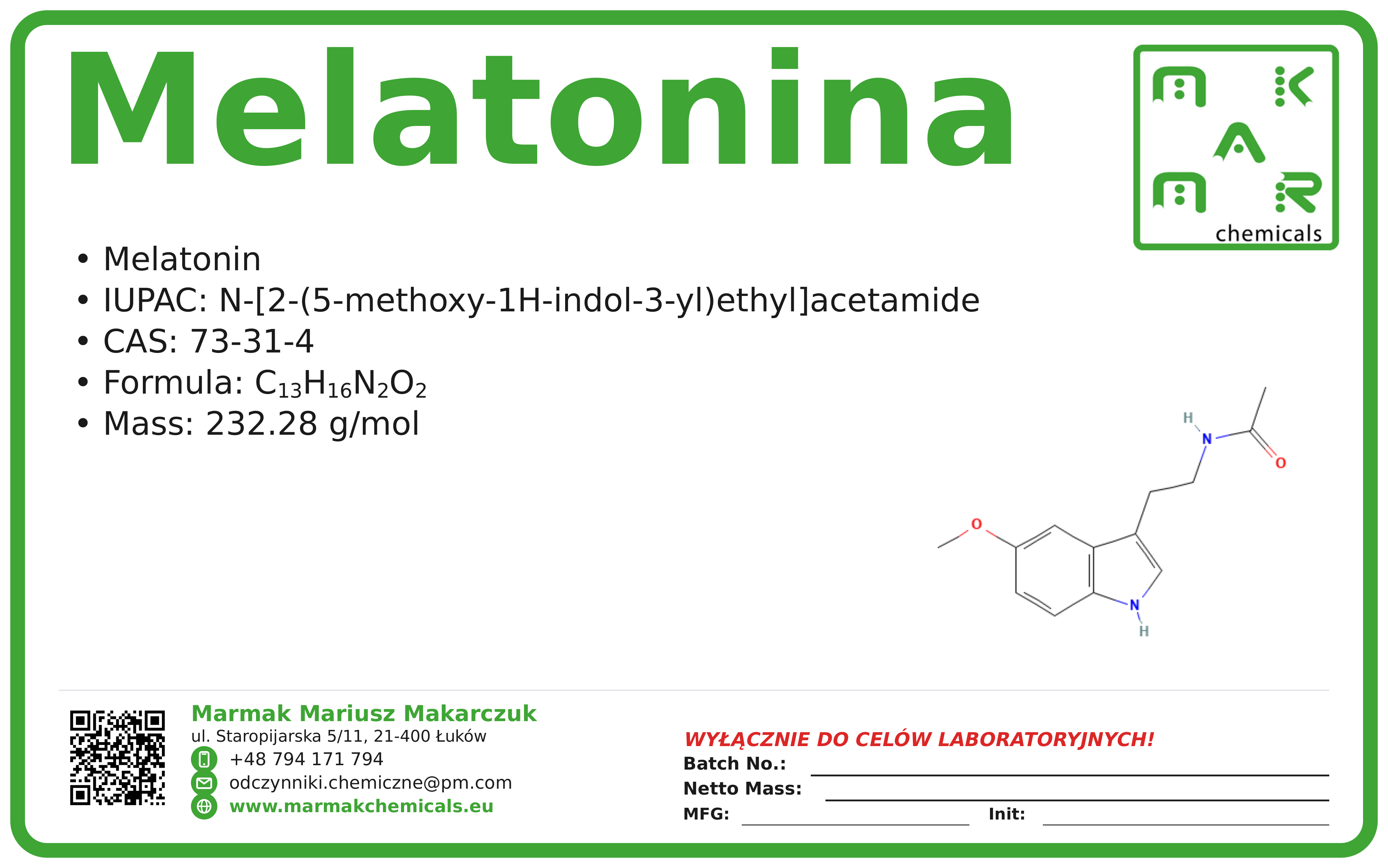
Reviews
There are no reviews yet.