Data sources:
PubChem, NIST Chemistry WebBook, CRC Handbook of Chemistry and Physics (103rd ed.)
Last updated: 2026-06-25
Regulatory status of the substance
No entries for this CAS in the restriction lists checked (SVHC candidate list, REACH Annex XVII; datasets incomplete — this is not a confirmation of compliance). CLP classification and transport status (ADR): see the GHS section and the safety data sheet (SDS).
Spectra are fetched on demand from 9 sources. Each spectrum is stored in our database — the next time it is opened there are zero requests to the external API. Download JCAMP-DX / CSV / PNG for every spectrum without searching.
Data retrieved via MolGod_Spectra_Remote_Fetcher (JCAMP-DX parser) and stored in the wp_molgod_spectra_cache table. Zero duplicate downloads, zero repeat queries to NIST on subsequent visits. Licensing terms are respected (only a deep link plus our own visualization is published).
Data retrieved live from multiple sources (priority chain). JCAMP-DX / CSV / PNG available for download under each spectrum.
IR — Fourier-transform infrared
Loading IR — Fourier-transform infrared…
MS — Mass spectrometry (EI 70eV)
Loading MS — Mass spectrometry (EI 70eV)…
MolGod_MS_SP7
🔎 Spectrum Search (JCAMP-DX)
Upload a JCAMP-DX file (.jdx, .dx, .jcm) — the system will calculate the cosine similarity against all spectra in the database and display the TOP 10 matches.
📚 Bibliography (Chicago)
McLafferty, Fred W., ed. 2018. Wiley Registry of Mass Spectral Data. 11th ed. Hoboken, NJ: Wiley. A reference MS library (~775k spectra).
Stein, Stephen E., and Donald R. Scott. 1994. "Optimization and Testing of Mass Spectral Library Search Algorithms for Compound Identification." Journal of the American Society for Mass Spectrometry 5 (9): 859–866. The cosine + dot-product algorithm of NIST MS Search.
McDonald, Robert S., and Paul A. Wilks Jr. 1988. "JCAMP-DX: A Standard Form for Exchange of Infrared Spectra in Computer Readable Form." Applied Spectroscopy 42 (1): 151–162. The JCAMP-DX specification (extended to 5.01 for NMR/MS).
McLafferty, Fred W., and František Tureček. 1993. "Interpretation of Mass Spectra." 4th ed. Mill Valley, CA: University Science Books. Cosine-similarity matching and MS fragmentation — the foundation of the search algorithm.
Sumner, Lloyd W., Alexander Amberg, Dave Barrett, Michael H. Beale, Richard Beger, Clare A. Daykin, Teresa W.-M. Fan, et al. 2007. "Proposed Minimum Reporting Standards for Chemical Analysis." Metabolomics 3 (3): 211–221. MSI Level 1-4 — confidence-level standards for spectral matching.
Stein, Stephen E. 1999. "An Integrated Method for Spectrum Extraction and Compound Identification from Gas Chromatography/Mass Spectrometry Data." Journal of the American Society for Mass Spectrometry 10 (8): 770–781. The AMDIS algorithm — deconvolution + library match (NIST).
Lindon, John C., George E. Tranter, and David W. Koppenaal, eds. 2017. "Encyclopedia of Spectroscopy and Spectrometry." 3rd ed. Amsterdam: Academic Press. Encyclopedia entries on spectral library searching.
Smith, Brian C. 2011. "Fundamentals of Fourier Transform Infrared Spectroscopy." 2nd ed. Boca Raton, FL: CRC Press. FT-IR and the JCAMP-DX format for transmission spectra.
Larkin, Peter. 2017. "Infrared and Raman Spectroscopy: Principles and Spectral Interpretation." 2nd ed. Amsterdam: Elsevier. Principles of IR/Raman library matching and peak preprocessing.
📐Physical & Chemical Properties (DB)
8 fields MolGod Score: No source
Haynes, William M., ed. 2024. CRC Handbook of Chemistry and Physics. 105th ed. Boca Raton: CRC Press/Taylor & Francis. ISBN 978-1-032-55554-4. ↗
National Institute of Standards and Technology. 2024. "NIST Chemistry WebBook, SRD 69." Gaithersburg, MD: NIST. Accessed 2025-01-01. ↗
Yaws, Carl L. 2014. The Yaws Handbook of Physical Properties for Hydrocarbons and Chemicals. 2nd ed. Oxford: Gulf Professional Publishing.
PubChem. 2024. "PubChem Compound Database." National Library of Medicine, National Institutes of Health. Accessed 2025-01-01. ↗
Marrero, J., and R. Gani. 2001. "Group-Contribution Based Estimation of Pure Component Properties." Fluid Phase Equilibria 183–184: 183–208. ↗
Joback, K. G., and R. C. Reid. 1987. "Estimation of Pure-Component Properties from Group-Contributions." Chemical Engineering Communications 57 (1–6): 233–243. ↗
Sangster, J. 1997. Octanol-Water Partition Coefficients: Fundamentals and Physical Chemistry. Chichester: Wiley. ISBN 978-0-471-97397-3.
Mannhold, Raimund, and Han van de Waterbeemd. 2001. "Substructure and Whole Molecule Approaches for Calculating Log P." Journal of Computer-Aided Molecular Design 15 (4): 337–354. ↗
Perrin, Ditlev D., Boyd Dempsey, and E. P. Serjeant. 1981. pKa Prediction for Organic Acids and Bases. London: Chapman and Hall. ISBN 0-412-21090-5.
Constantinou, Leonidas, and Rafiqul Gani. 1994. "New Group Contribution Method for Estimating Properties of Pure Compounds." AIChE Journal 40 (10): 1697–1710. ↗
Ertl, Peter, Bernhard Rohde, and Paul Selzer. 2000. "Fast Calculation of Molecular Polar Surface Area as a Sum of Fragment-Based Contributions and Its Application to the Prediction of Drug Transport Properties." Journal of Medicinal Chemistry 43 (20): 3714–3717. ↗
🔄 Concentration unit converter LIVEMolGod_UNITCONV_1
/* translators: %s, %d itd. to wartosci dynamiczne wstawiane do komunikatu. */
Enter the levodopa concentration in any unit — the rest will be calculated automatically.
Cohen ER, Cvitaš T, Frey JG, Holmström B, Kuchitsu K, Marquardt R, Mills I, Pavese F, Quack M, Stohner J, Strauss HL, Takami M, Thor AJ (2007)
g/L ↔ molarity
c (mol/L) = (g/L) / MW
±0.1% (depends on MW precision)
Cohen ER, Cvitaš T, Frey JG, Holmström B, Kuchitsu K, Marquardt R, Mills I, Pavese F, Quack M, Stohner J, Strauss HL, Takami M, Thor AJ (2007)
mmol/L ↔ molarity
c (mol/L) = mmol/L × 10⁻³
Exact
Cohen ER, Cvitaš T, Frey JG, Holmström B, Kuchitsu K, Marquardt R, Mills I, Pavese F, Quack M, Stohner J, Strauss HL, Takami M, Thor AJ (2007)
Celsius ↔ Kelvin
T(K) = t(°C) + 273.15
±0.01 K (ITS-90 scale)
BIPM (Bureau International des Poids et Mesures) (2019)
Celsius ↔ Fahrenheit
T(°F) = T(°C) × 9/5 + 32
±0.1 °F
Thompson A, Taylor BN (2008)
density-corrected % ↔ molarity
c (mol/L) = (%w/w × ρ × 10) / MW, ρ in g/mL
±0.1% when ρ known to 3 decimals
Cohen ER, Cvitaš T, Frey JG, Holmström B, Kuchitsu K, Marquardt R, Mills I, Pavese F, Quack M, Stohner J, Strauss HL, Takami M, Thor AJ (2007)
📚 Bibliography (8 authoritative sources)
Thompson A, Taylor BN (2008). Guide for the Use of the International System of Units (SI). NIST Special Publication 811 · DOI: 10.6028/NIST.SP.811-2008 → Primary SI standard for US scientific usage
Cohen ER, Cvitaš T, Frey JG, Holmström B, Kuchitsu K, Marquardt R, Mills I, Pavese F, Quack M, Stohner J, Strauss HL, Takami M, Thor AJ (2007). Quantities, Units and Symbols in Physical Chemistry — The IUPAC Green Book. RSC Publishing, 3rd ed. · DOI: 10.1039/9781847557889 · ISBN: 978-0-85404-433-7 → Canonical IUPAC guide for chemistry quantities/units
BIPM (Bureau International des Poids et Mesures) (2019). The International System of Units (SI), 9th edition. BIPM · ↗ → International SI definitions (incl. redefined kilogram 2019)
ISO/IEC (2022). Quantities and units — Part 1: General. International Organization for Standardization — ISO 80000-1:2022 · ↗ → General rules for physical quantities and units
ISO/IEC (2019). Quantities and units — Part 9: Physical chemistry and molecular physics. International Organization for Standardization — ISO 80000-9:2019 · ↗ → Concentration / molality / amount-of-substance conventions
Tiesinga E, Mohr PJ, Newell DB, Taylor BN (2021). CODATA recommended values of the fundamental physical constants: 2018. Rev. Mod. Phys. 93(2):025010 · DOI: 10.1103/RevModPhys.93.025010 → Avogadro, gas constant, molar volume (2019 SI revision)
IUPAC (2019). Compendium of Chemical Terminology — the IUPAC Gold Book (online). IUPAC · DOI: 10.1351/goldbook → Definitions of mass fraction, molality, normality, ppm, activity
Mills IM, Cvitaš T, Homann K, Kallay N, Kuchitsu K (1988). Quantities, Units and Symbols in Physical Chemistry. Blackwell Scientific Publications, 1st ed. · ISBN: 0-632-01773-5 → Historical predecessor of IUPAC Green Book
Rumble, John R., ed. 2023. CRC Handbook of Chemistry and Physics. 104th ed. Boca Raton, FL: CRC Press. [link ↗]
International Association for the Properties of Water and Steam (IAPWS). 1997. "Release on the Static Dielectric Constant of Ordinary Water Substance." IAPWS R8-97. [link ↗]
Reichardt, Christian, and Thomas Welton. 2011. Solvents and Solvent Effects in Organic Chemistry. 4th ed. Weinheim: Wiley-VCH. https://doi.org/10.1002/9783527632220. [link ↗]
Hansen, Charles M. 2007. Hansen Solubility Parameters: A User's Handbook. 2nd ed. Boca Raton, FL: CRC Press. https://doi.org/10.1201/9781420006834. [link ↗]
IFA. n.d. "Water." GESTIS Substance Database. Institut für Arbeitsschutz der Deutschen Gesetzlichen Unfallversicherung. Accessed April 25, 2026. [link ↗]
Rumble, John R., ed. 2023. CRC Handbook of Chemistry and Physics. 104th ed. Boca Raton, FL: CRC Press. [link ↗]
Reichardt, Christian, and Thomas Welton. 2011. Solvents and Solvent Effects in Organic Chemistry. 4th ed. Weinheim: Wiley-VCH. https://doi.org/10.1002/9783527632220. [link ↗]
Snyder, Lloyd R., Joseph J. Kirkland, and John W. Dolan. 2010. Introduction to Modern Liquid Chromatography. 3rd ed. Hoboken, NJ: Wiley. https://doi.org/10.1002/9780470508183. [link ↗]
Smallwood, Ian M. 1996. Handbook of Organic Solvent Properties. London: Arnold. https://doi.org/10.1016/B978-0-340-64578-9.X5000-9. [link ↗]
Reichardt, Christian, and Thomas Welton. 2011. Solvents and Solvent Effects in Organic Chemistry. 4th ed. Weinheim: Wiley-VCH. https://doi.org/10.1002/9783527632220. [link ↗]
Hansen, Charles M. 2007. Hansen Solubility Parameters: A User's Handbook. 2nd ed. Boca Raton, FL: CRC Press. [link ↗]
Rumble, John R., ed. 2023. CRC Handbook of Chemistry and Physics. 104th ed. Boca Raton, FL: CRC Press. [link ↗]
Smallwood, Ian M. 1996. Handbook of Organic Solvent Properties. London: Arnold. [link ↗]
National Institute of Standards and Technology. n.d. "Methane, dichloro- (CAS 75-09-2)." NIST Chemistry WebBook, SRD 69. Accessed April 25, 2026. [link ↗]
Hansen, Charles M. 2007. Hansen Solubility Parameters: A User's Handbook. 2nd ed. Boca Raton, FL: CRC Press. [link ↗]
International Agency for Research on Cancer. 1999. "Dichloromethane." IARC Monographs on the Evaluation of Carcinogenic Risks to Humans 71: 251–315. [link ↗]
Reichardt, Christian, and Thomas Welton. 2011. Solvents and Solvent Effects in Organic Chemistry. 4th ed. Weinheim: Wiley-VCH. [link ↗]
Armarego, Wilfred L. F., and Christina Li Lin Chai. 2009. Purification of Laboratory Chemicals. 6th ed. Oxford: Butterworth-Heinemann. https://doi.org/10.1016/B978-1-85617-567-8.50003-3. [link ↗]
Hansen, Charles M. 2007. Hansen Solubility Parameters: A User's Handbook. 2nd ed. Boca Raton, FL: CRC Press. [link ↗]
National Institute of Standards and Technology. n.d. "Furan, tetrahydro- (CAS 109-99-9)." NIST Chemistry WebBook. Accessed April 25, 2026. [link ↗]
Smallwood, Ian M. 1996. Handbook of Organic Solvent Properties. London: Arnold. [link ↗]
National Institute of Standards and Technology. n.d. "Hexane (CAS 110-54-3)." NIST Chemistry WebBook. Accessed April 25, 2026. [link ↗]
Hansen, Charles M. 2007. Hansen Solubility Parameters: A User's Handbook. 2nd ed. Boca Raton, FL: CRC Press. [link ↗]
Snyder, Lloyd R., Joseph J. Kirkland, and John W. Dolan. 2010. Introduction to Modern Liquid Chromatography. 3rd ed. Hoboken, NJ: Wiley. [link ↗]
Agency for Toxic Substances and Disease Registry. 1999. Toxicological Profile for n-Hexane. Atlanta, GA: U.S. Department of Health and Human Services. [link ↗]
International Agency for Research on Cancer. 1999. "Chloroform." IARC Monographs on the Evaluation of Carcinogenic Risks to Humans 73: 131–182. [link ↗]
National Institute of Standards and Technology. n.d. "Methane, trichloro- (CAS 67-66-3)." NIST Chemistry WebBook. Accessed April 25, 2026. [link ↗]
Hansen, Charles M. 2007. Hansen Solubility Parameters: A User's Handbook. 2nd ed. Boca Raton, FL: CRC Press. [link ↗]
Reichardt, Christian, and Thomas Welton. 2011. Solvents and Solvent Effects in Organic Chemistry. 4th ed. Weinheim: Wiley-VCH. [link ↗]
Solubility theory (applied in compatibility prediction):
Yalkowsky, Samuel H., and Shri C. Valvani. 1980. "Solubility and Partitioning I: Solubility of Nonelectrolytes in Water." Journal of Pharmaceutical Sciences 69 (8): 912–922. https://doi.org/10.1002/jps.2600690814 — General Solubility Equation (GSE): logS = 0.5 − logP − 0.01(MP−25).
Hansen, Charles M. 2007. Hansen Solubility Parameters: A User's Handbook. 2nd ed. Boca Raton, FL: CRC Press. https://doi.org/10.1201/9781420006834 — HSP triplet (dD, dP, dH) + wzór Ra.
Reichardt, Christian, and Thomas Welton. 2011. Solvents and Solvent Effects in Organic Chemistry. 4th ed. Weinheim: Wiley-VCH. https://doi.org/10.1002/9783527632220 — E_T(30) polarity scale, solwatochromia.
Snyder, Lloyd R., Joseph J. Kirkland, and John W. Dolan. 2010. Introduction to Modern Liquid Chromatography. 3rd ed. Hoboken, NJ: Wiley. https://doi.org/10.1002/9780470508183 — Eluotropic series, polarity index.
PubChem Compound Database — CAS 59-92-7 lookup ↗ — logP (XLogP3), water solubility experimental + predicted.
Full bibliography in the REFERENCES accordion (at the bottom of the page) — Chicago Manual of Style 17th ed., Author-Date.
🛡️ Safety — CAS 59-92-7MolGod_SAFEHUB_MAIN
Data limitations notice. The safety information on this page is for reference only and does not replace a full safety data sheet (SDS). Before using the product, consult the manufacturer's current safety data sheet and the GHS/CLP guidance. The CLP classification applies to the pure bulk substance, not to commercial formulations.
MolGod_GHS_SF1
GHS/CLP classification — Regulation (EC) No 1272/2008 + UN GHS Rev. 9 (2021).
P203 — Obtain, read and follow all safety instructions before use
⚠ Classification based on a consensus of sources (PubChem / supplier notifications) — not verified against the harmonised classification in Annex VI (CLP). The scope of hazards may be broader than the official classification; verify against the supplier's current safety data sheet before use.
Translations: CLP Regulation (EC) 1272/2008, Annexes III and IV. Data: PubChem/NLM.
MolGod_TOX_SF2
☢️ Toxicological data (IARC + EPA CTX)
🧬 IARC Carcinogen Classification
IARC classification:
No individual IARC entry for this CAS
No separate IARC monograph in the checked lists — this is NOT confirmation of a lack of carcinogenicity. Check the CLP/GHS classification (CMR / GHS section).
No harmonized CLP classification (Annex VI) is available for this CAS number. The codes below are aggregated supplier self-classifications (ECHA C&L notifications made available via PubChem) — they are NOT a harmonized classification and may be redundant. The supplier's Safety Data Sheet (SDS) remains the binding source.
Agarwal, Sarah. 2025. "Can Music Therapy (Rhythmic Auditory Stimulations) Completely Replace the Conventional Medicine (Levodopa) Used to Treat All the Symptoms of Parkinson's Disease and Delay Its Deterioration?." International Journal of Science and Research (IJSR): 1447-1458. https://doi.org/10.21275/sr25919112851. [DOI]
International Agency for Research on Cancer (IARC). 2024. "IARC Monographs on the Identification of Carcinogenic Hazards to Humans." Lyon: IARC. 🔗
U.S. EPA. 2024. "ECOTOX Knowledgebase." Washington, DC: U.S. Environmental Protection Agency. 🔗
ECHA. 2024. "Chemical Safety Assessment." European Chemicals Agency. 🔗
U.S. National Toxicology Program. 2024. Report on Carcinogens. 15th ed. Research Triangle Park, NC: National Institute of Environmental Health Sciences. 🔗
GESTIS. 2024. "GESTIS Substance Database." Institute for Occupational Safety and Health of the German Social Accident Insurance (DGUV). 🔗
U.S. EPA. 2024. "CompTox Chemicals Dashboard." Washington, DC: U.S. Environmental Protection Agency. 🔗
ECHA. 2023. "Regulation (EC) No 1272/2008 on Classification, Labelling and Packaging of Substances and Mixtures (CLP), Annex VI — Harmonised Classification." European Chemicals Agency. 🔗
Leist, Marcel, et al. 2014. "Consensus Report on the Future of Animal-Free Systemic Toxicity Testing." ALTEX 31 (3): 341–356. [DOI]
Hartung, Thomas. 2009. "Toxicology for the Twenty-First Century." Nature 460 (7252): 208–212. [DOI]
Lenga, Robert E., ed. 2008. The Sigma-Aldrich Library of Chemical Safety Data. 2nd ed. Milwaukee: Sigma-Aldrich.
MolGod_SPILL_SF4
🚨 Emergency procedure — chemical spillHEALTH_HAZARD
CAS 59-92-7GHS:H302💨 Ventilation
🥽 PPE — Personal protective equipment
Gloves:chemically resistant (select per SDS section 8)
Goggles:Yes
Suit:lab coat
Respirator:half-mask / full-face respirator per SDS (dust P2/P3)
📦 Small spill (<1L) — absorbent: inert mineral (vermiculite)
⚠️ GENERIC procedure derived from the GHS classification (no curated data for this CAS). Always follow the supplier's current Safety Data Sheet (SDS).

1. Minimize exposure — restrict access by unauthorized persons.
2. Full PPE + respiratory protection; no dust/vapor generation.
3. Sealed, labeled container.
4. Wash the area with water; treat residues and absorbent as hazardous waste.

Additional properties from GHS:
• irritant — avoid skin/eye contact and dust inhalation
• hazardous to the environment — prevent entry into drains, soil and water
🛢️ Large spill (>1L) ⚠️ HAZMAT
1. Evacuate; entry only in full PPE with respiratory protection.
2. Contain; avoid dispersal; follow the site procedure for CMR/STOT substances.
3. Collect mechanically into a labeled UN container; hand over to an authorized company (Polish Waste Database, BDO).
4. Report the incident per the OHS procedure; on release to the environment notify the Regional Environmental Inspectorate (WIOŚ).
🩹 First aid
🧴 Skin
1. Remove contaminated clothing.
2. Rinse the skin with plenty of water for ≥15 min.
3. The substance may be absorbed through the skin — monitor symptoms / see a doctor.
👁️ Eyes
1. Rinse with water for ≥15 min, eyelids held open; remove contact lenses.
2. See an ophthalmologist if irritation persists.
🫁 Inhalation
1. Move the casualty to fresh air, comfortable position.
2. If short of breath — oxygen / doctor.
🍽️ Ingestion
1. Rinse the mouth with water; do NOT induce vomiting.
2. Poison Control Center: +48 42 631 46 24.
🌍 Environment:
Water: HIGH; Soil: MEDIUM; ❌ Do not release into drains; Waste Code: 16 05 06*
📚 Scientific references (Chicago Author-Date) — 8
European Chemicals Agency (ECHA). 2020. Guidance on the Compilation of Safety Data Sheets — Section 6: Accidental Release Measures. ECHA.
[link ↗]
European Parliament and Council. 2008. Regulation (EC) No 1272/2008 (CLP) — Hazard classes and H-statements. Official Journal of the European Union L 353.
[link ↗]
National Institute for Occupational Safety and Health (NIOSH). 2023. Pocket Guide to Chemical Hazards — NIOSH Pocket Guide to Chemical Hazards. CDC.
[link ↗]
U.S. Occupational Safety and Health Administration. 2024. 29 CFR 1910.120 — Hazardous Waste Operations and Emergency Response (HAZWOPER). U.S. Code of Federal Regulations.
[link ↗]
National Fire Protection Association. 2018. NFPA 472: Standard for Competence of Responders to Hazardous Materials/Weapons of Mass Destruction Incidents. NFPA.
[link ↗]
European Parliament and Council. 2012. Directive 2012/18/EU on the Control of Major-Accident Hazards Involving Dangerous Substances (Seveso III). Official Journal of the European Union L 197: 1–37.
[link ↗]
U.S. National Institute for Occupational Safety and Health. 2024. NIOSH Pocket Guide to Chemical Hazards. Centers for Disease Control and Prevention.
[link ↗]
European Chemicals Agency. 2020. Guidance on the Compilation of Safety Data Sheets (SDS), Version 3.1. ECHA.
[link ↗]
Sources: GHS/CLP classification (PubChem/SDS) — generic fallback · ECHA Guidance on SDS (section 6) · NIOSH Pocket Guide.
Indicative data only — in an emergency, always follow the supplier's instructions and local occupational health and safety (OHS) regulations.
MolGod_WASTE_SF7
♻️ Chemical waste disposal (BDO)HEALTH_HAZARD⚠️ BDO required
📋 Full BDO list:bdo.mos.gov.pl ↗
— official register of the Ministry of Climate and Environment. Waste Transfer Card (KPO):BDO template
mandatory for every hazardous waste delivery.
📚 Scientific references (Chicago Author-Date)
European Commission. 2014. Commission Decision 2014/955/EU on the list of waste pursuant to Directive 2008/98/EC. Official Journal of the European Union. Decyzja 2014/955/UE. [link ↗] — European List of Waste (LoW) — 6-digit EWC codes + asterisk for hazardous
Ministerstwo Klimatu i Środowiska Rzeczypospolitej Polskiej. 2020. Rozporządzenie Ministra Klimatu z dnia 2 stycznia 2020 r. w sprawie katalogu odpadów. Dziennik Ustaw RP 2020 poz. 10. [link ↗] — Polish waste catalogue — implementation of Decision 2014/955/EU
Główny Inspektorat Ochrony Środowiska (GIOŚ). 2024. Baza Danych O Odpadach (BDO) — System rejestracji firm utylizacyjnych. Ministerstwo Klimatu i Środowiska. [link ↗] — Central register of the Polish Waste Database (BDO) — full list of companies authorised for waste management
Polska — Sejm RP. 2012. Ustawa z dnia 14 grudnia 2012 r. o odpadach. Dz.U. 2013 poz. 21 (z późn. zm.). [link ↗] — National act — defines the waste producer's obligations + registration in the Polish Waste Database (BDO)
Furr, A. Keith, ed.. 2000. CRC Handbook of Laboratory Safety. CRC Press. — Laboratory waste classification + segregation procedures (Waste Management chapter); EN 374:2013 glove standards for personnel handling hazardous waste.
Pohanish, Richard P.. 2017. Sittig's Handbook of Toxic and Hazardous Chemicals and Carcinogens. Elsevier. — Per-CAS waste classification + incompatibilities — input for EWC mapping.
Lewis, Richard J.. 2012. Sax's Dangerous Properties of Industrial Materials. Wiley. — Reactivity + storage compatibility of waste (oxidisers vs flammables — separate streams).
NIOSH. 2024. Pocket Guide to Chemical Hazards. U.S. Department of Health and Human Services. [link ↗] — PEL/REL/IDLH per CAS — basis for the PPE required during waste transport (KPO — Waste Transfer Card).
OSHA. 2024. Occupational Chemical Database — Hazardous Waste Operations (HAZWOPER). Occupational Safety and Health Administration. [link ↗] — 29 CFR 1910.120 — training + PPE for handling hazardous waste.
European Parliament and Council. 2008. Directive 2008/98/EC on waste (Waste Framework Directive). Official Journal of the European Union L 312/3. [link ↗] — Waste management hierarchy (prevention → recovery → disposal); defines "hazardous waste".
European Parliament and Council. 2009. Regulation (EC) No 1272/2008 (CLP) on classification, labelling and packaging of substances and mixtures. Official Journal of the European Union L 353. [link ↗] — CLP H-statement classification → mapping to EWC * (asterisk = hazardous).
United Nations Economic Commission for Europe (UNECE). 2023. European Agreement concerning the International Carriage of Dangerous Goods by Road (ADR 2023). UNECE. [link ↗] — ADR — requirements for transporting hazardous waste (KPO — Waste Transfer Card + UN number + classes 1–9).
IPCS INCHEM. 2024. International Programme on Chemical Safety — Waste Management Guidelines. WHO/UNEP/ILO. [link ↗] — International guidelines for neutralisation + disposal per CAS.
European Parliament and Council. 2006. Regulation (EC) No 1013/2006 on Shipments of Waste. Official Journal of the European Union L 190: 1–98. [link ↗] — Cross-border transfer of hazardous waste — notification + consent requirements before export
ℹ️ Regulatory obligations checklist dla CAS 59-92-7.
Status based on: ADR 2023 (Table A), REACH Annex XVII, CLP Annex VI (harmonised classification), hazard class from the m14-spill DB, SVHC, GIS and the Polish OEL list. Principle: no data = no claim (we do NOT declare "no restrictions" without a basis).
❌SDS (Safety Data Sheet) availablerequired
How to comply: Wymóg: aktualna SDS zgodna z Rozp. 1907/2006 (REACH) Aneks II, format 16-sekcyjny.
❌Compliant CLP label (pictograms + signal word + H/P)required
How to comply: The label must include: GHS pictograms, the signal word (Danger/Warning), hazard (H) and precautionary (P) statements, and manufacturer details. Required since 2010 (substances) and 2015 (mixtures).
❌Chemical OSH training (substance-specific)required
How to comply: Laboratory staff: initial training (general induction + job-specific) + refresher training every 5 years (or every 3 for engineering/technical positions). Documentation kept in personnel files.
How to comply: BDO registration is mandatory for producers of hazardous waste. A Waste Transfer Card (KPO) is required for every consignment. Annual report due by 15 March of the following year.
Legal basis: Ustawa z 14 grudnia 2012 r. o odpadach (Dz.U. 2013 poz. 21)
❓ADR transport (international agreement)to be verified
How to comply: No ADR data in the MOL-GOD dataset for this CAS number. Do NOT assume there are no restrictions — before shipping, verify the transport classification in ADR 2023 (Table A) and in section 14 of the safety data sheet (SDS).
Legal basis: Umowa europejska ADR 2023 + Ustawa z 19 sierpnia 2011 r. o przewozie towarów niebezpiecznych
🔵REACH registration (>1 t/year EU import)conditional
How to comply: Importers/manufacturers ≥1 tonne/year must register the substance with ECHA (technical dossier + Chemical Safety Report if ≥10 t). Check the ECHA Annex VI / registered substances list.
⚪SVHC notification (Substances of Very High Concern)not applicable
How to comply: Not confirmed on the SVHC candidate list (REACH art. 59) in the MOL-GOD dataset (incomplete set). Absence is NOT confirmation — check the current ECHA candidate list. The candidate list is NOT Annex XIV.
⚪REACH Annex XIV (authorisation list)not applicable
How to comply: Not confirmed on the REACH Annex XIV authorisation list in the MOL-GOD dataset (incomplete set). Absence is NOT confirmation — check the ECHA authorisation list.
Legal basis: Rozporządzenie (WE) 1907/2006 (REACH) Załącznik XIV — autoryzacja
⚪REACH Annex XVII (use/marketing restrictions)not applicable
How to comply: Not listed in the MOL-GOD REACH Annex XVII restriction set (incomplete set). Absence is NOT confirmation that there are no restrictions — when in doubt, check the consolidated Annex XVII on the ECHA website.
❓OEL — Occupational Exposure Limit in the working environmentto be verified
How to comply: No NDS data in the MOL-GOD dataset (incomplete set — ~41 of ~600 substances in the list). Absence does NOT mean there is no NDS — check the full list in Dz.U. 2024 poz. 1017 (Regulation of the Ministry of Family and Social Policy of 4 September 2024), and where none exists apply the OEL from EU directives or values recommended by NIOSH/ACGIH.
Legal basis: Rozp. MRiPS z 4 września 2024 r. (Dz.U. 2024 poz. 1017) — NDS i NDSCh
How to comply: Nie figuruje w dostępnym zbiorze roboczym prekursorów (lista niepełna). Nieobecność NIE jest potwierdzeniem — zweryfikuj wobec zał. I Rozp. (WE) 273/2004 i wykazu GIS przed obrotem.
Legal basis: Rozp. (WE) 273/2004 + Ustawa o przeciwdziałaniu narkomanii (Dz.U. 2005 nr 179 poz. 1485)
European Parliament and Council. 2008. Regulation (EC) No 1272/2008 on classification, labelling and packaging of substances and mixtures (CLP). Official Journal of the European Union L 353/1. CLP Regulation 1272/2008. [link ↗] — Classification, labelling and packaging of substances + mixtures (GHS implementation in the EU)
European Parliament and Council. 2006. Regulation (EC) No 1907/2006 concerning the Registration, Evaluation, Authorisation and Restriction of Chemicals (REACH). Official Journal of the European Union L 396/1. REACH Regulation 1907/2006. [link ↗] — REACH — registration, evaluation and authorisation of chemicals; SVHC; SDS Annex II
Ministerstwo Rodziny i Polityki Społecznej Rzeczypospolitej Polskiej. 2024. Rozporządzenie Ministra Rodziny i Polityki Społecznej z dnia 4 września 2024 r. w sprawie najwyższych dopuszczalnych stężeń i natężeń czynników szkodliwych dla zdrowia w środowisku pracy. Dziennik Ustaw RP 2024 poz. 1017. [link ↗] — NDS and NDSCh for ~600 chemical substances — current Polish occupational exposure limits
United Nations Economic Commission for Europe (UNECE). 2023. European Agreement concerning the International Carriage of Dangerous Goods by Road (ADR), 2023 Edition. United Nations, Geneva. ADR 2023. [link ↗] — International agreement on the road transport of dangerous goods — UN numbers, classes, packaging
📚 Consolidated scientific references — Chicago Author-Date 10 sources
References collected from all Safety Hub tabs. CAS: 59-92-7 ·
PubChem ↗
Parlament Europejski i Rada UE. 2008. "Rozporządzenie (WE) nr 1272/2008 w sprawie klasyfikacji, oznakowania i pakowania substancji (CLP)." Dz.Urz. UE L 353. [↗]
GHS, Regulations
United Nations Economic Commission for Europe (UNECE). 2021. "Globally Harmonized System of Classification and Labelling of Chemicals (GHS), Ninth Revised Edition." United Nations, Geneva. [↗]
GHS
Goldfrank, Lewis R., Robert S. Hoffman, Mary Ann Howland, et al.. 2019. "Goldfrank's Toxicologic Emergencies, 11th ed.." McGraw-Hill Education, New York. ISBN 978-1-25-985961-8.
Pierwsza pomoc, Toksykologia
National Institute for Occupational Safety and Health (NIOSH). 2023. "NIOSH Pocket Guide to Chemical Hazards (DHHS Publ. 2005-149)." U.S. Department of Health and Human Services / CDC, Cincinnati, OH. [↗]
Pierwsza pomoc, PPE, Toksykologia
European Committee for Standardization (CEN). 2016. "EN 374-1:2016 — Protective gloves against dangerous chemicals and micro-organisms." CEN, Brussels. [↗]
PPE
UNECE. 2023. "European Agreement Concerning the International Carriage of Dangerous Goods by Road (ADR 2023)." United Nations, Geneva. [↗]
Utylizacja, Regulacje
National Fire Protection Association (NFPA). 2022. "NFPA 400 — Hazardous Materials Code." NFPA, Quincy, MA. [↗]
Magazynowanie
Urben, P.G. (ed.). 2017. "Bretherick's Handbook of Reactive Chemical Hazards, 8th ed.." Butterworth-Heinemann / Elsevier, Oxford. [↗]
Magazynowanie
Ministerstwo Klimatu i Środowiska RP. 2023. "Baza danych o produktach i opakowaniach oraz o gospodarce odpadami (BDO)." Ministerstwo Klimatu i Środowiska, Warszawa. [↗]
Utylizacja
International Agency for Research on Cancer (IARC / WHO). 2024. "IARC Monographs on the Identification of Carcinogenic Hazards to Humans — List of Classifications." WHO, Lyon. [↗]
Toksykologia
Tabs with their own references (Emergency, PPE, Storage, Waste) contain additional bibliographic entries within their respective sections.
Paste a series of replicate measurements (CSV, or one number per line). The calculator computes the mean, standard deviation and 95% CI, and detects outliers (Grubbs + Dixon Q).
Separator: comma, space, tab, new line. Minimum 3 measurements.
📐 Statistical formulas
x̄ = Σxᵢ / n — arithmetic mean
s² = Σ(xᵢ - x̄)² / (n-1) — sample variance
s = √s² — standard deviation
RSD% = (s / x̄) × 100% — relative standard deviation
Choose a buffer from the list of 20 popular systems → enter the target pH → get an exact recipe with the masses to weigh out.
Step 1: Choose a buffer system
Step 2: Buffer parameters
Step 3: Your recipe
Step-by-step procedure:
📐 Calculation details (Henderson-Hasselbalch)
📜 Recipe history (last 10)
📅Project Planner — Lab Experiment ManagerNEW
MolGod_PLANNER_1
Plan your entire laboratory project: add experiments with reagents, replicates, and duration. You'll get a Gantt chart, a shopping list (with links to the store!), a budget with a 10% margin, and a GHS risk matrix.
💡 Log in to save projects.
Without logging in you can calculate but not save.
🔬 HPLC/GC methods (3 metod)
📄
Phytochemical Profiling, Antioxidant Capacity, and α-Amylase/α-Glucosidase Inhibitory Effects of 29 Faba Bean (Vicia faba L.) Varieties from China
Phase: mobile phase consisted of phase A (acetonitrile) and phase B (0
Detection: UV 760 nm
Flow: 0.40 mL/min
Temp.: 37.0 °C
Inj.: 50 \u03bcL
Gradient: elution program for phase B was as follows: 95% (0–2…
Li Y, Wang Z, Mei C, Sun W, Yuan X, Wang J, et al. Phytochemical Profiling, Antioxidant Capacity, and α-Amylase/α-Glucosidase Inhibitory Effects of 29 Faba Bean (Vicia faba L.) Varieties from China. Biology. 2025;14:982. doi:10.3390/biology14080982
Simple SummaryFaba beans are rich in protein, dietary fiber, vitamins, and minerals. Crucially, they contain significant levels of phytochemicals, particularly phenolic compounds. This study evaluated 29 Chinese faba bean varieties, revealing significant differences in their phytochemical profiles, antioxidant capacity, and enzyme inhibitory effects. Key findings highlight that flavonoids are the primary contributors to antioxidant activity, while L-DOPA, despite its weaker antioxidative properties, shows strong potential for managing blood glucose levels by inhibiting carbohydrate-digesting enzymes (α-amylase and α-glucosidase). These results underscore the potential of faba beans as functional foods tailored to oxidative stress prevention and diabetes management. The established phytochemical markers guide development of cultivars with enhanced nutritional functionality through targeted selection. By bridging the gap between traditional crops and modern health demands, this research supports the growing interest in plant-based solutions for chronic diseases and promotes sustainable dietary strategies.
Improved GMP-compliant multi-dose production and quality control of 6-[18F]fluoro-L-DOPA
HPLCEJNMMI Radiopharmacy and Chemistry201693% ✓CC-BYResearch method (specificity, robustness)
Column: C18, 250 x 10 mm, 150 \u03bcm
Phase: eluent of sodium citrate 8,71 g and sodium dodecylsulfon 0,8 g in 900 ml H2O…
Detection: MS
Flow: 3.00 mL/min
Temp.: 150.0 °C
Inj.: 200 \u03bcL
Gradient: acetonitrile, used as solvent for LC-MS analysis, was obtained from…
Luurtsema G, Boersma H, Schepers M, de Vries A, Maas B, Zijlma R, et al. Improved GMP-compliant multi-dose production and quality control of 6-[18F]fluoro-L-DOPA. EJNMMI Radiopharmacy and Chemistry. 2016;1:7. doi:10.1186/s41181-016-0009-1
Background6-[18F]Fluoro-L-3,4-dihydroxyphenylalanine (FDOPA) is a frequently used radiopharmaceutical for detecting neuroendocrine and brain tumors and for the differential diagnosis of Parkinson’s disease. To meet the demand for FDOPA, a high-yield GMP-compliant production method is required. Therefore, this study aimed to improve the FDOPA production and quality control procedures to enable distribution of the radiopharmaceutical over distances.FDOPA was prepared by electrophilic fluorination of the trimethylstannyl precursor with [18F]F2, produced from [18O]2 via the double-shoot approach, leading to FDOPA with higher specific activity as compared to FDOPA which was synthesized, using [18F]F2 produced from 20Ne, leading to FDOPA with a lower specific activity. The quality control of the product was performed using a validated UPLC system and compared with quality control with a conventional HPLC system. Impurities were identified using UPLC-MS.ResultsThe [18O]2 double-shoot radionuclide production method yielded significantly more [18F]F2 with less carrier F2 than the conventional method starting from 20Ne. After adjustment of radiolabeling parameters substantially higher amounts of FDOPA with higher specific activity could be obtained. Quality control by UPLC was much faster and detected more side-products than HPLC. UPLC-MS showed that the most important side-product was FDOPA-quinone, rather than 6-hydroxydopa as suggested by the European Pharmacopoeia.ConclusionThe production and quality control of FDOPA were significantly improved by introducing the [18O]2 double-shoot radionuclide production method, and product analysis by UPLC, respectively. As a result, FDOPA is now routinely available for clinical practice and for distribution over distances.
PETRadionuclide productionRadiochemistryAutomationQuality control
📄
Development and Validation of a Reversed-Phase HPLC Method with UV Detection for the Determination of L-Dopa in Vicia faba L. Broad Beans
Phase: mobile phases, and validation parameters, i
Detection: UV 950 nm
Flow: 1.00 mL/min
Temp.: 25.0 °C
Inj.: 1 \u03bcL
Gradient: HPLC System (Agilent Technologies, Santa Clara, CA, USA) equipped with…
Tesoro C, Ciriello R, Lelario F, Di Capua A, Pascale R, Bianco G, et al. Development and Validation of a Reversed-Phase HPLC Method with UV Detection for the Determination of L-Dopa in Vicia faba L. Broad Beans. Molecules. 2022;27:7468. doi:10.3390/molecules27217468
L-Dopa (LD), a substance used medically in the treatment of Parkinson’s disease, is found in several natural products, such as Vicia faba L., also known as broad beans. Due to its low chemical stability, LD analysis in plant matrices requires an appropriate optimization of the chosen analytical method to obtain reliable results. This work proposes an HPLC-UV method, validated according to EURACHEM guidelines as regards linearity, limits of detection and quantification, precision, accuracy, and matrix effect. The LD extraction was studied by evaluating its aqueous stability over 3 months. The best chromatographic conditions were found by systematically testing several C18 stationary phases and acidic mobile phases. In addition, the assessment of the best storage treatment of Vicia faba L. broad beans able to preserve a high LD content was performed. The best LD determination conditions include sun-drying storage, extraction in HCl 0.1 M, chromatographic separation with a Discovery C18 column, 250 × 4.6 mm, 5 µm particle size, and 99% formic acid 0.2% v/v and 1% methanol as the mobile phase. The optimized method proposed here overcomes the problems linked to LD stability and separation, thus contributing to the improvement of its analytical determination.
Solubility theory (applied in compatibility prediction):
Yalkowsky, Samuel H., and Shri C. Valvani. 1980. "Solubility and Partitioning I: Solubility of Nonelectrolytes in Water." Journal of Pharmaceutical Sciences 69 (8): 912–922. https://doi.org/10.1002/jps.2600690814 — General Solubility Equation (GSE): logS = 0.5 − logP − 0.01(MP−25).
Hansen, Charles M. 2007. Hansen Solubility Parameters: A User's Handbook. 2nd ed. CRC Press. https://doi.org/10.1201/9781420006834 — HSP triplet (dD, dP, dH) + wzór Ra.
Stefanis, E., and C. Panayiotou. 2008. "Prediction of Hansen Solubility Parameters with a New Group-Contribution Method." Int J Thermophys 29: 568–585. https://doi.org/10.1007/s10765-008-0415-z
Reichardt, Christian, and Thomas Welton. 2011. Solvents and Solvent Effects in Organic Chemistry. 4th ed. Wiley-VCH. https://doi.org/10.1002/9783527632220 — E_T(30) polarity scale, solwatochromia.
Snyder, Lloyd R., Joseph J. Kirkland, and John W. Dolan. 2010. Introduction to Modern Liquid Chromatography. 3rd ed. Wiley. https://doi.org/10.1002/9780470508183 — Eluotropic series, polarity index.
Van Krevelen, D. W., and K. Te Nijenhuis. 2009. Properties of Polymers. 4th ed. Elsevier. https://doi.org/10.1016/B978-0-08-054819-7.X0001-5 — Hoftyzer–Van Krevelen group contribution dla dD/dP/dH z SMILES.
Marcus, Yizhak. 1998. The Properties of Solvents. Wiley Series in Solution Chemistry, Vol. 4. ISBN 9780471983699 — Complete tabular set of 250+ solvents (ε, μ, donicity, acceptor numbers).
PubChem Compound Database — CAS 59-92-7 lookup ↗ — logP (XLogP3), water solubility experimental + predicted.
Full bibliography in the REFERENCES accordion (at the bottom of the page) — Chicago Manual of Style 17th ed., Author-Date.
🧮 Solubility calculator
Solubility:—
logS:—
Method:—
⚠️ —
Solubility vs temperature
🌐 Hansen Solubility Sphere (3D)
The closer to the molecule (red sphere), the better the solvent. · Advanced: labels + grid + axes + pulsation.
Your molecule
Good (Ra < 5)
Medium (Ra 5-10)
Weak (Ra > 10)
📚 HSP + Ra data sources
Agarwal, Sarah. 2025. "Can Music Therapy (Rhythmic Auditory Stimulations) Completely Replace the Conventional Medicine (Levodopa) Used to Treat All the Symptoms of Parkinson's Disease and Delay Its Deterioration?." International Journal of Science and Research (IJSR): 1447-1458. https://doi.org/10.21275/sr25919112851. [DOI ↗]
Anonymous. 1976. "LEVODOPA DOES NOT SUSTAIN IMPROVEMENT IN ALL PARKINSONIAN PATIENTS." InPharma 68 (1): 9-9. https://doi.org/10.1007/bf03289351. [DOI ↗]
Van Krevelen, D. W., and K. Te Nijenhuis. 2009. Properties of Polymers: Their Correlation with Chemical Structure; Their Numerical Estimation and Prediction from Additive Group Contributions. 4th ed. Amsterdam: Elsevier. [DOI ↗]
Stefanis, Eirini, and Costas Panayiotou. 2008. "Prediction of Hansen Solubility Parameters with a New Group-Contribution Method." International Journal of Thermophysics 29 (2): 568–585. [DOI ↗]
Hansen, Charles M. 2007. Hansen Solubility Parameters: A User's Handbook. 2nd ed. Boca Raton: CRC Press. [DOI ↗]
Method: Group Contribution (GC) — rapid δD/δP/δH estimation from logP when experimental data are unavailable. Accuracy ±2 MPa^½. For higher precision → HSPiP software.
❓ Jak przygotować roztwór standardowy L-DOPA o stężeniu 100 µg/mL?
MolGod_TECHFAQ_1_Q0
Aby przygotować roztwór standardowy L-DOPA o stężeniu 100 µg/mL, należy odważyć masę substancji zgodnie z obliczeniami. Masa molowa L-DOPA wynosi 197.19 g/mol. Dla stężenia 100 µg/mL (0.1 mg/mL) w 1 litrze roztworu potrzeba: 0.1 mg/mL * 1000 mL = 100 mg L-DOPA. Masa substancji do odważenia: 100 mg.
Helpful?
❓ Jak przechowywać L-DOPA, aby zachować jej stabilność?
MolGod_TECHFAQ_1_Q1
L-DOPA powinna być przechowywana w temperaturze 2-8°C, w ciemnym miejscu, chroniąc przed światłem i wilgocią. Zaleca się użycie szczelnie zamkniętych pojemników z ciemnego szkła lub tworzywa sztucznego odpornego na działanie substancji chemicznych.
Helpful?
❓ Jaka metoda analityczna jest najbardziej odpowiednia do analizy L-DOPA?
MolGod_TECHFAQ_1_Q2
Najbardziej odpowiednią metodą analityczną dla L-DOPA jest wysokosprawna chromatografia cieczowa (HPLC) ze względu na jej polarny charakter i masę molową. LogP L-DOPA nie jest podany, ale biorąc pod uwagę jej strukturę, HPLC z odpowiednią fazą stacjonarną (np. C18 lub polarne fazy) jest preferowana.
Helpful?
❓ Jakie są potencjalne reaktywności i niezgodności chemiczne L-DOPA?
MolGod_TECHFAQ_1_Q3
L-DOPA może ulegać degradacji w obecności silnych utleniaczy, zasad lub kwasów. Należy unikać kontaktu z substancjami silnie kwasowymi (np. HCl) i zasadowymi (np. NaOH). Może również reagować z nadtlenkami i innymi utleniaczami, prowadząc do degradacji.
Helpful?
❓ Jakie jest praktyczne zastosowanie laboratoryjne L-DOPA?
MolGod_TECHFAQ_1_Q4
L-DOPA jest stosowana jako standard w analizach biochemicznych, szczególnie w badaniach nad dopaminą i jej metabolitami. Jest również używana w syntezie farmaceutycznej do produkcji leków przeciwparkinsonowskich, takich jak levodopa.
Drug-likeness radar chart (Lipinski Ro5 / Veber). Green zone = compliance with criteria.
Predictive data — properties calculated in silico (SMILES/RDKit). These do not replace clinical studies. Do not use for drug evaluation without experimental verification.
Lipinski, Christopher A., Franco Lombardo, Beryl W. Dominy, and Paul J. Feeney. 1997. "Experimental and computational approaches to estimate solubility and permeability in drug discovery and development settings." Advanced Drug Delivery Reviews 23 (1-3): 3-25.
Veber, Daniel F., Stephen R. Johnson, Hung-Yuan Cheng, et al. 2002. "Molecular properties that influence the oral bioavailability of drug candidates." Journal of Medicinal Chemistry 45 (12): 2615-2623.
Daina, Antoine, Olivier Michielin, and Vincent Zoete. 2017. "SwissADME: a free web tool to evaluate pharmacokinetics, drug-likeness and medicinal chemistry friendliness." Scientific Reports 7: 42717.
Egan, William J., and Gregory Lauri. 2002. "Prediction of intestinal permeability." Advanced Drug Delivery Reviews 54 (3): 273-289.
Baell, Jonathan B., and Georgina A. Holloway. 2010. "New substructure filters for removal of pan assay interference compounds (PAINS) from screening libraries." Journal of Medicinal Chemistry 53 (7): 2719-2740.
Brenk, Ruth, Alessandro Schipani, Daniel James, et al. 2008. "Lessons learnt from assembling screening libraries for drug discovery for neglected diseases." ChemMedChem 3 (3): 435-444.
Ertl, Peter, and Ansgar Schuffenhauer. 2009. "Estimation of synthetic accessibility score of drug-like molecules based on molecular complexity and fragment contributions." Journal of Cheminformatics 1: 8.
Bickerton, G. Richard, Gaia V. Paolini, Jérémy Besnard, Sorel Muresan, and Andrew L. Hopkins. 2012. "Quantifying the Chemical Beauty of Drugs." Nature Chemistry 4 (2): 90-98.
Hopkins, Andrew L., and Colin R. Groom. 2002. "The Druggable Genome." Nature Reviews Drug Discovery 1 (9): 727-730.
Ghose, Arup K., Vellarkad N. Viswanadhan, and John J. Wendoloski. 1999. "A Knowledge-Based Approach in Designing Combinatorial or Medicinal Chemistry Libraries for Drug Discovery." Journal of Combinatorial Chemistry 1 (1): 55-68.
Tice, Raymond R., Christopher P. Austin, Robert J. Kavlock, and John R. Bucher. 2013. "Improving the Human Hazard Characterization of Chemicals: A Tox21 Update." Environmental Health Perspectives 121 (7): 756-765.
Leeson, Paul D., and Brian Springthorpe. 2007. "The Influence of Drug-Like Concepts on Decision-Making in Medicinal Chemistry." Nature Reviews Drug Discovery 6 (11): 881-890.
Hann, Michael M. 2011. "Molecular Obesity, Potency and Other Addictions in Drug Discovery." MedChemComm 2 (5): 349-355.
Davies, Mark, Michał Nowotka, George Papadatos, et al. 2015. "ChEMBL Web Services: Streamlining Access to Drug Discovery Data and Utilities." Nucleic Acids Research 43 (W1): W612-W620.
Walters, W. Patrick, and Mark A. Murcko. 2002. "Prediction of 'Drug-Likeness.'". Advanced Drug Delivery Reviews 54 (3): 255–271. https://doi.org/10.1016/S0169-409X(02)00003-0.
Congreve, Miles, Robin Carr, Christopher Murray, and Harren Jhoti. 2003. "A 'Rule of Three' for Fragment-Based Lead Discovery?" Drug Discovery Today 8 (19): 876–877. https://doi.org/10.1016/S1359-6446(03)02831-9.
Brenk, Ruth, Alessandro Schipani, Daniel James, Agata Krasowski, Iain Hugh Gilbert, Julie Frearson, and Paul Graham Wyatt. 2008. "Lessons Learnt from Assembling Screening Libraries for Drug Discovery for Neglected Diseases." ChemMedChem 3 (3): 435-444.
Schomburg, Karen T., Sascha Bietz, Hans Briem, Andrea M. Henzler, Stefan Urbaczek, and Matthias Rarey. 2014. "Facing the Challenges of Structure-Based Target Prediction by Inverse Virtual Screening." Journal of Chemical Information and Modeling 54 (6): 1676-1686.
Bemis, Guy W., and Mark A. Murcko. 1996. "The Properties of Known Drugs. 1. Molecular Frameworks." Journal of Medicinal Chemistry 39 (15): 2887-2893.
Schomburg, Karen T., and Matthias Rarey. 2014. "What Is the Potential of Structure-Based Target Prediction Methods?" Future Medicinal Chemistry 6 (17): 1987-1989.
Agarwal, Sarah. 2025. "Can Music Therapy (Rhythmic Auditory Stimulations) Completely Replace the Conventional Medicine (Levodopa) Used to Treat All the Symptoms of Parkinson's Disease and Delay Its Deterioration?." International Journal of Science and Research (IJSR): 1447-1458. https://doi.org/10.21275/sr25919112851. [DOI ↗]
Anonymous. 1976. "LEVODOPA DOES NOT SUSTAIN IMPROVEMENT IN ALL PARKINSONIAN PATIENTS." InPharma 68 (1): 9-9. https://doi.org/10.1007/bf03289351. [DOI ↗]
Bolton, Evan E., Yanli Wang, Paul A. Thiessen, and Stephen H. Bryant. 2008. "PubChem: Integrated Platform of Small Molecules and Biological Activities." Annual Reports in Computational Chemistry 4: 217-241. [DOI ↗]
Kim, Sunghwan, Jie Chen, Tiejun Cheng, et al. 2023. "PubChem 2023 update." Nucleic Acids Research 51 (D1): D1373-D1380. [DOI ↗]
Kim, Sunghwan, Tiejun Cheng, Jianyong He, Chen Cheng, et al. 2021. "PubChem Protein, Pathway, Reaction, and Disease Specifications." Journal of Cheminformatics 13: 16. [DOI ↗]
Hähnke, Volker D., Sunghwan Kim, and Evan E. Bolton. 2018. "PubChem chemical structure standardization." Journal of Cheminformatics 10: 36. [DOI ↗]
Wang, Yanli, Stephen H. Bryant, Tiejun Cheng, Jiyao Wang, et al. 2017. "PubChem BioAssay: 2017 update." Nucleic Acids Research 45 (D1): D955-D963. [DOI ↗]
Cheng, Tiejun, et al. 2014. "Computation of Octanol-Water Partition Coefficients by Guiding an Additive Model with Knowledge." Journal of Chemical Information and Modeling 54 (3): 793-805. [DOI ↗]
Susan H. Fox, Jonathan M. Brotchie. 2014. "Levodopa-Induced Dyskinesia in Parkinson's Disease." Springer. ↗
2020. "Allelopathy of Velvetbean: Determination and Identification of L-DOPA as a Candidate of Allelopathic Substances." https://doi.org/10.1201/9781420048629-7. [DOI ↗]
Wilkinson, Mark D., et al. 2016. "The FAIR Guiding Principles for scientific data management and stewardship." Scientific Data 3: 160018. [DOI ↗]
Hersey, Anne, et al. 2015. "Chemical databases: curation or integration by user-defined equivalence?" Drug Discovery Today: Technologies 14: 17-24.
Stern, Gerald. 1975. "The Clinical uses of Levodopa." University Park Press. ↗
Eva Bredberg. 1991. "Pharmacokinetic and pharmacodynamic studies of two dopaminomimetics, apomorphine and levodopa." Univ.. ↗
Veber, Daniel F., Stephen R. Johnson, Hung-Yuan Cheng, Brian R. Smith, Keith W. Ward, and Kenneth D. Kopple. 2002. "Molecular Properties That Influence the Oral Bioavailability of Drug Candidates." Journal of Medicinal Chemistry 45 (12): 2615-2623.
ECHA. 2024. "REACH Guidance." European Chemicals Agency. ↗
Groom, Colin R., Ian J. Bruno, Matthew P. Lightfoot, and Suzanna C. Ward. 2016. "The Cambridge Structural Database." Acta Crystallographica Section B 72 (2): 171-179. ↗
Why it matters:
Must-cite (canon) · historical paper (1969)
SCORE 2.25HistoricalMUST-CITE
MolGod_RTOPIC_LT2
🎯 Related research topics (TF-IDF)10 tags
📊 Automatically extracted topics from the abstracts of 10 publications for CAS 59-92-7.
Algorithm: TF-IDF (Salton & Buckley 1988) — term frequency × inverse document frequency.
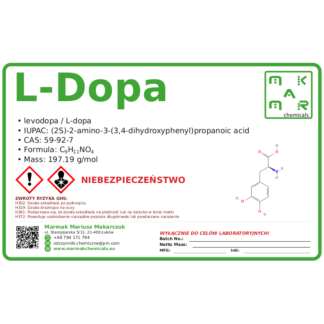
L-DOPA, znana również jako L-3,4,5-tetrahydrobiopterin, jest aminokwasem niebiałkowym z grupy aromatycznych. To powszechnie stosowany prekursor w syntezie neuroprzekaźników, takich jak dopamina, adrenalina czy noradrenalina. Jej wzór sumaryczny to C9H11NO4, a masa molowa wynosi 165,19 g/mol.
Zastosowanie
Neuroprzekaźniki: L-DOPA jest wykorzystywana w syntezie neuroprzekaźników, takich jak dopamina, adrenalina i noradrenalina. W medycynie stosowana jest jako lek w terapii choroby Parkinsona, gdyż jej przekształcenie w dopaminę łagodzi objawy tego schorzenia.
Barwniki: L-DOPA służy również jako substrat do produkcji barwników syntetycznych, takich jak indygo i fiolet metylowy. Jej zastosowanie w tej dziedzinie datuje się na lata 30. ubiegłego wieku.
Bezpieczeństwo
Ogólne wskazówki BHP: L-DOPA jest substancją chemiczną, która powinna być stosowana z ostrożnością. Należy przestrzegać środków bezpieczeństwa, takich jak korzystanie z odpowiedniej odzieży ochronnej i przestrzeganie procedur obowiązujących w laboratorium lub zakładzie produkcyjnym. W przypadku połknięcia, L-DOPA może wywołać mdłości, wymioty i biegunkę.
Przechowywanie
Temperatura: L-DOPA powinna być przechowywana w temperaturze pokojowej (15-25°C). Unikaj ekspozycji na bezpośrednie światło słoneczne i ultrafioletowe, gdyż może to przyspieszać degradację substancji.
Wilgotność: Przechowuj L-DOPA w suchym miejscu, o wilgotności względnej poniżej 60%. Wilgoć może przyspieszać utlenianie substancji i zmniejszać jej stabilność.
Stabilność chemiczna: L-DOPA jest wrażliwa na pewne czynniki chemiczne, takie jak ogrzewanie czy utlenianie. W celu zachowania
Gradient based on PubChem XLogP3 + LSS (Snyder et al. 2010, ch. 9).
Column: C18
Buffer: phosphate
Flow: 1 mL/min
logP:
-2.7(PubChem XLogP3)
Ramp: 5% → 95% B, 10 min
Total analysis time: 23 min
t (min)
%A
%B
flow (mL/min)
Comment
0
95
5
1
start (equilibrium)
2
95
5
1
end of initial hold
12
5
95
1
end of LSS ramp
17
5
95
1
column wash
18
95
5
1
return to init
23
95
5
1
re-equilibration
📚 Scientific references (Chicago Author-Date)
Snyder, Lloyd R., John W. Dolan, and Joseph J. Kirkland. 2010. Introduction to Modern Liquid Chromatography. Wiley. — Chapter 9 — gradient elution, LSS theory (cited as Snyder et al. 2010 in tool description).
Schoenmakers, Peter J. 1986. Optimization of Chromatographic Selectivity: A Guide to Method Development. Elsevier. — Numerical optimization of gradient programs.
Snyder, L. R., and J. W. Dolan. 2007. High-Performance Gradient Elution: The Practical Application of the Linear-Solvent-Strength Model. Wiley. — Foundational LSS reference for the %B_init = 5 + 8·logP heuristic implemented here.
Nikitas, Pavlos, and Adrian Pappa-Louisi. 2009. "Retention models for isocratic and gradient elution in reversed-phase liquid chromatography." Journal of Chromatography A 1216: 1737-1755. [DOI ↗] — Modern review of gradient retention models — basis for non-LSS extensions.
Carr, Peter W.. 2009. "The new physical chemistry of HPLC." Journal of Chromatography A 1216: 1764-1772. [DOI ↗]
Dong, Michael W. 2019. HPLC and UHPLC for Practicing Scientists. Wiley. https://doi.org/10.1002/9781119313793. — Modern UHPLC gradient programming, sub-2 µm scaling rules.
Wu, Naijun, and Anton M. Clausen. 2007. "Fundamental and practical aspects of ultrahigh pressure liquid chromatography for fast separations." Journal of Separation Science 30: 1167-1182. [DOI ↗]
Stoll, Dwight R., and Peter W. Carr. 2017. "Two-Dimensional Liquid Chromatography: A State of the Art Tutorial." Analytical Chemistry 89: 519-531. [DOI ↗] — Reference for orthogonal gradient design (2D-LC second dimension).
Dolan, John W.. 2013. "When to Modify Method Conditions." LCGC North America 31: 192-199.
Meyer, Veronika R. 2010. Practical High-Performance Liquid Chromatography. Wiley. — Chapter 7 — practical gradient design with isokratyczny scouting.
Stoll, Dwight R., and Peter W. Carr. 2017. "Two-Dimensional Liquid Chromatography: A State of the Art Tutorial." Analytical Chemistry 89: 519-531. [DOI ↗]
Carr, Peter W.. 2009. "The new physical chemistry of HPLC." Journal of Chromatography A 1216: 1764-1772. [DOI ↗]
Wu, Naijun, and Anton M. Clausen. 2007. "Fundamental and practical aspects of ultrahigh pressure liquid chromatography for fast separations." Journal of Separation Science 30: 1167-1182. [DOI ↗]
Engelhardt, Heinz. 2014. 100 Years of Chromatography. Wiley-VCH.
Vivó-Truyols, Gabriel, and Hans-Gerd Janssen. 2010. "Probabilistic approach to peak deconvolution in chromatography." Analytical Chemistry 82: 8525-8531. [DOI ↗]
Calculate the USP tailing factor (Tf) and asymmetry (As) from the peak half-widths. Enter a (left half-width) and b (right half-width) measured at 5% or 10% of peak height.
📚 References (Chicago Author-Date)
USP General Chapter <621>. 2024. "Chromatography." United States Pharmacopeial Convention. [link ↗] — Defines USP Tailing Factor T = (a+b)/(2a) measured at 5% peak height.
International Council for Harmonisation (ICH). 2023. "Validation of Analytical Procedures Q2(R2)." ICH Expert Working Group. [link ↗] — Tailing factor is a system suitability parameter (Section 6).
Foley, Joe P., and John G. Dorsey. 1983. "Equations for calculation of chromatographic figures of merit for ideal and skewed peaks." Analytical Chemistry 55: 730-737 https://doi.org/10.1021/ac00255a033 [link ↗] — Original asymmetry factor As = b/a at 10% height (Foley & Dorsey 1983).
Snyder, Lloyd R., Joseph J. Kirkland, and John W. Dolan. 2010. "Introduction to Modern Liquid Chromatography." Wiley. https://doi.org/10.1002/9780470508183 [link ↗] — Chapter 2.4 — peak shape diagnostics and remedies.
Dolan, John W.. 2003. "Peak tailing and resolution." LCGC North America 21: 610-614 [link ↗] — How tailing factor degrades effective resolution.
Vivó-Truyols, Gabriel, and Hans-Gerd Janssen. 2010. "Probabilistic approach to peak deconvolution in chromatography." Analytical Chemistry 82: 8525-8531 https://doi.org/10.1021/ac101742z [link ↗] — Modern numerical deconvolution for asymmetric peaks.
Kromidas, Stavros. 2017. "HPLC Made to Measure: A Practical Handbook for Optimization." Wiley-VCH. — Practical Tf and As thresholds for routine QC.
Dong, Michael W.. 2019. "HPLC and UHPLC for Practicing Scientists." Wiley. https://doi.org/10.1002/9781119313793 [link ↗]
Heyden, Yvan Vander, et al.. 2009. "Robustness of pharmaceutical liquid chromatographic methods." Journal of Chromatography B 877: 2120-2129 https://doi.org/10.1016/j.jchromb.2008.10.052 [link ↗]
Stoll, Dwight R., and Peter W. Carr. 2017. "Two-Dimensional Liquid Chromatography: A State of the Art Tutorial." Analytical Chemistry 89: 519-531 https://doi.org/10.1021/acs.analchem.6b03506 [link ↗]
Carr, Peter W.. 2009. "The new physical chemistry of HPLC." Journal of Chromatography A 1216: 1764-1772 https://doi.org/10.1016/j.chroma.2008.11.094 [link ↗]
Wu, Naijun, and Anton M. Clausen. 2007. "Fundamental and practical aspects of ultrahigh pressure liquid chromatography for fast separations." Journal of Separation Science 30: 1167-1182 https://doi.org/10.1002/jssc.200700026 [link ↗]
Engelhardt, Heinz. 2014. "100 Years of Chromatography." Wiley-VCH.
Vivó-Truyols, Gabriel, and Hans-Gerd Janssen. 2010. "Probabilistic approach to peak deconvolution in chromatography." Analytical Chemistry 82: 8525-8531 https://doi.org/10.1021/ac101742z [link ↗]
📊 Resolution and plate count calculator (Rs, N, H)FEATURE K
Calculate the resolution Rs, the number of theoretical plates N and HETP (H) for a pair of HPLC peaks. Enter the retention times, peak widths (at 50% or at the base) and the column length.
📚 References (Chicago Author-Date)
Snyder, Lloyd R., Joseph J. Kirkland, and John W. Dolan. 2010. "Introduction to Modern Liquid Chromatography." 3rd ed. John Wiley & Sons. ISBN 978-0-470-16754-0. https://doi.org/10.1002/9780470508183 [link ↗] — Chapter 2 covers resolution, plate count and HETP fundamentals (Snyder et al. 2010).
USP General Chapter <621>. 2024. "Chromatography." USP-NF 2024 ed. United States Pharmacopeial Convention. [link ↗] — Defines Rs >= 1.5 acceptance criterion and N calculation methods.
Dolan, John W.. 2003. "How much resolution is enough?." LCGC North America 21: 350-353 [link ↗] — Practical guidance on Rs targets for routine method development.
Van Deemter, J. J., F. J. Zuiderweg, and A. Klinkenberg. 1956. "Longitudinal diffusion and resistance to mass transfer as causes of nonideality in chromatography." Chemical Engineering Science 5: 271-289 https://doi.org/10.1016/0009-2509(56)80003-1 [link ↗] — Origin of N = 5.54·(tr/w0.5)² half-height plate count formulation.
Giddings, J. Calvin. 1965. "Dynamics of Chromatography, Part I: Principles and Theory." Marcel Dekker. ISBN 978-0-8247-1357-7. — Resolution equation Rs = (1/4)·√N·(α-1)/α·k/(1+k) (master equation).
Foley, Joe P., and John G. Dorsey. 1983. "Equations for calculation of chromatographic figures of merit for ideal and skewed peaks." Analytical Chemistry 55: 730-737 https://doi.org/10.1021/ac00255a033 [link ↗] — Skewed-peak corrections to apparent N.
Knox, John H.. 1977. "Practical aspects of LC theory." Journal of Chromatographic Science 15: 352-364 https://doi.org/10.1093/chromsci/15.9.352 [link ↗]
Carr, Peter W.. 2009. "The new physical chemistry of HPLC." Journal of Chromatography A 1216: 1764-1772 https://doi.org/10.1016/j.chroma.2008.11.094 [link ↗]
Dong, Michael W.. 2019. "HPLC and UHPLC for Practicing Scientists." 2nd ed. Wiley. ISBN 978-1-119-31378-3. https://doi.org/10.1002/9781119313793 [link ↗]
Stoll, Dwight R., and Peter W. Carr. 2017. "Two-Dimensional Liquid Chromatography: A State of the Art Tutorial." Analytical Chemistry 89: 519-531 https://doi.org/10.1021/acs.analchem.6b03506 [link ↗]
Carr, Peter W.. 2009. "The new physical chemistry of HPLC." Journal of Chromatography A 1216: 1764-1772 https://doi.org/10.1016/j.chroma.2008.11.094 [link ↗]
Wu, Naijun, and Anton M. Clausen. 2007. "Fundamental and practical aspects of ultrahigh pressure liquid chromatography for fast separations." Journal of Separation Science 30: 1167-1182 https://doi.org/10.1002/jssc.200700026 [link ↗]
Engelhardt, Heinz. 2014. "100 Years of Chromatography." 2nd ed. Wiley-VCH. ISBN 978-3-527-33473-5.
Vivó-Truyols, Gabriel, and Hans-Gerd Janssen. 2010. "Probabilistic approach to peak deconvolution in chromatography." Analytical Chemistry 82: 8525-8531 https://doi.org/10.1021/ac101742z [link ↗]
zł24.98Select options
This product has multiple variants. The options may be chosen on the product page
🧪 System Suitability — live calculator (USP <621>)FEATURE L
Enter data from 5–6 injections (areas, tR, tailing, plates) — the calculator computes %RSD and means and checks compliance with USP <621>. You can paste CSV (comma-separated) or edit individual values.
📚 References (Chicago Author-Date)
USP General Chapter <621>. 2024. "Chromatography (System Suitability section)." USP-NF 2024 ed. United States Pharmacopeial Convention. [link ↗] — Defines RSD area < 2%, tailing < 2.0, N > 2000 acceptance criteria.
International Council for Harmonisation (ICH). 2023. "Validation of Analytical Procedures Q2(R2)." ICH Expert Working Group. [link ↗] — Section 5.4 — system suitability is part of method validation.
US Food and Drug Administration (FDA). 2018. "Reviewer Guidance: Validation of Chromatographic Methods." US Food and Drug Administration. [link ↗] — CDER reviewer perspective on chromatographic validation expectations.
Snyder, Lloyd R., Joseph J. Kirkland, and John W. Dolan. 2010. "Introduction to Modern Liquid Chromatography." 3rd ed. Wiley. — Chapter 2 — system suitability fundamentals (RSD, Tf, N).
Heyden, Yvan Vander, et al.. 2009. "Robustness of pharmaceutical liquid chromatographic methods." — Robustness vs. system suitability — design-of-experiments framework.
Rozet, Eric, et al.. 2013. "Analysis of recent pharmaceutical regulatory documents on analytical method validation."
European Medicines Agency (EMA). 2011. "Guideline on bioanalytical method validation EMEA/CHMP/EWP/192217/2009." EMA. [link ↗] — EMA companion guideline with bioanalytical SS criteria.
Dong, Michael W.. 2019. "HPLC and UHPLC for Practicing Scientists." 2nd ed. Wiley. — UHPLC-specific suitability adjustments (n=5 vs. n=6).
Kazakevich, Yuri V., and Rosario LoBrutto, eds.. 2007. "HPLC for Pharmaceutical Scientists." Wiley-Interscience.
AOAC International. 2016. "Appendix F: Guidelines for Standard Method Performance Requirements." AOAC INTERNATIONAL. [link ↗] — Alternative SS thresholds for food/dietary samples.
Stoll, Dwight R., and Peter W. Carr. 2017. "Two-Dimensional Liquid Chromatography: A State of the Art Tutorial."
Carr, Peter W.. 2009. "The new physical chemistry of HPLC."
Wu, Naijun, and Anton M. Clausen. 2007. "Fundamental and practical aspects of ultrahigh pressure liquid chromatography for fast separations."
Engelhardt, Heinz. 2014. "100 Years of Chromatography." 2nd ed. Wiley-VCH.
Vivó-Truyols, Gabriel, and Hans-Gerd Janssen. 2010. "Probabilistic approach to peak deconvolution in chromatography."
📤 Embed this molecule on your site
MolGod_EMBED_1
Have a blog, forum or scientific service? Embed the interactive 3D molecule on your website — every reader will see it, with a link below to our shop where they can buy the reagent.
🔗 HTML iframe code (easiest — works everywhere)
Copy and paste into your site's HTML editor:
Dostosuj width i height do swojego layoutu.
⚙ WordPress Shortcode (for other shops with MOL-GOD)
🌐 Direct link (for emails, chats, LinkedIn, Twitter)
When you share the link, Facebook/LinkedIn/Discord will automatically fetch the image preview:
📋 License: The embed keeps a backlink to Marmak Chemicals (required — the shop is the data source). Chemical data comes from PubChem (CC0 — public domain). The embed is FREE for educational, commercial and hobby use.
📚 REFERENCES (Aggregate bibliography, Chicago Author-Date) 104 items
MolGod_REFS_1
All scientific sources cited in the accordions above for CAS 59-92-7. Format: Chicago Manual of Style 17th ed., Author-Date system.
AIST. 2026. Spectral Database for Organic Compounds (SDBS): CAS 59-92-7. Tsukuba, Japan: National Institute of Advanced Industrial Science and Technology. https://sdbs.db.aist.go.jp/. (Accessed 2026-08-01.)
PubChem. 2026. PubChem Compound Summary: CAS 59-92-7. Bethesda, MD: National Center for Biotechnology Information (NCBI), National Library of Medicine. https://pubchem.ncbi.nlm.nih.gov/#query=59-92-7. (Accessed 2026-08-01.)
European Chemicals Agency (ECHA). 2024. "Annex VI to Regulation (EC) No 1272/2008 (CLP) — Harmonised Classification and Labelling." ECHA, Helsinki / Official Journal of the European Union. https://echa.europa.eu/regulations/clp/clp-classification.
National Institute for Occupational Safety and Health (NIOSH). 2017. "Recommendations for Chemical Protective Clothing: A Companion to the NIOSH Pocket Guide." U.S. Department of Health & Human Services / CDC. https://www.cdc.gov/niosh/ncpc/default.html.
Connors, Kenneth A., Gordon L. Amidon, and Valentino J. Stella. 1986. Chemical Stability of Pharmaceuticals: A Handbook for Pharmacists, 2nd ed.. New York: Wiley. https://doi.org/10.1002/0471734683.
Rumble, John R., ed. 2019. CRC Handbook of Chemistry and Physics: 100th Edition. Boca Raton, FL: CRC Press. https://hbcp.chemnetbase.com/.
IARC. 2026. IARC Monographs on the Identification of Carcinogenic Hazards to Humans: CAS 59-92-7. Lyon, France: International Agency for Research on Cancer, World Health Organization. (Accessed 2026-08-01.)
📄 Scientific articles (peer-reviewed)
Stefanis, Emmanuel, and Costas Panayiotou. 2008. "Prediction of Hansen Solubility Parameters with a New Group-Contribution Method." International Journal of Thermophysics 29: 568-585. https://doi.org/10.1007/s10765-008-0415-z.
Stoll, Vincent S., and John S. Blanchard. 1990. "Buffers: Principles and Practice: In Methods in Enzymology, vol. 182." San Diego: Academic Press. https://doi.org/10.1016/0076-6879(90)82008-P.
European Parliament. 2008. "Regulation (EC) No 1272/2008 on Classification, Labelling and Packaging of Substances and Mixtures (CLP)." Official Journal of the European Union L 353: 1–1355.
United Nations. 2021. Globally Harmonized System of Classification and Labelling of Chemicals (GHS). 9th revised ed. ST/SG/AC.10/30/Rev.9. New York and Geneva: United Nations. https://unece.org/ghs-rev9-2021.
Snyder, Lloyd R., John W. Dolan, and Joseph J. Kirkland. 2010. Introduction to Modern Liquid Chromatography. Wiley.
Schoenmakers, Peter J.. 1986. Optimization of Chromatographic Selectivity: A Guide to Method Development. Elsevier.
Snyder, L. R., and J. W. Dolan. 2007. High-Performance Gradient Elution: The Practical Application of the Linear-Solvent-Strength Model. Wiley.
Nikitas, Pavlos, and Adrian Pappa-Louisi. 2009. "Retention models for isocratic and gradient elution in reversed-phase liquid chromatography." Journal of Chromatography A 1216: 1737-1755. https://doi.org/10.1016/j.chroma.2008.10.005.
Wu, Naijun, and Anton M. Clausen. 2007. "Fundamental and practical aspects of ultrahigh pressure liquid chromatography for fast separations." Journal of Separation Science 30: 1167-1182. https://doi.org/10.1002/jssc.200700026.
Engelhardt, Heinz. 2014. 100 Years of Chromatography. Wiley-VCH.
Vivó-Truyols, Gabriel, and Hans-Gerd Janssen. 2010. "Probabilistic approach to peak deconvolution in chromatography." Analytical Chemistry 82: 8525-8531. https://doi.org/10.1021/ac101742z.
Van Deemter, J. J., F. J. Zuiderweg, and A. Klinkenberg. 1956. "Longitudinal diffusion and resistance to mass transfer as causes of nonideality in chromatography." https://doi.org/10.1016/0009-2509(56)80003-1.
Giddings, J. Calvin. 1965. "Dynamics of Chromatography, Part I: Principles and Theory." Marcel Dekker.
Wu, Naijun, and Anton M. Clausen. 2007. "Fundamental and practical aspects of ultrahigh pressure liquid chromatography for fast separations." https://doi.org/10.1002/jssc.200700026.
Snyder, L. R., J. J. Kirkland, and J. L. Glajch. 1997. "Practical HPLC Method Development." Wiley.
Vivó-Truyols, Gabriel, and Hans-Gerd Janssen. 2010. "Probabilistic approach to peak deconvolution in chromatography." https://doi.org/10.1021/ac101742z.
Sadek, Paul C.. 2002. "The HPLC Solvent Guide." Wiley-Interscience.
Foley, Joe P., and John G. Dorsey. 1983. "Equations for calculation of chromatographic figures of merit for ideal and skewed peaks." https://doi.org/10.1021/ac00255a033.
Snyder, Lloyd R., Joseph J. Kirkland, and John W. Dolan. 2010. "Introduction to Modern Liquid Chromatography." Wiley. https://doi.org/10.1002/9780470508183.
United States Pharmacopeial Convention. 2024. "USP <621> Chromatography." In United States Pharmacopeia and National Formulary, USP 47-NF 42. Rockville, MD: USP. https://www.uspnf.com/.
International Organization for Standardization. 2017. "ISO/IEC 17025:2017 General Requirements for the Competence of Testing and Calibration Laboratories." Geneva: ISO. https://www.iso.org/standard/66912.html.
Kolthoff, Izaak Maurits, and Philip J. Elving, eds. 1978. Treatise on Analytical Chemistry, Part I: Theory and Practice. 2nd ed. New York: Wiley-Interscience.
Skoog, Douglas A., F. James Holler, and Stanley R. Crouch. 2018. Principles of Instrumental Analysis. 7th ed. Boston: Cengage Learning.
Christian, Gary D., Purnendu K. Dasgupta, and Kevin A. Schug. 2014. Analytical Chemistry. 7th ed. Hoboken, NJ: Wiley.
Snyder, Lloyd R., Joseph J. Kirkland, and John W. Dolan. 2010. "Introduction to Modern Liquid Chromatography." John Wiley & Sons. https://doi.org/10.1002/9780470508183.
U.S. FDA. 2026. "FDA Guidance and Resources: CAS 59-92-7." Silver Spring, MD: U.S. Food and Drug Administration. https://www.fda.gov/media/74954/download. (Accessed 2026-08-01.)
International Organization for Standardization. 1994. "ISO 5725-2:1994 Accuracy (Trueness and Precision) of Measurement Methods and Results — Part 2: Basic Method for the Determination of Repeatability and Reproducibility of a Standard Measurement Method." Geneva: ISO. https://www.iso.org/standard/11834.html.
Grubbs, Frank E. 1950. "Sample Criteria for Testing Outlying Observations." Annals of Mathematical Statistics 21 (1): 27–58.
Dixon, Wilfrid J. 1950. "Analysis of Extreme Values." Annals of Mathematical Statistics 21 (4): 488–506.
Snedecor, George W., and William G. Cochran. 1989. Statistical Methods. 8th ed. Ames, IA: Iowa State University Press.
Student [William Sealy Gosset]. 1908. "The Probable Error of a Mean." Biometrika 6 (1): 1–25.
International Organization for Standardization. 2005. "ISO 3534-1:2006 Statistics — Vocabulary and Symbols — Part 1: General Statistical Terms and Terms Used in Probability." Geneva: ISO. https://www.iso.org/standard/40145.html.
Thompson, Michael, Stephen L. R. Ellison, and Roger Wood. 2002. "Harmonized Guidelines for Single-Laboratory Validation of Methods of Analysis." Pure and Applied Chemistry 74 (5): 835–855.
Ministerstwo Klimatu i Srodowiska. 2026. "Baza Danych o Odpadach (BDO): CAS 59-92-7." Warszawa: Ministerstwo Klimatu i Srodowiska. https://bdo.mos.gov.pl/. (Accessed 2026-08-01.)
Pohanish, Richard P.. 2017. "Sittig's Handbook of Toxic and Hazardous Chemicals and Carcinogens." Elsevier.
Lewis, Richard J.. 2012. "Sax's Dangerous Properties of Industrial Materials." Wiley.
NIOSH. 2024. "Pocket Guide to Chemical Hazards." U.S. Department of Health and Human Services. https://www.cdc.gov/niosh/npg/.
U.S. OSHA. 2026. "Occupational Safety and Health Guidance: CAS 59-92-7." Washington, DC: U.S. Occupational Safety and Health Administration. https://www.osha.gov/chemicaldata. (Accessed 2026-08-01.)
IPCS INCHEM. 2024. "International Programme on Chemical Safety — Waste Management Guidelines." WHO/UNEP/ILO. https://www.inchem.org/.
International Organization for Standardization. 2017. "ISO/IEC 17025:2017 General requirements for the competence of testing and calibration laboratories." ISO. https://www.iso.org/standard/66912.html.
World Health Organization. 2010. "WHO Good Manufacturing Practices for Pharmaceutical Products: Main Principles (WHO Technical Report Series No. 957, Annex 3)." WHO Press. https://www.who.int/publications/m/item/trs957-annex3.
Pharmaceutical Inspection Co-operation Scheme (PIC/S). 2021. "Guide to Good Manufacturing Practice for Medicinal Products PE 009-15." PIC/S Secretariat, Geneva. https://picscheme.org/en/publications.


Reviews
There are no reviews yet.