Datenquellen:
PubChem, NIST Chemistry WebBook, CRC Handbook of Chemistry and Physics (103rd ed.)
Zuletzt aktualisiert: 2026-06-25
Regulatorischer Status der Substanz
Diese Substanz unterliegt regulatorischen Anforderungen: Bewirtschaftung gefährlicher Abfälle (BDO-Register). Details im Abschnitt "Regulatorischer Status (REACH/ECHA/CLP)" und im SDS. Regulatorische Information — schränkt den Kauf in diesem Shop nicht ein.
📚 Bibliografia książkowa oczekuje na wygenerowanie. Kuratowane podręczniki ogólne są dostępne poniżej; specyficzne dla CAS książki Google Books można pobrać z panelu administratora.
National Institute of Standards and Technology. 2024. "NIST Chemistry WebBook, SRD 69." Gaithersburg, MD: NIST. Accessed 2025-01-01. ↗
Spectral Database for Organic Structure Determination (SDBS). 2024. National Institute of Advanced Industrial Science and Technology (AIST), Japan. Accessed 2025-01-01. ↗
Ulrich, Eldon L., Hideo Akutsu, John F. Doreleijers, Yoko Harano, Yannis E. Ioannidis, Jundong Lin, Miron Livny, et al. 2008. "BioMagResBank." Nucleic Acids Research 36 (D1): D402–D408. [DOI ↗]
Horai, Hisayuki, Masanori Arita, Shigehiko Kanaya, Yoshito Nihei, Tasuku Ikeda, Kazuhiro Suwa, Yuya Ojima, et al. 2010. "MassBank: A Public Repository for Sharing Mass Spectral Data for Life Sciences." Journal of Mass Spectrometry 45 (7): 703–714. [DOI ↗]
Linstrom, P.J., and W.G. Mallard, eds. 2024. NIST Chemistry WebBook, NIST Standard Reference Database Number 69. Gaithersburg, MD: National Institute of Standards and Technology. ↗
McDonald, M. Shane, Mike McAvoy, and Ajit Bhalerao. 1988. "JCAMP-DX: A Standard Form for Exchange of Infrared Spectra in Computer Readable Form." Applied Spectroscopy 42 (1): 151–162. [DOI ↗]
PubChem. 2024. "PubChem Compound Database." National Library of Medicine, National Institutes of Health. Accessed 2025-01-01. ↗
Spektren werden bei Bedarf aus 9 Quellen abgerufen. Jedes Spektrum wird in unserer Datenbank gespeichert — beim nächsten Öffnen erfolgt keine Anfrage an die externe API. Laden Sie JCAMP-DX / CSV / PNG zu jedem Spektrum herunter, ohne zu suchen.
Daten werden über MolGod_Spectra_Remote_Fetcher (JCAMP-DX-Parser) abgerufen und in der Tabelle wp_molgod_spectra_cache gespeichert. Keine doppelten Downloads, keine erneuten Anfragen an NIST bei späteren Aufrufen. Lizenzen werden eingehalten (veröffentlicht wird nur ein Deep-Link plus eigene Visualisierung).
Daten werden live aus mehreren Quellen abgerufen (Priority-Chain). JCAMP-DX / CSV / PNG stehen unter jedem Spektrum zum Download bereit.
IR — Fourier-Transform-Infrarot
IR — Fourier-Transform-Infrarot wird geladen…
MS — Massenspektrometrie (EI 70eV)
MS — Massenspektrometrie (EI 70eV) wird geladen…
MolGod_DFT_SP5
🧮 Vergleich DFT vs. Experiment (IR)
Überlagerung des experimentellen IR-Spektrums mit dem theoretisch berechneten Spektrum nach der B3LYP/6-31G*-Methode (Skalierungsfaktor 0.9614, Scott & Radom 1996).
Becke, Axel D. 1993. "Density-Functional Thermochemistry. III. The Role of Exact Exchange." Journal of Chemical Physics 98 (7): 5648–5652. Definition des B3LYP-Funktionals.
Scott, Anthony P., and Leo Radom. 1996. "Harmonic Vibrational Frequencies: An Evaluation of Hartree–Fock, Møller–Plesset, Quadratic Configuration Interaction, Density Functional Theory, and Semiempirical Scale Factors." Journal of Physical Chemistry 100 (41): 16502–16513. Skalierungsfaktoren für DFT (z. B. 0.9614 für B3LYP/6-31G*).
Merrick, Jeffrey P., Damian Moran, and Leo Radom. 2007. "An Evaluation of Harmonic Vibrational Frequency Scale Factors." Journal of Physical Chemistry A 111 (45): 11683–11700. Aktualisierung von Scott & Radom — Skalierungsfaktoren für neuere DFT-Funktionale.
Lee, Chengteh, Weitao Yang, and Robert G. Parr. 1988. "Development of the Colle-Salvetti Correlation-Energy Formula into a Functional of the Electron Density." Physical Review B 37 (2): 785–789. LYP-Korrelation — Ergänzung zu Becke 1993 für B3LYP.
Hehre, Warren J., Robert Ditchfield, and John A. Pople. 1972. "Self-Consistent Molecular Orbital Methods. XII. Further Extensions of Gaussian-Type Basis Sets." Journal of Chemical Physics 56 (5): 2257–2261. Definition des 6-31G*-Basissatzes (Split-Valence + Polarisation).
Johnson, Russell D., III, ed. 2022. "NIST Computational Chemistry Comparison and Benchmark Database (CCCBDB)." NIST Standard Reference Database 101, Release 22. https://cccbdb.nist.gov. Benchmark für theoretische Werte — Ausweichlink im Widget.
Cramer, Christopher J. 2004. "Essentials of Computational Chemistry: Theories and Models." 2nd ed. Chichester: Wiley. Lehrbuch zu DFT-Methoden und der Berechnung von Schwingungsfrequenzen.
Jensen, Frank. 2017. "Introduction to Computational Chemistry." 3rd ed. Chichester: Wiley. Moderne Computerchemie — Basissätze und Methoden für Schwingungsspektren.
Foresman, James B., and Æleen Frisch. 2015. "Exploring Chemistry with Electronic Structure Methods." 3rd ed. Wallingford, CT: Gaussian, Inc. Praktischer Gaussian-Leitfaden — IR + Raman + NMR mittels DFT.
MolGod_SPECGUIDE_SP6
🎓 Leitfaden zur Spektreninterpretation (für Studierende)
Automatisch generierte Erläuterungen zu jeder Bande im Spektrum — warum sie dort auftritt, wo sie auftritt, und was sie über die Struktur aussagt.
IR (infrared) (440 Peaks)
Das IR (infrared)-Spektrum enthält 440 identifizierte Banden. Die nachstehende Analyse erläutert, was jede davon strukturell bedeutet und warum sie im jeweiligen Bereich auftritt.
C=O stretch (carboxylic acid)COOH● high
Die Bande "C=O stretch (carboxylic acid)" tritt in folgenden Fällen auf: 1,722.0 cm⁻¹ (stark (s)), 2,506.0 cm⁻¹ (stark (s)), 2,514.0 cm⁻¹ (stark (s)). Eine sehr breite O–H-Bande (~2500–3300) zusammen mit C=O (~1710) ist die klassische Signatur einer Carbonsäure (Dimer).
O–H stretch (H-bonded, alcohol/acid)OH● high
Die Bande "O–H stretch (H-bonded, alcohol/acid)" tritt in folgenden Fällen auf: 3,202.0 cm⁻¹ (stark (s)), 3,210.0 cm⁻¹ (stark (s)), 3,218.0 cm⁻¹ (stark (s)). Weist auf das Vorhandensein von O–H-Bindungen hin (Alkohol/Säure/Wasser). Die breite Bande resultiert aus der Bildung von Wasserstoffbrücken im flüssigen/festen Zustand.
C–H bend (CH3, CH2 — methyl/methylene)CH3/CH2● high
Die Bande "C–H bend (CH3, CH2 — methyl/methylene)" tritt in folgenden Fällen auf: 1,434.0 cm⁻¹ (stark (s)), 1,442.0 cm⁻¹ (stark (s)), 1,450.0 cm⁻¹ (stark (s)). Dies ist die Streckschwingung aliphatischer sp³-C–H-Bindungen. Praktisch in jeder organischen Verbindung mit Alkylkette vorhanden.
C–H stretch (=C–H, aromatic/vinyl)CH_arom● high
Die Bande "C–H stretch (=C–H, aromatic/vinyl)" tritt in folgenden Fällen auf: 3,034.0 cm⁻¹ (stark (s)), 3,042.0 cm⁻¹ (stark (s)), 3,050.0 cm⁻¹ (stark (s)). Aromatische (sp²) C–H — stets oberhalb 3000 cm⁻¹, im Unterschied zu Alkyl-C–H.
C=O stretch (amide I)CONH2● high
Die Bande "C=O stretch (amide I)" tritt in folgenden Fällen auf: 1,634.0 cm⁻¹ (stark (s)), 1,642.0 cm⁻¹ (stark (s)), 1,650.0 cm⁻¹ (stark (s)). Amid I (C=O) und Amid II (N–H-Deformation) ergeben zusammen ein charakteristisches Duo um 1660 + 1550 cm⁻¹.
C≡N stretch (nitrile)CN● high
Die Bande "C≡N stretch (nitrile)" tritt in folgenden Fällen auf: 2,210.0 cm⁻¹ (stark (s)), 2,218.0 cm⁻¹ (stark (s)), 2,226.0 cm⁻¹ (stark (s)). Die C≡N-Bande des Nitrils ergibt eine schmale, scharfe Bande bei ~2250 cm⁻¹ — leicht von C≡C zu unterscheiden, die schwächer und mitunter abwesend ist (Symmetrie).
📚 Bibliografie (Chicago)
Field, Leslie D., Sev Sternhell, and John R. Kalman. 2013. "Organic Structures from Spectra." 5th ed. Chichester: Wiley. Ein studentisches Übungsbuch (Begleiter zum Interpretationsleitfaden).
Williams, Dudley H., and Ian Fleming. 2008. "Spectroscopic Methods in Organic Chemistry." 6th ed. London: McGraw-Hill. Ein Klassiker der narrativen Spektreninterpretation — erklärt, "warum der Peak hier liegt".
Crews, Phillip, Jaime Rodríguez, and Marcel Jaspars. 2009. "Organic Structure Analysis." 2nd ed. New York: Oxford University Press. Ein Workflow für die mehrparametrige strukturelle Interpretation.
McLafferty, Fred W., and František Tureček. 1993. "Interpretation of Mass Spectra." 4th ed. Mill Valley, CA: University Science Books. MS-Fragmentierungsmechanismen — McLafferty-Umlagerung, m/z 29 = CHO.
Reusch, William. 2013. "Virtual Textbook of Organic Chemistry: Spectroscopy." East Lansing, MI: Michigan State University. https://www2.chemistry.msu.edu/faculty/reusch/VirtTxtJml/Spectrpy/spectro.htm. Ein offener didaktischer Leitfaden zu IR/NMR/MS/UV — ideal zur Erläuterung funktioneller Gruppen.
Hesse, Manfred, Herbert Meier, and Bernd Zeeh. 2007. "Spektroskopische Methoden in der organischen Chemie." 8th ed. Stuttgart: Thieme. Das deutsche Standardlehrbuch zur Spektreninterpretation.
Lampman, Gary M., Donald L. Pavia, George S. Kriz, and James R. Vyvyan. 2010. "Spectroscopy." 4th ed. Belmont, CA: Cengage Learning. Ein Arbeitsbuch mit integrierten interpretativen Erläuterungen.
Kalsi, P. S. 2010. "Spectroscopy of Organic Compounds." 6th ed. New Delhi: New Age International. Ein vollständiges Lehrbuch zur Interpretation von IR/NMR/MS/UV-Spektren.
MolGod_MS_SP7
🔎 Spektrensuche (JCAMP-DX)
Laden Sie eine JCAMP-DX-Datei (.jdx, .dx, .jcm) hoch — das System berechnet die Cosine-Ähnlichkeit zu allen Spektren in der Datenbank und zeigt die TOP 10 Treffer an.
📚 Bibliografie (Chicago)
McLafferty, Fred W., ed. 2018. Wiley Registry of Mass Spectral Data. 11th ed. Hoboken, NJ: Wiley. Eine MS-Referenzbibliothek (~775k Spektren).
Stein, Stephen E., and Donald R. Scott. 1994. "Optimization and Testing of Mass Spectral Library Search Algorithms for Compound Identification." Journal of the American Society for Mass Spectrometry 5 (9): 859–866. Der Cosine- und Dot-Product-Algorithmus von NIST MS Search.
McDonald, Robert S., and Paul A. Wilks Jr. 1988. "JCAMP-DX: A Standard Form for Exchange of Infrared Spectra in Computer Readable Form." Applied Spectroscopy 42 (1): 151–162. Die JCAMP-DX-Spezifikation (erweitert auf 5.01 für NMR/MS).
McLafferty, Fred W., and František Tureček. 1993. "Interpretation of Mass Spectra." 4th ed. Mill Valley, CA: University Science Books. Cosine-Similarity-Matching und MS-Fragmentierung — die Grundlage des Suchalgorithmus.
Sumner, Lloyd W., Alexander Amberg, Dave Barrett, Michael H. Beale, Richard Beger, Clare A. Daykin, Teresa W.-M. Fan, et al. 2007. "Proposed Minimum Reporting Standards for Chemical Analysis." Metabolomics 3 (3): 211–221. MSI Level 1-4 — Standards für die Konfidenzstufe des spektralen Matchings.
Stein, Stephen E. 1999. "An Integrated Method for Spectrum Extraction and Compound Identification from Gas Chromatography/Mass Spectrometry Data." Journal of the American Society for Mass Spectrometry 10 (8): 770–781. Der AMDIS-Algorithmus — Dekonvolution + Library-Match (NIST).
Lindon, John C., George E. Tranter, and David W. Koppenaal, eds. 2017. "Encyclopedia of Spectroscopy and Spectrometry." 3rd ed. Amsterdam: Academic Press. Enzyklopädische Einträge zum Thema Spectral Library Searching.
Smith, Brian C. 2011. "Fundamentals of Fourier Transform Infrared Spectroscopy." 2nd ed. Boca Raton, FL: CRC Press. FT-IR und das JCAMP-DX-Format für Transmissionsspektren.
Larkin, Peter. 2017. "Infrared and Raman Spectroscopy: Principles and Spectral Interpretation." 2nd ed. Amsterdam: Elsevier. Grundlagen des IR/Raman-Library-Matchings und der Peak-Vorverarbeitung.
Haynes, William M., ed. 2024. CRC Handbook of Chemistry and Physics. 105th ed. Boca Raton: CRC Press/Taylor & Francis. ISBN 978-1-032-55554-4. ↗
National Institute of Standards and Technology. 2024. "NIST Chemistry WebBook, SRD 69." Gaithersburg, MD: NIST. Accessed 2025-01-01. ↗
Yaws, Carl L. 2014. The Yaws Handbook of Physical Properties for Hydrocarbons and Chemicals. 2nd ed. Oxford: Gulf Professional Publishing.
PubChem. 2024. "PubChem Compound Database." National Library of Medicine, National Institutes of Health. Accessed 2025-01-01. ↗
Marrero, J., and R. Gani. 2001. "Group-Contribution Based Estimation of Pure Component Properties." Fluid Phase Equilibria 183–184: 183–208. ↗
Joback, K. G., and R. C. Reid. 1987. "Estimation of Pure-Component Properties from Group-Contributions." Chemical Engineering Communications 57 (1–6): 233–243. ↗
Sangster, J. 1997. Octanol-Water Partition Coefficients: Fundamentals and Physical Chemistry. Chichester: Wiley. ISBN 978-0-471-97397-3.
Mannhold, Raimund, and Han van de Waterbeemd. 2001. "Substructure and Whole Molecule Approaches for Calculating Log P." Journal of Computer-Aided Molecular Design 15 (4): 337–354. ↗
Perrin, Ditlev D., Boyd Dempsey, and E. P. Serjeant. 1981. pKa Prediction for Organic Acids and Bases. London: Chapman and Hall. ISBN 0-412-21090-5.
Constantinou, Leonidas, and Rafiqul Gani. 1994. "New Group Contribution Method for Estimating Properties of Pure Compounds." AIChE Journal 40 (10): 1697–1710. ↗
Ertl, Peter, Bernhard Rohde, and Paul Selzer. 2000. "Fast Calculation of Molecular Polar Surface Area as a Sum of Fragment-Based Contributions and Its Application to the Prediction of Drug Transport Properties." Journal of Medicinal Chemistry 43 (20): 3714–3717. ↗
🔄 Umrechner für Konzentrationseinheiten LIVEMolGod_UNITCONV_1
/* translators: %s, %d itd. to wartosci dynamiczne wstawiane do komunikatu. */
Geben Sie die Konzentration Kofeina in einer beliebigen Einheit ein — der Rest wird automatisch berechnet.
Cohen ER, Cvitaš T, Frey JG, Holmström B, Kuchitsu K, Marquardt R, Mills I, Pavese F, Quack M, Stohner J, Strauss HL, Takami M, Thor AJ (2007)
g/L ↔ molarity
c (mol/L) = (g/L) / MW
±0.1% (depends on MW precision)
Cohen ER, Cvitaš T, Frey JG, Holmström B, Kuchitsu K, Marquardt R, Mills I, Pavese F, Quack M, Stohner J, Strauss HL, Takami M, Thor AJ (2007)
mmol/L ↔ molarity
c (mol/L) = mmol/L × 10⁻³
Exact
Cohen ER, Cvitaš T, Frey JG, Holmström B, Kuchitsu K, Marquardt R, Mills I, Pavese F, Quack M, Stohner J, Strauss HL, Takami M, Thor AJ (2007)
Celsius ↔ Kelvin
T(K) = t(°C) + 273.15
±0.01 K (ITS-90 scale)
BIPM (Bureau International des Poids et Mesures) (2019)
Celsius ↔ Fahrenheit
T(°F) = T(°C) × 9/5 + 32
±0.1 °F
Thompson A, Taylor BN (2008)
density-corrected % ↔ molarity
c (mol/L) = (%w/w × ρ × 10) / MW, ρ in g/mL
±0.1% when ρ known to 3 decimals
Cohen ER, Cvitaš T, Frey JG, Holmström B, Kuchitsu K, Marquardt R, Mills I, Pavese F, Quack M, Stohner J, Strauss HL, Takami M, Thor AJ (2007)
📚 Bibliographie (8 autoritative Quellen)
Thompson A, Taylor BN (2008). Guide for the Use of the International System of Units (SI). NIST Special Publication 811 · DOI: 10.6028/NIST.SP.811-2008 → Primary SI standard for US scientific usage
Cohen ER, Cvitaš T, Frey JG, Holmström B, Kuchitsu K, Marquardt R, Mills I, Pavese F, Quack M, Stohner J, Strauss HL, Takami M, Thor AJ (2007). Quantities, Units and Symbols in Physical Chemistry — The IUPAC Green Book. RSC Publishing, 3rd ed. · DOI: 10.1039/9781847557889 · ISBN: 978-0-85404-433-7 → Canonical IUPAC guide for chemistry quantities/units
BIPM (Bureau International des Poids et Mesures) (2019). The International System of Units (SI), 9th edition. BIPM · ↗ → International SI definitions (incl. redefined kilogram 2019)
ISO/IEC (2022). Quantities and units — Part 1: General. International Organization for Standardization — ISO 80000-1:2022 · ↗ → General rules for physical quantities and units
ISO/IEC (2019). Quantities and units — Part 9: Physical chemistry and molecular physics. International Organization for Standardization — ISO 80000-9:2019 · ↗ → Concentration / molality / amount-of-substance conventions
Tiesinga E, Mohr PJ, Newell DB, Taylor BN (2021). CODATA recommended values of the fundamental physical constants: 2018. Rev. Mod. Phys. 93(2):025010 · DOI: 10.1103/RevModPhys.93.025010 → Avogadro, gas constant, molar volume (2019 SI revision)
IUPAC (2019). Compendium of Chemical Terminology — the IUPAC Gold Book (online). IUPAC · DOI: 10.1351/goldbook → Definitions of mass fraction, molality, normality, ppm, activity
Mills IM, Cvitaš T, Homann K, Kallay N, Kuchitsu K (1988). Quantities, Units and Symbols in Physical Chemistry. Blackwell Scientific Publications, 1st ed. · ISBN: 0-632-01773-5 → Historical predecessor of IUPAC Green Book
🧪 Assistent zur Lösungsvorbereitung WIZARDMolGod_PREP_1
Rumble, John R., ed. 2023. CRC Handbook of Chemistry and Physics. 104th ed. Boca Raton, FL: CRC Press. [link ↗]
International Association for the Properties of Water and Steam (IAPWS). 1997. "Release on the Static Dielectric Constant of Ordinary Water Substance." IAPWS R8-97. [link ↗]
Reichardt, Christian, and Thomas Welton. 2011. Solvents and Solvent Effects in Organic Chemistry. 4th ed. Weinheim: Wiley-VCH. https://doi.org/10.1002/9783527632220. [link ↗]
Hansen, Charles M. 2007. Hansen Solubility Parameters: A User's Handbook. 2nd ed. Boca Raton, FL: CRC Press. https://doi.org/10.1201/9781420006834. [link ↗]
IFA. n.d. "Water." GESTIS Substance Database. Institut für Arbeitsschutz der Deutschen Gesetzlichen Unfallversicherung. Accessed April 25, 2026. [link ↗]
Rumble, John R., ed. 2023. CRC Handbook of Chemistry and Physics. 104th ed. Boca Raton, FL: CRC Press. [link ↗]
Reichardt, Christian, and Thomas Welton. 2011. Solvents and Solvent Effects in Organic Chemistry. 4th ed. Weinheim: Wiley-VCH. https://doi.org/10.1002/9783527632220. [link ↗]
Snyder, Lloyd R., Joseph J. Kirkland, and John W. Dolan. 2010. Introduction to Modern Liquid Chromatography. 3rd ed. Hoboken, NJ: Wiley. https://doi.org/10.1002/9780470508183. [link ↗]
Smallwood, Ian M. 1996. Handbook of Organic Solvent Properties. London: Arnold. https://doi.org/10.1016/B978-0-340-64578-9.X5000-9. [link ↗]
Reichardt, Christian, and Thomas Welton. 2011. Solvents and Solvent Effects in Organic Chemistry. 4th ed. Weinheim: Wiley-VCH. https://doi.org/10.1002/9783527632220. [link ↗]
Hansen, Charles M. 2007. Hansen Solubility Parameters: A User's Handbook. 2nd ed. Boca Raton, FL: CRC Press. [link ↗]
Rumble, John R., ed. 2023. CRC Handbook of Chemistry and Physics. 104th ed. Boca Raton, FL: CRC Press. [link ↗]
Smallwood, Ian M. 1996. Handbook of Organic Solvent Properties. London: Arnold. [link ↗]
National Institute of Standards and Technology. n.d. "Methane, dichloro- (CAS 75-09-2)." NIST Chemistry WebBook, SRD 69. Accessed April 25, 2026. [link ↗]
Hansen, Charles M. 2007. Hansen Solubility Parameters: A User's Handbook. 2nd ed. Boca Raton, FL: CRC Press. [link ↗]
International Agency for Research on Cancer. 1999. "Dichloromethane." IARC Monographs on the Evaluation of Carcinogenic Risks to Humans 71: 251–315. [link ↗]
Reichardt, Christian, and Thomas Welton. 2011. Solvents and Solvent Effects in Organic Chemistry. 4th ed. Weinheim: Wiley-VCH. [link ↗]
Armarego, Wilfred L. F., and Christina Li Lin Chai. 2009. Purification of Laboratory Chemicals. 6th ed. Oxford: Butterworth-Heinemann. https://doi.org/10.1016/B978-1-85617-567-8.50003-3. [link ↗]
Hansen, Charles M. 2007. Hansen Solubility Parameters: A User's Handbook. 2nd ed. Boca Raton, FL: CRC Press. [link ↗]
National Institute of Standards and Technology. n.d. "Furan, tetrahydro- (CAS 109-99-9)." NIST Chemistry WebBook. Accessed April 25, 2026. [link ↗]
Smallwood, Ian M. 1996. Handbook of Organic Solvent Properties. London: Arnold. [link ↗]
National Institute of Standards and Technology. n.d. "Hexane (CAS 110-54-3)." NIST Chemistry WebBook. Accessed April 25, 2026. [link ↗]
Hansen, Charles M. 2007. Hansen Solubility Parameters: A User's Handbook. 2nd ed. Boca Raton, FL: CRC Press. [link ↗]
Snyder, Lloyd R., Joseph J. Kirkland, and John W. Dolan. 2010. Introduction to Modern Liquid Chromatography. 3rd ed. Hoboken, NJ: Wiley. [link ↗]
Agency for Toxic Substances and Disease Registry. 1999. Toxicological Profile for n-Hexane. Atlanta, GA: U.S. Department of Health and Human Services. [link ↗]
International Agency for Research on Cancer. 1999. "Chloroform." IARC Monographs on the Evaluation of Carcinogenic Risks to Humans 73: 131–182. [link ↗]
National Institute of Standards and Technology. n.d. "Methane, trichloro- (CAS 67-66-3)." NIST Chemistry WebBook. Accessed April 25, 2026. [link ↗]
Hansen, Charles M. 2007. Hansen Solubility Parameters: A User's Handbook. 2nd ed. Boca Raton, FL: CRC Press. [link ↗]
Reichardt, Christian, and Thomas Welton. 2011. Solvents and Solvent Effects in Organic Chemistry. 4th ed. Weinheim: Wiley-VCH. [link ↗]
Löslichkeitstheorie (angewandt bei der Kompatibilitätsvorhersage):
Yalkowsky, Samuel H., and Shri C. Valvani. 1980. "Solubility and Partitioning I: Solubility of Nonelectrolytes in Water." Journal of Pharmaceutical Sciences 69 (8): 912–922. https://doi.org/10.1002/jps.2600690814 — General Solubility Equation (GSE): logS = 0.5 − logP − 0.01(MP−25).
Hansen, Charles M. 2007. Hansen Solubility Parameters: A User's Handbook. 2nd ed. Boca Raton, FL: CRC Press. https://doi.org/10.1201/9781420006834 — HSP triplet (dD, dP, dH) + wzór Ra.
Reichardt, Christian, and Thomas Welton. 2011. Solvents and Solvent Effects in Organic Chemistry. 4th ed. Weinheim: Wiley-VCH. https://doi.org/10.1002/9783527632220 — E_T(30) polarity scale, solwatochromia.
Snyder, Lloyd R., Joseph J. Kirkland, and John W. Dolan. 2010. Introduction to Modern Liquid Chromatography. 3rd ed. Hoboken, NJ: Wiley. https://doi.org/10.1002/9780470508183 — Eluotropic series, polarity index.
PubChem Compound Database — CAS 58-08-2 lookup ↗ — logP (XLogP3), water solubility experimental + predicted.
Vollständige Bibliografie im Akkordeon REFERENZEN (am Ende der Seite) — Chicago Manual of Style 17th ed., Author-Date.
🔬Leitfaden zur ReinheitsprüfungQualitätskontrolle
MolGod_PURITY_1
Überprüfen Sie die Reagenzreinheit mit standardisierten analytischen Methoden. Wählen Sie unten eine Testmethode und geben Sie Ihre Messergebnisse für die automatische Berechnung ein.
🛡️ Sicherheit — CAS 58-08-2MolGod_SAFEHUB_MAIN
Hinweis zu Datenbeschränkungen. Die Sicherheitsinformationen auf dieser Seite dienen nur zur Information und ersetzen kein vollständiges Sicherheitsdatenblatt (SDS). Konsultieren Sie vor der Verwendung des Produkts das aktuelle Sicherheitsdatenblatt des Herstellers sowie die GHS/CLP-Leitlinien. Die CLP-Einstufung bezieht sich auf die reine Bulk-Substanz, nicht auf handelsübliche Zubereitungen.
MolGod_GHS_SF1
GHS/CLP-Einstufung — Verordnung (EG) Nr. 1272/2008 + UN GHS Rev. 9 (2021).
⚠ Achtung (Warning)
❗GHS07Reizend / gesundheitsschädlich
🚨 Gefahrenhinweise (H)
H302 — Gesundheitsschädlich bei Verschlucken.
🛡 Sicherheitshinweise (P)
P264 — Nach Gebrauch gründlich waschen.
✓ Harmonisierte Einstufung gemäß Anhang VI der CLP-Verordnung (EG) 1272/2008 (amtliche, verbindliche Einstufung). Indexnummer: 613-086-00-5.
Referenz (Chicago): European Chemicals Agency. "caffeine, Index No. 613-086-00-5." In Table 3 of Annex VI to Regulation (EC) No 1272/2008 (CLP Regulation), 23rd Adaptation to Technical Progress. Helsinki: European Chemicals Agency, 2026. https://echa.europa.eu/information-on-chemicals/annex-vi-to-clp.
Übersetzungen: CLP-Verordnung (EG) 1272/2008, Anhang III und IV. Daten: PubChem/NLM.
MolGod_TOX_SF2
☢️ Toxikologische Daten (IARC + EPA CTX)
📖 Toxikologische Zusammenfassung
Kofeina (1,3,7-trimetyloksantyna, CAS 58-08-2) jest najszerzej spożywanym związkiem psychoaktywnym na świecie, o dobrze scharakteryzowanym profilu bezpieczeństwa. LD50 doustnie u szczura wynosi ~192 mg/kg masy ciała wg danych NIOSH/RTECS [1], wartość zbliżona do cytowanej przez EFSA (~200 mg/kg) [2]; cross-referencja [1,2]; klasa 4 Hodge'a i Sternera ("umiarkowanie toksyczna"). Mechanizm działania: kompetycyjny antagonizm receptorów adenozynowych A₁ i A₂A w ośrodkowym układzie nerwowym [3]. IARC w Monografii 116 (2016) potwierdziła brak przekonujących dowodów kancerogenności kofeiny jako czystego związku; kawa sklasyfikowana do Grupy 3 w 1991 r. a w 2016 r. przeniesiona do kategorii "not classifiable" [4]. Brak zharmonizowanej klasyfikacji CMR w Aneksie VI CLP [5]. EFSA (2015, opinia na podstawie 740 publikacji naukowych): pojedyncze dawki ≤ 200 mg (≈ 3 mg/kg mc.) są bezpieczne dla zdrowych dorosłych; dzienna dawka ≤ 400 mg nie stwarza obaw zdrowotnych w ogólnej populacji dorosłych; kobiety ciężarne: ≤ 200 mg/dobę; dzieci/młodzież: ≤ 3 mg/kg mc./dobę [2]. Objawy ostrego zatrucia (> 1 g doustnie): tachyarytmia, hipertermia, drgawki; przypadki śmiertelne dotyczą wyłącznie skoncentrowanych suplementów kofeiny [3].
🔖 Quellenangaben (6) — Chicago Notes-Bibliography
U.S. National Institute for Occupational Safety and Health (NIOSH) / Registry of Toxic Effects of Chemical Substances (RTECS). 2023. "Caffeine (CAS 58-08-2)." RTECS No. EV6475000. Atlanta: CDC/NIOSH. https://www.cdc.gov/niosh/rtecs/. [LD50 oral rat ≈ 192 mg/kg.]
EFSA Panel on Dietetic Products, Nutrition and Allergies (NDA). 2015. "Scientific Opinion on the Safety of Caffeine." EFSA Journal 13(5):4102. DOI: 10.2903/j.efsa.2015.4102. [Peer-reviewed; open-access; LD50 ≈ 200 mg/kg; UL 400 mg/dobę dorośli; 200 mg/dobę ciąża.]
International Agency for Research on Cancer (IARC). 2018. IARC Monographs on the Evaluation of Carcinogenic Risks to Humans, vol. 116: Coffee, Maté, Very Hot Beverages. Lyon: IARC/WHO. https://publications.iarc.who.int/566.
ECHA. 2023. "Regulation (EC) No 1272/2008 — Annex VI Harmonised Classification, Table 3.1." European Chemicals Agency. https://echa.europa.eu/regulations/clp/legislation. [Kofeina nie ujęta jako CMR.]
Cappelletti, Simone, Paola Daria, Giorgio Sani, and Mariarosaria Aromatario. 2015. "Caffeine: Cognitive and Physical Performance Enhancer or Psychoactive Drug?" Current Neuropharmacology 13(1):71–88. DOI: 10.2174/1570159X13666141210215655. [Peer-reviewed; objawy przedawkowania.]
Format: Chicago Notes-Bibliography (nummeriert). [n,m] = Querverweis: beide Quellen bestätigen unabhängig voneinander denselben Wert. DOI-Links = begutachtete wissenschaftliche Studien. RESTRICTED = Zugang über eine wissenschaftliche Bibliothek.
ℹ️ GHS-Meldungen der Lieferanten (Selbsteinstufung — nicht verbindlich)
Die nachstehenden Codes sind zusätzliche Selbsteinstufungen der Lieferanten (Selbsteinstufung, ECHA-C&L-/PubChem-Meldungen) — ergänzend zur oben stehenden verbindlichen harmonisierten Anhang-VI-Klassifizierung; sie können redundant sein.
Höchstes gemeldetes Warnsignal: Warning
(gemäß Angaben der Meldenden, nicht verbindlich)
Die Nummerierung [n] entspricht den hochgestellten Fußnoten im obigen Text. [n,m] = Querverweis: beide Quellen bestätigen unabhängig voneinander denselben Wert.
U.S. National Institute for Occupational Safety and Health (NIOSH) / Registry of Toxic Effects of Chemical Substances (RTECS). 2023. "Caffeine (CAS 58-08-2)." RTECS No. EV6475000. Atlanta: CDC/NIOSH. https://www.cdc.gov/niosh/rtecs/. [LD50 oral rat ≈ 192 mg/kg.] 🔗
EFSA Panel on Dietetic Products, Nutrition and Allergies (NDA). 2015. "Scientific Opinion on the Safety of Caffeine." EFSA Journal 13(5):4102. DOI: 10.2903/j.efsa.2015.4102. [Peer-reviewed; open-access; LD50 ≈ 200 mg/kg; UL 400 mg/dobę dorośli; 200 mg/dobę ciąża.] [DOI]
International Agency for Research on Cancer (IARC). 2018. IARC Monographs on the Evaluation of Carcinogenic Risks to Humans, vol. 116: Coffee, Maté, Very Hot Beverages. Lyon: IARC/WHO. https://publications.iarc.who.int/566. 🔗
ECHA. 2023. "Regulation (EC) No 1272/2008 — Annex VI Harmonised Classification, Table 3.1." European Chemicals Agency. https://echa.europa.eu/regulations/clp/legislation. [Kofeina nie ujęta jako CMR.] 🔗
Cappelletti, Simone, Paola Daria, Giorgio Sani, and Mariarosaria Aromatario. 2015. "Caffeine: Cognitive and Physical Performance Enhancer or Psychoactive Drug?" Current Neuropharmacology 13(1):71–88. DOI: 10.2174/1570159X13666141210215655. [Peer-reviewed; objawy przedawkowania.] [DOI]
📖 Allgemeine toxikologische Literatur (Modul)
International Agency for Research on Cancer (IARC). 2024. "IARC Monographs on the Identification of Carcinogenic Hazards to Humans." Lyon: IARC. 🔗
U.S. EPA. 2024. "ECOTOX Knowledgebase." Washington, DC: U.S. Environmental Protection Agency. 🔗
ECHA. 2024. "Chemical Safety Assessment." European Chemicals Agency. 🔗
U.S. National Toxicology Program. 2024. Report on Carcinogens. 15th ed. Research Triangle Park, NC: National Institute of Environmental Health Sciences. 🔗
GESTIS. 2024. "GESTIS Substance Database." Institute for Occupational Safety and Health of the German Social Accident Insurance (DGUV). 🔗
U.S. EPA. 2024. "CompTox Chemicals Dashboard." Washington, DC: U.S. Environmental Protection Agency. 🔗
ECHA. 2023. "Regulation (EC) No 1272/2008 on Classification, Labelling and Packaging of Substances and Mixtures (CLP), Annex VI — Harmonised Classification." European Chemicals Agency. 🔗
Leist, Marcel, et al. 2014. "Consensus Report on the Future of Animal-Free Systemic Toxicity Testing." ALTEX 31 (3): 341–356. [DOI]
Hartung, Thomas. 2009. "Toxicology for the Twenty-First Century." Nature 460 (7252): 208–212. [DOI]
Lenga, Robert E., ed. 2008. The Sigma-Aldrich Library of Chemical Safety Data. 2nd ed. Milwaukee: Sigma-Aldrich.
Slikker, William Jr., et al. 2004. "Dose-Dependent Terminal and Tissue Residues After Chronic Exposure." Toxicological Sciences 81 (2): 253–279. [DOI]
Calabrese, Edward J., and Linda A. Baldwin. 2003. "Toxicology Rethinks Its Central Belief." Nature 421 (6924): 691–692. [DOI]
Hodge, Harold C., and J. Harvey Sterner. 1949. "Tabulation of Toxicity Classes." American Industrial Hygiene Association Quarterly 10 (4): 93–96. [DOI]
MolGod_AID_SF3
🆘 Erste Hilfe — NotfallmaßnahmenCAS 58-08-2
Gefahr
Gefahrenklasse: TOXIC
⚠️ WICHTIG:
Bei einem schweren Zwischenfall — rufen Sie 112 oder das Giftinformationszentrum an: +48 42 631 47 24 (Łódź).
🩹
Hautkontakt
⏱ Zeitverlauf: Brak ostrych objawów; ewentualne podrażnienie po >30 min
🔴 Symptome
Brak — substancja farmakologicznie czynna ale niskie wchłanianie skórne
✅ Was zu tun ist
Spłucz wodą z mydłem
Krem nawilżający przy suchej skórze
🚑 Rettungswagen: Brak — utrzymujące się objawy >24h skontaktuj lekarza POZ
Ipecac-Sirup — NUR nach Rücksprache mit einem Toxikologen
📚 Quellen (Chicago Author-Date)
Goldfrank, Lewis R., Robert S. Hoffman, Mary Ann Howland, Neal A. Lewin, Lewis S. Nelson, and Silas W. Smith. 2019. Goldfrank's Toxicologic Emergencies. McGraw-Hill Education.
Olson, Kent R., Ilene B. Anderson, Neal L. Benowitz, Paul D. Blanc, Richard F. Clark, Thomas E. Kearney, Susan Y. Kim-Katz, and Alan H. B. Wu. 2018. Poisoning & Drug Overdose. McGraw-Hill.
World Health Organization (WHO). 2007. Antidotes for Poisoning by Cyanide (IPCS Evaluation Series 21). International Programme on Chemical Safety, WHO Press. ↗
Howland, Mary Ann, and Robert S. Aaron. 2002. Goldfrank's Antidotes for Pediatric Emergency Care. Lippincott Williams & Wilkins.
Centrum Zatruć Łódź. 2024. Procedury kliniczne w zatruciach ostrych — wytyczne dla ratowników. Centrum Informacji Toksykologicznej. ↗
National Institute for Occupational Safety and Health (NIOSH). 2007. Recommendations for First Aid Procedures for Chemical Exposures (NIOSH Pocket Guide to Chemical Hazards, DHHS Publication No. 2005-149). U.S. Department of Health and Human Services. ↗
United Nations Economic Commission for Europe (UNECE). 2021. Globally Harmonized System of Classification and Labelling of Chemicals (GHS), Revision 9. United Nations. ↗
Brent, Jeffrey. 2009. Fomepizole for the Treatment of Pediatric Ethylene and Diethylene Glycol, Butoxyethanol, and Methanol Poisonings. Clinical Toxicology 48(5): 401–406.
European Society for Paediatric Gastroenterology, Hepatology and Nutrition (ESPGHAN). 2018. Caustic Ingestion in Children — Position Paper. Journal of Pediatric Gastroenterology and Nutrition 66(5): 838–845.
Agency for Toxic Substances and Disease Registry (ATSDR). 2024. Toxicological Profiles — Medical Management Guidelines. U.S. Department of Health and Human Services. ↗
IPCS INCHEM. 2024. International Programme on Chemical Safety — Poisons Information Monographs. WHO/UNEP/ILO. ↗
American National Standards Institute (ANSI). 2014. ANSI Z358.1-2014 — Emergency Eyewash and Shower Equipment. International Safety Equipment Association.
MolGod_SPILL_SF4
🚨 Notfallverfahren — ChemikalienverschüttungTOXIC
CAS 58-08-2GHS:H302💨 Lüftung
🥽 PSA — Persönliche Schutzausrüstung
Gloves:nitrile_powder_free
Goggles:Ja
Respirator:dust_mask_P2
Suit:lab_coat
📦 Kleine Verschüttung (<1L) — Bindemittel: dry vacuum with HEPA filter
International Agency for Research on Cancer (IARC). 2018. Caffeine — IARC Group 3 (not classifiable) (IARC Monograph Vol. 51). WHO Press.
[Link ↗]
Goldfrank, Lewis R., Neal Flomenbaum, Neal A. Lewin, Mary Ann Howland, Robert S. Hoffman, and Lewis S. Nelson. 2015. Goldfrank's Toxicologic Emergencies. McGraw-Hill Education.
10th ed. ISBN 978-0-07-180184-3.
U.S. Occupational Safety and Health Administration. 2024. 29 CFR 1910.120 — Hazardous Waste Operations and Emergency Response (HAZWOPER). U.S. Code of Federal Regulations.
[Link ↗]
National Fire Protection Association. 2018. NFPA 472: Standard for Competence of Responders to Hazardous Materials/Weapons of Mass Destruction Incidents. NFPA.
[Link ↗]
European Parliament and Council. 2012. Directive 2012/18/EU on the Control of Major-Accident Hazards Involving Dangerous Substances (Seveso III). Official Journal of the European Union L 197: 1–37.
[Link ↗]
U.S. National Institute for Occupational Safety and Health. 2024. NIOSH Pocket Guide to Chemical Hazards. Centers for Disease Control and Prevention.
[Link ↗]
European Chemicals Agency. 2020. Guidance on the Compilation of Safety Data Sheets (SDS), Version 3.1. ECHA.
[Link ↗]
Quellen: ECHA · IARC Monograph Vol. 51 · Goldfrank Toxicologic Emergencies.
Zuletzt verifiziert: 2026-04-27 09:00:00.
Nur Richtwerte — befolgen Sie im Notfall stets die Anweisungen des Lieferanten + die lokalen Arbeitsschutzvorschriften.
European Committee for Standardization (CEN). 2016. EN 374-1:2016 — Protective gloves against dangerous chemicals and micro-organisms — Part 1: Terminology and performance requirements for chemical risks. CEN, Brussels. EN 374-1:2016. [link ↗] — Klassifizierung chemikalienbeständiger Handschuhe Typ A/B/C; JKLPT-Permeationstests
European Committee for Standardization (CEN). 2001. EN 166:2001 — Personal eye-protection — Specifications. CEN, Brussels. EN 166:2001. [link ↗] — Kennzeichnungen: B = mittlere Aufprallenergie, T = extreme Temperaturen, 9 = geschmolzene Metalle und heiße Feststoffe
European Committee for Standardization (CEN). 2009. EN 14605:2005+A1:2009 — Protective clothing against liquid chemicals — Performance requirements for clothing with liquid-tight (Type 3) or spray-tight (Type 4) connections. CEN, Brussels. EN 14605:2009. [link ↗] — Typ 3 (jet-tight) und Typ 4 (spray-tight) Schutz vor flüssigen Chemikalien
National Institute for Occupational Safety and Health (NIOSH). 2017. Recommendations for Chemical Protective Clothing: A Companion to the NIOSH Pocket Guide. U.S. Department of Health & Human Services / CDC. [link ↗] — Praktischer Leitfaden zur Auswahl von CPC (chemischer Schutzkleidung) je nach Substanz und Expositionsszenario
Occupational Safety and Health Administration (OSHA). 2011. Personal Protective Equipment — General requirements. U.S. Department of Labor — 29 CFR 1910.132. 29 CFR 1910.132. [link ↗] — Der Arbeitgeber muss PSA + Schulung + eine schriftlich dokumentierte Gefährdungsbeurteilung bereitstellen
MolGod_STORAGE_SF6
🗄️ Lagerverträglichkeitsmatrix (6×6)
Giftig
Visuelle Verträglichkeitsmatrix der Lagerklassen — prüfen Sie sie, bevor Sie Behälter nebeneinander stellen. Bewegen Sie den Mauszeiger über eine Zelle, um die Erläuterung und die zugrunde liegende Regel anzuzeigen (NFPA / OSHA / Bretherick / ECHA).
National Fire Protection Association (NFPA). 2024. NFPA 30: Flammable and Combustible Liquids Code. NFPA, Quincy, MA. NFPA 30 (2024 ed.). [link ↗] — §9.4–9.7 — class-based storage segregation rules (the canonical US lab/industrial reference)
Occupational Safety and Health Administration (OSHA). 2023. 29 CFR 1910.106 — Flammable Liquids. U.S. Department of Labor, Federal Register. 29 CFR 1910.106. [link ↗] — (d)(5)(i)–(iv) — flammable storage cabinet, inside-storage room, and segregation requirements
European Chemicals Agency (ECHA). 2024. Annex VI to Regulation (EC) No 1272/2008 (CLP) — Harmonised Classification and Labelling. ECHA, Helsinki / Official Journal of the European Union. CLP Annex VI. [link ↗] — §2.4–2.5 — EU-level classification driving storage compatibility under REACH/CLP
📋 Vollständige BDO-Liste:bdo.mos.gov.pl ↗
— offizielles Register des Ministeriums für Klima und Umwelt. Abfallübergabeschein (KPO):BDO-Vorlage
obligatorisch für jede Lieferung gefährlicher Abfälle.
European Commission. 2014. Commission Decision 2014/955/EU on the list of waste pursuant to Directive 2008/98/EC. Official Journal of the European Union. Decyzja 2014/955/UE. [link ↗] — European List of Waste (LoW) — 6-stellige EWC-Codes + Sternchen für gefährlich
Ministerstwo Klimatu i Środowiska Rzeczypospolitej Polskiej. 2020. Rozporządzenie Ministra Klimatu z dnia 2 stycznia 2020 r. w sprawie katalogu odpadów. Dziennik Ustaw RP 2020 poz. 10. [link ↗] — Polnischer Abfallkatalog — Umsetzung der Entscheidung 2014/955/EU
Główny Inspektorat Ochrony Środowiska (GIOŚ). 2024. Baza Danych O Odpadach (BDO) — System rejestracji firm utylizacyjnych. Ministerstwo Klimatu i Środowiska. [link ↗] — Zentrales BDO-Register — vollständige Liste der zur Abfallwirtschaft befugten Unternehmen
Polska — Sejm RP. 2012. Ustawa z dnia 14 grudnia 2012 r. o odpadach. Dz.U. 2013 poz. 21 (z późn. zm.). [link ↗] — Nationales Gesetz — definiert die Pflichten des Abfallerzeugers + Registrierung in der polnischen Abfalldatenbank (BDO)
Furr, A. Keith, ed.. 2000. CRC Handbook of Laboratory Safety. CRC Press. — Klassifizierung von Laborabfällen + Trennverfahren (Kapitel Waste Management); EN 374:2013 Handschuhstandards für Personen, die mit gefährlichen Abfällen umgehen.
Pohanish, Richard P.. 2017. Sittig's Handbook of Toxic and Hazardous Chemicals and Carcinogens. Elsevier. — Abfallklassifizierung pro CAS + Unverträglichkeiten — Eingabe für das EWC-Mapping.
Lewis, Richard J.. 2012. Sax's Dangerous Properties of Industrial Materials. Wiley. — Reaktivität + Lagerverträglichkeit von Abfällen (Oxidationsmittel vs. brennbare Stoffe — getrennte Ströme).
NIOSH. 2024. Pocket Guide to Chemical Hazards. U.S. Department of Health and Human Services. [link ↗] — PEL/REL/IDLH pro CAS — Grundlage für die beim Abfalltransport erforderliche PSA (KPO — Abfallübergabeschein).
OSHA. 2024. Occupational Chemical Database — Hazardous Waste Operations (HAZWOPER). Occupational Safety and Health Administration. [link ↗] — 29 CFR 1910.120 — Schulungen + PSA für den Umgang mit gefährlichen Abfällen.
European Parliament and Council. 2008. Directive 2008/98/EC on waste (Waste Framework Directive). Official Journal of the European Union L 312/3. [link ↗] — Abfallhierarchie (Vermeidung → Verwertung → Beseitigung); definiert "gefährlichen Abfall".
European Parliament and Council. 2009. Regulation (EC) No 1272/2008 (CLP) on classification, labelling and packaging of substances and mixtures. Official Journal of the European Union L 353. [link ↗] — CLP-Klassifizierung von H-Sätzen → Mapping auf EWC * (Sternchen = gefährlich).
United Nations Economic Commission for Europe (UNECE). 2023. European Agreement concerning the International Carriage of Dangerous Goods by Road (ADR 2023). UNECE. [link ↗] — ADR — Anforderungen an den Transport gefährlicher Abfälle (KPO — Abfallübergabeschein + UN-Nummer + Klassen 1–9).
IPCS INCHEM. 2024. International Programme on Chemical Safety — Waste Management Guidelines. WHO/UNEP/ILO. [link ↗] — Internationale Leitlinien zur Neutralisation + Entsorgung pro CAS.
European Parliament and Council. 2006. Regulation (EC) No 1013/2006 on Shipments of Waste. Official Journal of the European Union L 190: 1–98. [link ↗] — Grenzüberschreitende Verbringung gefährlicher Abfälle — Notifizierungs- + Zustimmungspflichten vor dem Export
ℹ️ Checkliste der regulatorischen Pflichten dla CAS 58-08-2.
Status basierend auf: ADR 2023 (Tabelle A), REACH Anhang XVII, CLP Anhang VI (harmonisierte Einstufung), Gefahrenklasse aus der m14-spill-DB, SVHC, GIS und der polnischen NDS-Liste. Grundsatz: keine Daten = keine Aussage (wir erklären NICHT "keine Beschränkungen" ohne Grundlage).
So gewährleisten Sie die Konformität: Das Etikett muss enthalten: GHS-Piktogramme, das Signalwort (Gefahr/Achtung), H-Sätze (Gefahrenhinweise) und P-Sätze (Sicherheitshinweise), Herstellerangaben. Erforderlich seit 2010 (Stoffe) und 2015 (Gemische). Für diese Substanz gilt eine HARMONISIERTE EINSTUFUNG (CLP Anhang VI) — siehe unten; sie hat Vorrang vor der Selbsteinstufung.
So gewährleisten Sie die Konformität: Laborpersonal: Erstschulung (allgemeine Unterweisung + arbeitsplatzbezogen) + Auffrischung alle 5 Jahre (oder alle 3 Jahre für ingenieurtechnische Positionen). Dokumentation in der Personalakte.
So gewährleisten Sie die Konformität: Die BDO-Registrierung ist für Erzeuger gefährlicher Abfälle verpflichtend. Für jede Lieferung ist eine Abfallübergabekarte (KPO) erforderlich. Jahresbericht bis zum 15. März des Folgejahres.
Rechtsgrundlage: Ustawa z 14 grudnia 2012 r. o odpadach (Dz.U. 2013 poz. 21)
So gewährleisten Sie die Konformität: Gemäß ADR 2023 ist die Substanz nicht als Gefahrgut im Straßentransport eingestuft — Standardbeförderung. Bestätigen Sie stets Form/Konzentration anhand von Abschnitt 14 des Sicherheitsdatenblatts.
Rechtsgrundlage: Umowa europejska ADR 2023 + Ustawa z 19 sierpnia 2011 r. o przewozie towarów niebezpiecznych
So gewährleisten Sie die Konformität: Importeure/Hersteller ab ≥1 Tonne/Jahr müssen die Substanz bei der ECHA registrieren (technisches Dossier + Chemical Safety Report bei ≥10 t). Prüfen Sie die ECHA Annex VI / registered substances list.
So gewährleisten Sie die Konformität: Nicht bestätigt in der SVHC-Kandidatenliste (REACH Art. 59) im MOL-GOD-Datensatz (unvollständiger Datensatz). Das Fehlen ist KEINE Bestätigung — prüfen Sie die aktuelle ECHA-Kandidatenliste. Die Kandidatenliste ist NICHT Anhang XIV.
⚪REACH Anhang XIV (Zulassungsliste)nicht zutreffend
So gewährleisten Sie die Konformität: Nicht bestätigt auf der REACH-Anhang-XIV-Zulassungsliste im MOL-GOD-Datensatz (unvollständiger Datensatz). Das Fehlen ist KEINE Bestätigung — prüfen Sie die ECHA-Zulassungsliste.
Rechtsgrundlage: Rozporządzenie (WE) 1907/2006 (REACH) Załącznik XIV — autoryzacja
⚪REACH Anhang XVII (Verwendungs-/Vermarktungsbeschränkungen)nicht zutreffend
So gewährleisten Sie die Konformität: Nicht im MOL-GOD-Beschränkungsdatensatz zu REACH Anhang XVII aufgeführt (unvollständiger Datensatz). Das Fehlen ist KEINE Bestätigung, dass keine Beschränkungen bestehen — prüfen Sie im Zweifelsfall den konsolidierten Anhang XVII auf den ECHA-Seiten.
Rechtsgrundlage: Rozporządzenie (WE) 1907/2006 (REACH) Załącznik XVII — ograniczenia produkcji/obrotu/stosowania
❓NDS — Höchstzulässige Konzentration am Arbeitsplatzzu überprüfen
So gewährleisten Sie die Konformität: Keine NDS-Daten im MOL-GOD-Datensatz (unvollständiger Datensatz — ~41 von ~600 Substanzen der Liste). Das Fehlen bedeutet NICHT, dass kein NDS existiert — prüfen Sie die vollständige Liste in Dz.U. 2024 poz. 1017 (Verordnung des Ministeriums für Familie und Sozialpolitik vom 4. September 2024) und wenden Sie andernfalls die OEL aus EU-Richtlinien oder von NIOSH/ACGIH empfohlene Werte an.
Rechtsgrundlage: Rozp. MRiPS z 4 września 2024 r. (Dz.U. 2024 poz. 1017) — NDS i NDSCh
So gewährleisten Sie die Konformität: Nie figuruje w dostępnym zbiorze roboczym prekursorów (lista niepełna). Nieobecność NIE jest potwierdzeniem — zweryfikuj wobec zał. I Rozp. (WE) 273/2004 i wykazu GIS przed obrotem.
Rechtsgrundlage: Rozp. (WE) 273/2004 + Ustawa o przeciwdziałaniu narkomanii (Dz.U. 2005 nr 179 poz. 1485)
European Parliament and Council. 2008. Regulation (EC) No 1272/2008 on classification, labelling and packaging of substances and mixtures (CLP). Official Journal of the European Union L 353/1. CLP Regulation 1272/2008. [link ↗] — Einstufung, Kennzeichnung und Verpackung von Stoffen + Gemischen (GHS-Umsetzung in der EU)
European Parliament and Council. 2006. Regulation (EC) No 1907/2006 concerning the Registration, Evaluation, Authorisation and Restriction of Chemicals (REACH). Official Journal of the European Union L 396/1. REACH Regulation 1907/2006. [link ↗] — REACH — Registrierung, Bewertung und Zulassung von Chemikalien; SVHC; SDS Anhang II
Ministerstwo Rodziny i Polityki Społecznej Rzeczypospolitej Polskiej. 2024. Rozporządzenie Ministra Rodziny i Polityki Społecznej z dnia 4 września 2024 r. w sprawie najwyższych dopuszczalnych stężeń i natężeń czynników szkodliwych dla zdrowia w środowisku pracy. Dziennik Ustaw RP 2024 poz. 1017. [link ↗] — NDS und NDSCh für ~600 chemische Substanzen — aktuelle polnische Arbeitsplatzgrenzwerte
United Nations Economic Commission for Europe (UNECE). 2023. European Agreement concerning the International Carriage of Dangerous Goods by Road (ADR), 2023 Edition. United Nations, Geneva. ADR 2023. [link ↗] — Internationales Übereinkommen über den Straßentransport gefährlicher Güter — UN-Nummern, Klassen, Verpackungen
📚 Konsolidierte wissenschaftliche Referenzen — Chicago Author-Date 10 Quellen
Referenzen aus allen Safety-Hub-Registerkarten gesammelt. CAS: 58-08-2 ·
PubChem ↗
Parlament Europejski i Rada UE. 2008. "Rozporządzenie (WE) nr 1272/2008 w sprawie klasyfikacji, oznakowania i pakowania substancji (CLP)." Dz.Urz. UE L 353. [↗]
GHS, Vorschriften
United Nations Economic Commission for Europe (UNECE). 2021. "Globally Harmonized System of Classification and Labelling of Chemicals (GHS), Ninth Revised Edition." United Nations, Geneva. [↗]
GHS
Goldfrank, Lewis R., Robert S. Hoffman, Mary Ann Howland, et al.. 2019. "Goldfrank's Toxicologic Emergencies, 11th ed.." McGraw-Hill Education, New York. ISBN 978-1-25-985961-8.
Pierwsza pomoc, Toksykologia
National Institute for Occupational Safety and Health (NIOSH). 2023. "NIOSH Pocket Guide to Chemical Hazards (DHHS Publ. 2005-149)." U.S. Department of Health and Human Services / CDC, Cincinnati, OH. [↗]
Pierwsza pomoc, PPE, Toksykologia
European Committee for Standardization (CEN). 2016. "EN 374-1:2016 — Protective gloves against dangerous chemicals and micro-organisms." CEN, Brussels. [↗]
PPE
UNECE. 2023. "European Agreement Concerning the International Carriage of Dangerous Goods by Road (ADR 2023)." United Nations, Geneva. [↗]
Utylizacja, Regulacje
National Fire Protection Association (NFPA). 2022. "NFPA 400 — Hazardous Materials Code." NFPA, Quincy, MA. [↗]
Magazynowanie
Urben, P.G. (ed.). 2017. "Bretherick's Handbook of Reactive Chemical Hazards, 8th ed.." Butterworth-Heinemann / Elsevier, Oxford. [↗]
Magazynowanie
Ministerstwo Klimatu i Środowiska RP. 2023. "Baza danych o produktach i opakowaniach oraz o gospodarce odpadami (BDO)." Ministerstwo Klimatu i Środowiska, Warszawa. [↗]
Utylizacja
International Agency for Research on Cancer (IARC / WHO). 2024. "IARC Monographs on the Identification of Carcinogenic Hazards to Humans — List of Classifications." WHO, Lyon. [↗]
Toksykologia
Registerkarten mit eigenen Referenzen (Emergency, PPE, Storage, Waste) enthalten zusätzliche bibliografische Einträge in ihren jeweiligen Abschnitten.
📈Analytische Statistik (t-Test · RSD · Grubbs · Q-Dixon)ICH Q2
MolGod_STATS_1
Fügen Sie eine Serie von Messwiederholungen ein (CSV oder eine Zahl pro Zeile). Der Rechner berechnet Mittelwert, Standardabweichung und 95% CI und erkennt Ausreißer (Grubbs + Dixon Q).
Trennzeichen: Komma, Leerzeichen, Tab, Zeilenumbruch. Min. 3 Messungen.
📐 Statistische Formeln
x̄ = Σxᵢ / n — arithmetisches Mittel
s² = Σ(xᵢ - x̄)² / (n-1) — Stichprobenvarianz
s = √s² — Standardabweichung
RSD% = (s / x̄) × 100% — relative Standardabweichung
Wählen Sie einen Puffer aus der Liste von 20 gängigen Systemen → geben Sie den Ziel-pH-Wert ein → Sie erhalten ein exaktes Rezept mit den einzuwiegenden Massen.
Schritt 1: Puffersystem wählen
Schritt 2: Pufferparameter
Schritt 3: Ihr Rezept
Schritt-für-Schritt-Verfahren:
📐 Berechnungsdetails (Henderson-Hasselbalch)
📜 Rezeptverlauf (letzte 10)
🚚Transportklassifizierung (ADR / IATA / IMDG)
MolGod_ADR_1
✅ Unterliegt keinen Transportvorschriften
Diese Substanz ist als nicht gefährlich für den Straßen- (ADR), Luft- (IATA) und Seetransport (IMDG) eingestuft.
📅Project Planner — Manager für LaborexperimenteNEU
MolGod_PLANNER_1
Planen Sie Ihr gesamtes Laborprojekt: Fügen Sie Experimente mit Reagenzien, Wiederholungen und Dauer hinzu. Sie erhalten ein Gantt-Diagramm, eine Einkaufsliste (mit Links zum Shop!), ein Budget mit 10% Reserve und eine GHS-Risikomatrix.
💡 Melden Sie sich an, um Projekte zu speichern.
Ohne Anmeldung können Sie berechnen, aber nicht speichern.
🔬 HPLC/GC-Methoden (3 Methoden)
📄
Changes in flavor quality of raw Liupao tea during the piling process
Phase: mobile phase A was 5 % acetonitrile, and the mobile phase B was…
Detektion: MS
Fluss: 0.80 mL/min
Temp.: 40.0 °C
Inj.: 20 \u03bcL
Gradient: elution was as follows: 0–20 min, 100 % A; 20
Huo H, Cai A, Xie Y, Guo C. Changes in flavor quality of raw Liupao tea during the piling process. Heliyon. 2024;10:e40175. doi:10.1016/j.heliyon.2024.e40175
PurposePiling is a critical process for the formation of raw Liupao tea (RLT) flavor quality. However, given the unclear changes in the flavor quality of RLT during the piling process, and the key substances of taste-contributing and aroma components that affecting the flavor quality of RLT was lacking. Herein, the present study aimed at evaluating the changes in flavor quality and its key substances of RLT during the piling process.MethodsSensory evaluation was conducted on RLT samples collected at 11 time points during the piling process. The biochemical and aroma components of these samples were detected using UV spectrophotometer, high-performance liquid chromatography (HPLC), and headspace solid-phase microextraction gas chromatography–mass spectrometer (HS-SPME-GC-MS), respectively. Multivariate analysis was performed to investigate the effects of piling time on the flavor quality of RLT.Key findingsThe sensory quality of RLT increased and then decreased during the piling process. The changes in flavor quality of RLT during the piling process could be divided into four stages: 0–6, 9–15, 18–24, and 27–30 h. The flavor quality of RLT changed significantly with the variations in biochemical and volatile compounds. The key contributors to taste changes included significant decreases in (−)-epigallocatechin gallate, (−)-epicatechin gallate, (−)-epigallocatechin, (−)-catechin gallate, and theobromine content and significant increases in gallic acid, gallocatechin, and theaflavin content. Additionally, alterations in the content of 19 characteristic aroma compounds, such as cedrol, methyl salicylate, methyl palmitate, trans-nerolidol, decanal, 6,10-Dimethyl-2-undecanone, neryl alcohol, α-cedrene, and (E, E)-2,4-heptadienal, significantly influenced the aroma of the tea infusion. This study provides insights into the formation of flavor quality in RLT at different piling stages, which also provide a scientific foundation for optimizing the piling and production proce...
Raw liupao teaPiling processSensory qualityBiochemical compoundsAroma compounds
📄
Evidence for the Hydration of Some Organic Compounds during Reverse-Phase HPLC Analysis
Phase: mobile phases in several isocratic modes with 5% concentration steps of the…
Detektion: UV 340 nm
Fluss: 0.40 mL/min
Temp.: 40.0 °C
Inj.: 5 \u03bcL
Gradient: grade, PanReac, Spain), and methanol (analytical grade, Kriokhrom, St
Zenkevich I, Derouiche A, Nikitina D. Evidence for the Hydration of Some Organic Compounds during Reverse-Phase HPLC Analysis. Molecules. 2023;28:734. doi:10.3390/molecules28020734
Some polar analytes (X) can reversibly form hydrates in water-containing eluents under the conditions of reversed-phase HPLC analysis, X + H2O ⇄ X × H2O. One of the methods to detect their formation is the recurrent approximation of the net retention times of such analytes, tR(C + ΔC) = atR(C) + b, where ΔC = const is the constant step in the variation of the organic modifier content of an eluent. These dependencies are linear if hydrates are not formed, but in the case of hydrate formation, they deviate from linearity under high water content. It has been shown that UV spectroscopic parameters, namely, relative optical densities: Arel = A(λ1)/A(λ2), depend on eluent composition for some organic compounds, but their variations cannot be used as indicators for hydrate formation. The coefficients that characterize the dependence of the analyte retention indices on the organic component concentration of an eluent, dRI/dC, appeared to be the most informative additional criterion for hydration. The values of these coefficients for most polar analytes are largely negative (dRI/dC < 0), whereas, for nonpolar compounds, they are largely positive (dRI/dC > 0).
reverse-phase HPLChydration of analytesrecurrent approximation of retention timesretention indicesdependence of indices on the concentration of an organic modifier in an eluent
📄
HPLC method development/validation and skin diffusion study of caffeine, methyl paraben and butyl paraben as skin–diffusing model drugs
Phase: mobile phase based on acetonitrile (solvent B) and water (solvent A) was…
Detektion: UV 268 nm
Fluss: 1.00 mL/min
Temp.: 70.0 °C
Inj.: 500 \u03bcL
Gradient: mobile phase based on acetonitrile (solvent B) and water (solvent…
Mansour R, Hamdan I, Salem M, Khalil E, Sallam A. HPLC method development/validation and skin diffusion study of caffeine, methyl paraben and butyl paraben as skin–diffusing model drugs. PLoS ONE. 2021;16:e0247879. doi:10.1371/journal.pone.0247879
The focus of this research was to develop and validate a suitable HPLC method, which allows simultaneous determination of three proposed skin model penetrants to investigate the percutaneous diffusion behavior of their combination: caffeine, methyl paraben and butyl paraben. These penetrants were selected because they represent a wide range of lipophilicities. This model highlights the effect of combining penetrants of different molecular properties on their diffusion behavior through skin. The proposed method employed a gradient system that was systematically optimized for separation and quantification of the penetrants. The effect of the stationary phase (C18, C4 and cyano (CN)) was assessed with CN proven to be superior in terms of peak shape, retentivity and dynamic linear range. Significant differences in retention time, peak broadening, and quantifiability between different stationary phases could be demonstrated. The method was validated as per ICH guidelines Q2 (R1) with a satisfactory outcome. The method was successfully applied for real diffusion experiments, and revealed notable differences between the individual penetrants and their ternary mixture on transdermal permeation. The method could potentially be extended to determine these analytes in other related skin permeation investigations.
📈 Methodenvalidierung (ICH Q2)
Keine Validierungsdaten. Kontaktieren Sie den Methodenautor.
Löslichkeitstheorie (angewendet in der Verträglichkeitsvorhersage):
Yalkowsky, Samuel H., and Shri C. Valvani. 1980. "Solubility and Partitioning I: Solubility of Nonelectrolytes in Water." Journal of Pharmaceutical Sciences 69 (8): 912–922. https://doi.org/10.1002/jps.2600690814 — General Solubility Equation (GSE): logS = 0.5 − logP − 0.01(MP−25).
Hansen, Charles M. 2007. Hansen Solubility Parameters: A User's Handbook. 2nd ed. CRC Press. https://doi.org/10.1201/9781420006834 — HSP triplet (dD, dP, dH) + wzór Ra.
Stefanis, E., and C. Panayiotou. 2008. "Prediction of Hansen Solubility Parameters with a New Group-Contribution Method." Int J Thermophys 29: 568–585. https://doi.org/10.1007/s10765-008-0415-z
Reichardt, Christian, and Thomas Welton. 2011. Solvents and Solvent Effects in Organic Chemistry. 4th ed. Wiley-VCH. https://doi.org/10.1002/9783527632220 — E_T(30) polarity scale, solwatochromia.
Snyder, Lloyd R., Joseph J. Kirkland, and John W. Dolan. 2010. Introduction to Modern Liquid Chromatography. 3rd ed. Wiley. https://doi.org/10.1002/9780470508183 — Eluotropic series, polarity index.
Van Krevelen, D. W., and K. Te Nijenhuis. 2009. Properties of Polymers. 4th ed. Elsevier. https://doi.org/10.1016/B978-0-08-054819-7.X0001-5 — Hoftyzer–Van Krevelen group contribution dla dD/dP/dH z SMILES.
Marcus, Yizhak. 1998. The Properties of Solvents. Wiley Series in Solution Chemistry, Vol. 4. ISBN 9780471983699 — Vollständige tabellarische Sammlung von 250+ Lösungsmitteln (ε, μ, Donizität, Akzeptorzahlen).
PubChem Compound Database — CAS 58-08-2 lookup ↗ — logP (XLogP3), water solubility experimental + predicted.
Vollständige Bibliografie im Akkordeon REFERENZEN (am Ende der Seite) — Chicago Manual of Style 17th ed., Author-Date.
🧮 Löslichkeitsrechner
Löslichkeit:—
logS:—
Methode:—
⚠️ —
Löslichkeit vs. Temperatur
🌐 Hansen Solubility Sphere (3D)
Je näher am Molekül (rote Kugel), desto besser das Lösungsmittel. · Erweitert: Beschriftungen + Gitter + Achsen + Pulsation.
Ihr Molekül
Gut (Ra < 5)
Mittel (Ra 5-10)
Schwach (Ra > 10)
📚 Datenquellen HSP + Ra
Van Krevelen, D. W., and K. Te Nijenhuis. 2009. Properties of Polymers: Their Correlation with Chemical Structure; Their Numerical Estimation and Prediction from Additive Group Contributions. 4th ed. Amsterdam: Elsevier. [DOI ↗]
Stefanis, Eirini, and Costas Panayiotou. 2008. "Prediction of Hansen Solubility Parameters with a New Group-Contribution Method." International Journal of Thermophysics 29 (2): 568–585. [DOI ↗]
Hansen, Charles M. 2007. Hansen Solubility Parameters: A User's Handbook. 2nd ed. Boca Raton: CRC Press. [DOI ↗]
Martin, Andre, Joel Newburger, and Alan Adjei. 1993. "Extended Hildebrand Solubility Approach: Solubility of Caffeine in Dioxane–Water Mixtures." Journal of Pharmaceutical Sciences 82 (3): 248–252. [DOI ↗]
Barton, Allan F. M. 1991. CRC Handbook of Solubility Parameters and Other Cohesion Parameters. 2nd ed. Boca Raton: CRC Press. ↗
Fedors, R. F. 1974. "A Method for Estimating Both the Solubility Parameters and Molar Volumes of Liquids." Polymer Engineering and Science 14 (2): 147–154. [DOI ↗]
Methode: Group Contribution (GC) — schnelle Schätzung von δD/δP/δH aus logP, wenn keine experimentellen Daten vorliegen. Genauigkeit ±2 MPa^½. Für höhere Präzision → HSPiP-Software.
❓ Jak przygotować roztwór standardowy kofeiny o stężeniu 10 mg/mL?
MolGod_TECHFAQ_1_Q0
Aby przygotować roztwór standardowy kofeiny o stężeniu 10 mg/mL, należy odważyć 19.42 mg (10 mg / 0.5 mol/L * 1 L) czystej kofeiny i rozpuścić w 1 mL rozpuszczalnika (np. metanolu lub wody). Następnie uzupełnić do objętości 1 mL, aby uzyskać dokładne stężenie.
Hilfreich?
❓ W jakich warunkach należy przechowywać kofeinę, aby zachować jej stabilność?
MolGod_TECHFAQ_1_Q1
Kofeinę należy przechowywać w temperaturze 2-8°C, w szczelnie zamkniętym pojemniku, chroniąc przed światłem (najlepiej w ciemnej butelce) i wilgocią. Wilgotność względna powietrza nie powinna przekraczać 65%.
Hilfreich?
❓ Jaka metoda analityczna jest zalecana do oznaczania kofeiny w próbkach stałych?
MolGod_TECHFAQ_1_Q2
Zalecaną metodą analityczną dla kofeiny (MW 194.19 g/mol, logP ~0.2) jest HPLC z odwróconymi fazami i detektorem UV (λ=273 nm). Alternatywnie można użyć GC po wstępnej ekstrakcji próbki.
Hilfreich?
❓ Z jakimi substancjami kofeina może reagować niepożądanie podczas przechowywania lub analizy?
MolGod_TECHFAQ_1_Q3
Kofeina może reagować z silnymi utleniaczami (np. nadtlenkiem wodoru), kwasami nieorganicznymi (np. HCl) oraz zasadami (np. NaOH). Należy unikać kontaktu z reduktorami i substancjami o odczynie skrajnym.
Hilfreich?
❓ W jakim celu stosuje się kofeinę w laboratoriach chemicznych?
MolGod_TECHFAQ_1_Q4
Kofeina jest stosowana jako wzorzec w analizie farmaceutycznej (np. oznaczanie zawartości w lekach), jako inhibitor fosfodiesterazy w badaniach biologicznych oraz jako dodatek do buforów w mikrobiologii.
Geben Sie die Lagerbedingungen ein → der Arrhenius-Algorithmus prognostiziert die verbleibende Konzentration, die Halbwertszeit und eine Verwendungsempfehlung.
📐 Berechnungsdetails (Arrhenius + erster Ordnung)
Sichtbare Anzeichen von Abbau:
❄️ Lagerungsempfehlungen
Temperature:
15-25°C
Container:
HDPE/glass, dry
Incompatible:
Strong oxidizers
🧪Assistent zur Lösungsherstellung (Smart Prep)MolGod_PREP_2
Geben Sie ein, was Sie zubereiten möchten — ich erstelle eine SOP
Beispiele unten — zum Einfügen anklicken:
Fertige Rezepte:
📚 Überblick über die wissenschaftliche Literatur — CAS 58-08-2MolGod_LITHUB_MAIN
Kolor: Biały, bezzapachowy proszek lub granulat o gorzki smak. Nierozpuszczalny w wodzie, rozpuszcza się w alkoholu i eterze. Substancja silnie reagująca z kwasami i zasadami, ulega hydrolizie do teofiliny i teobrominy.
Zastosowanie
Główne zastosowania:
Medycyna: Kofeina jest alkaloidem purynowym, który ma wszechstronne zastosowanie w farmakologii. Stymuluje ośrodkowy układ nerwowy, poprawiając koncentrację i redukując zmęczenie. Jest składnikiem leków przeciwbólowych, nasercowych i moczopędnych.
Przemysł spożywczy: Kofeina jest popularnym stymulantem w branży FMCG. Stosowana jako składnik napojów gazowanych, energetyków, kawy rozpuszczalnej, a nawet batoników czekoladowych i deserów. Znajduje zastosowanie również w dietetyce, wspomagając proces odchudzania poprzez przyspieszenie metabolizmu tłuszczów.
Bezpieczeństwo
Ogólne wskazówki BHP:
Kontrola dawkowania: Kofeina jest substancją psychoaktywną, dlatego należy zachować ostrożność podczas stosowania i korzystania z produktu. Przekroczenie zalecanej dawki może prowadzić do bezsenności, niepokoju, drgawek oraz uzależnienia.
Przechowywanie: Kofeinę należy przechowywać w suchym i chłodnym miejscu, z dala od źródeł ciepła i promieni słonecznych. Trzymać poza zasięgiem dzieci i osób nieupoważnionych do spożywania substancji psychoaktywnych.
Przechowywanie
Warunki magazynowania:
Reviews
There are no reviews yet.
Be the first to review “1g KOFEINA (CAS 58-08-2)” Cancel reply
📈 HPLC-Gradient — Optimierer (LSS)VORLAGE
Gradient basierend auf PubChem XLogP3 + LSS (Snyder et al. 2010, Kap. 9).
Snyder, Lloyd R., John W. Dolan, and Joseph J. Kirkland. 2010. Introduction to Modern Liquid Chromatography. Wiley. — Chapter 9 — gradient elution, LSS theory (cited as Snyder et al. 2010 in tool description).
Schoenmakers, Peter J. 1986. Optimization of Chromatographic Selectivity: A Guide to Method Development. Elsevier. — Numerical optimization of gradient programs.
Snyder, L. R., and J. W. Dolan. 2007. High-Performance Gradient Elution: The Practical Application of the Linear-Solvent-Strength Model. Wiley. — Foundational LSS reference for the %B_init = 5 + 8·logP heuristic implemented here.
Nikitas, Pavlos, and Adrian Pappa-Louisi. 2009. "Retention models for isocratic and gradient elution in reversed-phase liquid chromatography." Journal of Chromatography A 1216: 1737-1755. [DOI ↗] — Modern review of gradient retention models — basis for non-LSS extensions.
Carr, Peter W.. 2009. "The new physical chemistry of HPLC." Journal of Chromatography A 1216: 1764-1772. [DOI ↗]
Dong, Michael W. 2019. HPLC and UHPLC for Practicing Scientists. Wiley. https://doi.org/10.1002/9781119313793. — Modern UHPLC gradient programming, sub-2 µm scaling rules.
Wu, Naijun, and Anton M. Clausen. 2007. "Fundamental and practical aspects of ultrahigh pressure liquid chromatography for fast separations." Journal of Separation Science 30: 1167-1182. [DOI ↗]
Stoll, Dwight R., and Peter W. Carr. 2017. "Two-Dimensional Liquid Chromatography: A State of the Art Tutorial." Analytical Chemistry 89: 519-531. [DOI ↗] — Reference for orthogonal gradient design (2D-LC second dimension).
Dolan, John W.. 2013. "When to Modify Method Conditions." LCGC North America 31: 192-199.
Meyer, Veronika R. 2010. Practical High-Performance Liquid Chromatography. Wiley. — Chapter 7 — practical gradient design with isokratyczny scouting.
Stoll, Dwight R., and Peter W. Carr. 2017. "Two-Dimensional Liquid Chromatography: A State of the Art Tutorial." Analytical Chemistry 89: 519-531. [DOI ↗]
Carr, Peter W.. 2009. "The new physical chemistry of HPLC." Journal of Chromatography A 1216: 1764-1772. [DOI ↗]
Wu, Naijun, and Anton M. Clausen. 2007. "Fundamental and practical aspects of ultrahigh pressure liquid chromatography for fast separations." Journal of Separation Science 30: 1167-1182. [DOI ↗]
Engelhardt, Heinz. 2014. 100 Years of Chromatography. Wiley-VCH.
Vivó-Truyols, Gabriel, and Hans-Gerd Janssen. 2010. "Probabilistic approach to peak deconvolution in chromatography." Analytical Chemistry 82: 8525-8531. [DOI ↗]
Skoog, Douglas A., F. James Holler, and Stanley R. Crouch. 2017. "Principles of Instrumental Analysis." 7th ed. Cengage Learning. ISBN 978-1-305-57721-3.
Perkampus, Heinz-Helmut. 1992. "UV-VIS Spectroscopy and Its Applications." Springer. ISBN 978-3-642-77479-9. →
Sadek, Paul C.. 2002. "The HPLC Solvent Guide." 2nd ed. Wiley-Interscience. ISBN 978-0-471-41138-4.
Snyder, Lloyd R., Joseph J. Kirkland, and John W. Dolan. 2010. "Introduction to Modern Liquid Chromatography." 3rd ed. Wiley. ISBN 978-0-470-16754-0. →
Dong, Michael W.. 2019. "HPLC and UHPLC for Practicing Scientists." 2nd ed. Wiley. ISBN 978-1-119-31378-3. →
Stoll, Dwight R., and Peter W. Carr. 2017. "Two-Dimensional Liquid Chromatography: A State of the Art Tutorial." Analytical Chemistry 89: 519-531 →
Vivó-Truyols, Gabriel, and Hans-Gerd Janssen. 2010. "Probabilistic approach to peak deconvolution in chromatography." Analytical Chemistry 82: 8525-8531 →
Kazakevich, Yuri V., and Rosario LoBrutto, eds.. 2007. "HPLC for Pharmaceutical Scientists." Wiley-Interscience. ISBN 978-0-471-68162-4. →
Kim, Sunghwan, et al.. 2023. "PubChem 2023 update." Nucleic Acids Research 51: D1373-D1380 →
Stoll, Dwight R., and Peter W. Carr. 2017. "Two-Dimensional Liquid Chromatography: A State of the Art Tutorial." Analytical Chemistry 89: 519-531 →
Carr, Peter W.. 2009. "The new physical chemistry of HPLC." Journal of Chromatography A 1216: 1764-1772 →
Wu, Naijun, and Anton M. Clausen. 2007. "Fundamental and practical aspects of ultrahigh pressure liquid chromatography for fast separations." Journal of Separation Science 30: 1167-1182 →
Engelhardt, Heinz. 2014. "100 Years of Chromatography." 2nd ed. Wiley-VCH. ISBN 978-3-527-33473-5.
Vivó-Truyols, Gabriel, and Hans-Gerd Janssen. 2010. "Probabilistic approach to peak deconvolution in chromatography." Analytical Chemistry 82: 8525-8531 →
Berechnen Sie den USP-Tailing-Faktor (T) und die Asymmetrie (As) aus den Peak-Halbwertsbreiten. Geben Sie a (linke Halbbreite) und b (rechte Halbbreite) an, gemessen bei 5% oder 10% der Peakhöhe.
📚 References (Chicago Author-Date)
USP General Chapter <621>. 2024. "Chromatography." United States Pharmacopeial Convention. [link ↗] — Defines USP Tailing Factor T = (a+b)/(2a) measured at 5% peak height.
International Council for Harmonisation (ICH). 2023. "Validation of Analytical Procedures Q2(R2)." ICH Expert Working Group. [link ↗] — Tailing factor is a system suitability parameter (Section 6).
Foley, Joe P., and John G. Dorsey. 1983. "Equations for calculation of chromatographic figures of merit for ideal and skewed peaks." Analytical Chemistry 55: 730-737 https://doi.org/10.1021/ac00255a033 [link ↗] — Original asymmetry factor As = b/a at 10% height (Foley & Dorsey 1983).
Snyder, Lloyd R., Joseph J. Kirkland, and John W. Dolan. 2010. "Introduction to Modern Liquid Chromatography." Wiley. https://doi.org/10.1002/9780470508183 [link ↗] — Chapter 2.4 — peak shape diagnostics and remedies.
Dolan, John W.. 2003. "Peak tailing and resolution." LCGC North America 21: 610-614 [link ↗] — How tailing factor degrades effective resolution.
Vivó-Truyols, Gabriel, and Hans-Gerd Janssen. 2010. "Probabilistic approach to peak deconvolution in chromatography." Analytical Chemistry 82: 8525-8531 https://doi.org/10.1021/ac101742z [link ↗] — Modern numerical deconvolution for asymmetric peaks.
Kromidas, Stavros. 2017. "HPLC Made to Measure: A Practical Handbook for Optimization." Wiley-VCH. — Practical Tf and As thresholds for routine QC.
Dong, Michael W.. 2019. "HPLC and UHPLC for Practicing Scientists." Wiley. https://doi.org/10.1002/9781119313793 [link ↗]
Heyden, Yvan Vander, et al.. 2009. "Robustness of pharmaceutical liquid chromatographic methods." Journal of Chromatography B 877: 2120-2129 https://doi.org/10.1016/j.jchromb.2008.10.052 [link ↗]
Stoll, Dwight R., and Peter W. Carr. 2017. "Two-Dimensional Liquid Chromatography: A State of the Art Tutorial." Analytical Chemistry 89: 519-531 https://doi.org/10.1021/acs.analchem.6b03506 [link ↗]
Carr, Peter W.. 2009. "The new physical chemistry of HPLC." Journal of Chromatography A 1216: 1764-1772 https://doi.org/10.1016/j.chroma.2008.11.094 [link ↗]
Wu, Naijun, and Anton M. Clausen. 2007. "Fundamental and practical aspects of ultrahigh pressure liquid chromatography for fast separations." Journal of Separation Science 30: 1167-1182 https://doi.org/10.1002/jssc.200700026 [link ↗]
Engelhardt, Heinz. 2014. "100 Years of Chromatography." Wiley-VCH.
Vivó-Truyols, Gabriel, and Hans-Gerd Janssen. 2010. "Probabilistic approach to peak deconvolution in chromatography." Analytical Chemistry 82: 8525-8531 https://doi.org/10.1021/ac101742z [link ↗]
📊 Rechner für Auflösung und Bodenzahl (Rs, N, H)FEATURE K
Berechnen Sie die Auflösung Rs, die theoretische Bodenzahl N und HETP (H) für ein Paar von HPLC-Peaks. Geben Sie die Retentionszeiten, Peakbreiten (bei 50% oder an der Basis) und die Säulenlänge an.
📚 References (Chicago Author-Date)
Snyder, Lloyd R., Joseph J. Kirkland, and John W. Dolan. 2010. "Introduction to Modern Liquid Chromatography." 3rd ed. John Wiley & Sons. ISBN 978-0-470-16754-0. https://doi.org/10.1002/9780470508183 [link ↗] — Chapter 2 covers resolution, plate count and HETP fundamentals (Snyder et al. 2010).
USP General Chapter <621>. 2024. "Chromatography." USP-NF 2024 ed. United States Pharmacopeial Convention. [link ↗] — Defines Rs >= 1.5 acceptance criterion and N calculation methods.
Dolan, John W.. 2003. "How much resolution is enough?." LCGC North America 21: 350-353 [link ↗] — Practical guidance on Rs targets for routine method development.
Van Deemter, J. J., F. J. Zuiderweg, and A. Klinkenberg. 1956. "Longitudinal diffusion and resistance to mass transfer as causes of nonideality in chromatography." Chemical Engineering Science 5: 271-289 https://doi.org/10.1016/0009-2509(56)80003-1 [link ↗] — Origin of N = 5.54·(tr/w0.5)² half-height plate count formulation.
Giddings, J. Calvin. 1965. "Dynamics of Chromatography, Part I: Principles and Theory." Marcel Dekker. ISBN 978-0-8247-1357-7. — Resolution equation Rs = (1/4)·√N·(α-1)/α·k/(1+k) (master equation).
Foley, Joe P., and John G. Dorsey. 1983. "Equations for calculation of chromatographic figures of merit for ideal and skewed peaks." Analytical Chemistry 55: 730-737 https://doi.org/10.1021/ac00255a033 [link ↗] — Skewed-peak corrections to apparent N.
Knox, John H.. 1977. "Practical aspects of LC theory." Journal of Chromatographic Science 15: 352-364 https://doi.org/10.1093/chromsci/15.9.352 [link ↗]
Carr, Peter W.. 2009. "The new physical chemistry of HPLC." Journal of Chromatography A 1216: 1764-1772 https://doi.org/10.1016/j.chroma.2008.11.094 [link ↗]
Dong, Michael W.. 2019. "HPLC and UHPLC for Practicing Scientists." 2nd ed. Wiley. ISBN 978-1-119-31378-3. https://doi.org/10.1002/9781119313793 [link ↗]
Stoll, Dwight R., and Peter W. Carr. 2017. "Two-Dimensional Liquid Chromatography: A State of the Art Tutorial." Analytical Chemistry 89: 519-531 https://doi.org/10.1021/acs.analchem.6b03506 [link ↗]
Carr, Peter W.. 2009. "The new physical chemistry of HPLC." Journal of Chromatography A 1216: 1764-1772 https://doi.org/10.1016/j.chroma.2008.11.094 [link ↗]
Wu, Naijun, and Anton M. Clausen. 2007. "Fundamental and practical aspects of ultrahigh pressure liquid chromatography for fast separations." Journal of Separation Science 30: 1167-1182 https://doi.org/10.1002/jssc.200700026 [link ↗]
Engelhardt, Heinz. 2014. "100 Years of Chromatography." 2nd ed. Wiley-VCH. ISBN 978-3-527-33473-5.
Vivó-Truyols, Gabriel, and Hans-Gerd Janssen. 2010. "Probabilistic approach to peak deconvolution in chromatography." Analytical Chemistry 82: 8525-8531 https://doi.org/10.1021/ac101742z [link ↗]
zł15.10Select options
This product has multiple variants. The options may be chosen on the product page
🧪 Systemeignung — Live-Rechner (USP <621>)FEATURE L
Geben Sie Daten aus 5-6 Injektionen ein (Flächen, tR, Tailing, Böden) — der Rechner berechnet %RSD, Mittelwerte und prüft die Konformität mit USP <621>. Sie können CSV (kommagetrennt) einfügen oder einzelne Werte bearbeiten.
📚 References (Chicago Author-Date)
USP General Chapter <621>. 2024. "Chromatography (System Suitability section)." USP-NF 2024 ed. United States Pharmacopeial Convention. [link ↗] — Defines RSD area < 2%, tailing < 2.0, N > 2000 acceptance criteria.
International Council for Harmonisation (ICH). 2023. "Validation of Analytical Procedures Q2(R2)." ICH Expert Working Group. [link ↗] — Section 5.4 — system suitability is part of method validation.
US Food and Drug Administration (FDA). 2018. "Reviewer Guidance: Validation of Chromatographic Methods." US Food and Drug Administration. [link ↗] — CDER reviewer perspective on chromatographic validation expectations.
Snyder, Lloyd R., Joseph J. Kirkland, and John W. Dolan. 2010. "Introduction to Modern Liquid Chromatography." 3rd ed. Wiley. — Chapter 2 — system suitability fundamentals (RSD, Tf, N).
Heyden, Yvan Vander, et al.. 2009. "Robustness of pharmaceutical liquid chromatographic methods." — Robustness vs. system suitability — design-of-experiments framework.
Rozet, Eric, et al.. 2013. "Analysis of recent pharmaceutical regulatory documents on analytical method validation."
European Medicines Agency (EMA). 2011. "Guideline on bioanalytical method validation EMEA/CHMP/EWP/192217/2009." EMA. [link ↗] — EMA companion guideline with bioanalytical SS criteria.
Dong, Michael W.. 2019. "HPLC and UHPLC for Practicing Scientists." 2nd ed. Wiley. — UHPLC-specific suitability adjustments (n=5 vs. n=6).
Kazakevich, Yuri V., and Rosario LoBrutto, eds.. 2007. "HPLC for Pharmaceutical Scientists." Wiley-Interscience.
AOAC International. 2016. "Appendix F: Guidelines for Standard Method Performance Requirements." AOAC INTERNATIONAL. [link ↗] — Alternative SS thresholds for food/dietary samples.
Stoll, Dwight R., and Peter W. Carr. 2017. "Two-Dimensional Liquid Chromatography: A State of the Art Tutorial."
Carr, Peter W.. 2009. "The new physical chemistry of HPLC."
Wu, Naijun, and Anton M. Clausen. 2007. "Fundamental and practical aspects of ultrahigh pressure liquid chromatography for fast separations."
Engelhardt, Heinz. 2014. "100 Years of Chromatography." 2nd ed. Wiley-VCH.
Vivó-Truyols, Gabriel, and Hans-Gerd Janssen. 2010. "Probabilistic approach to peak deconvolution in chromatography."
🌍 Weltweites Vorkommen (3)MolGod_ABUND_1
Wichtige Regionen des natürlichen Vorkommens und Standorte der industriellen Produktion für CAS 58-08-2.
Minas GeraisBRNatürliche Lagerstätte
Brazylijski region uprawy kawy (Coffea arabica) — największy producent na świecie.
BGS. 2024. "World Mineral Statistics." British Geological Survey. https://www.bgs.ac.uk/mineralsuk/.
Emsley, John. 2001. "Nature's Building Blocks: An A-Z Guide to the Elements." Oxford University Press.
Wood, Eric J. 2013. "The Periodic Table and the Chemical Industry." Chemistry Education Research and Practice 14 (1): 5-16.
Tufte, Edward R. 2006. "Beautiful Evidence." Graphics Press.
Few, Stephen. 2009. "Now You See It: Simple Visualization Techniques for Quantitative Analysis." Analytics Press.
Mayer, Richard E. 2009. "Multimedia Learning." 2nd ed. Cambridge University Press.
⚗️ Jonizacja w funkcji pH (Henderson-Hasselbalch)MolGod_PHION_1
Typ: Zasada · pKa: 14
pH
% jonowy
% niejonowy
0
100.0 %
0.0 %
2
100.0 %
0.0 %
4
100.0 %
0.0 %
6
100.0 %
0.0 %
8
100.0 %
0.0 %
10
100.0 %
0.0 %
12
99.0 %
1.0 %
14
50.0 %
50.0 %
Źródła dla tej substancji (8)
CRC Handbook 91st ed. Lide, David R., ed. 2010. CRC Handbook of Chemistry and Physics. 91st ed. Boca Raton, FL: CRC Press.
CRC Handbook 105th ed. Haynes, William M., David R. Lide, and Thomas J. Bruno, eds. 2024. CRC Handbook of Chemistry and Physics. 105th ed. Boca Raton, FL: CRC Press.
NIST WebBook — link Linstrom, Peter J., and William G. Mallard, eds. 2024. NIST Chemistry WebBook. NIST Standard Reference Database Number 69. Gaithersburg, MD: National Institute of Standards and Technology.
PubChem CID 2519 — link Kim, Sunghwan, Jie Chen, Tiejun Cheng, Asta Gindulyte, Jia He, Siqian He, Qingliang Li, et al. 2023. "PubChem 2023 update." Nucleic Acids Research 51 (D1): D1373-D1380. PubChem CID 2519.
DrugBank DB00201 — link Knox, Craig, Mike Wilson, Christen M. Klinger, Mark Franklin, Eponine Oler, Alex Wilson, Allison Pon, et al. 2024. "DrugBank 6.0: the DrugBank Knowledgebase for 2024." Nucleic Acids Research 52 (D1): D1265-D1275. DrugBank ID DB00201.
ChEMBL CHEMBL113 — link Zdrazil, Barbara, Eloy Felix, Fiona Hunter, Emma J. Manners, James Blackshaw, Sybilla Corbett, Marleen de Veij, et al. 2024. "The ChEMBL Database in 2023." Nucleic Acids Research 52 (D1): D1180-D1192. ChEMBL ID CHEMBL113.
IUPAC Perrin, Douglas D. 1965. Dissociation Constants of Organic Bases in Aqueous Solution. IUPAC. London: Butterworths.
Bibliografia metody (Chicago)
Henderson, L. J. 1908. "Concerning the Relationship between the Strength of Acids and Their Capacity to Preserve Neutrality." American Journal of Physiology 21 (4): 173-179.
Hasselbalch, K. A. 1917. "Die Berechnung der Wasserstoffzahl des Blutes aus der freien und gebundenen Kohlensäure desselben." Biochemische Zeitschrift 78: 112-144.
Po, Henry N., and N. M. Senozan. 2001. "The Henderson-Hasselbalch Equation: Its History and Limitations." Journal of Chemical Education 78 (11): 1499-1503.
Avdeef, Alex. 2012. "Absorption and Drug Development: Solubility, Permeability, and Charge State." 2nd ed. Wiley.
Avdeef, Alex. 2007. "Solubility of sparingly-soluble ionizable drugs." Advanced Drug Delivery Reviews 59 (7): 568-590.
Volgyi, Gergely, et al. 2007. "Potentiometric and spectrophotometric pKa determination of water-insoluble compounds." Analytica Chimica Acta 583 (2): 418-428.
Fini, Adamo, Giuseppe Fazio, and Giuseppina Feroci. 1997. "Solubility and solubilization properties of non-steroidal anti-inflammatory drugs." Pharmaceutica Acta Helvetiae 70 (4): 305-318.
Mauger, John W., Anthony N. Paruta, and Robert J. Gerraughty. 1972. "Solubilities of sulfadiazine, sulfisomidine, and sulfadimethoxine." Journal of Pharmaceutical Sciences 61 (1): 94-97.
Lyman, Warren J., William F. Reehl, and David H. Rosenblatt. 1990. "Handbook of Chemical Property Estimation Methods." American Chemical Society.
Marcus, Yizhak. 1998. "The Properties of Solvents." Wiley.
Serjeant, E. P., and Boyd Dempsey. 1979. Ionisation Constants of Organic Acids in Aqueous Solution. IUPAC Chemical Data Series No. 23. Oxford: Pergamon Press.
Perrin, Douglas D. 1965. Dissociation Constants of Organic Bases in Aqueous Solution. IUPAC. London: Butterworths.
Goldberg, Robert N., Nand Kishore, and Rebecca Lennen. 2002. "Thermodynamic Quantities for the Ionization Reactions of Buffers." Journal of Physical and Chemical Reference Data 31 (2): 231-370.
Haynes, William M., David R. Lide, and Thomas J. Bruno, eds. 2024. CRC Handbook of Chemistry and Physics. 105th ed. Boca Raton, FL: CRC Press.
Lide, David R., ed. 2010. CRC Handbook of Chemistry and Physics. 91st ed. Boca Raton, FL: CRC Press.
Kim, Sunghwan, Jie Chen, Tiejun Cheng, Asta Gindulyte, Jia He, Siqian He, Qingliang Li, et al. 2023. "PubChem 2023 update." Nucleic Acids Research 51 (D1): D1373-D1380.
Knox, Craig, Mike Wilson, Christen M. Klinger, Mark Franklin, Eponine Oler, Alex Wilson, Allison Pon, et al. 2024. "DrugBank 6.0: the DrugBank Knowledgebase for 2024." Nucleic Acids Research 52 (D1): D1265-D1275.
Zdrazil, Barbara, Eloy Felix, Fiona Hunter, Emma J. Manners, James Blackshaw, Sybilla Corbett, Marleen de Veij, et al. 2024. "The ChEMBL Database in 2023." Nucleic Acids Research 52 (D1): D1180-D1192.
Kanehisa, Minoru, Miho Furumichi, Yoko Sato, Masayuki Kawashima, and Mari Ishiguro-Watanabe. 2023. "KEGG for taxonomy-based analysis of pathways and genomes." Nucleic Acids Research 51 (D1): D587-D592.
Linstrom, Peter J., and William G. Mallard, eds. 2024. NIST Chemistry WebBook. NIST Standard Reference Database Number 69. Gaithersburg, MD: National Institute of Standards and Technology.
Nelson, David L., and Michael M. Cox. 2017. Lehninger Principles of Biochemistry. 7th ed. New York: W. H. Freeman.
Linstrom, Peter J., and William G. Mallard, eds. 2023. NIST Chemistry WebBook, NIST Standard Reference Database Number 69. Gaithersburg, MD: National Institute of Standards and Technology. [DOI]
Mayerhöfer, Thomas G., Samir Pahlow, and Jürgen Popp. 2020. "The Bouguer-Beer-Lambert Law: Shining Light on the Obscure." ChemPhysChem 21 (18): 2029-2046. [DOI]
Skoog, Douglas A., F. James Holler, and Stanley R. Crouch. 2017. Principles of Instrumental Analysis. 7th ed. Boston: Cengage Learning. ISBN 978-1-305-57721-3.
Lindon, John C., George E. Tranter, and David W. Koppenaal, eds. 2017. "Encyclopedia of Spectroscopy and Spectrometry." 3rd ed. Amsterdam: Academic Press. ISBN 978-0-12-803224-4.
Field, Leslie D., Sev Sternhell, and John R. Kalman. 2013. "Organic Structures from Spectra." 5th ed. Chichester: Wiley. ISBN 978-1-119-96582-6.
Reusch, William. 2013. "Virtual Textbook of Organic Chemistry: Spectroscopy." East Lansing, MI: Michigan State University.
Lampman, Gary M., Donald L. Pavia, George S. Kriz, and James R. Vyvyan. 2010. "Spectroscopy." 4th ed. Belmont, CA: Cengage Learning. ISBN 978-0-495-88992-9.
Kalsi, P. S. 2010. "Spectroscopy of Organic Compounds." 6th ed. New Delhi: New Age International. ISBN 978-81-224-2032-9.
Williams, Dudley H., and Ian Fleming. 2008. "Spectroscopic Methods in Organic Chemistry." 6th ed. London: McGraw-Hill. ISBN 978-0-07-711559-0.
Sadek, Paul C. 2002. The HPLC Solvent Guide. 2nd ed. Hoboken: Wiley. ISBN 978-0-471-41242-2.
Banwell, Colin N., and Elaine M. McCash. 1994. "Fundamentals of Molecular Spectroscopy." 4th ed. London: McGraw-Hill. ISBN 978-0-07-707976-1.
Perkampus, Heinz-Helmut. 1992. UV-VIS Spectroscopy and Its Applications. Berlin: Springer. https://doi.org/10.1007/978-3-642-77479-9.
Fieser, Louis F. 1949. "Extension of Woodward's Rules for Prediction of Conjugated Diene Absorption." Journal of the American Chemical Society 71 (5): 1854-1857. [DOI]
Woodward, Robert B. 1942. "Structure and the Absorption Spectra of Alpha,Beta-Unsaturated Ketones." Journal of the American Chemical Society 64 (1): 72-75. [DOI]
Beer, August. 1852. "Bestimmung der Absorption des rothen Lichts in farbigen Flüssigkeiten." Annalen der Physik und Chemie 86: 78-88. https://doi.org/10.1002/andp.18521620505.
Lambert, Johann Heinrich. 1760. Photometria. Augsburg: Sumptibus Vidae.
ℹ️ Status: no_data
No UV spectral data found for Caffeine. Possible reasons: (1) Compound has no UV chromophore structure, (2) Not in NIST/CrossRef/PubChem databases, (3) Inorganic salt or small molecule without aromatic rings.
Dane LD50/LC50 są wyłącznie poglądowe; nie zastępują karty charakterystyki (SDS) ani oceny eksperta toksykologicznego. Klasyfikacja GHS dla drogi doustnej (mg/kg bw) wg UN GHS, 10. rev. 2023, Annex 1 §3.1.1.
Bibliografia (Chicago)
Hodge, Harold C., and James H. Sterner. 1949. "Tabulation of toxicity classes." American Industrial Hygiene Association Quarterly 10 (4): 93-96.
U.S. EPA. 2024. "ChemView." https://chemview.epa.gov/.
United Nations. 2023. "Globally Harmonized System of Classification and Labelling of Chemicals (GHS)." 10th rev. ed. New York: UN.
Lipnick, Robert L., et al. 1995. "Comparison of the up-and-down, conventional LD50, and fixed-dose acute toxicity procedures." Food and Chemical Toxicology 33 (3): 223-231.
ATSDR. 2024. "Toxicological Profiles." Agency for Toxic Substances and Disease Registry. https://www.atsdr.cdc.gov/.
Hayes, Wallace, and Claire L. Kruger, eds. 2014. "Hayes' Principles and Methods of Toxicology." 6th ed. CRC Press.
Lewis, Richard J. 2012. "Sax's Dangerous Properties of Industrial Materials." 12th ed. Wiley.
IARC. 2024. "Monographs on the Evaluation of Carcinogenic Risks to Humans." International Agency for Research on Cancer (per kryteria klasyfikacji rakotwórczości IARC Group 1/2A/2B).
Pohanish, Richard P. 2017. "Sittig's Handbook of Toxic and Hazardous Chemicals and Carcinogens." 7th ed. Elsevier.
Bingham, Eula, Barbara Cohrssen, and Charles H. Powell, eds. 2012. "Patty's Toxicology." 6th ed. Wiley.
WHO. 2023. "Recommended Classification of Pesticides by Hazard." World Health Organization (zgodne z UN GHS Annex 1 §3.1.1).
⚠️ Interakcje lekowe (1)MolGod_DRUGINT_1
Znane interakcje farmakokinetyczne i farmakodynamiczne dla CAS 58-08-2 wg konsensusowych źródeł klinicznych. Niniejsze informacje są edukacyjne — nie zastępują konsultacji lekarskiej.
Mechanizm: Oba antagonizują receptory adenozynowe A1/A2A i hamują fosfodiesterazę (PDE3/4). Kofeina hamuje CYP1A2 i konkuruje o ten sam szlak metabolizmu co teofilina (demetylacja).
Hansten, Philip D., and John R. Horn. 2024. "The Top 100 Drug Interactions: A Guide to Patient Management." H&H Publications.
Stockley, Ivan H., ed. 2021. "Stockley's Drug Interactions." 12th ed. Pharmaceutical Press.
Indiana University. 2024. "P450 Drug Interaction Table." https://drug-interactions.medicine.iu.edu/.
Lexicomp. 2024. "Lexicomp Drug Interactions Database." Wolters Kluwer.
U.S. FDA. 2023. "Drug Development and Drug Interactions Table of Substrates, Inhibitors and Inducers." https://www.fda.gov/drugs/drug-interactions-labeling/drug-development-and-drug-interactions-table-substrates-inhibitors-and-inducers.
Goldfrank, Lewis R., et al. 2019. "Goldfrank's Toxicologic Emergencies." 11th ed. McGraw-Hill (rozdz. Drug Interactions — synergie + antagonizmy w zatruciach mieszanych).
Olson, Kent R., et al. 2018. "Poisoning & Drug Overdose." 7th ed. McGraw-Hill (kliniczne management interakcji w przedawkowaniu).
Dollery, Colin, ed. 1999. "Therapeutic Drugs." 2nd ed. Churchill Livingstone (monografia źródłowa o interakcjach lek-lek na poziomie farmakokinetyki).
Rosenstock, Linda, et al. 2005. "Textbook of Clinical Occupational and Environmental Medicine." 2nd ed. Elsevier Saunders (occupational + drug exposure interakcje).
Lippmann, Morton. 2009. "Environmental Toxicants: Human Exposures and Their Health Effects." 3rd ed. Wiley (modulacja CYP3A4/CYP2D6 przez ekspozycje środowiskowe).
Hayes, Wallace, and Claire L. Kruger, eds. 2014. "Hayes' Principles and Methods of Toxicology." 6th ed. CRC Press (in vitro screening DDI: rola P-gp, BCRP).
💎 Kristallformen / Polymorphe3 Formen in der DatenbankMolGod_POLYMORPH_2
Newman, David J., and Gordon M. Cragg. 2020. "Natural Products as Sources of New Drugs over the Nearly Four Decades from 01/1981 to 09/2019." Journal of Natural Products 83 (3): 770-803.
Macrae, Clare F., Ioana Sovago, Simon J. Cottrell, et al. 2020. "Mercury 4.0: from visualization to analysis, design and prediction." Journal of Applied Crystallography 53 (1): 226-235. https://doi.org/10.1107/S1600576719014092.
International Conference on Harmonisation. 2017. "ICH Q6A: Specifications: Test Procedures and Acceptance Criteria for New Drug Substances and New Drug Products." Geneva: ICH. https://www.ich.org/page/quality-guidelines.
Groom, Colin R., Ian J. Bruno, Matthew P. Lightfoot, and Suzanna C. Ward. 2016. "The Cambridge Structural Database." Acta Crystallographica Section B: Structural Science, Crystal Engineering and Materials 72 (2): 171-179.
Davies, Mark, Michał Nowotka, George Papadatos, et al. 2015. "ChEMBL Web Services: Streamlining Access to Drug Discovery Data and Utilities." Nucleic Acids Research 43 (W1): W612-W620.
Price, Sarah L. 2014. "Predicting crystal structures of organic compounds." Chemical Society Reviews 43 (7): 2098-2111. https://doi.org/10.1039/C3CS60279F.
Hann, Michael M. 2011. "Molecular Obesity, Potency and Other Addictions in Drug Discovery." MedChemComm 2 (5): 349-355.
Yu, Lian. 2010. "Polymorphism in molecular solids: an extraordinary system of red, orange, and yellow crystals." Accounts of Chemical Research 43 (9): 1257-1266. https://doi.org/10.1021/ar100040r.
Spek, Anthony L. 2009. "Structure validation in chemical crystallography." Acta Crystallographica D 65 (2): 148-155. https://doi.org/10.1107/S090744490804362X.
Sheldrick, George M. 2008. "A short history of SHELX." Acta Crystallographica A 64 (1): 112-122. https://doi.org/10.1107/S0108767307043930.
Florence, Alastair J. 2008. "Approaches to high-throughput physical form screening and discovery." In Polymorphism: in the Pharmaceutical Industry, edited by Rolf Hilfiker, 139-184. Weinheim: Wiley-VCH.
Leeson, Paul D., and Brian Springthorpe. 2007. "The Influence of Drug-Like Concepts on Decision-Making in Medicinal Chemistry." Nature Reviews Drug Discovery 6 (11): 881-890.
Bond, Andrew D., Roland Boese, and Gautam R. Desiraju. 2007. "On the polymorphism of aspirin: crystalline aspirin as intergrowths of two polymorphic domains." Angewandte Chemie International Edition 46 (4): 618-622. https://doi.org/10.1002/anie.200603373.
Hilfiker, Rolf, ed. 2006. Polymorphism in the Pharmaceutical Industry. Weinheim: Wiley-VCH.
Singhal, Dharmendra, and William Curatolo. 2004. "Drug Polymorphism and Dosage Form Design: A Practical Perspective." Advanced Drug Delivery Reviews 56 (3): 335-347.
Datta, Sapan, and David J. W. Grant. 2004. "Crystal structures of drugs: advances in determination, prediction and engineering." Nature Reviews Drug Discovery 3 (1): 42-57. https://doi.org/10.1038/nrd1280.
Allen, Frank H. 2002. "The Cambridge Structural Database: a quarter of a million crystal structures and rising." Acta Crystallographica B 58 (3): 380-388. https://doi.org/10.1107/S0108768102003890.
Bauer, Jeffery, Stephen Spanton, Rodger Henry, et al. 2001. "Ritonavir: an extraordinary example of conformational polymorphism." Pharmaceutical Research 18 (6): 859-866. https://doi.org/10.1023/A:1011052932607.
Vippagunta, Sudha R., Harry G. Brittain, and David J. W. Grant. 2001. "Crystalline solids." Advanced Drug Delivery Reviews 48 (1): 3-26. https://doi.org/10.1016/S0169-409X(01)00097-7.
Mullin, John W. 2001. Crystallization. 4th ed. Oxford: Butterworth-Heinemann.
Chemburkar, Sanjay R., Jeffery Bauer, Klaus Deming, et al. 2000. "Dealing with the impact of ritonavir polymorphs on the late stages of bulk drug process development." Organic Process Research & Development 4 (5): 413-417. https://doi.org/10.1021/op000023y.
Davey, Roger J., and John Garside. 2000. From Molecules to Crystallizers: An Introduction to Crystallization. Oxford Chemistry Primer 86. Oxford: Oxford University Press.
U.S. Food and Drug Administration. 2000. "Guidance for Industry — Q6A Specifications: Test Procedures and Acceptance Criteria for New Drug Substances and New Drug Products: Chemical Substances." Silver Spring, MD: FDA. https://www.fda.gov/media/71361/download.
Bernstein, Joel, and Anthony L. Henck. 1998. "Disappearing and Reappearing Polymorphs — An Anathema to Crystal Engineering?" Crystal Engineering 1 (2): 119-125.
Threlfall, Terence L. 1995. "Analysis of organic polymorphs: a review." The Analyst 120 (10): 2435-2460. https://doi.org/10.1039/AN9952002435.
Desiraju, Gautam R. 1995. "Supramolecular synthons in crystal engineering — a new organic synthesis." Angewandte Chemie International Edition 34 (21): 2311-2327. https://doi.org/10.1002/anie.199523111.
Bürgi, Hans-Beat, and Jack D. Dunitz, eds. 1994. Structure Correlation. 2 vols. Weinheim: VCH.
Gavezzotti, Angelo. 1994. "Are crystal structures predictable?" Accounts of Chemical Research 27 (10): 309-314. https://doi.org/10.1021/ar00046a004.
Etter, Margaret C. 1990. "Encoding and decoding hydrogen-bond patterns of organic compounds." Accounts of Chemical Research 23 (4): 120-126. https://doi.org/10.1021/ar00172a005.
Burger, Artur, and Rudolf Ramberger. 1979. "On the polymorphism of pharmaceuticals and other molecular crystals. I. Theory of thermodynamic rules." Mikrochimica Acta 72 (3-4): 259-271. https://doi.org/10.1007/BF01197379.
Haleblian, John, and Walter McCrone. 1969. "Pharmaceutical applications of polymorphism." Journal of Pharmaceutical Sciences 58 (8): 911-929. https://doi.org/10.1002/jps.2600580802.
McCrone, Walter C. 1965. "Polymorphism." In Physics and Chemistry of the Organic Solid State, edited by David Fox, Mortimer M. Labes, and Arnold Weissberger, vol. 2, 725-767. New York: Interscience.
Ostwald, Wilhelm. 1897. "Studien über die Bildung und Umwandlung fester Körper." Zeitschrift für Physikalische Chemie 22: 289-330.
📤 Betten Sie dieses Molekül auf Ihrer Website ein
MolGod_EMBED_1
Haben Sie einen Blog, ein Forum oder einen wissenschaftlichen Dienst? Betten Sie das interaktive 3D-Molekül auf Ihrer Website ein — jeder Ihrer Leser sieht es, und darunter gibt es einen Link zu unserem Shop, wo er das Reagenz kaufen kann.
📱 QR code (zum Druck auf Flyern / Etiketten / Katalogen)
Platzieren Sie ihn in einem Produktkatalog, auf einem Flaschenetikett oder einem Flyer. Der Kunde scannt ihn — sieht das 3D-Molekül auf seinem Telefon, mit einem Link zu Ihrem Shop.
Wenn Sie den Link teilen, ruft Facebook/LinkedIn/Discord automatisch die Bildvorschau ab:
📋 Lizenz: Der Embed behält einen Backlink zu Marmak Chemicals (erforderlich — der Shop ist die Datenquelle). Chemische Daten stammen von PubChem (CC0 — gemeinfrei). Der Embed ist KOSTENLOS für Bildungs-, kommerzielle und Hobbyzwecke.
📚 REFERENZEN (Gesammelte Bibliografie, Chicago Author-Date) 106 Einträge
MolGod_REFS_1
Alle wissenschaftlichen Quellen, die in den Akkordeons oben für CAS 58-08-2 zitiert werden. Format: Chicago Manual of Style, 17. Aufl., Autor-Datum-System.
AIST. 2026. Spectral Database for Organic Compounds (SDBS): CAS 58-08-2. Tsukuba, Japan: National Institute of Advanced Industrial Science and Technology. https://sdbs.db.aist.go.jp/. (Accessed 2026-08-01.)
PubChem. 2026. PubChem Compound Summary: CAS 58-08-2. Bethesda, MD: National Center for Biotechnology Information (NCBI), National Library of Medicine. https://pubchem.ncbi.nlm.nih.gov/#query=58-08-2. (Accessed 2026-08-01.)
European Chemicals Agency (ECHA). 2024. "Annex VI to Regulation (EC) No 1272/2008 (CLP) — Harmonised Classification and Labelling." ECHA, Helsinki / Official Journal of the European Union. https://echa.europa.eu/regulations/clp/clp-classification.
National Institute for Occupational Safety and Health (NIOSH). 2017. "Recommendations for Chemical Protective Clothing: A Companion to the NIOSH Pocket Guide." U.S. Department of Health & Human Services / CDC. https://www.cdc.gov/niosh/ncpc/default.html.
Connors, Kenneth A., Gordon L. Amidon, and Valentino J. Stella. 1986. Chemical Stability of Pharmaceuticals: A Handbook for Pharmacists, 2nd ed.. New York: Wiley. https://doi.org/10.1002/0471734683.
Rumble, John R., ed. 2019. CRC Handbook of Chemistry and Physics: 100th Edition. Boca Raton, FL: CRC Press. https://hbcp.chemnetbase.com/.
IARC. 2026. IARC Monographs on the Identification of Carcinogenic Hazards to Humans: CAS 58-08-2. Lyon, France: International Agency for Research on Cancer, World Health Organization. (Accessed 2026-08-01.)
📄 Wissenschaftliche Artikel (peer-reviewed)
Stefanis, Emmanuel, and Costas Panayiotou. 2008. "Prediction of Hansen Solubility Parameters with a New Group-Contribution Method." International Journal of Thermophysics 29: 568-585. https://doi.org/10.1007/s10765-008-0415-z.
Stoll, Vincent S., and John S. Blanchard. 1990. "Buffers: Principles and Practice: In Methods in Enzymology, vol. 182." San Diego: Academic Press. https://doi.org/10.1016/0076-6879(90)82008-P.
European Parliament. 2008. "Regulation (EC) No 1272/2008 on Classification, Labelling and Packaging of Substances and Mixtures (CLP)." Official Journal of the European Union L 353: 1–1355.
United Nations. 2021. Globally Harmonized System of Classification and Labelling of Chemicals (GHS). 9th revised ed. ST/SG/AC.10/30/Rev.9. New York and Geneva: United Nations. https://unece.org/ghs-rev9-2021.
Merck Index 15th ed. (2013). 2026. "Merck Index 15th ed. (2013): CAS 58-08-2." (Accessed 2026-08-01.)
Snyder, Lloyd R., John W. Dolan, and Joseph J. Kirkland. 2010. Introduction to Modern Liquid Chromatography. Wiley.
Schoenmakers, Peter J.. 1986. Optimization of Chromatographic Selectivity: A Guide to Method Development. Elsevier.
Snyder, L. R., and J. W. Dolan. 2007. High-Performance Gradient Elution: The Practical Application of the Linear-Solvent-Strength Model. Wiley.
Nikitas, Pavlos, and Adrian Pappa-Louisi. 2009. "Retention models for isocratic and gradient elution in reversed-phase liquid chromatography." Journal of Chromatography A 1216: 1737-1755. https://doi.org/10.1016/j.chroma.2008.10.005.
Wu, Naijun, and Anton M. Clausen. 2007. "Fundamental and practical aspects of ultrahigh pressure liquid chromatography for fast separations." Journal of Separation Science 30: 1167-1182. https://doi.org/10.1002/jssc.200700026.
Engelhardt, Heinz. 2014. 100 Years of Chromatography. Wiley-VCH.
Vivó-Truyols, Gabriel, and Hans-Gerd Janssen. 2010. "Probabilistic approach to peak deconvolution in chromatography." Analytical Chemistry 82: 8525-8531. https://doi.org/10.1021/ac101742z.
Van Deemter, J. J., F. J. Zuiderweg, and A. Klinkenberg. 1956. "Longitudinal diffusion and resistance to mass transfer as causes of nonideality in chromatography." https://doi.org/10.1016/0009-2509(56)80003-1.
Giddings, J. Calvin. 1965. "Dynamics of Chromatography, Part I: Principles and Theory." Marcel Dekker.
Wu, Naijun, and Anton M. Clausen. 2007. "Fundamental and practical aspects of ultrahigh pressure liquid chromatography for fast separations." https://doi.org/10.1002/jssc.200700026.
Snyder, L. R., J. J. Kirkland, and J. L. Glajch. 1997. "Practical HPLC Method Development." Wiley.
Vivó-Truyols, Gabriel, and Hans-Gerd Janssen. 2010. "Probabilistic approach to peak deconvolution in chromatography." https://doi.org/10.1021/ac101742z.
Sadek, Paul C.. 2002. "The HPLC Solvent Guide." Wiley-Interscience.
Foley, Joe P., and John G. Dorsey. 1983. "Equations for calculation of chromatographic figures of merit for ideal and skewed peaks." https://doi.org/10.1021/ac00255a033.
Snyder, Lloyd R., Joseph J. Kirkland, and John W. Dolan. 2010. "Introduction to Modern Liquid Chromatography." Wiley. https://doi.org/10.1002/9780470508183.
United States Pharmacopeial Convention. 2024. "USP <621> Chromatography." In United States Pharmacopeia and National Formulary, USP 47-NF 42. Rockville, MD: USP. https://www.uspnf.com/.
International Organization for Standardization. 2017. "ISO/IEC 17025:2017 General Requirements for the Competence of Testing and Calibration Laboratories." Geneva: ISO. https://www.iso.org/standard/66912.html.
Kolthoff, Izaak Maurits, and Philip J. Elving, eds. 1978. Treatise on Analytical Chemistry, Part I: Theory and Practice. 2nd ed. New York: Wiley-Interscience.
Skoog, Douglas A., F. James Holler, and Stanley R. Crouch. 2018. Principles of Instrumental Analysis. 7th ed. Boston: Cengage Learning.
Christian, Gary D., Purnendu K. Dasgupta, and Kevin A. Schug. 2014. Analytical Chemistry. 7th ed. Hoboken, NJ: Wiley.
Snyder, Lloyd R., Joseph J. Kirkland, and John W. Dolan. 2010. "Introduction to Modern Liquid Chromatography." John Wiley & Sons. https://doi.org/10.1002/9780470508183.
U.S. FDA. 2026. "FDA Guidance and Resources: CAS 58-08-2." Silver Spring, MD: U.S. Food and Drug Administration. https://www.fda.gov/media/74954/download. (Accessed 2026-08-01.)
International Organization for Standardization. 1994. "ISO 5725-2:1994 Accuracy (Trueness and Precision) of Measurement Methods and Results — Part 2: Basic Method for the Determination of Repeatability and Reproducibility of a Standard Measurement Method." Geneva: ISO. https://www.iso.org/standard/11834.html.
Grubbs, Frank E. 1950. "Sample Criteria for Testing Outlying Observations." Annals of Mathematical Statistics 21 (1): 27–58.
Dixon, Wilfrid J. 1950. "Analysis of Extreme Values." Annals of Mathematical Statistics 21 (4): 488–506.
Snedecor, George W., and William G. Cochran. 1989. Statistical Methods. 8th ed. Ames, IA: Iowa State University Press.
Student [William Sealy Gosset]. 1908. "The Probable Error of a Mean." Biometrika 6 (1): 1–25.
International Organization for Standardization. 2005. "ISO 3534-1:2006 Statistics — Vocabulary and Symbols — Part 1: General Statistical Terms and Terms Used in Probability." Geneva: ISO. https://www.iso.org/standard/40145.html.
Thompson, Michael, Stephen L. R. Ellison, and Roger Wood. 2002. "Harmonized Guidelines for Single-Laboratory Validation of Methods of Analysis." Pure and Applied Chemistry 74 (5): 835–855.
Ministerstwo Klimatu i Srodowiska. 2026. "Baza Danych o Odpadach (BDO): CAS 58-08-2." Warszawa: Ministerstwo Klimatu i Srodowiska. https://bdo.mos.gov.pl/. (Accessed 2026-08-01.)
Pohanish, Richard P.. 2017. "Sittig's Handbook of Toxic and Hazardous Chemicals and Carcinogens." Elsevier.
Lewis, Richard J.. 2012. "Sax's Dangerous Properties of Industrial Materials." Wiley.
NIOSH. 2024. "Pocket Guide to Chemical Hazards." U.S. Department of Health and Human Services. https://www.cdc.gov/niosh/npg/.
U.S. OSHA. 2026. "Occupational Safety and Health Guidance: CAS 58-08-2." Washington, DC: U.S. Occupational Safety and Health Administration. https://www.osha.gov/chemicaldata. (Accessed 2026-08-01.)
IPCS INCHEM. 2024. "International Programme on Chemical Safety — Waste Management Guidelines." WHO/UNEP/ILO. https://www.inchem.org/.
International Organization for Standardization. 2017. "ISO/IEC 17025:2017 General requirements for the competence of testing and calibration laboratories." ISO. https://www.iso.org/standard/66912.html.
World Health Organization. 2010. "WHO Good Manufacturing Practices for Pharmaceutical Products: Main Principles (WHO Technical Report Series No. 957, Annex 3)." WHO Press. https://www.who.int/publications/m/item/trs957-annex3.
Pharmaceutical Inspection Co-operation Scheme (PIC/S). 2021. "Guide to Good Manufacturing Practice for Medicinal Products PE 009-15." PIC/S Secretariat, Geneva. https://picscheme.org/en/publications.
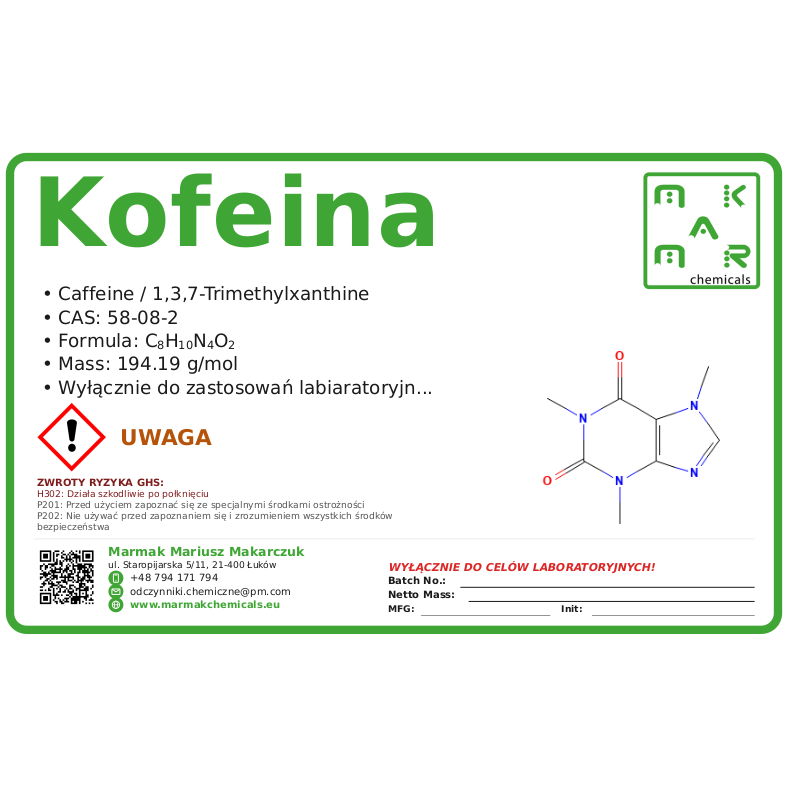


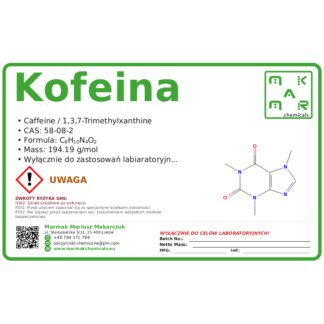
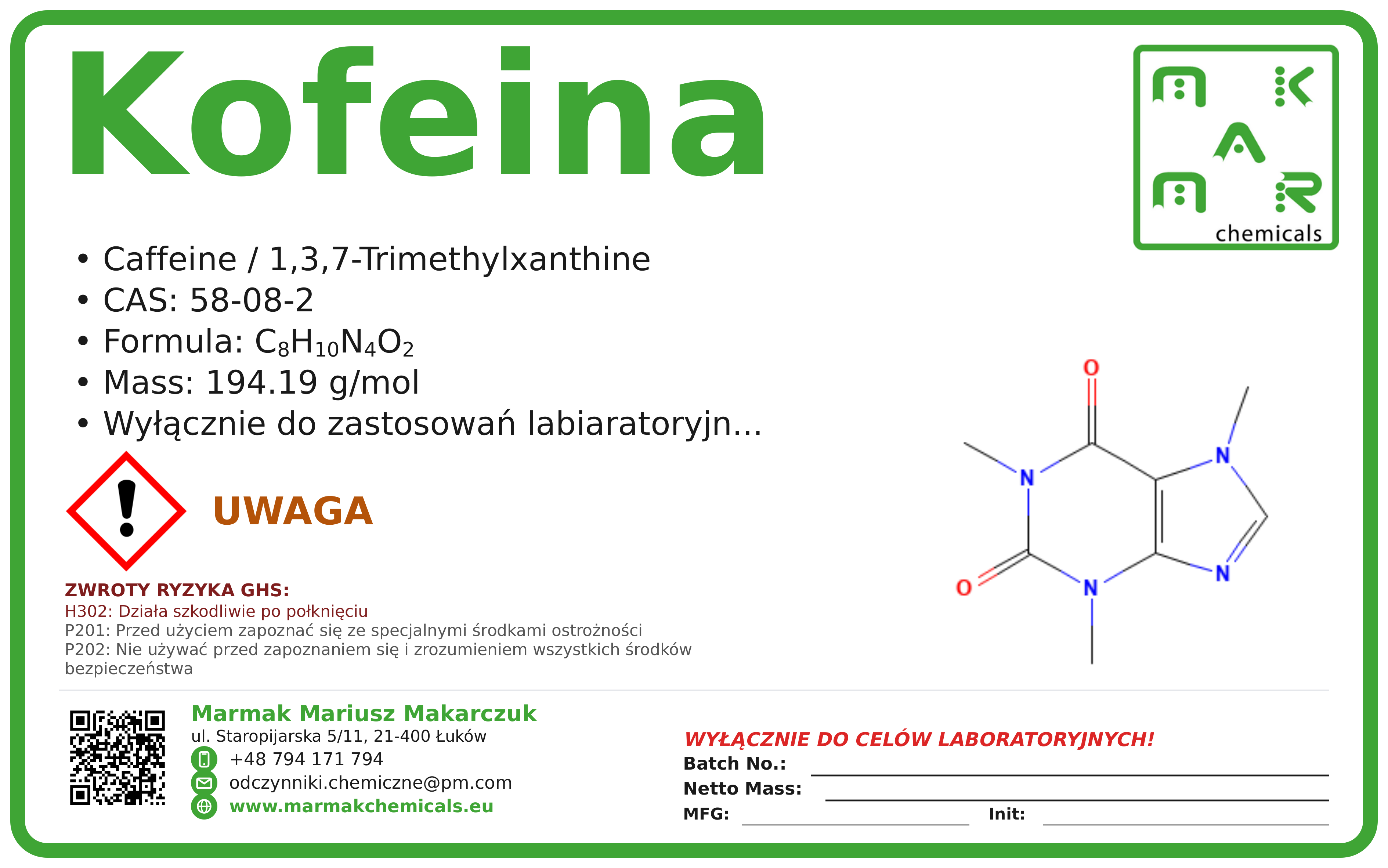
Reviews
There are no reviews yet.