Data sources: PubChem (NLM/NIH), Yaws Handbook 2nd ed. (2014) Last updated: 2026-06-30
📊Physical & Chemical Properties
Quick Reference
Formula:C2H6OS
MW:78.14 g/mol
CAS:67-68-5
Detailed Properties
Property
Value
Unit
Conditions
Source
Density (ρ)
1.0958
g/cm³
25°C
Yaws Handbook 2nd ed. (2014)
Melting Point (mp)
18.50
°C
1 atm
Yaws Handbook 2nd ed. (2014)
Boiling Point (bp)
189.00
°C
1 atm
Yaws Handbook 2nd ed. (2014)
Flash Point
87.00
°C
closed cup
Yaws Handbook 2nd ed. (2014)
Vapor Pressure
0.420
mmHg
20°C
Yaws Handbook 2nd ed. (2014)
Water Solubility
miscible
g/L
20°C
Yaws Handbook 2nd ed. (2014)
Viscosity (η)
1.991
cP
25°C
Yaws Handbook 2nd ed. (2014)
Refractive Index (nD)
1.4793
20°C, D-line
Yaws Handbook 2nd ed. (2014)
pKa
35.000
25°C
Yaws Handbook 2nd ed. (2014)
🔬 Advanced Properties
Surface Tension
43.540 mN/m
20°C
Dielectric Constant (ε)
46.700
25°C
Heat Capacity (Cp)
1.950 J/(g·K)
25°C
Chemical Identifiers
SMILES:CS(=O)C
Data sources:
PubChem, NIST Chemistry WebBook, CRC Handbook of Chemistry and Physics (103rd ed.)
Last updated: 2026-06-25
Regulatory status of the substance
This substance is subject to regulatory requirements: hazardous waste management (BDO register). Details in the \"Regulatory Status (REACH/ECHA/CLP)\" section and on the SDS. Regulatory information — does not restrict purchase in this store.
📚 The book bibliography is awaiting generation. Curated general textbooks are available below; CAS-specific Google Books can be fetched from the admin panel.
National Institute of Standards and Technology. 2024. "NIST Chemistry WebBook, SRD 69." Gaithersburg, MD: NIST. Accessed 2025-01-01. ↗
Spectral Database for Organic Structure Determination (SDBS). 2024. National Institute of Advanced Industrial Science and Technology (AIST), Japan. Accessed 2025-01-01. ↗
Ulrich, Eldon L., Hideo Akutsu, John F. Doreleijers, Yoko Harano, Yannis E. Ioannidis, Jundong Lin, Miron Livny, et al. 2008. "BioMagResBank." Nucleic Acids Research 36 (D1): D402–D408. [DOI ↗]
Horai, Hisayuki, Masanori Arita, Shigehiko Kanaya, Yoshito Nihei, Tasuku Ikeda, Kazuhiro Suwa, Yuya Ojima, et al. 2010. "MassBank: A Public Repository for Sharing Mass Spectral Data for Life Sciences." Journal of Mass Spectrometry 45 (7): 703–714. [DOI ↗]
Linstrom, P.J., and W.G. Mallard, eds. 2024. NIST Chemistry WebBook, NIST Standard Reference Database Number 69. Gaithersburg, MD: National Institute of Standards and Technology. ↗
McDonald, M. Shane, Mike McAvoy, and Ajit Bhalerao. 1988. "JCAMP-DX: A Standard Form for Exchange of Infrared Spectra in Computer Readable Form." Applied Spectroscopy 42 (1): 151–162. [DOI ↗]
PubChem. 2024. "PubChem Compound Database." National Library of Medicine, National Institutes of Health. Accessed 2025-01-01. ↗
Spectra are fetched on demand from 9 sources. Each spectrum is stored in our database — the next time it is opened there are zero requests to the external API. Download JCAMP-DX / CSV / PNG for every spectrum without searching.
Data retrieved via MolGod_Spectra_Remote_Fetcher (JCAMP-DX parser) and stored in the wp_molgod_spectra_cache table. Zero duplicate downloads, zero repeat queries to NIST on subsequent visits. Licensing terms are respected (only a deep link plus our own visualization is published).
Data retrieved live from multiple sources (priority chain). JCAMP-DX / CSV / PNG available for download under each spectrum.
IR — Fourier-transform infrared
Loading IR — Fourier-transform infrared…
MS — Mass spectrometry (EI 70eV)
Loading MS — Mass spectrometry (EI 70eV)…
MolGod_DFT_SP5
🧮 DFT vs experiment comparison (IR)
Overlay of the experimental IR spectrum on the theoretically calculated spectrum using the B3LYP/6-31G* method (scaling factor 0.9614, Scott & Radom 1996).
Experimental DFT (theoretical)
Full theoretical data (geometry, frequencies): NIST CCCBDB ↗
📚 Bibliography (Chicago)
Becke, Axel D. 1993. "Density-Functional Thermochemistry. III. The Role of Exact Exchange." Journal of Chemical Physics 98 (7): 5648–5652. Definition of the B3LYP functional.
Scott, Anthony P., and Leo Radom. 1996. "Harmonic Vibrational Frequencies: An Evaluation of Hartree–Fock, Møller–Plesset, Quadratic Configuration Interaction, Density Functional Theory, and Semiempirical Scale Factors." Journal of Physical Chemistry 100 (41): 16502–16513. Scaling factors for DFT (e.g., 0.9614 for B3LYP/6-31G*).
Merrick, Jeffrey P., Damian Moran, and Leo Radom. 2007. "An Evaluation of Harmonic Vibrational Frequency Scale Factors." Journal of Physical Chemistry A 111 (45): 11683–11700. An update to Scott & Radom — scale factors for newer DFT functionals.
Lee, Chengteh, Weitao Yang, and Robert G. Parr. 1988. "Development of the Colle-Salvetti Correlation-Energy Formula into a Functional of the Electron Density." Physical Review B 37 (2): 785–789. The LYP correlation — complements Becke 1993 for B3LYP.
Hehre, Warren J., Robert Ditchfield, and John A. Pople. 1972. "Self-Consistent Molecular Orbital Methods. XII. Further Extensions of Gaussian-Type Basis Sets." Journal of Chemical Physics 56 (5): 2257–2261. Definition of the 6-31G* basis set (split-valence + polarization).
Johnson, Russell D., III, ed. 2022. "NIST Computational Chemistry Comparison and Benchmark Database (CCCBDB)." NIST Standard Reference Database 101, Release 22. https://cccbdb.nist.gov. Benchmark for theoretical values — the fallback link in the widget.
Cramer, Christopher J. 2004. "Essentials of Computational Chemistry: Theories and Models." 2nd ed. Chichester: Wiley. A textbook on DFT methods and vibrational frequency calculations.
Jensen, Frank. 2017. "Introduction to Computational Chemistry." 3rd ed. Chichester: Wiley. Modern computational chemistry — basis sets and methods for vibrational spectra.
Foresman, James B., and Æleen Frisch. 2015. "Exploring Chemistry with Electronic Structure Methods." 3rd ed. Wallingford, CT: Gaussian, Inc. A practical Gaussian guide — IR + Raman + NMR from DFT.
MolGod_SPECGUIDE_SP6
🎓 Spectrum interpretation guide (for students)
Automatically generated explanations for each band in the spectrum — why it appears where it does, and what it reveals about the structure.
IR (infrared) (440 peaks)
The IR (infrared) spectrum contains 440 identified bands. The analysis below explains what each one means structurally and why it appears in that particular range.
C=O stretch (carboxylic acid)COOH● high
Band "C=O stretch (carboxylic acid)" appears in cases: 1,722.0 cm⁻¹ (strong (s)), 2,506.0 cm⁻¹ (strong (s)), 2,514.0 cm⁻¹ (strong (s)). A very broad O–H band (~2500–3300) together with C=O (~1710) is the classic signature of a carboxylic acid (dimer).
O–H stretch (H-bonded, alcohol/acid)OH● high
Band "O–H stretch (H-bonded, alcohol/acid)" appears in cases: 3,202.0 cm⁻¹ (strong (s)), 3,210.0 cm⁻¹ (strong (s)), 3,218.0 cm⁻¹ (strong (s)). Indicates the presence of O–H bonds (alcohol/acid/water). The broad band results from hydrogen bonding in the liquid/solid state.
C–H bend (CH3, CH2 — methyl/methylene)CH3/CH2● high
Band "C–H bend (CH3, CH2 — methyl/methylene)" appears in cases: 1,434.0 cm⁻¹ (strong (s)), 1,442.0 cm⁻¹ (strong (s)), 1,450.0 cm⁻¹ (strong (s)). This is the stretching vibration of aliphatic sp³ C–H bonds. Present in virtually every organic compound with an alkyl chain.
Band "C=O stretch (amide I)" appears in cases: 1,634.0 cm⁻¹ (strong (s)), 1,642.0 cm⁻¹ (strong (s)), 1,650.0 cm⁻¹ (strong (s)). Amide I (C=O) and amide II (N–H bend) together produce a characteristic duo around 1660 + 1550 cm⁻¹.
C≡N stretch (nitrile)CN● high
Band "C≡N stretch (nitrile)" appears in cases: 2,210.0 cm⁻¹ (strong (s)), 2,218.0 cm⁻¹ (strong (s)), 2,226.0 cm⁻¹ (strong (s)). Nitrile C≡N gives a thin, sharp band at ~2250 cm⁻¹ — easily distinguished from C≡C, which is weaker and can be absent (symmetry).
📚 Bibliography (Chicago)
Field, Leslie D., Sev Sternhell, and John R. Kalman. 2013. "Organic Structures from Spectra." 5th ed. Chichester: Wiley. A student problem-set textbook (interpretation guide companion).
Williams, Dudley H., and Ian Fleming. 2008. "Spectroscopic Methods in Organic Chemistry." 6th ed. London: McGraw-Hill. A classic of narrative spectral interpretation — explains "why the peak is here".
Crews, Phillip, Jaime Rodríguez, and Marcel Jaspars. 2009. "Organic Structure Analysis." 2nd ed. New York: Oxford University Press. A workflow for multi-parameter structural interpretation.
McLafferty, Fred W., and František Tureček. 1993. "Interpretation of Mass Spectra." 4th ed. Mill Valley, CA: University Science Books. MS fragmentation mechanisms — McLafferty rearrangement, m/z 29 = CHO.
Reusch, William. 2013. "Virtual Textbook of Organic Chemistry: Spectroscopy." East Lansing, MI: Michigan State University. https://www2.chemistry.msu.edu/faculty/reusch/VirtTxtJml/Spectrpy/spectro.htm. An open educational guide to IR/NMR/MS/UV — ideal for explaining functional groups.
Hesse, Manfred, Herbert Meier, and Bernd Zeeh. 2007. "Spektroskopische Methoden in der organischen Chemie." 8th ed. Stuttgart: Thieme. The standard German textbook on spectral interpretation.
Lampman, Gary M., Donald L. Pavia, George S. Kriz, and James R. Vyvyan. 2010. "Spectroscopy." 4th ed. Belmont, CA: Cengage Learning. A workbook with integrated interpretive narratives.
Kalsi, P. S. 2010. "Spectroscopy of Organic Compounds." 6th ed. New Delhi: New Age International. A complete textbook on IR/NMR/MS/UV spectral interpretation.
MolGod_MS_SP7
🔎 Spectrum Search (JCAMP-DX)
Upload a JCAMP-DX file (.jdx, .dx, .jcm) — the system will calculate the cosine similarity against all spectra in the database and display the TOP 10 matches.
📚 Bibliography (Chicago)
McLafferty, Fred W., ed. 2018. Wiley Registry of Mass Spectral Data. 11th ed. Hoboken, NJ: Wiley. A reference MS library (~775k spectra).
Stein, Stephen E., and Donald R. Scott. 1994. "Optimization and Testing of Mass Spectral Library Search Algorithms for Compound Identification." Journal of the American Society for Mass Spectrometry 5 (9): 859–866. The cosine + dot-product algorithm of NIST MS Search.
McDonald, Robert S., and Paul A. Wilks Jr. 1988. "JCAMP-DX: A Standard Form for Exchange of Infrared Spectra in Computer Readable Form." Applied Spectroscopy 42 (1): 151–162. The JCAMP-DX specification (extended to 5.01 for NMR/MS).
McLafferty, Fred W., and František Tureček. 1993. "Interpretation of Mass Spectra." 4th ed. Mill Valley, CA: University Science Books. Cosine-similarity matching and MS fragmentation — the foundation of the search algorithm.
Sumner, Lloyd W., Alexander Amberg, Dave Barrett, Michael H. Beale, Richard Beger, Clare A. Daykin, Teresa W.-M. Fan, et al. 2007. "Proposed Minimum Reporting Standards for Chemical Analysis." Metabolomics 3 (3): 211–221. MSI Level 1-4 — confidence-level standards for spectral matching.
Stein, Stephen E. 1999. "An Integrated Method for Spectrum Extraction and Compound Identification from Gas Chromatography/Mass Spectrometry Data." Journal of the American Society for Mass Spectrometry 10 (8): 770–781. The AMDIS algorithm — deconvolution + library match (NIST).
Lindon, John C., George E. Tranter, and David W. Koppenaal, eds. 2017. "Encyclopedia of Spectroscopy and Spectrometry." 3rd ed. Amsterdam: Academic Press. Encyclopedia entries on spectral library searching.
Smith, Brian C. 2011. "Fundamentals of Fourier Transform Infrared Spectroscopy." 2nd ed. Boca Raton, FL: CRC Press. FT-IR and the JCAMP-DX format for transmission spectra.
Larkin, Peter. 2017. "Infrared and Raman Spectroscopy: Principles and Spectral Interpretation." 2nd ed. Amsterdam: Elsevier. Principles of IR/Raman library matching and peak preprocessing.
📐Physical & Chemical Properties (DB)
34 fields MolGod Score: Primary
Haynes, William M., ed. 2024. CRC Handbook of Chemistry and Physics. 105th ed. Boca Raton: CRC Press/Taylor & Francis. ISBN 978-1-032-55554-4. ↗
National Institute of Standards and Technology. 2024. "NIST Chemistry WebBook, SRD 69." Gaithersburg, MD: NIST. Accessed 2025-01-01. ↗
Yaws, Carl L. 2014. The Yaws Handbook of Physical Properties for Hydrocarbons and Chemicals. 2nd ed. Oxford: Gulf Professional Publishing.
PubChem. 2024. "PubChem Compound Database." National Library of Medicine, National Institutes of Health. Accessed 2025-01-01. ↗
Marrero, J., and R. Gani. 2001. "Group-Contribution Based Estimation of Pure Component Properties." Fluid Phase Equilibria 183–184: 183–208. ↗
Joback, K. G., and R. C. Reid. 1987. "Estimation of Pure-Component Properties from Group-Contributions." Chemical Engineering Communications 57 (1–6): 233–243. ↗
Sangster, J. 1997. Octanol-Water Partition Coefficients: Fundamentals and Physical Chemistry. Chichester: Wiley. ISBN 978-0-471-97397-3.
Mannhold, Raimund, and Han van de Waterbeemd. 2001. "Substructure and Whole Molecule Approaches for Calculating Log P." Journal of Computer-Aided Molecular Design 15 (4): 337–354. ↗
Perrin, Ditlev D., Boyd Dempsey, and E. P. Serjeant. 1981. pKa Prediction for Organic Acids and Bases. London: Chapman and Hall. ISBN 0-412-21090-5.
Constantinou, Leonidas, and Rafiqul Gani. 1994. "New Group Contribution Method for Estimating Properties of Pure Compounds." AIChE Journal 40 (10): 1697–1710. ↗
Ertl, Peter, Bernhard Rohde, and Paul Selzer. 2000. "Fast Calculation of Molecular Polar Surface Area as a Sum of Fragment-Based Contributions and Its Application to the Prediction of Drug Transport Properties." Journal of Medicinal Chemistry 43 (20): 3714–3717. ↗
🔄 Concentration unit converter LIVEMolGod_UNITCONV_1
/* translators: %s, %d itd. to wartosci dynamiczne wstawiane do komunikatu. */
Enter the Dimethyl Sulfoxide concentration in any unit — the rest will be calculated automatically.
Cohen ER, Cvitaš T, Frey JG, Holmström B, Kuchitsu K, Marquardt R, Mills I, Pavese F, Quack M, Stohner J, Strauss HL, Takami M, Thor AJ (2007)
g/L ↔ molarity
c (mol/L) = (g/L) / MW
±0.1% (depends on MW precision)
Cohen ER, Cvitaš T, Frey JG, Holmström B, Kuchitsu K, Marquardt R, Mills I, Pavese F, Quack M, Stohner J, Strauss HL, Takami M, Thor AJ (2007)
mmol/L ↔ molarity
c (mol/L) = mmol/L × 10⁻³
Exact
Cohen ER, Cvitaš T, Frey JG, Holmström B, Kuchitsu K, Marquardt R, Mills I, Pavese F, Quack M, Stohner J, Strauss HL, Takami M, Thor AJ (2007)
Celsius ↔ Kelvin
T(K) = t(°C) + 273.15
±0.01 K (ITS-90 scale)
BIPM (Bureau International des Poids et Mesures) (2019)
Celsius ↔ Fahrenheit
T(°F) = T(°C) × 9/5 + 32
±0.1 °F
Thompson A, Taylor BN (2008)
density-corrected % ↔ molarity
c (mol/L) = (%w/w × ρ × 10) / MW, ρ in g/mL
±0.1% when ρ known to 3 decimals
Cohen ER, Cvitaš T, Frey JG, Holmström B, Kuchitsu K, Marquardt R, Mills I, Pavese F, Quack M, Stohner J, Strauss HL, Takami M, Thor AJ (2007)
📚 Bibliography (8 authoritative sources)
Thompson A, Taylor BN (2008). Guide for the Use of the International System of Units (SI). NIST Special Publication 811 · DOI: 10.6028/NIST.SP.811-2008 → Primary SI standard for US scientific usage
Cohen ER, Cvitaš T, Frey JG, Holmström B, Kuchitsu K, Marquardt R, Mills I, Pavese F, Quack M, Stohner J, Strauss HL, Takami M, Thor AJ (2007). Quantities, Units and Symbols in Physical Chemistry — The IUPAC Green Book. RSC Publishing, 3rd ed. · DOI: 10.1039/9781847557889 · ISBN: 978-0-85404-433-7 → Canonical IUPAC guide for chemistry quantities/units
BIPM (Bureau International des Poids et Mesures) (2019). The International System of Units (SI), 9th edition. BIPM · ↗ → International SI definitions (incl. redefined kilogram 2019)
ISO/IEC (2022). Quantities and units — Part 1: General. International Organization for Standardization — ISO 80000-1:2022 · ↗ → General rules for physical quantities and units
ISO/IEC (2019). Quantities and units — Part 9: Physical chemistry and molecular physics. International Organization for Standardization — ISO 80000-9:2019 · ↗ → Concentration / molality / amount-of-substance conventions
Tiesinga E, Mohr PJ, Newell DB, Taylor BN (2021). CODATA recommended values of the fundamental physical constants: 2018. Rev. Mod. Phys. 93(2):025010 · DOI: 10.1103/RevModPhys.93.025010 → Avogadro, gas constant, molar volume (2019 SI revision)
IUPAC (2019). Compendium of Chemical Terminology — the IUPAC Gold Book (online). IUPAC · DOI: 10.1351/goldbook → Definitions of mass fraction, molality, normality, ppm, activity
Mills IM, Cvitaš T, Homann K, Kallay N, Kuchitsu K (1988). Quantities, Units and Symbols in Physical Chemistry. Blackwell Scientific Publications, 1st ed. · ISBN: 0-632-01773-5 → Historical predecessor of IUPAC Green Book
Rumble, John R., ed. 2023. CRC Handbook of Chemistry and Physics. 104th ed. Boca Raton, FL: CRC Press. [link ↗]
International Association for the Properties of Water and Steam (IAPWS). 1997. "Release on the Static Dielectric Constant of Ordinary Water Substance." IAPWS R8-97. [link ↗]
Reichardt, Christian, and Thomas Welton. 2011. Solvents and Solvent Effects in Organic Chemistry. 4th ed. Weinheim: Wiley-VCH. https://doi.org/10.1002/9783527632220. [link ↗]
Hansen, Charles M. 2007. Hansen Solubility Parameters: A User's Handbook. 2nd ed. Boca Raton, FL: CRC Press. https://doi.org/10.1201/9781420006834. [link ↗]
IFA. n.d. "Water." GESTIS Substance Database. Institut für Arbeitsschutz der Deutschen Gesetzlichen Unfallversicherung. Accessed April 25, 2026. [link ↗]
Rumble, John R., ed. 2023. CRC Handbook of Chemistry and Physics. 104th ed. Boca Raton, FL: CRC Press. [link ↗]
Reichardt, Christian, and Thomas Welton. 2011. Solvents and Solvent Effects in Organic Chemistry. 4th ed. Weinheim: Wiley-VCH. https://doi.org/10.1002/9783527632220. [link ↗]
Snyder, Lloyd R., Joseph J. Kirkland, and John W. Dolan. 2010. Introduction to Modern Liquid Chromatography. 3rd ed. Hoboken, NJ: Wiley. https://doi.org/10.1002/9780470508183. [link ↗]
Smallwood, Ian M. 1996. Handbook of Organic Solvent Properties. London: Arnold. https://doi.org/10.1016/B978-0-340-64578-9.X5000-9. [link ↗]
Reichardt, Christian, and Thomas Welton. 2011. Solvents and Solvent Effects in Organic Chemistry. 4th ed. Weinheim: Wiley-VCH. https://doi.org/10.1002/9783527632220. [link ↗]
Hansen, Charles M. 2007. Hansen Solubility Parameters: A User's Handbook. 2nd ed. Boca Raton, FL: CRC Press. [link ↗]
Rumble, John R., ed. 2023. CRC Handbook of Chemistry and Physics. 104th ed. Boca Raton, FL: CRC Press. [link ↗]
Smallwood, Ian M. 1996. Handbook of Organic Solvent Properties. London: Arnold. [link ↗]
National Institute of Standards and Technology. n.d. "Methane, dichloro- (CAS 75-09-2)." NIST Chemistry WebBook, SRD 69. Accessed April 25, 2026. [link ↗]
Hansen, Charles M. 2007. Hansen Solubility Parameters: A User's Handbook. 2nd ed. Boca Raton, FL: CRC Press. [link ↗]
International Agency for Research on Cancer. 1999. "Dichloromethane." IARC Monographs on the Evaluation of Carcinogenic Risks to Humans 71: 251–315. [link ↗]
Reichardt, Christian, and Thomas Welton. 2011. Solvents and Solvent Effects in Organic Chemistry. 4th ed. Weinheim: Wiley-VCH. [link ↗]
Armarego, Wilfred L. F., and Christina Li Lin Chai. 2009. Purification of Laboratory Chemicals. 6th ed. Oxford: Butterworth-Heinemann. https://doi.org/10.1016/B978-1-85617-567-8.50003-3. [link ↗]
Hansen, Charles M. 2007. Hansen Solubility Parameters: A User's Handbook. 2nd ed. Boca Raton, FL: CRC Press. [link ↗]
National Institute of Standards and Technology. n.d. "Furan, tetrahydro- (CAS 109-99-9)." NIST Chemistry WebBook. Accessed April 25, 2026. [link ↗]
Smallwood, Ian M. 1996. Handbook of Organic Solvent Properties. London: Arnold. [link ↗]
National Institute of Standards and Technology. n.d. "Hexane (CAS 110-54-3)." NIST Chemistry WebBook. Accessed April 25, 2026. [link ↗]
Hansen, Charles M. 2007. Hansen Solubility Parameters: A User's Handbook. 2nd ed. Boca Raton, FL: CRC Press. [link ↗]
Snyder, Lloyd R., Joseph J. Kirkland, and John W. Dolan. 2010. Introduction to Modern Liquid Chromatography. 3rd ed. Hoboken, NJ: Wiley. [link ↗]
Agency for Toxic Substances and Disease Registry. 1999. Toxicological Profile for n-Hexane. Atlanta, GA: U.S. Department of Health and Human Services. [link ↗]
International Agency for Research on Cancer. 1999. "Chloroform." IARC Monographs on the Evaluation of Carcinogenic Risks to Humans 73: 131–182. [link ↗]
National Institute of Standards and Technology. n.d. "Methane, trichloro- (CAS 67-66-3)." NIST Chemistry WebBook. Accessed April 25, 2026. [link ↗]
Hansen, Charles M. 2007. Hansen Solubility Parameters: A User's Handbook. 2nd ed. Boca Raton, FL: CRC Press. [link ↗]
Reichardt, Christian, and Thomas Welton. 2011. Solvents and Solvent Effects in Organic Chemistry. 4th ed. Weinheim: Wiley-VCH. [link ↗]
Solubility theory (applied in compatibility prediction):
Yalkowsky, Samuel H., and Shri C. Valvani. 1980. "Solubility and Partitioning I: Solubility of Nonelectrolytes in Water." Journal of Pharmaceutical Sciences 69 (8): 912–922. https://doi.org/10.1002/jps.2600690814 — General Solubility Equation (GSE): logS = 0.5 − logP − 0.01(MP−25).
Hansen, Charles M. 2007. Hansen Solubility Parameters: A User's Handbook. 2nd ed. Boca Raton, FL: CRC Press. https://doi.org/10.1201/9781420006834 — HSP triplet (dD, dP, dH) + wzór Ra.
Reichardt, Christian, and Thomas Welton. 2011. Solvents and Solvent Effects in Organic Chemistry. 4th ed. Weinheim: Wiley-VCH. https://doi.org/10.1002/9783527632220 — E_T(30) polarity scale, solwatochromia.
Snyder, Lloyd R., Joseph J. Kirkland, and John W. Dolan. 2010. Introduction to Modern Liquid Chromatography. 3rd ed. Hoboken, NJ: Wiley. https://doi.org/10.1002/9780470508183 — Eluotropic series, polarity index.
PubChem Compound Database — CAS 67-68-5 lookup ↗ — logP (XLogP3), water solubility experimental + predicted.
Full bibliography in the REFERENCES accordion (at the bottom of the page) — Chicago Manual of Style 17th ed., Author-Date.
🛡️ Safety — CAS 67-68-5MolGod_SAFEHUB_MAIN
Data limitations notice. The safety information on this page is for reference only and does not replace a full safety data sheet (SDS). Before using the product, consult the manufacturer's current safety data sheet and the GHS/CLP guidance. The CLP classification applies to the pure bulk substance, not to commercial formulations.
MolGod_GHS_SF1
GHS/CLP classification — Regulation (EC) No 1272/2008 + UN GHS Rev. 9 (2021).
P210 — Keep away from heat, hot surfaces, sparks, open flames and other ignition sources. No smoking
✓ Harmonised classification pursuant to Annex VI of the CLP Regulation (EC) 1272/2008 (official, binding classification).
Translations: CLP Regulation (EC) 1272/2008, Annexes III and IV. Data: PubChem/NLM.
MolGod_TOX_SF2
☢️ Toxicological data (IARC + EPA CTX)
📖 Toxicological summary
Dimetylosulfotlenek (DMSO, CAS 67-68-5; EC 200-664-3) jest aprotonowym polarnym rozpuszczalnikiem o wyjątkowo niskiej toksyczności ostrej. LD50 doustnie u szczura wynosi 14 500 mg/kg masy ciała wg dossier ECHA REACH [1] i danych RTECS [2]; cross-referencja [1,2]; substancja klasy 5 Hodge'a i Sternera ("praktycznie nieszkodliwa"). NIOSH nie ustala limitów narażenia zawodowego; substancja nie figuruje w listach OSHA PEL ani ACGIH TLV [3]. IARC nie zaklasyfikowała DMSO [4]; brak CMR w Aneksie VI CLP [1]. DMSO jest zatwierdzonym przez FDA nośnikiem farmaceutycznym (Inactive Ingredient Database) w preparatach miejscowych i pozajelitowych; lecznicze zastosowanie DMSO zostało zatwierdzone przez FDA w 1978 r. dla śródpęcherzowego leczenia śródmiąższowego zapalenia pęcherza (DMSO 50%) [5]. Wyjątkowa właściwość penetracji: DMSO przenika skórę i błony biologiczne w ciągu sekund, transportując jednocześnie cząsteczki rozpuszczone — wymaga ostrożności przy jednoczesnej ekspozycji na inne substancje chemiczne. Charakterystyczny marker narażenia: przenoszenie zapachu "czosnku/ostryg" do wydychanego powietrza i moczu przez metabolit dimetylosulfid [6].
🔖 Source citations (6) — Chicago Notes-Bibliography
U.S. National Institute for Occupational Safety and Health (NIOSH) / RTECS. 2023. "Dimethyl Sulfoxide (CAS 67-68-5)." RTECS No. PV6210000. Atlanta: CDC/NIOSH. https://www.cdc.gov/niosh/rtecs/.
U.S. National Institute for Occupational Safety and Health (NIOSH). 2007. NIOSH Pocket Guide to Chemical Hazards. DHHS (NIOSH) Pub. No. 2007-151. Rev. 2018. Atlanta: CDC/NIOSH. https://www.cdc.gov/niosh/npg/. [Brak wpisu REL/PEL dla DMSO.]
International Agency for Research on Cancer (IARC). 2025. "List of Classifications." Lyon: IARC/WHO. https://monographs.iarc.who.int/list-of-classifications/. [CAS 67-68-5 nie sklasyfikowany.]
U.S. Food and Drug Administration (FDA). 2023. "Dimethyl Sulfoxide (DMSO) — Approved Drug Products." Silver Spring, MD: FDA. https://www.accessdata.fda.gov/scripts/cder/daf/. [NDA 017423; śródpęcherzowe leczenie IC, zatwierdzone 1978.]
Santos, Nuno C., João Figueira-Coelho, João Martins-Silva, and Carlota Saldanha. 2003. "Multidisciplinary Utilization of Dimethyl Sulfoxide: Pharmacological, Cellular, and Molecular Aspects." Biochemical Pharmacology 65(7):1035–1041. DOI: 10.1016/S0006-2952(03)00046-X. [Peer-reviewed; przegląd zastosowań; metabolizm; marker oddechowy.]
Format: Chicago Notes-Bibliography (numbered). [n,m] = cross-reference: both sources independently confirm the same value. DOI links = peer-reviewed scientific studies. RESTRICTED = access via a scientific library.
No individual IARC entry for this CAS
No separate IARC monograph in the checked lists — this is NOT confirmation of a lack of carcinogenicity. Check the CLP/GHS classification (CMR / GHS section).
No harmonized CLP classification (Annex VI) is available for this CAS number. The codes below are aggregated supplier self-classifications (ECHA C&L notifications made available via PubChem) — they are NOT a harmonized classification and may be redundant. The supplier's Safety Data Sheet (SDS) remains the binding source.
U.S. National Institute for Occupational Safety and Health (NIOSH) / RTECS. 2023. "Dimethyl Sulfoxide (CAS 67-68-5)." RTECS No. PV6210000. Atlanta: CDC/NIOSH. https://www.cdc.gov/niosh/rtecs/. 🔗
U.S. National Institute for Occupational Safety and Health (NIOSH). 2007. NIOSH Pocket Guide to Chemical Hazards. DHHS (NIOSH) Pub. No. 2007-151. Rev. 2018. Atlanta: CDC/NIOSH. https://www.cdc.gov/niosh/npg/. [Brak wpisu REL/PEL dla DMSO.] 🔗
International Agency for Research on Cancer (IARC). 2025. "List of Classifications." Lyon: IARC/WHO. https://monographs.iarc.who.int/list-of-classifications/. [CAS 67-68-5 nie sklasyfikowany.] 🔗
U.S. Food and Drug Administration (FDA). 2023. "Dimethyl Sulfoxide (DMSO) — Approved Drug Products." Silver Spring, MD: FDA. https://www.accessdata.fda.gov/scripts/cder/daf/. [NDA 017423; śródpęcherzowe leczenie IC, zatwierdzone 1978.] 🔗
Santos, Nuno C., João Figueira-Coelho, João Martins-Silva, and Carlota Saldanha. 2003. "Multidisciplinary Utilization of Dimethyl Sulfoxide: Pharmacological, Cellular, and Molecular Aspects." Biochemical Pharmacology 65(7):1035–1041. DOI: 10.1016/S0006-2952(03)00046-X. [Peer-reviewed; przegląd zastosowań; metabolizm; marker oddechowy.] [DOI]
📖 General toxicological literature (module)
International Agency for Research on Cancer (IARC). 2024. "IARC Monographs on the Identification of Carcinogenic Hazards to Humans." Lyon: IARC. 🔗
U.S. EPA. 2024. "ECOTOX Knowledgebase." Washington, DC: U.S. Environmental Protection Agency. 🔗
ECHA. 2024. "Chemical Safety Assessment." European Chemicals Agency. 🔗
U.S. National Toxicology Program. 2024. Report on Carcinogens. 15th ed. Research Triangle Park, NC: National Institute of Environmental Health Sciences. 🔗
GESTIS. 2024. "GESTIS Substance Database." Institute for Occupational Safety and Health of the German Social Accident Insurance (DGUV). 🔗
U.S. EPA. 2024. "CompTox Chemicals Dashboard." Washington, DC: U.S. Environmental Protection Agency. 🔗
ECHA. 2023. "Regulation (EC) No 1272/2008 on Classification, Labelling and Packaging of Substances and Mixtures (CLP), Annex VI — Harmonised Classification." European Chemicals Agency. 🔗
Leist, Marcel, et al. 2014. "Consensus Report on the Future of Animal-Free Systemic Toxicity Testing." ALTEX 31 (3): 341–356. [DOI]
Hartung, Thomas. 2009. "Toxicology for the Twenty-First Century." Nature 460 (7252): 208–212. [DOI]
Lenga, Robert E., ed. 2008. The Sigma-Aldrich Library of Chemical Safety Data. 2nd ed. Milwaukee: Sigma-Aldrich.
Slikker, William Jr., et al. 2004. "Dose-Dependent Terminal and Tissue Residues After Chronic Exposure." Toxicological Sciences 81 (2): 253–279. [DOI]
Calabrese, Edward J., and Linda A. Baldwin. 2003. "Toxicology Rethinks Its Central Belief." Nature 421 (6924): 691–692. [DOI]
Hodge, Harold C., and J. Harvey Sterner. 1949. "Tabulation of Toxicity Classes." American Industrial Hygiene Association Quarterly 10 (4): 93–96. [DOI]
MolGod_AID_SF3
🆘 First Aid — Emergency ProceduresCAS 67-68-5
Warning
Hazard class: IRRITANT
⚠️ IMPORTANT:
In case of a serious incident — call 112 or the Poison Control Center: +48 42 631 47 24 (Łódź).
DMSO: penetrant — do not apply together with other chemicals (systemic transfer). Do NOT use latex gloves.
🩹
Skin contact
⏱ Timeline: Brak ostrych objawów; ewentualne podrażnienie po >30 min
🔴 Symptoms
Pieczenie, swędzenie
PENETRANT — przenosi rozpuszczone substancje przez skórę
Czosnkowy posmak/zapach z ust w 1 min
✅ What to do
Zdejmij odzież NATYCHMIAST
Spłucz dużą ilością wody 15 min
Sprawdź czy DMSO nie zawierał innych chemikaliów (przenosi je do krwiobiegu)
❌ What to avoid
NIGDY nie nakładaj DMSO z innymi chemikaliami na skórę (przenoszenie systemowe)
NIE używaj rękawic lateksowych (przenikają DMSO)
🚑 Ambulance: Brak — utrzymujące się objawy >24h skontaktuj lekarza POZ
Goldfrank, Lewis R., Robert S. Hoffman, Mary Ann Howland, Neal A. Lewin, Lewis S. Nelson, and Silas W. Smith. 2019. Goldfrank's Toxicologic Emergencies. McGraw-Hill Education.
Olson, Kent R., Ilene B. Anderson, Neal L. Benowitz, Paul D. Blanc, Richard F. Clark, Thomas E. Kearney, Susan Y. Kim-Katz, and Alan H. B. Wu. 2018. Poisoning & Drug Overdose. McGraw-Hill.
World Health Organization (WHO). 2007. Antidotes for Poisoning by Cyanide (IPCS Evaluation Series 21). International Programme on Chemical Safety, WHO Press. ↗
Howland, Mary Ann, and Robert S. Aaron. 2002. Goldfrank's Antidotes for Pediatric Emergency Care. Lippincott Williams & Wilkins.
Centrum Zatruć Łódź. 2024. Procedury kliniczne w zatruciach ostrych — wytyczne dla ratowników. Centrum Informacji Toksykologicznej. ↗
National Institute for Occupational Safety and Health (NIOSH). 2007. Recommendations for First Aid Procedures for Chemical Exposures (NIOSH Pocket Guide to Chemical Hazards, DHHS Publication No. 2005-149). U.S. Department of Health and Human Services. ↗
United Nations Economic Commission for Europe (UNECE). 2021. Globally Harmonized System of Classification and Labelling of Chemicals (GHS), Revision 9. United Nations. ↗
Brent, Jeffrey. 2009. Fomepizole for the Treatment of Pediatric Ethylene and Diethylene Glycol, Butoxyethanol, and Methanol Poisonings. Clinical Toxicology 48(5): 401–406.
European Society for Paediatric Gastroenterology, Hepatology and Nutrition (ESPGHAN). 2018. Caustic Ingestion in Children — Position Paper. Journal of Pediatric Gastroenterology and Nutrition 66(5): 838–845.
Agency for Toxic Substances and Disease Registry (ATSDR). 2024. Toxicological Profiles — Medical Management Guidelines. U.S. Department of Health and Human Services. ↗
IPCS INCHEM. 2024. International Programme on Chemical Safety — Poisons Information Monographs. WHO/UNEP/ILO. ↗
American National Standards Institute (ANSI). 2014. ANSI Z358.1-2014 — Emergency Eyewash and Shower Equipment. International Safety Equipment Association.
MolGod_SPILL_SF4
🚨 Emergency procedure — chemical spillIRRITANT
CAS 67-68-5GHS:H315H319H227💨 Ventilation
🥽 PPE — Personal protective equipment
Gloves:nitrile (>0.4mm)
Goggles:Yes
Respirator:not_required_unless_vapors
Suit:lab_coat
Boots:closed_toe_shoes
📦 Small spill (<1L) — absorbent: vermiculite
1. Wietrzyć pomieszczenie (otwórz okna + wyciąg)
2. Załóż rękawice nitrylowe (>0.4mm) + okulary ochronne
3. Posyp absorbent (wermikulit/piasek) wokół rozlania
4. Zbierz od krawędzi do środka (nie rozprowadzaj!)
5. Umieść zanieczyszczony absorbent w szczelnym pojemniku PP/HDPE
6. Przemyj miejsce wodą z detergentem (3×)
7. Wytrzyj do sucha (ścierki → do pojemnika odpadów)
8. Umyj ręce nawet przez rękawice (DMSO penetruje!)
🛢️ Large spill (>1L) ⚠️ HAZMAT
1. EWAKUUJ personel niezaangażowany w oczyszczanie (>5m)
2. Wietrzyć intensywnie (>30 min)
3. Załóż pełne PPE: rękawice nitrylowe + kombinezon chemoodporny + gogle + respirator P2 (jeśli pary)
4. Otamuj rozlanie (użyj absorpcyjnych barier/poduszek)
5. Nie dopuść do kanalizacji/gleby (użyj zapór)
6. Zbierz mechanicznie (pompą próżniową do beczki UN)
7. Posyp pozostałości absorbent (wermikulit 50L/m²)
8. Zbierz łopatą/miotłą do kontenera 200L UN
9. Przemyj teren wodą (do odzysku!) 3×
10. Zgłoś incydent kierownikowi BHP + wpisz do rejestru
🩹 First aid
🧴 Skin
1. Zdejmij zanieczyszczoną odzież NATYCHMIAST
2. Przemyj skórę wodą z mydłem (15 min)
3. UWAGA: DMSO penetruje skórę i przenosi inne substancje! Jeśli na skórze były inne chemikalia → LEKARZ NATYCHMIAST
4. W razie podrażnienia → lekarz
👁️ Eyes
1. Przemyj NATYCHMIAST czystą wodą (15 min)
2. Trzymaj oczy otwarte podczas płukania
3. Usuń soczewki kontaktowe jeśli możliwe
4. ZAWSZE → OKULISTA (nawet bez objawów)
🫁 Inhalation
1. Wyprowadź poszkodowanego na świeże powietrze
2. Jeśli oddycha z trudem → tlen
3. Nie oddychało → CPR + wzywaj 112
4. Obserwuj 24h (opóźnione objawy oddechowe)
🍽️ Ingestion
1. NIE WYWOŁUJ WYMIOTÓW
2. Wypłucz usta wodą
3. Wypij szklankę wody
4. LEKARZ NATYCHMIAST + pokaż etykietę produktu
5. Centrum Zatruć: +48 42 631 46 24
🌍 Environment:
Water: MODERATE; Soil: LOW; ❌ Do not release into drains; Waste Code: 07 01 04*
Goldfrank, Lewis R., Neal Flomenbaum, Neal A. Lewin, Mary Ann Howland, Robert S. Hoffman, and Lewis S. Nelson. 2015. Goldfrank's Toxicologic Emergencies. McGraw-Hill Education.
10th ed. ISBN 978-0071801843.
U.S. Occupational Safety and Health Administration. 2024. 29 CFR 1910.120 — Hazardous Waste Operations and Emergency Response (HAZWOPER). U.S. Code of Federal Regulations.
[link ↗]
National Fire Protection Association. 2018. NFPA 472: Standard for Competence of Responders to Hazardous Materials/Weapons of Mass Destruction Incidents. NFPA.
[link ↗]
European Parliament and Council. 2012. Directive 2012/18/EU on the Control of Major-Accident Hazards Involving Dangerous Substances (Seveso III). Official Journal of the European Union L 197: 1–37.
[link ↗]
U.S. National Institute for Occupational Safety and Health. 2024. NIOSH Pocket Guide to Chemical Hazards. Centers for Disease Control and Prevention.
[link ↗]
European Chemicals Agency. 2020. Guidance on the Compilation of Safety Data Sheets (SDS), Version 3.1. ECHA.
[link ↗]
Sources: ECHA SDS · NIOSH Pocket Guide · GESTIS · Goldfrank Toxicologic Emergencies 10th ed..
Last verified: 2026-04-26 10:00:00.
Indicative data only — in an emergency, always follow the supplier's instructions and local occupational health and safety (OHS) regulations.
MolGod_PPE_SF5
⚠️ Visual PPE guide (personal protective equipment)Irritant
🧤 Gloves
Standard nitrile >0.1 mm EN 374-1 typ C
Standard protection against dermal irritation
👁️ Safety Glasses / Goggles
EN 166 D
Protection against solid particles and droplets; basic category
🥼 Lab Coat / Coverall
Standard cotton lab coat EN 13688
Standard buttoned long sleeve
💨 Ventilation
4 ACH(air changes/hour) General laboratory ventilation
4 ACH minimum for open operations; fume hood for concentrated CaCl2 dusts
European Committee for Standardization (CEN). 2016. EN 374-1:2016 — Protective gloves against dangerous chemicals and micro-organisms — Part 1: Terminology and performance requirements for chemical risks. CEN, Brussels. EN 374-1:2016. [link ↗] — Classification of chemical-resistant gloves type A/B/C; JKLPT permeation tests
European Committee for Standardization (CEN). 2001. EN 166:2001 — Personal eye-protection — Specifications. CEN, Brussels. EN 166:2001. [link ↗] — Markings: B = medium-energy impact, T = extreme temperatures, 9 = molten metals and hot solids
European Committee for Standardization (CEN). 2009. EN 14605:2005+A1:2009 — Protective clothing against liquid chemicals — Performance requirements for clothing with liquid-tight (Type 3) or spray-tight (Type 4) connections. CEN, Brussels. EN 14605:2009. [link ↗] — Type 3 (jet-tight) and Type 4 (spray-tight) protection against liquid chemicals
National Institute for Occupational Safety and Health (NIOSH). 2017. Recommendations for Chemical Protective Clothing: A Companion to the NIOSH Pocket Guide. U.S. Department of Health & Human Services / CDC. [link ↗] — Practical guide to CPC (chemical protective clothing) selection per substance and exposure scenario
Occupational Safety and Health Administration (OSHA). 2011. Personal Protective Equipment — General requirements. U.S. Department of Labor — 29 CFR 1910.132. 29 CFR 1910.132. [link ↗] — The employer must provide PPE + training + a documented written hazard assessment
MolGod_STORAGE_SF6
🗄️ Storage compatibility matrix (6×6)
Toxic
Visual storage compatibility matrix — check before placing containers next to each other. Hover over a cell to see the explanation and the source rule (NFPA / OSHA / Bretherick / ECHA).
✓
Safe (SAFE)!
Caution (CAUTION)✗
Incompatible (INCOMPATIBLE)◐
Separate (SEPARATE)
National Fire Protection Association (NFPA). 2024. NFPA 30: Flammable and Combustible Liquids Code. NFPA, Quincy, MA. NFPA 30 (2024 ed.). [link ↗] — §9.4–9.7 — class-based storage segregation rules (the canonical US lab/industrial reference)
Occupational Safety and Health Administration (OSHA). 2023. 29 CFR 1910.106 — Flammable Liquids. U.S. Department of Labor, Federal Register. 29 CFR 1910.106. [link ↗] — (d)(5)(i)–(iv) — flammable storage cabinet, inside-storage room, and segregation requirements
European Chemicals Agency (ECHA). 2024. Annex VI to Regulation (EC) No 1272/2008 (CLP) — Harmonised Classification and Labelling. ECHA, Helsinki / Official Journal of the European Union. CLP Annex VI. [link ↗] — §2.4–2.5 — EU-level classification driving storage compatibility under REACH/CLP
MolGod_WASTE_SF7
♻️ Chemical waste disposal (BDO)IRRITANT⚠️ BDO required
📋 Full BDO list:bdo.mos.gov.pl ↗
— official register of the Ministry of Climate and Environment. Waste Transfer Card (KPO):BDO template
mandatory for every hazardous waste delivery.
📚 Scientific references (Chicago Author-Date)
European Commission. 2014. Commission Decision 2014/955/EU on the list of waste pursuant to Directive 2008/98/EC. Official Journal of the European Union. Decyzja 2014/955/UE. [link ↗] — European List of Waste (LoW) — 6-digit EWC codes + asterisk for hazardous
Ministerstwo Klimatu i Środowiska Rzeczypospolitej Polskiej. 2020. Rozporządzenie Ministra Klimatu z dnia 2 stycznia 2020 r. w sprawie katalogu odpadów. Dziennik Ustaw RP 2020 poz. 10. [link ↗] — Polish waste catalogue — implementation of Decision 2014/955/EU
Główny Inspektorat Ochrony Środowiska (GIOŚ). 2024. Baza Danych O Odpadach (BDO) — System rejestracji firm utylizacyjnych. Ministerstwo Klimatu i Środowiska. [link ↗] — Central register of the Polish Waste Database (BDO) — full list of companies authorised for waste management
Polska — Sejm RP. 2012. Ustawa z dnia 14 grudnia 2012 r. o odpadach. Dz.U. 2013 poz. 21 (z późn. zm.). [link ↗] — National act — defines the waste producer's obligations + registration in the Polish Waste Database (BDO)
Furr, A. Keith, ed.. 2000. CRC Handbook of Laboratory Safety. CRC Press. — Laboratory waste classification + segregation procedures (Waste Management chapter); EN 374:2013 glove standards for personnel handling hazardous waste.
Pohanish, Richard P.. 2017. Sittig's Handbook of Toxic and Hazardous Chemicals and Carcinogens. Elsevier. — Per-CAS waste classification + incompatibilities — input for EWC mapping.
Lewis, Richard J.. 2012. Sax's Dangerous Properties of Industrial Materials. Wiley. — Reactivity + storage compatibility of waste (oxidisers vs flammables — separate streams).
NIOSH. 2024. Pocket Guide to Chemical Hazards. U.S. Department of Health and Human Services. [link ↗] — PEL/REL/IDLH per CAS — basis for the PPE required during waste transport (KPO — Waste Transfer Card).
OSHA. 2024. Occupational Chemical Database — Hazardous Waste Operations (HAZWOPER). Occupational Safety and Health Administration. [link ↗] — 29 CFR 1910.120 — training + PPE for handling hazardous waste.
European Parliament and Council. 2008. Directive 2008/98/EC on waste (Waste Framework Directive). Official Journal of the European Union L 312/3. [link ↗] — Waste management hierarchy (prevention → recovery → disposal); defines "hazardous waste".
European Parliament and Council. 2009. Regulation (EC) No 1272/2008 (CLP) on classification, labelling and packaging of substances and mixtures. Official Journal of the European Union L 353. [link ↗] — CLP H-statement classification → mapping to EWC * (asterisk = hazardous).
United Nations Economic Commission for Europe (UNECE). 2023. European Agreement concerning the International Carriage of Dangerous Goods by Road (ADR 2023). UNECE. [link ↗] — ADR — requirements for transporting hazardous waste (KPO — Waste Transfer Card + UN number + classes 1–9).
IPCS INCHEM. 2024. International Programme on Chemical Safety — Waste Management Guidelines. WHO/UNEP/ILO. [link ↗] — International guidelines for neutralisation + disposal per CAS.
European Parliament and Council. 2006. Regulation (EC) No 1013/2006 on Shipments of Waste. Official Journal of the European Union L 190: 1–98. [link ↗] — Cross-border transfer of hazardous waste — notification + consent requirements before export
ℹ️ Regulatory obligations checklist dla CAS 67-68-5.
Status based on: ADR 2023 (Table A), REACH Annex XVII, CLP Annex VI (harmonised classification), hazard class from the m14-spill DB, SVHC, GIS and the Polish OEL list. Principle: no data = no claim (we do NOT declare "no restrictions" without a basis).
❌SDS (Safety Data Sheet) availablerequired
How to comply: Wymóg: aktualna SDS zgodna z Rozp. 1907/2006 (REACH) Aneks II, format 16-sekcyjny.
❌Compliant CLP label (pictograms + signal word + H/P)required
How to comply: The label must include: GHS pictograms, the signal word (Danger/Warning), hazard (H) and precautionary (P) statements, and manufacturer details. Required since 2010 (substances) and 2015 (mixtures).
❌Chemical OSH training (substance-specific)required
How to comply: Laboratory staff: initial training (general induction + job-specific) + refresher training every 5 years (or every 3 for engineering/technical positions). Documentation kept in personnel files.
How to comply: BDO registration is mandatory for producers of hazardous waste. A Waste Transfer Card (KPO) is required for every consignment. Annual report due by 15 March of the following year.
Legal basis: Ustawa z 14 grudnia 2012 r. o odpadach (Dz.U. 2013 poz. 21)
⚪ADR transport (international agreement)not applicable
How to comply: Under ADR 2023 the substance is not classified as dangerous goods for road transport — standard carriage. Always confirm the form/concentration against section 14 of the safety data sheet.
Legal basis: Umowa europejska ADR 2023 + Ustawa z 19 sierpnia 2011 r. o przewozie towarów niebezpiecznych
🔵REACH registration (>1 t/year EU import)conditional
How to comply: Importers/manufacturers ≥1 tonne/year must register the substance with ECHA (technical dossier + Chemical Safety Report if ≥10 t). Check the ECHA Annex VI / registered substances list.
⚪SVHC notification (Substances of Very High Concern)not applicable
How to comply: Not confirmed on the SVHC candidate list (REACH art. 59) in the MOL-GOD dataset (incomplete set). Absence is NOT confirmation — check the current ECHA candidate list. The candidate list is NOT Annex XIV.
⚪REACH Annex XIV (authorisation list)not applicable
How to comply: Not confirmed on the REACH Annex XIV authorisation list in the MOL-GOD dataset (incomplete set). Absence is NOT confirmation — check the ECHA authorisation list.
Legal basis: Rozporządzenie (WE) 1907/2006 (REACH) Załącznik XIV — autoryzacja
⚪REACH Annex XVII (use/marketing restrictions)not applicable
How to comply: Not listed in the MOL-GOD REACH Annex XVII restriction set (incomplete set). Absence is NOT confirmation that there are no restrictions — when in doubt, check the consolidated Annex XVII on the ECHA website.
❓OEL — Occupational Exposure Limit in the working environmentto be verified
How to comply: No NDS data in the MOL-GOD dataset (incomplete set — ~41 of ~600 substances in the list). Absence does NOT mean there is no NDS — check the full list in Dz.U. 2024 poz. 1017 (Regulation of the Ministry of Family and Social Policy of 4 September 2024), and where none exists apply the OEL from EU directives or values recommended by NIOSH/ACGIH.
Legal basis: Rozp. MRiPS z 4 września 2024 r. (Dz.U. 2024 poz. 1017) — NDS i NDSCh
How to comply: Nie figuruje w dostępnym zbiorze roboczym prekursorów (lista niepełna). Nieobecność NIE jest potwierdzeniem — zweryfikuj wobec zał. I Rozp. (WE) 273/2004 i wykazu GIS przed obrotem.
Legal basis: Rozp. (WE) 273/2004 + Ustawa o przeciwdziałaniu narkomanii (Dz.U. 2005 nr 179 poz. 1485)
European Parliament and Council. 2008. Regulation (EC) No 1272/2008 on classification, labelling and packaging of substances and mixtures (CLP). Official Journal of the European Union L 353/1. CLP Regulation 1272/2008. [link ↗] — Classification, labelling and packaging of substances + mixtures (GHS implementation in the EU)
European Parliament and Council. 2006. Regulation (EC) No 1907/2006 concerning the Registration, Evaluation, Authorisation and Restriction of Chemicals (REACH). Official Journal of the European Union L 396/1. REACH Regulation 1907/2006. [link ↗] — REACH — registration, evaluation and authorisation of chemicals; SVHC; SDS Annex II
Ministerstwo Rodziny i Polityki Społecznej Rzeczypospolitej Polskiej. 2024. Rozporządzenie Ministra Rodziny i Polityki Społecznej z dnia 4 września 2024 r. w sprawie najwyższych dopuszczalnych stężeń i natężeń czynników szkodliwych dla zdrowia w środowisku pracy. Dziennik Ustaw RP 2024 poz. 1017. [link ↗] — NDS and NDSCh for ~600 chemical substances — current Polish occupational exposure limits
United Nations Economic Commission for Europe (UNECE). 2023. European Agreement concerning the International Carriage of Dangerous Goods by Road (ADR), 2023 Edition. United Nations, Geneva. ADR 2023. [link ↗] — International agreement on the road transport of dangerous goods — UN numbers, classes, packaging
📚 Consolidated scientific references — Chicago Author-Date 10 sources
References collected from all Safety Hub tabs. CAS: 67-68-5 ·
PubChem ↗
Parlament Europejski i Rada UE. 2008. "Rozporządzenie (WE) nr 1272/2008 w sprawie klasyfikacji, oznakowania i pakowania substancji (CLP)." Dz.Urz. UE L 353. [↗]
GHS, Regulations
United Nations Economic Commission for Europe (UNECE). 2021. "Globally Harmonized System of Classification and Labelling of Chemicals (GHS), Ninth Revised Edition." United Nations, Geneva. [↗]
GHS
Goldfrank, Lewis R., Robert S. Hoffman, Mary Ann Howland, et al.. 2019. "Goldfrank's Toxicologic Emergencies, 11th ed.." McGraw-Hill Education, New York. ISBN 978-1-25-985961-8.
Pierwsza pomoc, Toksykologia
National Institute for Occupational Safety and Health (NIOSH). 2023. "NIOSH Pocket Guide to Chemical Hazards (DHHS Publ. 2005-149)." U.S. Department of Health and Human Services / CDC, Cincinnati, OH. [↗]
Pierwsza pomoc, PPE, Toksykologia
European Committee for Standardization (CEN). 2016. "EN 374-1:2016 — Protective gloves against dangerous chemicals and micro-organisms." CEN, Brussels. [↗]
PPE
UNECE. 2023. "European Agreement Concerning the International Carriage of Dangerous Goods by Road (ADR 2023)." United Nations, Geneva. [↗]
Utylizacja, Regulacje
National Fire Protection Association (NFPA). 2022. "NFPA 400 — Hazardous Materials Code." NFPA, Quincy, MA. [↗]
Magazynowanie
Urben, P.G. (ed.). 2017. "Bretherick's Handbook of Reactive Chemical Hazards, 8th ed.." Butterworth-Heinemann / Elsevier, Oxford. [↗]
Magazynowanie
Ministerstwo Klimatu i Środowiska RP. 2023. "Baza danych o produktach i opakowaniach oraz o gospodarce odpadami (BDO)." Ministerstwo Klimatu i Środowiska, Warszawa. [↗]
Utylizacja
International Agency for Research on Cancer (IARC / WHO). 2024. "IARC Monographs on the Identification of Carcinogenic Hazards to Humans — List of Classifications." WHO, Lyon. [↗]
Toksykologia
Tabs with their own references (Emergency, PPE, Storage, Waste) contain additional bibliographic entries within their respective sections.
Paste a series of replicate measurements (CSV, or one number per line). The calculator computes the mean, standard deviation and 95% CI, and detects outliers (Grubbs + Dixon Q).
Separator: comma, space, tab, new line. Minimum 3 measurements.
📐 Statistical formulas
x̄ = Σxᵢ / n — arithmetic mean
s² = Σ(xᵢ - x̄)² / (n-1) — sample variance
s = √s² — standard deviation
RSD% = (s / x̄) × 100% — relative standard deviation
Plan your entire laboratory project: add experiments with reagents, replicates, and duration. You'll get a Gantt chart, a shopping list (with links to the store!), a budget with a 10% margin, and a GHS risk matrix.
💡 Log in to save projects.
Without logging in you can calculate but not save.
🔬 HPLC/GC methods (3 metod)
📄
An Integrated Strategy for Rapid Discovery and Identification of Quality Markers in Gardenia Fructus Using an Omics Discrimination-Grey Correlation-Biological Verification Method
HPLCFrontiers in Pharmacology202190% ✓CC-BYResearch method (specificity, robustness)
Column: C18, 5 \u03bcm
Phase: mobile phase was composed of formic acid–water (0
Detection: MS
Flow: 1.00 mL/min
Temp.: 60.0 °C
Inj.: 25 \u03bcL
Gradient: of the drug group was set as shown in the…
Dong R, Tian Q, Shi Y, Chen S, Zhang Y, Deng Z, et al. An Integrated Strategy for Rapid Discovery and Identification of Quality Markers in Gardenia Fructus Using an Omics Discrimination-Grey Correlation-Biological Verification Method. Frontiers in Pharmacology. 2021;12:705498. doi:10.3389/fphar.2021.705498
Background: Gardenia Fructus (GF), a traditional Chinese medicine of Gardenia Ellis in Rubiaceae family, has the potential to clear heat and purge fire and has been widely used to treat multiple infection-related diseases. However, the quality markers (Q-Markers) of GF have not been revealed comprehensively.
Methods: In this experiment, the transgenic zebrafish lines, Tg (l-fabp:EGFP) and Tg (lyz:EGFP), were used to evaluate two main kinds of traditional efficacies of GF, hepatoprotective and anti-inflammatory effects. All the GF samples from different production areas were tested their anti-liver injury and anti-inflammantory activities. High-performance liquid chromatography-quadrupole time-of-flight mass spectrometry method (HPLC-Q-TOF/MS) was employed for herbal metabonomic analysis of GF samples. Gray correlation analysis (GCA) was utilized to screen out the components closely associated with the activities. Finally, the zebrafish model was applied to verify the bioactivity of the crucial components to determine the Q-Markers of GF.
Results: The zebrafish models were established by inducing with hydrogen peroxide or copper sulfate and applied to quickly evaluate the hepatoprotective effect and inflammation of GF samples. 27 potentially active components for liver protection and 21 potentially active components with anti-inflammatory properties were identified by herbal metabolomic analysis based on HPLC-Q-TOF/MS. The GCA result showed that five of the 27 components were highly correlated with liver protection, 15 of the 21 components were highly correlated with anti-inflammatory activity. Among them, geniposide and crocin-1 were confirmed their bioactivities on zebrafish experiment to be responsible for the protective effects of GF against liver injury, and genipin-1-β-D-gentiobioside, quinic acid, gardenoside, d-glucuronic acid, l-malic acid, mannitol, rutin, and chlorogenic acid were confirmed to be responsible for the anti-inflammatory effects. Finally, acco...
Comparison of Quantification Using UV-Vis, NMR, and HPLC Methods of Retinol-Like Bakuchiol Present in Cosmetic Products
HPLC-DADInternational Journal of Molecular Sciences202590% ✓CC-BYResearch method (specificity, robustness)
Column: C18, 5 \u03bcm
Phase: mobile phase consists of 1% formic acid and acetonitrile, 35/65 (v/v)
Detection: UV 300 nm
Flow: 1.00 mL/min
Temp.: 35.0 °C
Inj.: 20 \u03bcL
Gradient: pump, a diode-array detector, an autosampler with a thermostat, and…
Grzelecka M, Siudem P, Tyburc N, Triyasmono L, Holzgrabe U, Paradowska K. Comparison of Quantification Using UV-Vis, NMR, and HPLC Methods of Retinol-Like Bakuchiol Present in Cosmetic Products. International Journal of Molecular Sciences. 2025;26:6638. doi:10.3390/ijms26146638
Retinoids are used in cosmetics as anti-aging ingredients, along with other substances. However, due to limitations in use (such as photodegradation), it seems necessary to look for retinoid alternatives to be applied in cosmetic products. Bakuchiol, a natural alternative of retinoids, isolated from Psolarea corylifolia, is one such compound. It has great cosmetic potential and its mechanism of action is not yet fully explored. From the point of view of the bioactive compound, it is also essential to develop a method for rapid quality control of cosmetic preparations containing bakuchiol. The aim of this study was to apply and compare methods for the quantification of bakuchiol in cosmetic products using UV-Vis, 1H qNMR, and HPLC. The results show the possibility of using the 1H NMR method in the routine quality control of cosmetics with bakuchiol because of its comparable results with HPLC analysis and significantly shorter analysis time.
cosmeticsbakuchiolH qNMRHPLCUV-Vis
📄
Identification of the Antidepressant Function of the Edible Mushroom Pleurotus eryngii
HPLCJournal of Fungi202193% ✓CC-BYResearch method (specificity, robustness)
Column: C18, 10 x 250 mm, 5 \u03bcm
Phase: mobile phase was methanol:water (50:50)
Detection: UV 550 nm
Flow: 1.00 mL/min
Temp.: 60.0 °C
Inj.: 5 \u03bcL
Gradient: procedure as the analytical column
Park Y, Jang S, Lee H, Kang S, Seo H, Yeon S, et al. Identification of the Antidepressant Function of the Edible Mushroom Pleurotus eryngii. Journal of Fungi. 2021;7:190. doi:10.3390/jof7030190
Pleurotus eryngii produces various functional molecules that mediate physiological functions in humans. Recently, we observed that P. eryngii produces molecules that have antidepressant functions. An ethanol extract of the fruiting body of P. eryngii was obtained, and the extract was purified by XAD-16 resin using an open column system. The ethanol eluate was separated by HPLC, and the fraction with an antidepressant function was identified. Using LC-MS, the molecular structure of the HPLC fraction with antidepressant function was identified as that of tryptamine, a functional molecule that is a tryptophan derivative. The antidepressant effect was identified from the ethanol extract, XAD-16 column eluate, and HPLC fraction by a serotonin receptor binding assay and a cell-based binding assay. Furthermore, a forced swimming test (FST) showed that the mice treated with purified fractions of P. eryngii exhibited decreased immobility time compared with nontreated mice. From these results, we suggest that the extract of P. eryngii has an antidepressant function and that it may be employed as an antidepressant health supplement.
Solubility theory (applied in compatibility prediction):
Yalkowsky, Samuel H., and Shri C. Valvani. 1980. "Solubility and Partitioning I: Solubility of Nonelectrolytes in Water." Journal of Pharmaceutical Sciences 69 (8): 912–922. https://doi.org/10.1002/jps.2600690814 — General Solubility Equation (GSE): logS = 0.5 − logP − 0.01(MP−25).
Hansen, Charles M. 2007. Hansen Solubility Parameters: A User's Handbook. 2nd ed. CRC Press. https://doi.org/10.1201/9781420006834 — HSP triplet (dD, dP, dH) + wzór Ra.
Stefanis, E., and C. Panayiotou. 2008. "Prediction of Hansen Solubility Parameters with a New Group-Contribution Method." Int J Thermophys 29: 568–585. https://doi.org/10.1007/s10765-008-0415-z
Reichardt, Christian, and Thomas Welton. 2011. Solvents and Solvent Effects in Organic Chemistry. 4th ed. Wiley-VCH. https://doi.org/10.1002/9783527632220 — E_T(30) polarity scale, solwatochromia.
Snyder, Lloyd R., Joseph J. Kirkland, and John W. Dolan. 2010. Introduction to Modern Liquid Chromatography. 3rd ed. Wiley. https://doi.org/10.1002/9780470508183 — Eluotropic series, polarity index.
Van Krevelen, D. W., and K. Te Nijenhuis. 2009. Properties of Polymers. 4th ed. Elsevier. https://doi.org/10.1016/B978-0-08-054819-7.X0001-5 — Hoftyzer–Van Krevelen group contribution dla dD/dP/dH z SMILES.
Marcus, Yizhak. 1998. The Properties of Solvents. Wiley Series in Solution Chemistry, Vol. 4. ISBN 9780471983699 — Complete tabular set of 250+ solvents (ε, μ, donicity, acceptor numbers).
PubChem Compound Database — CAS 67-68-5 lookup ↗ — logP (XLogP3), water solubility experimental + predicted.
Full bibliography in the REFERENCES accordion (at the bottom of the page) — Chicago Manual of Style 17th ed., Author-Date.
🧮 Solubility calculator
Solubility:—
logS:—
Method:—
⚠️ —
Solubility vs temperature
🌐 Hansen Solubility Sphere (3D)
The closer to the molecule (red sphere), the better the solvent. · Advanced: labels + grid + axes + pulsation.
Your molecule
Good (Ra < 5)
Medium (Ra 5-10)
Weak (Ra > 10)
📚 HSP + Ra data sources
Van Krevelen, D. W., and K. Te Nijenhuis. 2009. Properties of Polymers: Their Correlation with Chemical Structure; Their Numerical Estimation and Prediction from Additive Group Contributions. 4th ed. Amsterdam: Elsevier. [DOI ↗]
Stefanis, Eirini, and Costas Panayiotou. 2008. "Prediction of Hansen Solubility Parameters with a New Group-Contribution Method." International Journal of Thermophysics 29 (2): 568–585. [DOI ↗]
Hansen, Charles M. 2007. Hansen Solubility Parameters: A User's Handbook. 2nd ed. Boca Raton: CRC Press. [DOI ↗]
Martin, Andre, Joel Newburger, and Alan Adjei. 1993. "Extended Hildebrand Solubility Approach: Solubility of Caffeine in Dioxane–Water Mixtures." Journal of Pharmaceutical Sciences 82 (3): 248–252. [DOI ↗]
Barton, Allan F. M. 1991. CRC Handbook of Solubility Parameters and Other Cohesion Parameters. 2nd ed. Boca Raton: CRC Press. ↗
Fedors, R. F. 1974. "A Method for Estimating Both the Solubility Parameters and Molar Volumes of Liquids." Polymer Engineering and Science 14 (2): 147–154. [DOI ↗]
Method: Group Contribution (GC) — rapid δD/δP/δH estimation from logP when experimental data are unavailable. Accuracy ±2 MPa^½. For higher precision → HSPiP software.
❓ Jak przygotować roztwór standardowy DMSO o stężeniu 1 mg/mL?
MolGod_TECHFAQ_1_Q0
Aby przygotować roztwór standardowy DMSO (CAS 67-68-5) o stężeniu 1 mg/mL, należy odważyć 1 mg substancji. Masa molowa DMSO wynosi 78.14 g/mol, więc 1 mg to 1/78.14 mmol ≈ 0.0128 mmol. Aby uzyskać stężenie 1 mg/mL (czyli 1 ppm), należy rozpuścić tę ilość w 1 mL rozpuszczalnika, np. metanolu lub wody dejonizowanej.
Helpful?
❓ Jak przechowywać DMSO, aby zachować jego stabilność?
MolGod_TECHFAQ_1_Q1
DMSO należy przechowywać w szczelnie zamkniętych pojemnikach z ciemnego szkła lub tworzywa sztuczego odpornego na rozpuszczalniki, w temperaturze 2-8°C. Unikać ekspozycji na światło (przechowywać w ciemnym miejscu) i wilgoć (stosować osuszacze). Okres przydatności do użycia wynosi zwykle 1-2 lata od daty produkcji.
Helpful?
❓ Jaka metoda analityczna jest zalecana do oznaczania stężenia DMSO w próbkach?
MolGod_TECHFAQ_1_Q2
Dla DMSO (MW = 78.14 g/mol, logP ≈ -2.9) zalecaną metodą jest HPLC z detektorem UV (λ = 280 nm) lub spektrometrią mas (MS). GC nie jest odpowiednia ze względu na polarność i niską lotność DMSO. Kolumny odporne na silne rozpuszczalniki, np. C18, z elucją gradientową metanol/woda.
Helpful?
❓ Jakie są główne niezgodności chemiczne DMSO i jak ich unikać?
MolGod_TECHFAQ_1_Q3
DMSO jest silnym rozpuszczalnikiem polarnym, reaguje z niektórymi tworzywami sztucznymi (np. polistyren) i może hydrolizować estry w obecności kwasów/zasad. Unikać kontaktu z materiałami wrażliwymi na rozpuszczalniki polarne; stosować szkło lub PTFE. Przechowywać oddzielnie od silnych utleniaczy (np. KMnO4).
Helpful?
❓ W jakich zastosowaniach laboratoryjnych wykorzystuje się DMSO i w jakich warunkach?
MolGod_TECHFAQ_1_Q4
DMSO stosuje się jako rozpuszczalnik w syntezie organicznej (np. reakcje SN2), nośnik leków (ze względu na zdolność przenikania przez błony komórkowe) oraz środek konserwujący. Typowe stężenia: 10-50%. Reakcje prowadzić w temperaturze pokojowej lub podgrzewając, ale unikać wrzenia (ryzyko rozkładu).
Drug-likeness radar chart (Lipinski Ro5 / Veber). Green zone = compliance with criteria.
Predictive data — properties calculated in silico (SMILES/RDKit). These do not replace clinical studies. Do not use for drug evaluation without experimental verification.
Lipinski, Christopher A., Franco Lombardo, Beryl W. Dominy, and Paul J. Feeney. 1997. "Experimental and computational approaches to estimate solubility and permeability in drug discovery and development settings." Advanced Drug Delivery Reviews 23 (1-3): 3-25.
Veber, Daniel F., Stephen R. Johnson, Hung-Yuan Cheng, et al. 2002. "Molecular properties that influence the oral bioavailability of drug candidates." Journal of Medicinal Chemistry 45 (12): 2615-2623.
Daina, Antoine, Olivier Michielin, and Vincent Zoete. 2017. "SwissADME: a free web tool to evaluate pharmacokinetics, drug-likeness and medicinal chemistry friendliness." Scientific Reports 7: 42717.
Egan, William J., and Gregory Lauri. 2002. "Prediction of intestinal permeability." Advanced Drug Delivery Reviews 54 (3): 273-289.
Baell, Jonathan B., and Georgina A. Holloway. 2010. "New substructure filters for removal of pan assay interference compounds (PAINS) from screening libraries." Journal of Medicinal Chemistry 53 (7): 2719-2740.
Brenk, Ruth, Alessandro Schipani, Daniel James, et al. 2008. "Lessons learnt from assembling screening libraries for drug discovery for neglected diseases." ChemMedChem 3 (3): 435-444.
Ertl, Peter, and Ansgar Schuffenhauer. 2009. "Estimation of synthetic accessibility score of drug-like molecules based on molecular complexity and fragment contributions." Journal of Cheminformatics 1: 8.
Bickerton, G. Richard, Gaia V. Paolini, Jérémy Besnard, Sorel Muresan, and Andrew L. Hopkins. 2012. "Quantifying the Chemical Beauty of Drugs." Nature Chemistry 4 (2): 90-98.
Hopkins, Andrew L., and Colin R. Groom. 2002. "The Druggable Genome." Nature Reviews Drug Discovery 1 (9): 727-730.
Ghose, Arup K., Vellarkad N. Viswanadhan, and John J. Wendoloski. 1999. "A Knowledge-Based Approach in Designing Combinatorial or Medicinal Chemistry Libraries for Drug Discovery." Journal of Combinatorial Chemistry 1 (1): 55-68.
Tice, Raymond R., Christopher P. Austin, Robert J. Kavlock, and John R. Bucher. 2013. "Improving the Human Hazard Characterization of Chemicals: A Tox21 Update." Environmental Health Perspectives 121 (7): 756-765.
Leeson, Paul D., and Brian Springthorpe. 2007. "The Influence of Drug-Like Concepts on Decision-Making in Medicinal Chemistry." Nature Reviews Drug Discovery 6 (11): 881-890.
Hann, Michael M. 2011. "Molecular Obesity, Potency and Other Addictions in Drug Discovery." MedChemComm 2 (5): 349-355.
Davies, Mark, Michał Nowotka, George Papadatos, et al. 2015. "ChEMBL Web Services: Streamlining Access to Drug Discovery Data and Utilities." Nucleic Acids Research 43 (W1): W612-W620.
Walters, W. Patrick, and Mark A. Murcko. 2002. "Prediction of 'Drug-Likeness.'". Advanced Drug Delivery Reviews 54 (3): 255–271. https://doi.org/10.1016/S0169-409X(02)00003-0.
Congreve, Miles, Robin Carr, Christopher Murray, and Harren Jhoti. 2003. "A 'Rule of Three' for Fragment-Based Lead Discovery?" Drug Discovery Today 8 (19): 876–877. https://doi.org/10.1016/S1359-6446(03)02831-9.
Brenk, Ruth, Alessandro Schipani, Daniel James, Agata Krasowski, Iain Hugh Gilbert, Julie Frearson, and Paul Graham Wyatt. 2008. "Lessons Learnt from Assembling Screening Libraries for Drug Discovery for Neglected Diseases." ChemMedChem 3 (3): 435-444.
Schomburg, Karen T., Sascha Bietz, Hans Briem, Andrea M. Henzler, Stefan Urbaczek, and Matthias Rarey. 2014. "Facing the Challenges of Structure-Based Target Prediction by Inverse Virtual Screening." Journal of Chemical Information and Modeling 54 (6): 1676-1686.
Bemis, Guy W., and Mark A. Murcko. 1996. "The Properties of Known Drugs. 1. Molecular Frameworks." Journal of Medicinal Chemistry 39 (15): 2887-2893.
Schomburg, Karen T., and Matthias Rarey. 2014. "What Is the Potential of Structure-Based Target Prediction Methods?" Future Medicinal Chemistry 6 (17): 1987-1989.
Bolton, Evan E., Yanli Wang, Paul A. Thiessen, and Stephen H. Bryant. 2008. "PubChem: Integrated Platform of Small Molecules and Biological Activities." Annual Reports in Computational Chemistry 4: 217-241. [DOI ↗]
Kim, Sunghwan, Jie Chen, Tiejun Cheng, et al. 2023. "PubChem 2023 update." Nucleic Acids Research 51 (D1): D1373-D1380. [DOI ↗]
Kim, Sunghwan, Tiejun Cheng, Jianyong He, Chen Cheng, et al. 2021. "PubChem Protein, Pathway, Reaction, and Disease Specifications." Journal of Cheminformatics 13: 16. [DOI ↗]
Hähnke, Volker D., Sunghwan Kim, and Evan E. Bolton. 2018. "PubChem chemical structure standardization." Journal of Cheminformatics 10: 36. [DOI ↗]
Wang, Yanli, Stephen H. Bryant, Tiejun Cheng, Jiyao Wang, et al. 2017. "PubChem BioAssay: 2017 update." Nucleic Acids Research 45 (D1): D955-D963. [DOI ↗]
Cheng, Tiejun, et al. 2014. "Computation of Octanol-Water Partition Coefficients by Guiding an Additive Model with Knowledge." Journal of Chemical Information and Modeling 54 (3): 793-805. [DOI ↗]
Stanley W. Jacob, Jack C. de la Torre. 2015. "Dimethyl Sulfoxide (DMSO) in Trauma and Disease." Taylor & Francis Group. ↗
Wilkinson, Mark D., et al. 2016. "The FAIR Guiding Principles for scientific data management and stewardship." Scientific Data 3: 160018. [DOI ↗]
Hersey, Anne, et al. 2015. "Chemical databases: curation or integration by user-defined equivalence?" Drug Discovery Today: Technologies 14: 17-24.
Amandha Dawn Vollmer. 2020. "Healing with DMSO." Ulysses Press. ↗
Barry Tarshis. 1981. "DMSO, the true story of a remarkable pain-killing drug." Morrow. ↗
Veber, Daniel F., Stephen R. Johnson, Hung-Yuan Cheng, Brian R. Smith, Keith W. Ward, and Kenneth D. Kopple. 2002. "Molecular Properties That Influence the Oral Bioavailability of Drug Candidates." Journal of Medicinal Chemistry 45 (12): 2615-2623.
ECHA. 2024. "REACH Guidance." European Chemicals Agency. ↗
Groom, Colin R., Ian J. Bruno, Matthew P. Lightfoot, and Suzanna C. Ward. 2016. "The Cambridge Structural Database." Acta Crystallographica Section B 72 (2): 171-179. ↗
Dimethyl sulfoxide: history, chemistry, and clinical utility in dermatology
Capriotti, K.; Capriotti, J.A. (2007) · Journal of Clinical and Aesthetic Dermatology
Why it matters:
Must-cite (canon) · 190 citations
SCORE 7.64PharmacologyMUST-CITECitations: 190
MolGod_RTOPIC_LT2
🎯 Related research topics (TF-IDF)5 tags
📊 Automatically extracted topics from the abstracts of 5 publications for CAS 67-68-5.
Algorithm: TF-IDF (Salton & Buckley 1988) — term frequency × inverse document frequency.
breast cancer 2
patient-level meta-analysis 2
meta-analysis randomised 2
randomised trials 2
tamoxifen 2
🔍 Ranking details (TF-IDF)
Tag
TF
DF
IDF
Score
breast cancer
2
2
1.693
4.741
patient-level meta-analysis
2
2
1.693
4.741
meta-analysis randomised
2
2
1.693
4.741
randomised trials
2
2
1.693
4.741
tamoxifen
2
2
1.693
3.386
MolGod_CITNET_LT3
🔗 Citation network5 seed papers
📊 Citation graph for CAS 67-68-5.
Each node = a research paper; an A→B edge = paper A cites B. Data from OpenAlex (Priem 2022).
⚡ Fetch network data
Network built on-demand from the OpenAlex API (24h cache).
Nazwa chemiczna: dimetylosulfotlenek (DMSO) Wzór chemiczny: CH3SO2
Właściwości fizykochemiczne
Barwa: bezbarwna, przezroczysta ciecz
Gęstość: 1,21 g/mL (w temp. 18-24°C)
Temperatura topnienia: -69,35°C
Temperatura wrzenia: -70,3°C (przy obniżonym ciśnieniu)
Rozpuszczalność w wodzie: bardzo dobrze rozpuszcza się w wodzie (ok. 12 g/100 mL wody w temp. 20°C), praktycznie nierozpuszczalny w alkoholu etylowym, metanolu i acetonie.
Gęstość względna (refraktometria): 1,21 (w temp. 18-24°C)
Zastosowanie
Typowe zastosowania w przemyśle/laboratorium: DMSO test (CAS 67-68-5) znajduje zastosowanie m.in. w laboratoriach badawczych, chemii organicznej i bioorganicznej do syntezy organicznej, w medycynie alternatywnej (np. jako środek przeciwzapalny), a także w rolnictwie i leśnictwie jako biocydent czy rozpuszczalnik. Przykładowe zastosowania to:
Laboratoria chemiczne: Jako rozpuszczalnik w syntezie organicznej (np. do rozpuszczania substancji lipofilowych), a także jako modulator receptorów GABA-ergicznych w badaniach farmakologicznych.
Medycyna alternatywna: Stosowany zewnętrznie (np. w postaci maści) jako środek przeciwzapalny, przeciwbólowy i antyseptyczny, a także wewnętrznie (np. dożylnie
Reviews
There are no reviews yet.
Be the first to review “DMSO Test (CAS 67-68-5)” Cancel reply
📈 HPLC gradient — optimizer (LSS)TEMPLATE
Gradient based on PubChem XLogP3 + LSS (Snyder et al. 2010, ch. 9).
Column: C18
Buffer: phosphate
Flow: 1 mL/min
logP:
-0.6(PubChem XLogP3)
Ramp: 5% → 95% B, 10 min
Total analysis time: 23 min
t (min)
%A
%B
flow (mL/min)
Comment
0
95
5
1
start (equilibrium)
2
95
5
1
end of initial hold
12
5
95
1
end of LSS ramp
17
5
95
1
column wash
18
95
5
1
return to init
23
95
5
1
re-equilibration
📚 Scientific references (Chicago Author-Date)
Snyder, Lloyd R., John W. Dolan, and Joseph J. Kirkland. 2010. Introduction to Modern Liquid Chromatography. Wiley. — Chapter 9 — gradient elution, LSS theory (cited as Snyder et al. 2010 in tool description).
Schoenmakers, Peter J. 1986. Optimization of Chromatographic Selectivity: A Guide to Method Development. Elsevier. — Numerical optimization of gradient programs.
Snyder, L. R., and J. W. Dolan. 2007. High-Performance Gradient Elution: The Practical Application of the Linear-Solvent-Strength Model. Wiley. — Foundational LSS reference for the %B_init = 5 + 8·logP heuristic implemented here.
Nikitas, Pavlos, and Adrian Pappa-Louisi. 2009. "Retention models for isocratic and gradient elution in reversed-phase liquid chromatography." Journal of Chromatography A 1216: 1737-1755. [DOI ↗] — Modern review of gradient retention models — basis for non-LSS extensions.
Carr, Peter W.. 2009. "The new physical chemistry of HPLC." Journal of Chromatography A 1216: 1764-1772. [DOI ↗]
Dong, Michael W. 2019. HPLC and UHPLC for Practicing Scientists. Wiley. https://doi.org/10.1002/9781119313793. — Modern UHPLC gradient programming, sub-2 µm scaling rules.
Wu, Naijun, and Anton M. Clausen. 2007. "Fundamental and practical aspects of ultrahigh pressure liquid chromatography for fast separations." Journal of Separation Science 30: 1167-1182. [DOI ↗]
Stoll, Dwight R., and Peter W. Carr. 2017. "Two-Dimensional Liquid Chromatography: A State of the Art Tutorial." Analytical Chemistry 89: 519-531. [DOI ↗] — Reference for orthogonal gradient design (2D-LC second dimension).
Dolan, John W.. 2013. "When to Modify Method Conditions." LCGC North America 31: 192-199.
Meyer, Veronika R. 2010. Practical High-Performance Liquid Chromatography. Wiley. — Chapter 7 — practical gradient design with isokratyczny scouting.
Stoll, Dwight R., and Peter W. Carr. 2017. "Two-Dimensional Liquid Chromatography: A State of the Art Tutorial." Analytical Chemistry 89: 519-531. [DOI ↗]
Carr, Peter W.. 2009. "The new physical chemistry of HPLC." Journal of Chromatography A 1216: 1764-1772. [DOI ↗]
Wu, Naijun, and Anton M. Clausen. 2007. "Fundamental and practical aspects of ultrahigh pressure liquid chromatography for fast separations." Journal of Separation Science 30: 1167-1182. [DOI ↗]
Engelhardt, Heinz. 2014. 100 Years of Chromatography. Wiley-VCH.
Vivó-Truyols, Gabriel, and Hans-Gerd Janssen. 2010. "Probabilistic approach to peak deconvolution in chromatography." Analytical Chemistry 82: 8525-8531. [DOI ↗]
Calculate the USP tailing factor (Tf) and asymmetry (As) from the peak half-widths. Enter a (left half-width) and b (right half-width) measured at 5% or 10% of peak height.
📚 References (Chicago Author-Date)
USP General Chapter <621>. 2024. "Chromatography." United States Pharmacopeial Convention. [link ↗] — Defines USP Tailing Factor T = (a+b)/(2a) measured at 5% peak height.
International Council for Harmonisation (ICH). 2023. "Validation of Analytical Procedures Q2(R2)." ICH Expert Working Group. [link ↗] — Tailing factor is a system suitability parameter (Section 6).
Foley, Joe P., and John G. Dorsey. 1983. "Equations for calculation of chromatographic figures of merit for ideal and skewed peaks." Analytical Chemistry 55: 730-737 https://doi.org/10.1021/ac00255a033 [link ↗] — Original asymmetry factor As = b/a at 10% height (Foley & Dorsey 1983).
Snyder, Lloyd R., Joseph J. Kirkland, and John W. Dolan. 2010. "Introduction to Modern Liquid Chromatography." Wiley. https://doi.org/10.1002/9780470508183 [link ↗] — Chapter 2.4 — peak shape diagnostics and remedies.
Dolan, John W.. 2003. "Peak tailing and resolution." LCGC North America 21: 610-614 [link ↗] — How tailing factor degrades effective resolution.
Vivó-Truyols, Gabriel, and Hans-Gerd Janssen. 2010. "Probabilistic approach to peak deconvolution in chromatography." Analytical Chemistry 82: 8525-8531 https://doi.org/10.1021/ac101742z [link ↗] — Modern numerical deconvolution for asymmetric peaks.
Kromidas, Stavros. 2017. "HPLC Made to Measure: A Practical Handbook for Optimization." Wiley-VCH. — Practical Tf and As thresholds for routine QC.
Dong, Michael W.. 2019. "HPLC and UHPLC for Practicing Scientists." Wiley. https://doi.org/10.1002/9781119313793 [link ↗]
Heyden, Yvan Vander, et al.. 2009. "Robustness of pharmaceutical liquid chromatographic methods." Journal of Chromatography B 877: 2120-2129 https://doi.org/10.1016/j.jchromb.2008.10.052 [link ↗]
Stoll, Dwight R., and Peter W. Carr. 2017. "Two-Dimensional Liquid Chromatography: A State of the Art Tutorial." Analytical Chemistry 89: 519-531 https://doi.org/10.1021/acs.analchem.6b03506 [link ↗]
Carr, Peter W.. 2009. "The new physical chemistry of HPLC." Journal of Chromatography A 1216: 1764-1772 https://doi.org/10.1016/j.chroma.2008.11.094 [link ↗]
Wu, Naijun, and Anton M. Clausen. 2007. "Fundamental and practical aspects of ultrahigh pressure liquid chromatography for fast separations." Journal of Separation Science 30: 1167-1182 https://doi.org/10.1002/jssc.200700026 [link ↗]
Engelhardt, Heinz. 2014. "100 Years of Chromatography." Wiley-VCH.
Vivó-Truyols, Gabriel, and Hans-Gerd Janssen. 2010. "Probabilistic approach to peak deconvolution in chromatography." Analytical Chemistry 82: 8525-8531 https://doi.org/10.1021/ac101742z [link ↗]
📊 Resolution and plate count calculator (Rs, N, H)FEATURE K
Calculate the resolution Rs, the number of theoretical plates N and HETP (H) for a pair of HPLC peaks. Enter the retention times, peak widths (at 50% or at the base) and the column length.
📚 References (Chicago Author-Date)
Snyder, Lloyd R., Joseph J. Kirkland, and John W. Dolan. 2010. "Introduction to Modern Liquid Chromatography." 3rd ed. John Wiley & Sons. ISBN 978-0-470-16754-0. https://doi.org/10.1002/9780470508183 [link ↗] — Chapter 2 covers resolution, plate count and HETP fundamentals (Snyder et al. 2010).
USP General Chapter <621>. 2024. "Chromatography." USP-NF 2024 ed. United States Pharmacopeial Convention. [link ↗] — Defines Rs >= 1.5 acceptance criterion and N calculation methods.
Dolan, John W.. 2003. "How much resolution is enough?." LCGC North America 21: 350-353 [link ↗] — Practical guidance on Rs targets for routine method development.
Van Deemter, J. J., F. J. Zuiderweg, and A. Klinkenberg. 1956. "Longitudinal diffusion and resistance to mass transfer as causes of nonideality in chromatography." Chemical Engineering Science 5: 271-289 https://doi.org/10.1016/0009-2509(56)80003-1 [link ↗] — Origin of N = 5.54·(tr/w0.5)² half-height plate count formulation.
Giddings, J. Calvin. 1965. "Dynamics of Chromatography, Part I: Principles and Theory." Marcel Dekker. ISBN 978-0-8247-1357-7. — Resolution equation Rs = (1/4)·√N·(α-1)/α·k/(1+k) (master equation).
Foley, Joe P., and John G. Dorsey. 1983. "Equations for calculation of chromatographic figures of merit for ideal and skewed peaks." Analytical Chemistry 55: 730-737 https://doi.org/10.1021/ac00255a033 [link ↗] — Skewed-peak corrections to apparent N.
Knox, John H.. 1977. "Practical aspects of LC theory." Journal of Chromatographic Science 15: 352-364 https://doi.org/10.1093/chromsci/15.9.352 [link ↗]
Carr, Peter W.. 2009. "The new physical chemistry of HPLC." Journal of Chromatography A 1216: 1764-1772 https://doi.org/10.1016/j.chroma.2008.11.094 [link ↗]
Dong, Michael W.. 2019. "HPLC and UHPLC for Practicing Scientists." 2nd ed. Wiley. ISBN 978-1-119-31378-3. https://doi.org/10.1002/9781119313793 [link ↗]
Stoll, Dwight R., and Peter W. Carr. 2017. "Two-Dimensional Liquid Chromatography: A State of the Art Tutorial." Analytical Chemistry 89: 519-531 https://doi.org/10.1021/acs.analchem.6b03506 [link ↗]
Carr, Peter W.. 2009. "The new physical chemistry of HPLC." Journal of Chromatography A 1216: 1764-1772 https://doi.org/10.1016/j.chroma.2008.11.094 [link ↗]
Wu, Naijun, and Anton M. Clausen. 2007. "Fundamental and practical aspects of ultrahigh pressure liquid chromatography for fast separations." Journal of Separation Science 30: 1167-1182 https://doi.org/10.1002/jssc.200700026 [link ↗]
Engelhardt, Heinz. 2014. "100 Years of Chromatography." 2nd ed. Wiley-VCH. ISBN 978-3-527-33473-5.
Vivó-Truyols, Gabriel, and Hans-Gerd Janssen. 2010. "Probabilistic approach to peak deconvolution in chromatography." Analytical Chemistry 82: 8525-8531 https://doi.org/10.1021/ac101742z [link ↗]
🧪 System Suitability — live calculator (USP <621>)FEATURE L
Enter data from 5–6 injections (areas, tR, tailing, plates) — the calculator computes %RSD and means and checks compliance with USP <621>. You can paste CSV (comma-separated) or edit individual values.
📚 References (Chicago Author-Date)
USP General Chapter <621>. 2024. "Chromatography (System Suitability section)." USP-NF 2024 ed. United States Pharmacopeial Convention. [link ↗] — Defines RSD area < 2%, tailing < 2.0, N > 2000 acceptance criteria.
International Council for Harmonisation (ICH). 2023. "Validation of Analytical Procedures Q2(R2)." ICH Expert Working Group. [link ↗] — Section 5.4 — system suitability is part of method validation.
US Food and Drug Administration (FDA). 2018. "Reviewer Guidance: Validation of Chromatographic Methods." US Food and Drug Administration. [link ↗] — CDER reviewer perspective on chromatographic validation expectations.
Snyder, Lloyd R., Joseph J. Kirkland, and John W. Dolan. 2010. "Introduction to Modern Liquid Chromatography." 3rd ed. Wiley. — Chapter 2 — system suitability fundamentals (RSD, Tf, N).
Heyden, Yvan Vander, et al.. 2009. "Robustness of pharmaceutical liquid chromatographic methods." — Robustness vs. system suitability — design-of-experiments framework.
Rozet, Eric, et al.. 2013. "Analysis of recent pharmaceutical regulatory documents on analytical method validation."
European Medicines Agency (EMA). 2011. "Guideline on bioanalytical method validation EMEA/CHMP/EWP/192217/2009." EMA. [link ↗] — EMA companion guideline with bioanalytical SS criteria.
Dong, Michael W.. 2019. "HPLC and UHPLC for Practicing Scientists." 2nd ed. Wiley. — UHPLC-specific suitability adjustments (n=5 vs. n=6).
Kazakevich, Yuri V., and Rosario LoBrutto, eds.. 2007. "HPLC for Pharmaceutical Scientists." Wiley-Interscience.
AOAC International. 2016. "Appendix F: Guidelines for Standard Method Performance Requirements." AOAC INTERNATIONAL. [link ↗] — Alternative SS thresholds for food/dietary samples.
Stoll, Dwight R., and Peter W. Carr. 2017. "Two-Dimensional Liquid Chromatography: A State of the Art Tutorial."
Carr, Peter W.. 2009. "The new physical chemistry of HPLC."
Wu, Naijun, and Anton M. Clausen. 2007. "Fundamental and practical aspects of ultrahigh pressure liquid chromatography for fast separations."
Engelhardt, Heinz. 2014. "100 Years of Chromatography." 2nd ed. Wiley-VCH.
Vivó-Truyols, Gabriel, and Hans-Gerd Janssen. 2010. "Probabilistic approach to peak deconvolution in chromatography."
🌍 Worldwide occurrence (3)MolGod_ABUND_1
Key regions of natural occurrence and industrial production for CAS 67-68-5.
BGS. 2024. "World Mineral Statistics." British Geological Survey. https://www.bgs.ac.uk/mineralsuk/.
Emsley, John. 2001. "Nature's Building Blocks: An A-Z Guide to the Elements." Oxford University Press.
Wood, Eric J. 2013. "The Periodic Table and the Chemical Industry." Chemistry Education Research and Practice 14 (1): 5-16.
Tufte, Edward R. 2006. "Beautiful Evidence." Graphics Press.
Few, Stephen. 2009. "Now You See It: Simple Visualization Techniques for Quantitative Analysis." Analytics Press.
Mayer, Richard E. 2009. "Multimedia Learning." 2nd ed. Cambridge University Press.
☣️ Toxicity (LD50 / LC50) Nie sklasyfikowanoMolGod_LD50_1
LD50
14500 mg/kg
Gatunek / droga
Rat / doustnie
Klasyfikacja
Practically nontoxic
Skala GHS (Acute Toxicity, oral, mg/kg bw):
Cat 1 (≤5)
Cat 2 (5–50)
Cat 3 (50–300)
Cat 4 (300–2000)
Cat 5 (2000–5000)
Źródło: Bartsch et al. 1976, Arch. Toxicol.; Gaylord Chemical SDS (1976). CAS 67-68-5.
Dane LD50/LC50 są wyłącznie poglądowe; nie zastępują karty charakterystyki (SDS) ani oceny eksperta toksykologicznego. Klasyfikacja GHS dla drogi doustnej (mg/kg bw) wg UN GHS, 10. rev. 2023, Annex 1 §3.1.1.
Bibliografia (Chicago)
Hodge, Harold C., and James H. Sterner. 1949. "Tabulation of toxicity classes." American Industrial Hygiene Association Quarterly 10 (4): 93-96.
U.S. EPA. 2024. "ChemView." https://chemview.epa.gov/.
United Nations. 2023. "Globally Harmonized System of Classification and Labelling of Chemicals (GHS)." 10th rev. ed. New York: UN.
Lipnick, Robert L., et al. 1995. "Comparison of the up-and-down, conventional LD50, and fixed-dose acute toxicity procedures." Food and Chemical Toxicology 33 (3): 223-231.
ATSDR. 2024. "Toxicological Profiles." Agency for Toxic Substances and Disease Registry. https://www.atsdr.cdc.gov/.
Hayes, Wallace, and Claire L. Kruger, eds. 2014. "Hayes' Principles and Methods of Toxicology." 6th ed. CRC Press.
Lewis, Richard J. 2012. "Sax's Dangerous Properties of Industrial Materials." 12th ed. Wiley.
IARC. 2024. "Monographs on the Evaluation of Carcinogenic Risks to Humans." International Agency for Research on Cancer (per kryteria klasyfikacji rakotwórczości IARC Group 1/2A/2B).
Pohanish, Richard P. 2017. "Sittig's Handbook of Toxic and Hazardous Chemicals and Carcinogens." 7th ed. Elsevier.
Bingham, Eula, Barbara Cohrssen, and Charles H. Powell, eds. 2012. "Patty's Toxicology." 6th ed. Wiley.
WHO. 2023. "Recommended Classification of Pesticides by Hazard." World Health Organization (zgodne z UN GHS Annex 1 §3.1.1).
⚠️ Interakcje lekowe (1)MolGod_DRUGINT_1
Znane interakcje farmakokinetyczne i farmakodynamiczne dla CAS 67-68-5 wg konsensusowych źródeł klinicznych. Niniejsze informacje są edukacyjne — nie zastępują konsultacji lekarskiej.
Mechanizm: DMSO zwiększa przepuszczalność błon biologicznych i może nasilać układową absorpcję heparyny stosowanej miejscowo. Dodatkowo DMSO wykazuje słabe działanie antyagregacyjne (hamowanie OH• i fibryny).
Skutek kliniczny: Możliwe nasilenie efektu antykoagulacyjnego i ryzyka krwawienia, zwłaszcza przy aplikacji przezskórnej DMSO + heparyna.
Postępowanie: Unikać łączenia w aplikacjach skórnych. Monitorować APTT/anty-Xa przy heparynie systemowej i ekspozycji zawodowej na DMSO.
Źródło: Stockley 2021
Bibliografia (Chicago)
Hansten, Philip D., and John R. Horn. 2024. "The Top 100 Drug Interactions: A Guide to Patient Management." H&H Publications.
Stockley, Ivan H., ed. 2021. "Stockley's Drug Interactions." 12th ed. Pharmaceutical Press.
Indiana University. 2024. "P450 Drug Interaction Table." https://drug-interactions.medicine.iu.edu/.
Lexicomp. 2024. "Lexicomp Drug Interactions Database." Wolters Kluwer.
U.S. FDA. 2023. "Drug Development and Drug Interactions Table of Substrates, Inhibitors and Inducers." https://www.fda.gov/drugs/drug-interactions-labeling/drug-development-and-drug-interactions-table-substrates-inhibitors-and-inducers.
Goldfrank, Lewis R., et al. 2019. "Goldfrank's Toxicologic Emergencies." 11th ed. McGraw-Hill (rozdz. Drug Interactions — synergie + antagonizmy w zatruciach mieszanych).
Olson, Kent R., et al. 2018. "Poisoning & Drug Overdose." 7th ed. McGraw-Hill (kliniczne management interakcji w przedawkowaniu).
Dollery, Colin, ed. 1999. "Therapeutic Drugs." 2nd ed. Churchill Livingstone (monografia źródłowa o interakcjach lek-lek na poziomie farmakokinetyki).
Rosenstock, Linda, et al. 2005. "Textbook of Clinical Occupational and Environmental Medicine." 2nd ed. Elsevier Saunders (occupational + drug exposure interakcje).
Lippmann, Morton. 2009. "Environmental Toxicants: Human Exposures and Their Health Effects." 3rd ed. Wiley (modulacja CYP3A4/CYP2D6 przez ekspozycje środowiskowe).
Hayes, Wallace, and Claire L. Kruger, eds. 2014. "Hayes' Principles and Methods of Toxicology." 6th ed. CRC Press (in vitro screening DDI: rola P-gp, BCRP).
💎 Crystal forms / Polymorphs1 forma w bazieMolGod_POLYMORPH_2
Newman, David J., and Gordon M. Cragg. 2020. "Natural Products as Sources of New Drugs over the Nearly Four Decades from 01/1981 to 09/2019." Journal of Natural Products 83 (3): 770-803.
Macrae, Clare F., Ioana Sovago, Simon J. Cottrell, et al. 2020. "Mercury 4.0: from visualization to analysis, design and prediction." Journal of Applied Crystallography 53 (1): 226-235. https://doi.org/10.1107/S1600576719014092.
International Conference on Harmonisation. 2017. "ICH Q6A: Specifications: Test Procedures and Acceptance Criteria for New Drug Substances and New Drug Products." Geneva: ICH. https://www.ich.org/page/quality-guidelines.
Groom, Colin R., Ian J. Bruno, Matthew P. Lightfoot, and Suzanna C. Ward. 2016. "The Cambridge Structural Database." Acta Crystallographica Section B: Structural Science, Crystal Engineering and Materials 72 (2): 171-179.
Davies, Mark, Michał Nowotka, George Papadatos, et al. 2015. "ChEMBL Web Services: Streamlining Access to Drug Discovery Data and Utilities." Nucleic Acids Research 43 (W1): W612-W620.
Price, Sarah L. 2014. "Predicting crystal structures of organic compounds." Chemical Society Reviews 43 (7): 2098-2111. https://doi.org/10.1039/C3CS60279F.
Hann, Michael M. 2011. "Molecular Obesity, Potency and Other Addictions in Drug Discovery." MedChemComm 2 (5): 349-355.
Yu, Lian. 2010. "Polymorphism in molecular solids: an extraordinary system of red, orange, and yellow crystals." Accounts of Chemical Research 43 (9): 1257-1266. https://doi.org/10.1021/ar100040r.
Spek, Anthony L. 2009. "Structure validation in chemical crystallography." Acta Crystallographica D 65 (2): 148-155. https://doi.org/10.1107/S090744490804362X.
Sheldrick, George M. 2008. "A short history of SHELX." Acta Crystallographica A 64 (1): 112-122. https://doi.org/10.1107/S0108767307043930.
Florence, Alastair J. 2008. "Approaches to high-throughput physical form screening and discovery." In Polymorphism: in the Pharmaceutical Industry, edited by Rolf Hilfiker, 139-184. Weinheim: Wiley-VCH.
Leeson, Paul D., and Brian Springthorpe. 2007. "The Influence of Drug-Like Concepts on Decision-Making in Medicinal Chemistry." Nature Reviews Drug Discovery 6 (11): 881-890.
Bond, Andrew D., Roland Boese, and Gautam R. Desiraju. 2007. "On the polymorphism of aspirin: crystalline aspirin as intergrowths of two polymorphic domains." Angewandte Chemie International Edition 46 (4): 618-622. https://doi.org/10.1002/anie.200603373.
Hilfiker, Rolf, ed. 2006. Polymorphism in the Pharmaceutical Industry. Weinheim: Wiley-VCH.
Singhal, Dharmendra, and William Curatolo. 2004. "Drug Polymorphism and Dosage Form Design: A Practical Perspective." Advanced Drug Delivery Reviews 56 (3): 335-347.
Datta, Sapan, and David J. W. Grant. 2004. "Crystal structures of drugs: advances in determination, prediction and engineering." Nature Reviews Drug Discovery 3 (1): 42-57. https://doi.org/10.1038/nrd1280.
Allen, Frank H. 2002. "The Cambridge Structural Database: a quarter of a million crystal structures and rising." Acta Crystallographica B 58 (3): 380-388. https://doi.org/10.1107/S0108768102003890.
Bauer, Jeffery, Stephen Spanton, Rodger Henry, et al. 2001. "Ritonavir: an extraordinary example of conformational polymorphism." Pharmaceutical Research 18 (6): 859-866. https://doi.org/10.1023/A:1011052932607.
Vippagunta, Sudha R., Harry G. Brittain, and David J. W. Grant. 2001. "Crystalline solids." Advanced Drug Delivery Reviews 48 (1): 3-26. https://doi.org/10.1016/S0169-409X(01)00097-7.
Mullin, John W. 2001. Crystallization. 4th ed. Oxford: Butterworth-Heinemann.
Chemburkar, Sanjay R., Jeffery Bauer, Klaus Deming, et al. 2000. "Dealing with the impact of ritonavir polymorphs on the late stages of bulk drug process development." Organic Process Research & Development 4 (5): 413-417. https://doi.org/10.1021/op000023y.
Davey, Roger J., and John Garside. 2000. From Molecules to Crystallizers: An Introduction to Crystallization. Oxford Chemistry Primer 86. Oxford: Oxford University Press.
U.S. Food and Drug Administration. 2000. "Guidance for Industry — Q6A Specifications: Test Procedures and Acceptance Criteria for New Drug Substances and New Drug Products: Chemical Substances." Silver Spring, MD: FDA. https://www.fda.gov/media/71361/download.
Bernstein, Joel, and Anthony L. Henck. 1998. "Disappearing and Reappearing Polymorphs — An Anathema to Crystal Engineering?" Crystal Engineering 1 (2): 119-125.
Threlfall, Terence L. 1995. "Analysis of organic polymorphs: a review." The Analyst 120 (10): 2435-2460. https://doi.org/10.1039/AN9952002435.
Desiraju, Gautam R. 1995. "Supramolecular synthons in crystal engineering — a new organic synthesis." Angewandte Chemie International Edition 34 (21): 2311-2327. https://doi.org/10.1002/anie.199523111.
Bürgi, Hans-Beat, and Jack D. Dunitz, eds. 1994. Structure Correlation. 2 vols. Weinheim: VCH.
Gavezzotti, Angelo. 1994. "Are crystal structures predictable?" Accounts of Chemical Research 27 (10): 309-314. https://doi.org/10.1021/ar00046a004.
Etter, Margaret C. 1990. "Encoding and decoding hydrogen-bond patterns of organic compounds." Accounts of Chemical Research 23 (4): 120-126. https://doi.org/10.1021/ar00172a005.
Burger, Artur, and Rudolf Ramberger. 1979. "On the polymorphism of pharmaceuticals and other molecular crystals. I. Theory of thermodynamic rules." Mikrochimica Acta 72 (3-4): 259-271. https://doi.org/10.1007/BF01197379.
Haleblian, John, and Walter McCrone. 1969. "Pharmaceutical applications of polymorphism." Journal of Pharmaceutical Sciences 58 (8): 911-929. https://doi.org/10.1002/jps.2600580802.
McCrone, Walter C. 1965. "Polymorphism." In Physics and Chemistry of the Organic Solid State, edited by David Fox, Mortimer M. Labes, and Arnold Weissberger, vol. 2, 725-767. New York: Interscience.
Ostwald, Wilhelm. 1897. "Studien über die Bildung und Umwandlung fester Körper." Zeitschrift für Physikalische Chemie 22: 289-330.
📤 Embed this molecule on your site
MolGod_EMBED_1
Have a blog, forum or scientific service? Embed the interactive 3D molecule on your website — every reader will see it, with a link below to our shop where they can buy the reagent.
🔗 HTML iframe code (easiest — works everywhere)
Copy and paste into your site's HTML editor:
Dostosuj width i height do swojego layoutu.
⚙ WordPress Shortcode (for other shops with MOL-GOD)
🌐 Direct link (for emails, chats, LinkedIn, Twitter)
When you share the link, Facebook/LinkedIn/Discord will automatically fetch the image preview:
📋 License: The embed keeps a backlink to Marmak Chemicals (required — the shop is the data source). Chemical data comes from PubChem (CC0 — public domain). The embed is FREE for educational, commercial and hobby use.
📚 REFERENCES (Aggregate bibliography, Chicago Author-Date) 105 items
MolGod_REFS_1
All scientific sources cited in the accordions above for CAS 67-68-5. Format: Chicago Manual of Style 17th ed., Author-Date system.
AIST. 2026. Spectral Database for Organic Compounds (SDBS): CAS 67-68-5. Tsukuba, Japan: National Institute of Advanced Industrial Science and Technology. https://sdbs.db.aist.go.jp/. (Accessed 2026-08-01.)
PubChem. 2026. PubChem Compound Summary: CAS 67-68-5. Bethesda, MD: National Center for Biotechnology Information (NCBI), National Library of Medicine. https://pubchem.ncbi.nlm.nih.gov/#query=67-68-5. (Accessed 2026-08-01.)
European Chemicals Agency (ECHA). 2024. "Annex VI to Regulation (EC) No 1272/2008 (CLP) — Harmonised Classification and Labelling." ECHA, Helsinki / Official Journal of the European Union. https://echa.europa.eu/regulations/clp/clp-classification.
National Institute for Occupational Safety and Health (NIOSH). 2017. "Recommendations for Chemical Protective Clothing: A Companion to the NIOSH Pocket Guide." U.S. Department of Health & Human Services / CDC. https://www.cdc.gov/niosh/ncpc/default.html.
Connors, Kenneth A., Gordon L. Amidon, and Valentino J. Stella. 1986. Chemical Stability of Pharmaceuticals: A Handbook for Pharmacists, 2nd ed.. New York: Wiley. https://doi.org/10.1002/0471734683.
Rumble, John R., ed. 2019. CRC Handbook of Chemistry and Physics: 100th Edition. Boca Raton, FL: CRC Press. https://hbcp.chemnetbase.com/.
IARC. 2026. IARC Monographs on the Identification of Carcinogenic Hazards to Humans: CAS 67-68-5. Lyon, France: International Agency for Research on Cancer, World Health Organization. (Accessed 2026-08-01.)
📄 Scientific articles (peer-reviewed)
Stefanis, Emmanuel, and Costas Panayiotou. 2008. "Prediction of Hansen Solubility Parameters with a New Group-Contribution Method." International Journal of Thermophysics 29: 568-585. https://doi.org/10.1007/s10765-008-0415-z.
Stoll, Vincent S., and John S. Blanchard. 1990. "Buffers: Principles and Practice: In Methods in Enzymology, vol. 182." San Diego: Academic Press. https://doi.org/10.1016/0076-6879(90)82008-P.
European Parliament. 2008. "Regulation (EC) No 1272/2008 on Classification, Labelling and Packaging of Substances and Mixtures (CLP)." Official Journal of the European Union L 353: 1–1355.
United Nations. 2021. Globally Harmonized System of Classification and Labelling of Chemicals (GHS). 9th revised ed. ST/SG/AC.10/30/Rev.9. New York and Geneva: United Nations. https://unece.org/ghs-rev9-2021.
Snyder, Lloyd R., John W. Dolan, and Joseph J. Kirkland. 2010. Introduction to Modern Liquid Chromatography. Wiley.
Schoenmakers, Peter J.. 1986. Optimization of Chromatographic Selectivity: A Guide to Method Development. Elsevier.
Snyder, L. R., and J. W. Dolan. 2007. High-Performance Gradient Elution: The Practical Application of the Linear-Solvent-Strength Model. Wiley.
Nikitas, Pavlos, and Adrian Pappa-Louisi. 2009. "Retention models for isocratic and gradient elution in reversed-phase liquid chromatography." Journal of Chromatography A 1216: 1737-1755. https://doi.org/10.1016/j.chroma.2008.10.005.
Wu, Naijun, and Anton M. Clausen. 2007. "Fundamental and practical aspects of ultrahigh pressure liquid chromatography for fast separations." Journal of Separation Science 30: 1167-1182. https://doi.org/10.1002/jssc.200700026.
Engelhardt, Heinz. 2014. 100 Years of Chromatography. Wiley-VCH.
Vivó-Truyols, Gabriel, and Hans-Gerd Janssen. 2010. "Probabilistic approach to peak deconvolution in chromatography." Analytical Chemistry 82: 8525-8531. https://doi.org/10.1021/ac101742z.
Van Deemter, J. J., F. J. Zuiderweg, and A. Klinkenberg. 1956. "Longitudinal diffusion and resistance to mass transfer as causes of nonideality in chromatography." https://doi.org/10.1016/0009-2509(56)80003-1.
Giddings, J. Calvin. 1965. "Dynamics of Chromatography, Part I: Principles and Theory." Marcel Dekker.
Wu, Naijun, and Anton M. Clausen. 2007. "Fundamental and practical aspects of ultrahigh pressure liquid chromatography for fast separations." https://doi.org/10.1002/jssc.200700026.
Snyder, L. R., J. J. Kirkland, and J. L. Glajch. 1997. "Practical HPLC Method Development." Wiley.
Vivó-Truyols, Gabriel, and Hans-Gerd Janssen. 2010. "Probabilistic approach to peak deconvolution in chromatography." https://doi.org/10.1021/ac101742z.
Sadek, Paul C.. 2002. "The HPLC Solvent Guide." Wiley-Interscience.
Foley, Joe P., and John G. Dorsey. 1983. "Equations for calculation of chromatographic figures of merit for ideal and skewed peaks." https://doi.org/10.1021/ac00255a033.
Snyder, Lloyd R., Joseph J. Kirkland, and John W. Dolan. 2010. "Introduction to Modern Liquid Chromatography." Wiley. https://doi.org/10.1002/9780470508183.
United States Pharmacopeial Convention. 2024. "USP <621> Chromatography." In United States Pharmacopeia and National Formulary, USP 47-NF 42. Rockville, MD: USP. https://www.uspnf.com/.
International Organization for Standardization. 2017. "ISO/IEC 17025:2017 General Requirements for the Competence of Testing and Calibration Laboratories." Geneva: ISO. https://www.iso.org/standard/66912.html.
Kolthoff, Izaak Maurits, and Philip J. Elving, eds. 1978. Treatise on Analytical Chemistry, Part I: Theory and Practice. 2nd ed. New York: Wiley-Interscience.
Skoog, Douglas A., F. James Holler, and Stanley R. Crouch. 2018. Principles of Instrumental Analysis. 7th ed. Boston: Cengage Learning.
Christian, Gary D., Purnendu K. Dasgupta, and Kevin A. Schug. 2014. Analytical Chemistry. 7th ed. Hoboken, NJ: Wiley.
Snyder, Lloyd R., Joseph J. Kirkland, and John W. Dolan. 2010. "Introduction to Modern Liquid Chromatography." John Wiley & Sons. https://doi.org/10.1002/9780470508183.
U.S. FDA. 2026. "FDA Guidance and Resources: CAS 67-68-5." Silver Spring, MD: U.S. Food and Drug Administration. https://www.fda.gov/media/74954/download. (Accessed 2026-08-01.)
International Organization for Standardization. 1994. "ISO 5725-2:1994 Accuracy (Trueness and Precision) of Measurement Methods and Results — Part 2: Basic Method for the Determination of Repeatability and Reproducibility of a Standard Measurement Method." Geneva: ISO. https://www.iso.org/standard/11834.html.
Grubbs, Frank E. 1950. "Sample Criteria for Testing Outlying Observations." Annals of Mathematical Statistics 21 (1): 27–58.
Dixon, Wilfrid J. 1950. "Analysis of Extreme Values." Annals of Mathematical Statistics 21 (4): 488–506.
Snedecor, George W., and William G. Cochran. 1989. Statistical Methods. 8th ed. Ames, IA: Iowa State University Press.
Student [William Sealy Gosset]. 1908. "The Probable Error of a Mean." Biometrika 6 (1): 1–25.
International Organization for Standardization. 2005. "ISO 3534-1:2006 Statistics — Vocabulary and Symbols — Part 1: General Statistical Terms and Terms Used in Probability." Geneva: ISO. https://www.iso.org/standard/40145.html.
Thompson, Michael, Stephen L. R. Ellison, and Roger Wood. 2002. "Harmonized Guidelines for Single-Laboratory Validation of Methods of Analysis." Pure and Applied Chemistry 74 (5): 835–855.
Ministerstwo Klimatu i Srodowiska. 2026. "Baza Danych o Odpadach (BDO): CAS 67-68-5." Warszawa: Ministerstwo Klimatu i Srodowiska. https://bdo.mos.gov.pl/. (Accessed 2026-08-01.)
Pohanish, Richard P.. 2017. "Sittig's Handbook of Toxic and Hazardous Chemicals and Carcinogens." Elsevier.
Lewis, Richard J.. 2012. "Sax's Dangerous Properties of Industrial Materials." Wiley.
NIOSH. 2024. "Pocket Guide to Chemical Hazards." U.S. Department of Health and Human Services. https://www.cdc.gov/niosh/npg/.
U.S. OSHA. 2026. "Occupational Safety and Health Guidance: CAS 67-68-5." Washington, DC: U.S. Occupational Safety and Health Administration. https://www.osha.gov/chemicaldata. (Accessed 2026-08-01.)
IPCS INCHEM. 2024. "International Programme on Chemical Safety — Waste Management Guidelines." WHO/UNEP/ILO. https://www.inchem.org/.
International Organization for Standardization. 2017. "ISO/IEC 17025:2017 General requirements for the competence of testing and calibration laboratories." ISO. https://www.iso.org/standard/66912.html.
World Health Organization. 2010. "WHO Good Manufacturing Practices for Pharmaceutical Products: Main Principles (WHO Technical Report Series No. 957, Annex 3)." WHO Press. https://www.who.int/publications/m/item/trs957-annex3.
Pharmaceutical Inspection Co-operation Scheme (PIC/S). 2021. "Guide to Good Manufacturing Practice for Medicinal Products PE 009-15." PIC/S Secretariat, Geneva. https://picscheme.org/en/publications.

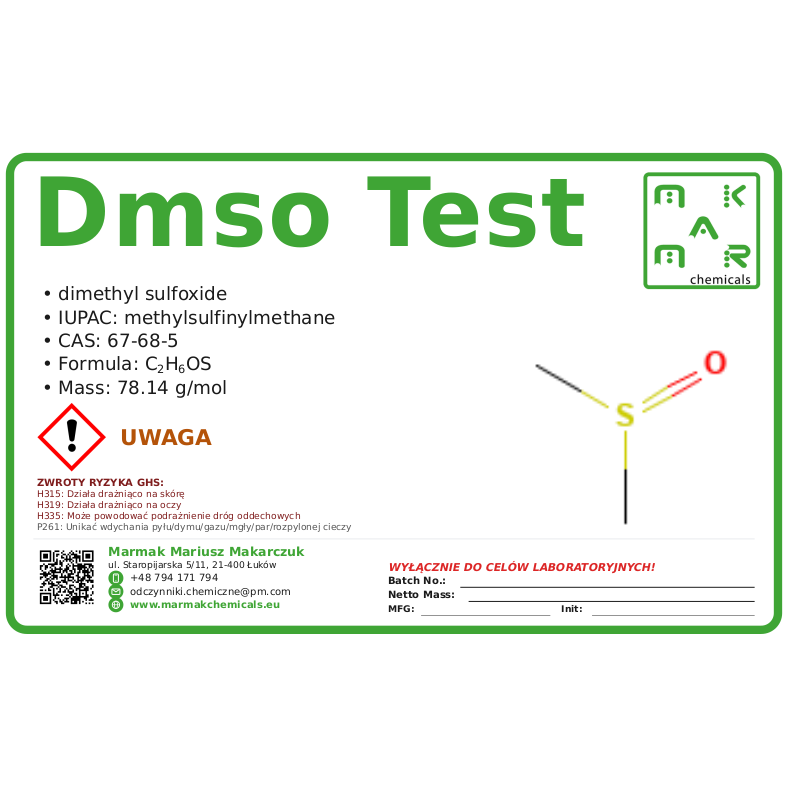


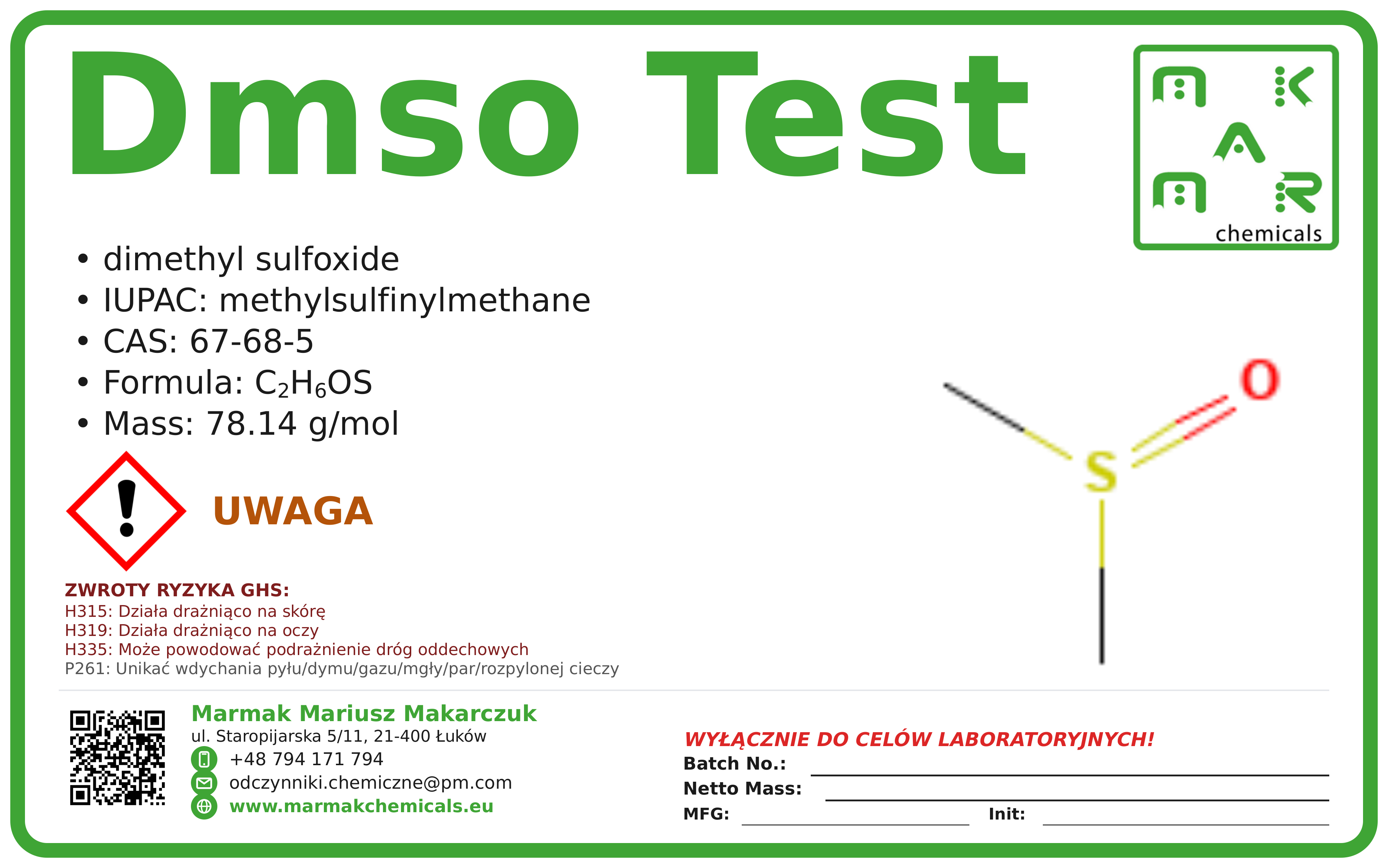
Reviews
There are no reviews yet.