Data sources:
PubChem, NIST Chemistry WebBook, CRC Handbook of Chemistry and Physics (103rd ed.)
Last updated: 2026-06-25
Status regulacyjny substancji
Ta substancja podlega wymogom regulacyjnym: gospodarka odpadami niebezpiecznymi (BDO). Szczegoly w sekcji "Status regulacyjny (REACH/ECHA/CLP)" oraz na karcie SDS. Informacja regulacyjna — nie ogranicza zakupu w sklepie.
📚 Die Buch-Bibliografie wartet auf ihre Erstellung. Kuratierte allgemeine Lehrbücher stehen unten zur Verfügung; CAS-spezifische Google-Books-Titel können über das Administrationspanel abgerufen werden.
National Institute of Standards and Technology. 2024. "NIST Chemistry WebBook, SRD 69." Gaithersburg, MD: NIST. Accessed 2025-01-01. ↗
Spectral Database for Organic Structure Determination (SDBS). 2024. National Institute of Advanced Industrial Science and Technology (AIST), Japan. Accessed 2025-01-01. ↗
Ulrich, Eldon L., Hideo Akutsu, John F. Doreleijers, Yoko Harano, Yannis E. Ioannidis, Jundong Lin, Miron Livny, et al. 2008. "BioMagResBank." Nucleic Acids Research 36 (D1): D402–D408. [DOI ↗]
Horai, Hisayuki, Masanori Arita, Shigehiko Kanaya, Yoshito Nihei, Tasuku Ikeda, Kazuhiro Suwa, Yuya Ojima, et al. 2010. "MassBank: A Public Repository for Sharing Mass Spectral Data for Life Sciences." Journal of Mass Spectrometry 45 (7): 703–714. [DOI ↗]
Linstrom, P.J., and W.G. Mallard, eds. 2024. NIST Chemistry WebBook, NIST Standard Reference Database Number 69. Gaithersburg, MD: National Institute of Standards and Technology. ↗
McDonald, M. Shane, Mike McAvoy, and Ajit Bhalerao. 1988. "JCAMP-DX: A Standard Form for Exchange of Infrared Spectra in Computer Readable Form." Applied Spectroscopy 42 (1): 151–162. [DOI ↗]
PubChem. 2024. "PubChem Compound Database." National Library of Medicine, National Institutes of Health. Accessed 2025-01-01. ↗
MolGod_SPECDB_SP2
📊Bazy widm spektroskopowych — dane inline9 źródełMolGod_SPECDB_2
Widma pobierane na żądanie z 9 źródeł. Każde widmo jest zapisywane w naszej bazie — kolejne otwarcie = zero zapytania do zewnętrznego API. Pobierz JCAMP-DX / CSV / PNG przy każdym widmie bez szukania.
Dane pobierane przez MolGod_Spectra_Remote_Fetcher (JCAMP-DX parser) i zapisywane w tabeli wp_molgod_spectra_cache. Zero duplikatów pobrań, zero zapytań do NIST przy kolejnych otwarciach. Licencje przestrzegane (publikowany tylko deep-link + własna wizualizacja).
Dane pobierane na żywo z wielu źródeł (priority-chain). JCAMP-DX / CSV / PNG dostępne do pobrania pod każdym widmem.
IR — Fourier-transform infrared
Ładowanie IR — Fourier-transform infrared…
MS — Mass spectrometry (EI 70eV)
Ładowanie MS — Mass spectrometry (EI 70eV)…
MolGod_DFT_SP5
🧮 Porównanie DFT vs eksperyment (IR)
Nakładka eksperymentalnego widma IR na obliczone teoretycznie metodą B3LYP/6-31G* (czynnik skalujący 0.9614, Scott & Radom 1996).
Eksperyment DFT (theoretical)
Pełne dane teoretyczne (geometria, częstości): NIST CCCBDB ↗
📚 Bibliografia (Chicago)
Becke, Axel D. 1993. "Density-Functional Thermochemistry. III. The Role of Exact Exchange." Journal of Chemical Physics 98 (7): 5648–5652. Definicja funkcjonału B3LYP.
Scott, Anthony P., and Leo Radom. 1996. "Harmonic Vibrational Frequencies: An Evaluation of Hartree–Fock, Møller–Plesset, Quadratic Configuration Interaction, Density Functional Theory, and Semiempirical Scale Factors." Journal of Physical Chemistry 100 (41): 16502–16513. Współczynniki skalujące dla DFT (np. 0.9614 dla B3LYP/6-31G*).
Merrick, Jeffrey P., Damian Moran, and Leo Radom. 2007. "An Evaluation of Harmonic Vibrational Frequency Scale Factors." Journal of Physical Chemistry A 111 (45): 11683–11700. Aktualizacja Scott & Radom — scale factors dla nowszych funkcjonałów DFT.
Lee, Chengteh, Weitao Yang, and Robert G. Parr. 1988. "Development of the Colle-Salvetti Correlation-Energy Formula into a Functional of the Electron Density." Physical Review B 37 (2): 785–789. Korelacja LYP — uzupełnienie Becke 1993 dla B3LYP.
Hehre, Warren J., Robert Ditchfield, and John A. Pople. 1972. "Self-Consistent Molecular Orbital Methods. XII. Further Extensions of Gaussian-Type Basis Sets." Journal of Chemical Physics 56 (5): 2257–2261. Definicja bazy 6-31G* (split-valence + polaryzacja).
Johnson, Russell D., III, ed. 2022. "NIST Computational Chemistry Comparison and Benchmark Database (CCCBDB)." NIST Standard Reference Database 101, Release 22. https://cccbdb.nist.gov. Benchmark dla wartości teoretycznych — fallback link w widget.
Cramer, Christopher J. 2004. "Essentials of Computational Chemistry: Theories and Models." 2nd ed. Chichester: Wiley. Podręcznik metod DFT i obliczeń częstości drgań.
Jensen, Frank. 2017. "Introduction to Computational Chemistry." 3rd ed. Chichester: Wiley. Modern computational chemistry — bazy + metody dla widm wibracyjnych.
Foresman, James B., and Æleen Frisch. 2015. "Exploring Chemistry with Electronic Structure Methods." 3rd ed. Wallingford, CT: Gaussian, Inc. Praktyczny przewodnik Gaussian — IR + Raman + NMR z DFT.
MolGod_SPECGUIDE_SP6
🎓 Przewodnik interpretacji widm (dla studentów)
Auto-wygenerowane wyjaśnienia każdego pasma w widmie — dlaczego pojawia się tam, gdzie się pojawia, i co świadczy o strukturze.
IR (infrared) (440 pików)
Widmo IR (infrared) zawiera 440 zidentyfikowanych pasm. Poniższa analiza tłumaczy, co każde z nich znaczy strukturalnie i dlaczego pojawia się w danym zakresie.
C=O stretch (carboxylic acid)COOH● high
Pasmo "C=O stretch (carboxylic acid)" pojawia się w przypadkach: 1,722.0 cm⁻¹ (silne (s)), 2,506.0 cm⁻¹ (silne (s)), 2,514.0 cm⁻¹ (silne (s)). Bardzo szerokie O–H (~2500–3300) + C=O (~1710) razem to klasyczna sygnatura kwasu karboksylowego (dimer).
O–H stretch (H-bonded, alcohol/acid)OH● high
Pasmo "O–H stretch (H-bonded, alcohol/acid)" pojawia się w przypadkach: 3,202.0 cm⁻¹ (silne (s)), 3,210.0 cm⁻¹ (silne (s)), 3,218.0 cm⁻¹ (silne (s)). Świadczy o obecności wiązań O–H (alkohol/kwas/woda). Szerokie pasmo wynika z tworzenia mostków wodorowych w stanie ciekłym/stałym.
C–H bend (CH3, CH2 — methyl/methylene)CH3/CH2● high
Pasmo "C–H bend (CH3, CH2 — methyl/methylene)" pojawia się w przypadkach: 1,434.0 cm⁻¹ (silne (s)), 1,442.0 cm⁻¹ (silne (s)), 1,450.0 cm⁻¹ (silne (s)). To rozciąganie alifatycznych C–H sp³. Obecne praktycznie w każdym związku organicznym z łańcuchem alkilowym.
C–H stretch (=C–H, aromatic/vinyl)CH_arom● high
Pasmo "C–H stretch (=C–H, aromatic/vinyl)" pojawia się w przypadkach: 3,034.0 cm⁻¹ (silne (s)), 3,042.0 cm⁻¹ (silne (s)), 3,050.0 cm⁻¹ (silne (s)). C–H przy pierścieniu aromatycznym (sp²) — zawsze powyżej 3000 cm⁻¹, w odróżnieniu od alkilowych C–H.
C=O stretch (amide I)CONH2● high
Pasmo "C=O stretch (amide I)" pojawia się w przypadkach: 1,634.0 cm⁻¹ (silne (s)), 1,642.0 cm⁻¹ (silne (s)), 1,650.0 cm⁻¹ (silne (s)). Amid I (C=O) i amid II (N–H bend) razem dają charakterystyczny duet w okolicy 1660 + 1550 cm⁻¹.
C≡N stretch (nitrile)CN● high
Pasmo "C≡N stretch (nitrile)" pojawia się w przypadkach: 2,210.0 cm⁻¹ (silne (s)), 2,218.0 cm⁻¹ (silne (s)), 2,226.0 cm⁻¹ (silne (s)). C≡N nitrylu daje cienkie, wyraźne pasmo ~2250 cm⁻¹ — łatwo odróżnić od C≡C, które jest słabsze i bywa nieobecne (symetria).
📚 Bibliografia (Chicago)
Field, Leslie D., Sev Sternhell, and John R. Kalman. 2013. "Organic Structures from Spectra." 5th ed. Chichester: Wiley. Studencki problem-set podręcznik (interpretation guide companion).
Williams, Dudley H., and Ian Fleming. 2008. "Spectroscopic Methods in Organic Chemistry." 6th ed. London: McGraw-Hill. Klasyk narratywnej interpretacji widm — wyjaśnia "dlaczego pik tu".
Crews, Phillip, Jaime Rodríguez, and Marcel Jaspars. 2009. "Organic Structure Analysis." 2nd ed. New York: Oxford University Press. Workflow strukturalnej interpretacji wieloparametrycznej.
McLafferty, Fred W., and František Tureček. 1993. "Interpretation of Mass Spectra." 4th ed. Mill Valley, CA: University Science Books. Mechanizmy fragmentacji MS — McLafferty rearrangement, m/z 29 = CHO.
Reusch, William. 2013. "Virtual Textbook of Organic Chemistry: Spectroscopy." East Lansing, MI: Michigan State University. https://www2.chemistry.msu.edu/faculty/reusch/VirtTxtJml/Spectrpy/spectro.htm. Otwarty dydaktyczny przewodnik po IR/NMR/MS/UV — ideal do wyjaśnień grup funkcyjnych.
Hesse, Manfred, Herbert Meier, and Bernd Zeeh. 2007. "Spektroskopische Methoden in der organischen Chemie." 8th ed. Stuttgart: Thieme. Niemiecki standardowy podręcznik interpretacji widm.
Lampman, Gary M., Donald L. Pavia, George S. Kriz, and James R. Vyvyan. 2010. "Spectroscopy." 4th ed. Belmont, CA: Cengage Learning. Workbook ze sklejonymi narracjami interpretacyjnymi.
Kalsi, P. S. 2010. "Spectroscopy of Organic Compounds." 6th ed. New Delhi: New Age International. Kompletny podręcznik interpretacji widm IR/NMR/MS/UV.
MolGod_MS_SP7
🔎 Wyszukiwanie po widmie (JCAMP-DX)
Wgraj plik JCAMP-DX (.jdx, .dx, .jcm) — system policzy podobieństwo cosinusowe do wszystkich widm w bazie i pokaże TOP 10 dopasowań.
📚 Bibliografia (Chicago)
McLafferty, Fred W., ed. 2018. Wiley Registry of Mass Spectral Data. 11th ed. Hoboken, NJ: Wiley. Referencyjna biblioteka MS (~775k widm).
Stein, Stephen E., and Donald R. Scott. 1994. "Optimization and Testing of Mass Spectral Library Search Algorithms for Compound Identification." Journal of the American Society for Mass Spectrometry 5 (9): 859–866. Algorytm cosine + dot-product NIST MS Search.
McDonald, Robert S., and Paul A. Wilks Jr. 1988. "JCAMP-DX: A Standard Form for Exchange of Infrared Spectra in Computer Readable Form." Applied Spectroscopy 42 (1): 151–162. Specyfikacja JCAMP-DX (rozszerzona do 5.01 dla NMR/MS).
McLafferty, Fred W., and František Tureček. 1993. "Interpretation of Mass Spectra." 4th ed. Mill Valley, CA: University Science Books. Cosine similarity matching i fragmentacja MS — fundament algorytmu wyszukiwania.
Sumner, Lloyd W., Alexander Amberg, Dave Barrett, Michael H. Beale, Richard Beger, Clare A. Daykin, Teresa W.-M. Fan, et al. 2007. "Proposed Minimum Reporting Standards for Chemical Analysis." Metabolomics 3 (3): 211–221. MSI Level 1-4 — standardy poziomu pewności dopasowania widmowego.
Stein, Stephen E. 1999. "An Integrated Method for Spectrum Extraction and Compound Identification from Gas Chromatography/Mass Spectrometry Data." Journal of the American Society for Mass Spectrometry 10 (8): 770–781. Algorytm AMDIS — dekonwolucja + library match (NIST).
Lindon, John C., George E. Tranter, and David W. Koppenaal, eds. 2017. "Encyclopedia of Spectroscopy and Spectrometry." 3rd ed. Amsterdam: Academic Press. Encyklopedyczne hasła dot. spectral library searching.
Smith, Brian C. 2011. "Fundamentals of Fourier Transform Infrared Spectroscopy." 2nd ed. Boca Raton, FL: CRC Press. FT-IR i format JCAMP-DX dla widm transmisyjnych.
Larkin, Peter. 2017. "Infrared and Raman Spectroscopy: Principles and Spectral Interpretation." 2nd ed. Amsterdam: Elsevier. Principles of IR/Raman library matching i preprocessing peakow.
📐Physical & Chemical Properties (DB)
17 fields MolGod Score: Pierwszorzędne
Haynes, William M., ed. 2024. CRC Handbook of Chemistry and Physics. 105th ed. Boca Raton: CRC Press/Taylor & Francis. ISBN 978-1-032-55554-4. ↗
National Institute of Standards and Technology. 2024. "NIST Chemistry WebBook, SRD 69." Gaithersburg, MD: NIST. Accessed 2025-01-01. ↗
Yaws, Carl L. 2014. The Yaws Handbook of Physical Properties for Hydrocarbons and Chemicals. 2nd ed. Oxford: Gulf Professional Publishing.
PubChem. 2024. "PubChem Compound Database." National Library of Medicine, National Institutes of Health. Accessed 2025-01-01. ↗
Marrero, J., and R. Gani. 2001. "Group-Contribution Based Estimation of Pure Component Properties." Fluid Phase Equilibria 183–184: 183–208. ↗
Joback, K. G., and R. C. Reid. 1987. "Estimation of Pure-Component Properties from Group-Contributions." Chemical Engineering Communications 57 (1–6): 233–243. ↗
Sangster, J. 1997. Octanol-Water Partition Coefficients: Fundamentals and Physical Chemistry. Chichester: Wiley. ISBN 978-0-471-97397-3.
Mannhold, Raimund, and Han van de Waterbeemd. 2001. "Substructure and Whole Molecule Approaches for Calculating Log P." Journal of Computer-Aided Molecular Design 15 (4): 337–354. ↗
Perrin, Ditlev D., Boyd Dempsey, and E. P. Serjeant. 1981. pKa Prediction for Organic Acids and Bases. London: Chapman and Hall. ISBN 0-412-21090-5.
Constantinou, Leonidas, and Rafiqul Gani. 1994. "New Group Contribution Method for Estimating Properties of Pure Compounds." AIChE Journal 40 (10): 1697–1710. ↗
Ertl, Peter, Bernhard Rohde, and Paul Selzer. 2000. "Fast Calculation of Molecular Polar Surface Area as a Sum of Fragment-Based Contributions and Its Application to the Prediction of Drug Transport Properties." Journal of Medicinal Chemistry 43 (20): 3714–3717. ↗
🔄 Konwerter jednostek stężeń LIVEMolGod_UNITCONV_1
/* translators: %s, %d itd. to wartosci dynamiczne wstawiane do komunikatu. */
Wpisz stężenie Kofeina w dowolnej jednostce — reszta obliczy się automatycznie.
Cohen ER, Cvitaš T, Frey JG, Holmström B, Kuchitsu K, Marquardt R, Mills I, Pavese F, Quack M, Stohner J, Strauss HL, Takami M, Thor AJ (2007)
g/L ↔ molarity
c (mol/L) = (g/L) / MW
±0.1% (depends on MW precision)
Cohen ER, Cvitaš T, Frey JG, Holmström B, Kuchitsu K, Marquardt R, Mills I, Pavese F, Quack M, Stohner J, Strauss HL, Takami M, Thor AJ (2007)
mmol/L ↔ molarity
c (mol/L) = mmol/L × 10⁻³
Exact
Cohen ER, Cvitaš T, Frey JG, Holmström B, Kuchitsu K, Marquardt R, Mills I, Pavese F, Quack M, Stohner J, Strauss HL, Takami M, Thor AJ (2007)
Celsius ↔ Kelvin
T(K) = t(°C) + 273.15
±0.01 K (ITS-90 scale)
BIPM (Bureau International des Poids et Mesures) (2019)
Celsius ↔ Fahrenheit
T(°F) = T(°C) × 9/5 + 32
±0.1 °F
Thompson A, Taylor BN (2008)
density-corrected % ↔ molarity
c (mol/L) = (%w/w × ρ × 10) / MW, ρ in g/mL
±0.1% when ρ known to 3 decimals
Cohen ER, Cvitaš T, Frey JG, Holmström B, Kuchitsu K, Marquardt R, Mills I, Pavese F, Quack M, Stohner J, Strauss HL, Takami M, Thor AJ (2007)
📚 Bibliografia (8 źródeł autorytatywnych)
Thompson A, Taylor BN (2008). Guide for the Use of the International System of Units (SI). NIST Special Publication 811 · DOI: 10.6028/NIST.SP.811-2008 → Primary SI standard for US scientific usage
Cohen ER, Cvitaš T, Frey JG, Holmström B, Kuchitsu K, Marquardt R, Mills I, Pavese F, Quack M, Stohner J, Strauss HL, Takami M, Thor AJ (2007). Quantities, Units and Symbols in Physical Chemistry — The IUPAC Green Book. RSC Publishing, 3rd ed. · DOI: 10.1039/9781847557889 · ISBN: 978-0-85404-433-7 → Canonical IUPAC guide for chemistry quantities/units
BIPM (Bureau International des Poids et Mesures) (2019). The International System of Units (SI), 9th edition. BIPM · ↗ → International SI definitions (incl. redefined kilogram 2019)
ISO/IEC (2022). Quantities and units — Part 1: General. International Organization for Standardization — ISO 80000-1:2022 · ↗ → General rules for physical quantities and units
ISO/IEC (2019). Quantities and units — Part 9: Physical chemistry and molecular physics. International Organization for Standardization — ISO 80000-9:2019 · ↗ → Concentration / molality / amount-of-substance conventions
Tiesinga E, Mohr PJ, Newell DB, Taylor BN (2021). CODATA recommended values of the fundamental physical constants: 2018. Rev. Mod. Phys. 93(2):025010 · DOI: 10.1103/RevModPhys.93.025010 → Avogadro, gas constant, molar volume (2019 SI revision)
IUPAC (2019). Compendium of Chemical Terminology — the IUPAC Gold Book (online). IUPAC · DOI: 10.1351/goldbook → Definitions of mass fraction, molality, normality, ppm, activity
Mills IM, Cvitaš T, Homann K, Kallay N, Kuchitsu K (1988). Quantities, Units and Symbols in Physical Chemistry. Blackwell Scientific Publications, 1st ed. · ISBN: 0-632-01773-5 → Historical predecessor of IUPAC Green Book
Rumble, John R., ed. 2023. CRC Handbook of Chemistry and Physics. 104th ed. Boca Raton, FL: CRC Press. [link ↗]
International Association for the Properties of Water and Steam (IAPWS). 1997. "Release on the Static Dielectric Constant of Ordinary Water Substance." IAPWS R8-97. [link ↗]
Reichardt, Christian, and Thomas Welton. 2011. Solvents and Solvent Effects in Organic Chemistry. 4th ed. Weinheim: Wiley-VCH. https://doi.org/10.1002/9783527632220. [link ↗]
Hansen, Charles M. 2007. Hansen Solubility Parameters: A User's Handbook. 2nd ed. Boca Raton, FL: CRC Press. https://doi.org/10.1201/9781420006834. [link ↗]
IFA. n.d. "Water." GESTIS Substance Database. Institut für Arbeitsschutz der Deutschen Gesetzlichen Unfallversicherung. Accessed April 25, 2026. [link ↗]
Rumble, John R., ed. 2023. CRC Handbook of Chemistry and Physics. 104th ed. Boca Raton, FL: CRC Press. [link ↗]
Reichardt, Christian, and Thomas Welton. 2011. Solvents and Solvent Effects in Organic Chemistry. 4th ed. Weinheim: Wiley-VCH. https://doi.org/10.1002/9783527632220. [link ↗]
Snyder, Lloyd R., Joseph J. Kirkland, and John W. Dolan. 2010. Introduction to Modern Liquid Chromatography. 3rd ed. Hoboken, NJ: Wiley. https://doi.org/10.1002/9780470508183. [link ↗]
Smallwood, Ian M. 1996. Handbook of Organic Solvent Properties. London: Arnold. https://doi.org/10.1016/B978-0-340-64578-9.X5000-9. [link ↗]
Reichardt, Christian, and Thomas Welton. 2011. Solvents and Solvent Effects in Organic Chemistry. 4th ed. Weinheim: Wiley-VCH. https://doi.org/10.1002/9783527632220. [link ↗]
Hansen, Charles M. 2007. Hansen Solubility Parameters: A User's Handbook. 2nd ed. Boca Raton, FL: CRC Press. [link ↗]
Rumble, John R., ed. 2023. CRC Handbook of Chemistry and Physics. 104th ed. Boca Raton, FL: CRC Press. [link ↗]
Smallwood, Ian M. 1996. Handbook of Organic Solvent Properties. London: Arnold. [link ↗]
National Institute of Standards and Technology. n.d. "Methane, dichloro- (CAS 75-09-2)." NIST Chemistry WebBook, SRD 69. Accessed April 25, 2026. [link ↗]
Hansen, Charles M. 2007. Hansen Solubility Parameters: A User's Handbook. 2nd ed. Boca Raton, FL: CRC Press. [link ↗]
International Agency for Research on Cancer. 1999. "Dichloromethane." IARC Monographs on the Evaluation of Carcinogenic Risks to Humans 71: 251–315. [link ↗]
Reichardt, Christian, and Thomas Welton. 2011. Solvents and Solvent Effects in Organic Chemistry. 4th ed. Weinheim: Wiley-VCH. [link ↗]
Armarego, Wilfred L. F., and Christina Li Lin Chai. 2009. Purification of Laboratory Chemicals. 6th ed. Oxford: Butterworth-Heinemann. https://doi.org/10.1016/B978-1-85617-567-8.50003-3. [link ↗]
Hansen, Charles M. 2007. Hansen Solubility Parameters: A User's Handbook. 2nd ed. Boca Raton, FL: CRC Press. [link ↗]
National Institute of Standards and Technology. n.d. "Furan, tetrahydro- (CAS 109-99-9)." NIST Chemistry WebBook. Accessed April 25, 2026. [link ↗]
Smallwood, Ian M. 1996. Handbook of Organic Solvent Properties. London: Arnold. [link ↗]
National Institute of Standards and Technology. n.d. "Hexane (CAS 110-54-3)." NIST Chemistry WebBook. Accessed April 25, 2026. [link ↗]
Hansen, Charles M. 2007. Hansen Solubility Parameters: A User's Handbook. 2nd ed. Boca Raton, FL: CRC Press. [link ↗]
Snyder, Lloyd R., Joseph J. Kirkland, and John W. Dolan. 2010. Introduction to Modern Liquid Chromatography. 3rd ed. Hoboken, NJ: Wiley. [link ↗]
Agency for Toxic Substances and Disease Registry. 1999. Toxicological Profile for n-Hexane. Atlanta, GA: U.S. Department of Health and Human Services. [link ↗]
International Agency for Research on Cancer. 1999. "Chloroform." IARC Monographs on the Evaluation of Carcinogenic Risks to Humans 73: 131–182. [link ↗]
National Institute of Standards and Technology. n.d. "Methane, trichloro- (CAS 67-66-3)." NIST Chemistry WebBook. Accessed April 25, 2026. [link ↗]
Hansen, Charles M. 2007. Hansen Solubility Parameters: A User's Handbook. 2nd ed. Boca Raton, FL: CRC Press. [link ↗]
Reichardt, Christian, and Thomas Welton. 2011. Solvents and Solvent Effects in Organic Chemistry. 4th ed. Weinheim: Wiley-VCH. [link ↗]
Teoria rozpuszczalnosci (zastosowane w przewidywaniu kompatybilnosci):
Yalkowsky, Samuel H., and Shri C. Valvani. 1980. "Solubility and Partitioning I: Solubility of Nonelectrolytes in Water." Journal of Pharmaceutical Sciences 69 (8): 912–922. https://doi.org/10.1002/jps.2600690814 — General Solubility Equation (GSE): logS = 0.5 − logP − 0.01(MP−25).
Hansen, Charles M. 2007. Hansen Solubility Parameters: A User's Handbook. 2nd ed. Boca Raton, FL: CRC Press. https://doi.org/10.1201/9781420006834 — HSP triplet (dD, dP, dH) + wzór Ra.
Reichardt, Christian, and Thomas Welton. 2011. Solvents and Solvent Effects in Organic Chemistry. 4th ed. Weinheim: Wiley-VCH. https://doi.org/10.1002/9783527632220 — E_T(30) polarity scale, solwatochromia.
Snyder, Lloyd R., Joseph J. Kirkland, and John W. Dolan. 2010. Introduction to Modern Liquid Chromatography. 3rd ed. Hoboken, NJ: Wiley. https://doi.org/10.1002/9780470508183 — Eluotropic series, polarity index.
PubChem Compound Database — CAS 58-08-2 lookup ↗ — logP (XLogP3), water solubility experimental + predicted.
Kompletna bibliografia w akordeonie REFERENCJE (na dole strony) — Chicago Manual of Style 17th ed., Author-Date.
🔬Purity Check GuideQuality Control
MolGod_PURITY_1
Verify reagent purity using standardized analytical methods. Select a test method below and enter your measurement results for automated calculation.
🛡️ Bezpieczeństwo — CAS 58-08-2MolGod_SAFEHUB_MAIN
Informacja o ograniczeniach danych. Informacje dotyczące bezpieczeństwa zawarte na tej stronie mają charakter informacyjny i nie zastępują pełnej karty charakterystyki (SDS). Przed użyciem produktu zapoznaj się z aktualną kartą charakterystyki producenta oraz wytycznymi GHS/CLP. Klasyfikacja CLP dotyczy czystej substancji bulk, nie preparatów handlowych.
MolGod_GHS_SF1
Klasyfikacja GHS/CLP — Rozporządzenie (WE) nr 1272/2008 + UN GHS Rev. 9 (2021).
⚠ Uwaga (Warning)
❗GHS07Drażniące / szkodliwe
🚨 Zwroty wskazujące rodzaj zagrożenia (H)
H302 — Działa szkodliwie po połknięciu
🛡 Zwroty określające środki ostrożności (P)
P264 — Dokładnie umyć ręce po użyciu
✓ Klasyfikacja zharmonizowana zgodnie z załącznikiem VI do rozporządzenia CLP (WE) 1272/2008 (klasyfikacja urzędowa, wiążąca). Numer indeksowy: 613-086-00-5.
Referencja (Chicago): European Chemicals Agency. "caffeine, Index No. 613-086-00-5." In Table 3 of Annex VI to Regulation (EC) No 1272/2008 (CLP Regulation), 23rd Adaptation to Technical Progress. Helsinki: European Chemicals Agency, 2026. https://echa.europa.eu/information-on-chemicals/annex-vi-to-clp.
Tłumaczenia: Rozporządzenie CLP (WE) 1272/2008, Załącznik III i IV. Dane: PubChem/NLM.
MolGod_TOX_SF2
☢️ Dane toksykologiczne (IARC + EPA CTX)
📖 Streszczenie toksykologiczne
Kofeina (1,3,7-trimetyloksantyna, CAS 58-08-2) jest najszerzej spożywanym związkiem psychoaktywnym na świecie, o dobrze scharakteryzowanym profilu bezpieczeństwa. LD50 doustnie u szczura wynosi ~192 mg/kg masy ciała wg danych NIOSH/RTECS [1], wartość zbliżona do cytowanej przez EFSA (~200 mg/kg) [2]; cross-referencja [1,2]; klasa 4 Hodge'a i Sternera ("umiarkowanie toksyczna"). Mechanizm działania: kompetycyjny antagonizm receptorów adenozynowych A₁ i A₂A w ośrodkowym układzie nerwowym [3]. IARC w Monografii 116 (2016) potwierdziła brak przekonujących dowodów kancerogenności kofeiny jako czystego związku; kawa sklasyfikowana do Grupy 3 w 1991 r. a w 2016 r. przeniesiona do kategorii "not classifiable" [4]. Brak zharmonizowanej klasyfikacji CMR w Aneksie VI CLP [5]. EFSA (2015, opinia na podstawie 740 publikacji naukowych): pojedyncze dawki ≤ 200 mg (≈ 3 mg/kg mc.) są bezpieczne dla zdrowych dorosłych; dzienna dawka ≤ 400 mg nie stwarza obaw zdrowotnych w ogólnej populacji dorosłych; kobiety ciężarne: ≤ 200 mg/dobę; dzieci/młodzież: ≤ 3 mg/kg mc./dobę [2]. Objawy ostrego zatrucia (> 1 g doustnie): tachyarytmia, hipertermia, drgawki; przypadki śmiertelne dotyczą wyłącznie skoncentrowanych suplementów kofeiny [3].
🔖 Cytowania źródłowe (6) — Chicago Notes-Bibliography
U.S. National Institute for Occupational Safety and Health (NIOSH) / Registry of Toxic Effects of Chemical Substances (RTECS). 2023. "Caffeine (CAS 58-08-2)." RTECS No. EV6475000. Atlanta: CDC/NIOSH. https://www.cdc.gov/niosh/rtecs/. [LD50 oral rat ≈ 192 mg/kg.]
EFSA Panel on Dietetic Products, Nutrition and Allergies (NDA). 2015. "Scientific Opinion on the Safety of Caffeine." EFSA Journal 13(5):4102. DOI: 10.2903/j.efsa.2015.4102. [Peer-reviewed; open-access; LD50 ≈ 200 mg/kg; UL 400 mg/dobę dorośli; 200 mg/dobę ciąża.]
International Agency for Research on Cancer (IARC). 2018. IARC Monographs on the Evaluation of Carcinogenic Risks to Humans, vol. 116: Coffee, Maté, Very Hot Beverages. Lyon: IARC/WHO. https://publications.iarc.who.int/566.
ECHA. 2023. "Regulation (EC) No 1272/2008 — Annex VI Harmonised Classification, Table 3.1." European Chemicals Agency. https://echa.europa.eu/regulations/clp/legislation. [Kofeina nie ujęta jako CMR.]
Cappelletti, Simone, Paola Daria, Giorgio Sani, and Mariarosaria Aromatario. 2015. "Caffeine: Cognitive and Physical Performance Enhancer or Psychoactive Drug?" Current Neuropharmacology 13(1):71–88. DOI: 10.2174/1570159X13666141210215655. [Peer-reviewed; objawy przedawkowania.]
Format: Chicago Notes-Bibliography (numbered). [n,m] = cross-reference: oba źródła niezależnie potwierdzają tę samą wartość. DOI-links = recenzowane badania naukowe. RESTRICTED = dostęp przez bibliotekę naukową.
Poniższe kody to dodatkowe zgłoszenia własne dostawców (samoklasyfikacja, notyfikacje ECHA C&L / PubChem) — uzupełnienie do wiążącej klasyfikacji zharmonizowanej Annex VI powyżej; bywają nadmiarowe.
Najwyższy zgłoszony sygnał ostrzegawczy: Warning
(wg zgłoszeń notyfikujących, niewiążące)
📚 Źródła · Bibliografia (Chicago Notes-Bibliography)
Numeracja [n] odpowiada przypisom górnym w tekście powyżej. [n,m] = cross-referencja: oba źródła niezależnie potwierdzają tę samą wartość.
U.S. National Institute for Occupational Safety and Health (NIOSH) / Registry of Toxic Effects of Chemical Substances (RTECS). 2023. "Caffeine (CAS 58-08-2)." RTECS No. EV6475000. Atlanta: CDC/NIOSH. https://www.cdc.gov/niosh/rtecs/. [LD50 oral rat ≈ 192 mg/kg.] 🔗
EFSA Panel on Dietetic Products, Nutrition and Allergies (NDA). 2015. "Scientific Opinion on the Safety of Caffeine." EFSA Journal 13(5):4102. DOI: 10.2903/j.efsa.2015.4102. [Peer-reviewed; open-access; LD50 ≈ 200 mg/kg; UL 400 mg/dobę dorośli; 200 mg/dobę ciąża.] [DOI]
International Agency for Research on Cancer (IARC). 2018. IARC Monographs on the Evaluation of Carcinogenic Risks to Humans, vol. 116: Coffee, Maté, Very Hot Beverages. Lyon: IARC/WHO. https://publications.iarc.who.int/566. 🔗
ECHA. 2023. "Regulation (EC) No 1272/2008 — Annex VI Harmonised Classification, Table 3.1." European Chemicals Agency. https://echa.europa.eu/regulations/clp/legislation. [Kofeina nie ujęta jako CMR.] 🔗
Cappelletti, Simone, Paola Daria, Giorgio Sani, and Mariarosaria Aromatario. 2015. "Caffeine: Cognitive and Physical Performance Enhancer or Psychoactive Drug?" Current Neuropharmacology 13(1):71–88. DOI: 10.2174/1570159X13666141210215655. [Peer-reviewed; objawy przedawkowania.] [DOI]
📖 Ogólna literatura toksykologiczna (moduł)
International Agency for Research on Cancer (IARC). 2024. "IARC Monographs on the Identification of Carcinogenic Hazards to Humans." Lyon: IARC. 🔗
U.S. EPA. 2024. "ECOTOX Knowledgebase." Washington, DC: U.S. Environmental Protection Agency. 🔗
ECHA. 2024. "Chemical Safety Assessment." European Chemicals Agency. 🔗
U.S. National Toxicology Program. 2024. Report on Carcinogens. 15th ed. Research Triangle Park, NC: National Institute of Environmental Health Sciences. 🔗
GESTIS. 2024. "GESTIS Substance Database." Institute for Occupational Safety and Health of the German Social Accident Insurance (DGUV). 🔗
U.S. EPA. 2024. "CompTox Chemicals Dashboard." Washington, DC: U.S. Environmental Protection Agency. 🔗
ECHA. 2023. "Regulation (EC) No 1272/2008 on Classification, Labelling and Packaging of Substances and Mixtures (CLP), Annex VI — Harmonised Classification." European Chemicals Agency. 🔗
Leist, Marcel, et al. 2014. "Consensus Report on the Future of Animal-Free Systemic Toxicity Testing." ALTEX 31 (3): 341–356. [DOI]
Hartung, Thomas. 2009. "Toxicology for the Twenty-First Century." Nature 460 (7252): 208–212. [DOI]
Lenga, Robert E., ed. 2008. The Sigma-Aldrich Library of Chemical Safety Data. 2nd ed. Milwaukee: Sigma-Aldrich.
Slikker, William Jr., et al. 2004. "Dose-Dependent Terminal and Tissue Residues After Chronic Exposure." Toxicological Sciences 81 (2): 253–279. [DOI]
Calabrese, Edward J., and Linda A. Baldwin. 2003. "Toxicology Rethinks Its Central Belief." Nature 421 (6924): 691–692. [DOI]
Hodge, Harold C., and J. Harvey Sterner. 1949. "Tabulation of Toxicity Classes." American Industrial Hygiene Association Quarterly 10 (4): 93–96. [DOI]
MolGod_AID_SF3
🆘 Pierwsza pomoc — procedury awaryjneCAS 58-08-2
Niebezpieczeństwo / Danger
Klasa zagrożenia: TOXIC
⚠️ WAŻNE:
W razie poważnego incydentu — dzwoń 112 lub Centrum Zatruć: +48 42 631 47 24 (Łódź).
🩹
Kontakt ze skórą
⏱ Tempo: Brak ostrych objawów; ewentualne podrażnienie po >30 min
🔴 Objawy
Brak — substancja farmakologicznie czynna ale niskie wchłanianie skórne
✅ Co robić
Spłucz wodą z mydłem
Krem nawilżający przy suchej skórze
🚑 Karetka: Brak — utrzymujące się objawy >24h skontaktuj lekarza POZ
WHO 2007; ECHA Substance Infocard
👁️
Kontakt z oczami
⏱ Tempo: Natychmiastowe ustępujące podrażnienie
🔴 Objawy
Łagodne podrażnienie spojówek
✅ Co robić
Płucz wodą 5–15 min
Konsultacja okulisty jeśli pieczenie >30 min
🚑 Karetka: Brak — chyba że ból utrzymuje się >1h
NIOSH Pocket Guide; ANSI Z358.1-2014
🫁
Wdychanie / drogi oddechowe
⏱ Tempo: n/d
🔴 Objawy
Brak objawów (bezpieczne)
✅ Co robić
Świeże powietrze przy zauważalnym pyle/zapachu
🚑 Karetka: Brak
NIOSH Pocket Guide
🩺
Połknięcie / droga pokarmowa
⏱ Tempo: Tachykardia 30–60 min; arytmia >2 g 1–4h
🔴 Objawy
Tachykardia, drżenie >500 mg
Arytmia, drgawki >5 g
Śmierć >10 g (czysta kofeina)
✅ Co robić
Centrum Zatruć przy spożyciu >2 g czystej kofeiny
Karetka przy >5 g lub objawach arytmii
❌ Czego unikać
NIE bagatelizuj proszku (1 łyżeczka ≈ 4 g = śmiertelne!)
🚑 Karetka: Spożycie >2 g czystej kofeiny OR objawy arytmii
🧰 Apteczka pierwszej pomocy — wymagane wyposażenie
Butelka do przemywania oczu (≥500 mL, ANSI Z358.1)
Saline solution 0.9% NaCl (sterylna, ≥250 mL)
Bandaże jałowe + plastry hipoalergiczne
Lateksowe rękawice ratownicze (rozmiar M/L/XL)
Maska ochronna FFP2/FFP3
Termometr bezkontaktowy
Węgiel aktywny (50 g)
Ipecac syrup — TYLKO z konsultacji toksykologa
📚 Źródła (Chicago Author-Date)
Goldfrank, Lewis R., Robert S. Hoffman, Mary Ann Howland, Neal A. Lewin, Lewis S. Nelson, and Silas W. Smith. 2019. Goldfrank's Toxicologic Emergencies. McGraw-Hill Education.
Olson, Kent R., Ilene B. Anderson, Neal L. Benowitz, Paul D. Blanc, Richard F. Clark, Thomas E. Kearney, Susan Y. Kim-Katz, and Alan H. B. Wu. 2018. Poisoning & Drug Overdose. McGraw-Hill.
World Health Organization (WHO). 2007. Antidotes for Poisoning by Cyanide (IPCS Evaluation Series 21). International Programme on Chemical Safety, WHO Press. ↗
Howland, Mary Ann, and Robert S. Aaron. 2002. Goldfrank's Antidotes for Pediatric Emergency Care. Lippincott Williams & Wilkins.
Centrum Zatruć Łódź. 2024. Procedury kliniczne w zatruciach ostrych — wytyczne dla ratowników. Centrum Informacji Toksykologicznej. ↗
National Institute for Occupational Safety and Health (NIOSH). 2007. Recommendations for First Aid Procedures for Chemical Exposures (NIOSH Pocket Guide to Chemical Hazards, DHHS Publication No. 2005-149). U.S. Department of Health and Human Services. ↗
United Nations Economic Commission for Europe (UNECE). 2021. Globally Harmonized System of Classification and Labelling of Chemicals (GHS), Revision 9. United Nations. ↗
Brent, Jeffrey. 2009. Fomepizole for the Treatment of Pediatric Ethylene and Diethylene Glycol, Butoxyethanol, and Methanol Poisonings. Clinical Toxicology 48(5): 401–406.
European Society for Paediatric Gastroenterology, Hepatology and Nutrition (ESPGHAN). 2018. Caustic Ingestion in Children — Position Paper. Journal of Pediatric Gastroenterology and Nutrition 66(5): 838–845.
Agency for Toxic Substances and Disease Registry (ATSDR). 2024. Toxicological Profiles — Medical Management Guidelines. U.S. Department of Health and Human Services. ↗
IPCS INCHEM. 2024. International Programme on Chemical Safety — Poisons Information Monographs. WHO/UNEP/ILO. ↗
American National Standards Institute (ANSI). 2014. ANSI Z358.1-2014 — Emergency Eyewash and Shower Equipment. International Safety Equipment Association.
MolGod_SPILL_SF4
🚨 Procedura awaryjna — rozlanie chemikaliówTOXIC
CAS 58-08-2GHS:H302💨 Wentylacja
🥽 PPE — Środki ochrony osobistej
Gloves:nitrile_powder_free
Goggles:Tak
Respirator:dust_mask_P2
Suit:lab_coat
📦 Małe rozlanie (<1L) — absorbent: dry vacuum with HEPA filter
International Agency for Research on Cancer (IARC). 2018. Caffeine — IARC Group 3 (not classifiable) (IARC Monograph Vol. 51). WHO Press.
[link ↗]
Goldfrank, Lewis R., Neal Flomenbaum, Neal A. Lewin, Mary Ann Howland, Robert S. Hoffman, and Lewis S. Nelson. 2015. Goldfrank's Toxicologic Emergencies. McGraw-Hill Education.
10th ed. ISBN 978-0-07-180184-3.
U.S. Occupational Safety and Health Administration. 2024. 29 CFR 1910.120 — Hazardous Waste Operations and Emergency Response (HAZWOPER). U.S. Code of Federal Regulations.
[link ↗]
National Fire Protection Association. 2018. NFPA 472: Standard for Competence of Responders to Hazardous Materials/Weapons of Mass Destruction Incidents. NFPA.
[link ↗]
European Parliament and Council. 2012. Directive 2012/18/EU on the Control of Major-Accident Hazards Involving Dangerous Substances (Seveso III). Official Journal of the European Union L 197: 1–37.
[link ↗]
U.S. National Institute for Occupational Safety and Health. 2024. NIOSH Pocket Guide to Chemical Hazards. Centers for Disease Control and Prevention.
[link ↗]
European Chemicals Agency. 2020. Guidance on the Compilation of Safety Data Sheets (SDS), Version 3.1. ECHA.
[link ↗]
Źródła: ECHA · IARC Monograph Vol. 51 · Goldfrank Toxicologic Emergencies.
Ostatnia weryfikacja: 2026-04-27 09:00:00.
Dane orientacyjne — w sytuacji awaryjnej zawsze stosuj instrukcje dostawcy + lokalne przepisy BHP.
MolGod_PPE_SF5
☠️ Wizualny przewodnik PPE (środki ochrony indywidualnej)Toksyczne
🧤 Rękawice
Nitryl podwójny (double-glove) >0.2 mm (każda warstwa) EN 374-1 typ B
Wymiana co 30 min lub natychmiast po kontakcie
👁️ Okulary / gogle
EN 166 B
Pełna ochrona boczna; gogle uszczelnione (sealed) dla pyłów toksycznych
🥼 Fartuch / kombinezon
Pełny lab coat zapinany + jednorazowe rękawy EN 13688
European Committee for Standardization (CEN). 2016. EN 374-1:2016 — Protective gloves against dangerous chemicals and micro-organisms — Part 1: Terminology and performance requirements for chemical risks. CEN, Brussels. EN 374-1:2016. [link ↗] — Klasyfikacja rękawic chemoodpornych typ A/B/C; testy permeacji JKLPT
European Committee for Standardization (CEN). 2001. EN 166:2001 — Personal eye-protection — Specifications. CEN, Brussels. EN 166:2001. [link ↗] — Markings: B = średnia energia uderzenia, T = ekstremalne temp., 9 = stopione metale i ciała stałe
European Committee for Standardization (CEN). 2009. EN 14605:2005+A1:2009 — Protective clothing against liquid chemicals — Performance requirements for clothing with liquid-tight (Type 3) or spray-tight (Type 4) connections. CEN, Brussels. EN 14605:2009. [link ↗] — Type 3 (jet-tight) i Type 4 (spray-tight) ochrona przed cieczowymi chemikaliami
National Institute for Occupational Safety and Health (NIOSH). 2017. Recommendations for Chemical Protective Clothing: A Companion to the NIOSH Pocket Guide. U.S. Department of Health & Human Services / CDC. [link ↗] — Praktyczny przewodnik doboru CPC per substancja i scenariusz ekspozycji
Occupational Safety and Health Administration (OSHA). 2011. Personal Protective Equipment — General requirements. U.S. Department of Labor — 29 CFR 1910.132. 29 CFR 1910.132. [link ↗] — Pracodawca musi zapewnić PPE + szkolenie + hazard assessment udokumentowane na piśmie
National Fire Protection Association (NFPA). 2024. NFPA 30: Flammable and Combustible Liquids Code. NFPA, Quincy, MA. NFPA 30 (2024 ed.). [link ↗] — §9.4–9.7 — class-based storage segregation rules (the canonical US lab/industrial reference)
Occupational Safety and Health Administration (OSHA). 2023. 29 CFR 1910.106 — Flammable Liquids. U.S. Department of Labor, Federal Register. 29 CFR 1910.106. [link ↗] — (d)(5)(i)–(iv) — flammable storage cabinet, inside-storage room, and segregation requirements
European Chemicals Agency (ECHA). 2024. Annex VI to Regulation (EC) No 1272/2008 (CLP) — Harmonised Classification and Labelling. ECHA, Helsinki / Official Journal of the European Union. CLP Annex VI. [link ↗] — §2.4–2.5 — EU-level classification driving storage compatibility under REACH/CLP
📋 Pełna lista BDO:bdo.mos.gov.pl ↗
— oficjalny rejestr Ministerstwa Klimatu i Środowiska. Karta Przekazania Odpadu (KPO):wzór BDO
obowiązkowy dla każdej dostawy odpadów niebezpiecznych.
📚 Naukowe referencje (Chicago Author-Date)
European Commission. 2014. Commission Decision 2014/955/EU on the list of waste pursuant to Directive 2008/98/EC. Official Journal of the European Union. Decyzja 2014/955/UE. [link ↗] — European List of Waste (LoW) — kody EWC 6-cyfrowe + gwiazdka dla hazardous
Ministerstwo Klimatu i Środowiska Rzeczypospolitej Polskiej. 2020. Rozporządzenie Ministra Klimatu z dnia 2 stycznia 2020 r. w sprawie katalogu odpadów. Dziennik Ustaw RP 2020 poz. 10. [link ↗] — Polski katalog odpadów — implementacja Decyzji 2014/955/UE
Główny Inspektorat Ochrony Środowiska (GIOŚ). 2024. Baza Danych O Odpadach (BDO) — System rejestracji firm utylizacyjnych. Ministerstwo Klimatu i Środowiska. [link ↗] — Centralny rejestr BDO — pełna lista firm uprawnionych do gospodarki odpadami
Polska — Sejm RP. 2012. Ustawa z dnia 14 grudnia 2012 r. o odpadach. Dz.U. 2013 poz. 21 (z późn. zm.). [link ↗] — Ustawa krajowa — definiuje obowiązki wytwórcy odpadów + BDO registration
Furr, A. Keith, ed.. 2000. CRC Handbook of Laboratory Safety. CRC Press. — Klasyfikacja odpadów lab + procedury segregacji (rozdz. Waste Management); EN 374:2013 standardów rękawic dla osób manipulujących odpadem niebezpiecznym.
Pohanish, Richard P.. 2017. Sittig's Handbook of Toxic and Hazardous Chemicals and Carcinogens. Elsevier. — Per-CAS waste classification + incompatibilities — input do mapowania EWC.
Lewis, Richard J.. 2012. Sax's Dangerous Properties of Industrial Materials. Wiley. — Reaktywność + zgodność magazynowa odpadów (oxidizers vs flammables — separate streams).
NIOSH. 2024. Pocket Guide to Chemical Hazards. U.S. Department of Health and Human Services. [link ↗] — PEL/REL/IDLH per CAS — basis dla wymaganego PPE przy transporcie odpadu (KPO).
OSHA. 2024. Occupational Chemical Database — Hazardous Waste Operations (HAZWOPER). Occupational Safety and Health Administration. [link ↗] — 29 CFR 1910.120 — szkolenia + PPE dla obsługi odpadów niebezpiecznych.
European Parliament and Council. 2008. Directive 2008/98/EC on waste (Waste Framework Directive). Official Journal of the European Union L 312/3. [link ↗] — Hierarchia gospodarki odpadami (prevention → recovery → disposal); definiuje "hazardous waste".
European Parliament and Council. 2009. Regulation (EC) No 1272/2008 (CLP) on classification, labelling and packaging of substances and mixtures. Official Journal of the European Union L 353. [link ↗] — Klasyfikacja CLP H-statements → mapping do EWC * (asterisk = hazardous).
United Nations Economic Commission for Europe (UNECE). 2023. European Agreement concerning the International Carriage of Dangerous Goods by Road (ADR 2023). UNECE. [link ↗] — ADR — wymagania transportu odpadów niebezpiecznych (KPO + UN-numer + klasy 1–9).
IPCS INCHEM. 2024. International Programme on Chemical Safety — Waste Management Guidelines. WHO/UNEP/ILO. [link ↗] — Międzynarodowe wytyczne neutralizacji + utylizacji per CAS.
European Parliament and Council. 2006. Regulation (EC) No 1013/2006 on Shipments of Waste. Official Journal of the European Union L 190: 1–98. [link ↗] — Transgraniczny transfer odpadów niebezpiecznych — wymogi notyfikacji + zgody przed eksportem
MolGod_REG_SF8
📋 Zgodność regulacyjna (compliance checklist)TOXIC7 wymagane12 pozycji
ℹ️ Lista kontrolna obowiązków regulacyjnych dla CAS 58-08-2.
Status oparty na: ADR 2023 (Tabela A), REACH Załącznik XVII, CLP Załącznik VI (klasyfikacja zharmonizowana), hazard class z m14-spill DB, SVHC, GIS oraz NDS PL. Zasada: brak danych = brak twierdzenia (NIE deklarujemy „braku ograniczeń" bez podstawy).
❌SDS (Karta Charakterystyki) dostępnawymagane
Jak zapewnić zgodność: Wymóg: aktualna SDS zgodna z Rozp. 1907/2006 (REACH) Aneks II, format 16-sekcyjny.
Jak zapewnić zgodność: Etykieta musi zawierać: piktogramy GHS, słowo sygnałowe (Niebezpieczeństwo/Uwaga), zwroty H (zagrożenia) i P (środki ostrożności), dane producenta. Wymagane od 2010 (substancje) i 2015 (mieszaniny). Dla tej substancji obowiązuje KLASYFIKACJA ZHARMONIZOWANA (CLP zał. VI) — patrz niżej; jest nadrzędna nad samoklasyfikacją.
Jak zapewnić zgodność: Pracownicy laboratoryjni: szkolenie wstępne (instruktaż ogólny + stanowiskowy) + okresowe co 5 lat (lub co 3 dla pracowników na stanowiskach inżynieryjno-technicznych). Dokumentacja w aktach osobowych.
Jak zapewnić zgodność: Rejestracja w BDO obowiązkowa dla wytwórców odpadów niebezpiecznych. Karta Przekazania Odpadu (KPO) dla każdej dostawy. Sprawozdanie roczne do 15 marca następnego roku.
Podstawa prawna: Ustawa z 14 grudnia 2012 r. o odpadach (Dz.U. 2013 poz. 21)
Jak zapewnić zgodność: Zgodnie z ADR 2023 substancja niesklasyfikowana jako towar niebezpieczny w transporcie drogowym — przewóz standardowy. Zawsze potwierdź formę/stężenie z sekcją 14 karty charakterystyki.
Podstawa prawna: Umowa europejska ADR 2023 + Ustawa z 19 sierpnia 2011 r. o przewozie towarów niebezpiecznych
Jak zapewnić zgodność: Importerzy/producenci ≥1 tony/rok muszą zarejestrować substancję w ECHA (dossier techniczne + Chemical Safety Report jeśli ≥10 t). Sprawdź ECHA Annex VI / registered substances list.
⚪Zgłoszenie SVHC (Substancje wzbudzające szczególnie duże obawy)nie dotyczy
Jak zapewnić zgodność: Nie potwierdzono na liście kandydackiej SVHC (REACH art. 59) w zbiorze MOL-GOD (zbiór niepełny). Nieobecność NIE jest potwierdzeniem — sprawdź aktualną listę kandydacką ECHA. Lista kandydacka to NIE załącznik XIV.
⚪REACH Załącznik XIV (lista autoryzacyjna)nie dotyczy
Jak zapewnić zgodność: Nie potwierdzono na liście autoryzacyjnej REACH Załącznik XIV w zbiorze MOL-GOD (zbiór niepełny). Nieobecność NIE jest potwierdzeniem — sprawdź listę autoryzacyjną ECHA.
Podstawa prawna: Rozporządzenie (WE) 1907/2006 (REACH) Załącznik XIV — autoryzacja
⚪REACH Załącznik XVII (ograniczenia stosowania/marketingu)nie dotyczy
Jak zapewnić zgodność: Nie figuruje w zbiorze ograniczeń REACH Załącznik XVII MOL-GOD (zbiór niepełny). Nieobecność NIE jest potwierdzeniem braku ograniczeń — przy wątpliwości sprawdź skonsolidowany Załącznik XVII na stronach ECHA.
❓NDS — Najwyższe Dopuszczalne Stężenie w środowisku pracydo weryfikacji
Jak zapewnić zgodność: Brak danych NDS w zbiorze MOL-GOD (zbiór niepełny — ~41 z ~600 substancji wykazu). Nieobecność NIE oznacza braku NDS — sprawdź pełny wykaz Dz.U. 2024 poz. 1017 (Rozp. MRiPS z 4 września 2024 r.), a w razie braku stosuj OEL z dyrektyw EU lub zalecane przez NIOSH/ACGIH.
Podstawa prawna: Rozp. MRiPS z 4 września 2024 r. (Dz.U. 2024 poz. 1017) — NDS i NDSCh
⚪Rejestr GIS (prekursory / psychotropy)nie dotyczy
Jak zapewnić zgodność: Nie figuruje w dostępnym zbiorze roboczym prekursorów (lista niepełna). Nieobecność NIE jest potwierdzeniem — zweryfikuj wobec zał. I Rozp. (WE) 273/2004 i wykazu GIS przed obrotem.
Podstawa prawna: Rozp. (WE) 273/2004 + Ustawa o przeciwdziałaniu narkomanii (Dz.U. 2005 nr 179 poz. 1485)
European Parliament and Council. 2008. Regulation (EC) No 1272/2008 on classification, labelling and packaging of substances and mixtures (CLP). Official Journal of the European Union L 353/1. CLP Regulation 1272/2008. [link ↗] — Klasyfikacja, oznakowanie i pakowanie substancji + mieszanin (GHS implementation w UE)
European Parliament and Council. 2006. Regulation (EC) No 1907/2006 concerning the Registration, Evaluation, Authorisation and Restriction of Chemicals (REACH). Official Journal of the European Union L 396/1. REACH Regulation 1907/2006. [link ↗] — REACH — rejestracja, ocena i autoryzacja chemikaliów; SVHC; SDS Aneks II
Ministerstwo Rodziny i Polityki Społecznej Rzeczypospolitej Polskiej. 2024. Rozporządzenie Ministra Rodziny i Polityki Społecznej z dnia 4 września 2024 r. w sprawie najwyższych dopuszczalnych stężeń i natężeń czynników szkodliwych dla zdrowia w środowisku pracy. Dziennik Ustaw RP 2024 poz. 1017. [link ↗] — NDS i NDSCh dla ~600 substancji chemicznych — aktualne polskie limity ekspozycji zawodowej
United Nations Economic Commission for Europe (UNECE). 2023. European Agreement concerning the International Carriage of Dangerous Goods by Road (ADR), 2023 Edition. United Nations, Geneva. ADR 2023. [link ↗] — Międzynarodowa umowa drogowego transportu towarów niebezpiecznych — UN numbers, klasy, opakowania
📚 Skonsolidowane referencje naukowe — Chicago Author-Date 10 źródeł
Referencje zebrane ze wszystkich zakładek Safety Hub. CAS: 58-08-2 ·
PubChem ↗
Parlament Europejski i Rada UE. 2008. "Rozporządzenie (WE) nr 1272/2008 w sprawie klasyfikacji, oznakowania i pakowania substancji (CLP)." Dz.Urz. UE L 353. [↗]
GHS, Regulacje
United Nations Economic Commission for Europe (UNECE). 2021. "Globally Harmonized System of Classification and Labelling of Chemicals (GHS), Ninth Revised Edition." United Nations, Geneva. [↗]
GHS
Goldfrank, Lewis R., Robert S. Hoffman, Mary Ann Howland, et al.. 2019. "Goldfrank's Toxicologic Emergencies, 11th ed.." McGraw-Hill Education, New York. ISBN 978-1-25-985961-8.
Pierwsza pomoc, Toksykologia
National Institute for Occupational Safety and Health (NIOSH). 2023. "NIOSH Pocket Guide to Chemical Hazards (DHHS Publ. 2005-149)." U.S. Department of Health and Human Services / CDC, Cincinnati, OH. [↗]
Pierwsza pomoc, PPE, Toksykologia
European Committee for Standardization (CEN). 2016. "EN 374-1:2016 — Protective gloves against dangerous chemicals and micro-organisms." CEN, Brussels. [↗]
PPE
UNECE. 2023. "European Agreement Concerning the International Carriage of Dangerous Goods by Road (ADR 2023)." United Nations, Geneva. [↗]
Utylizacja, Regulacje
National Fire Protection Association (NFPA). 2022. "NFPA 400 — Hazardous Materials Code." NFPA, Quincy, MA. [↗]
Magazynowanie
Urben, P.G. (ed.). 2017. "Bretherick's Handbook of Reactive Chemical Hazards, 8th ed.." Butterworth-Heinemann / Elsevier, Oxford. [↗]
Magazynowanie
Ministerstwo Klimatu i Środowiska RP. 2023. "Baza danych o produktach i opakowaniach oraz o gospodarce odpadami (BDO)." Ministerstwo Klimatu i Środowiska, Warszawa. [↗]
Utylizacja
International Agency for Research on Cancer (IARC / WHO). 2024. "IARC Monographs on the Identification of Carcinogenic Hazards to Humans — List of Classifications." WHO, Lyon. [↗]
Toksykologia
Zakładki z własnymi referencjami (Emergency, PPE, Storage, Waste) zawierają dodatkowe pozycje bibliograficzne wewnątrz swoich sekcji.
Wklej serię powtórzeń pomiarów (CSV lub po jednej liczbie w linii). Kalkulator policzy średnią, odchylenie, 95% CI, wykryje outliery (Grubbs + Dixon Q).
Separator: przecinek, spacja, tab, nowa linia. Min 3 pomiary.
Zaplanuj cały projekt laboratoryjny: dodaj eksperymenty z reagentami, powtórzeniami i czasem trwania. Otrzymasz wykres Gantta, listę zakupów (linki do sklepu!), budżet z 10% marginesem i macierz ryzyka GHS.
💡 Zaloguj się, aby zapisywać projekty.
Bez logowania możesz kalkulować, ale nie zapisać.
🔬 Metody HPLC/GC (3 metoda)
📄
Changes in flavor quality of raw Liupao tea during the piling process
Faza: mobile phase A was 5 % acetonitrile, and the mobile phase B was…
Detekcja: MS
Przepływ: 0.80 mL/min
Temp.: 40.0 °C
Inj.: 20 \u03bcL
Gradient: elution was as follows: 0–20 min, 100 % A; 20
Huo H, Cai A, Xie Y, Guo C. Changes in flavor quality of raw Liupao tea during the piling process. Heliyon. 2024;10:e40175. doi:10.1016/j.heliyon.2024.e40175
PurposePiling is a critical process for the formation of raw Liupao tea (RLT) flavor quality. However, given the unclear changes in the flavor quality of RLT during the piling process, and the key substances of taste-contributing and aroma components that affecting the flavor quality of RLT was lacking. Herein, the present study aimed at evaluating the changes in flavor quality and its key substances of RLT during the piling process.MethodsSensory evaluation was conducted on RLT samples collected at 11 time points during the piling process. The biochemical and aroma components of these samples were detected using UV spectrophotometer, high-performance liquid chromatography (HPLC), and headspace solid-phase microextraction gas chromatography–mass spectrometer (HS-SPME-GC-MS), respectively. Multivariate analysis was performed to investigate the effects of piling time on the flavor quality of RLT.Key findingsThe sensory quality of RLT increased and then decreased during the piling process. The changes in flavor quality of RLT during the piling process could be divided into four stages: 0–6, 9–15, 18–24, and 27–30 h. The flavor quality of RLT changed significantly with the variations in biochemical and volatile compounds. The key contributors to taste changes included significant decreases in (−)-epigallocatechin gallate, (−)-epicatechin gallate, (−)-epigallocatechin, (−)-catechin gallate, and theobromine content and significant increases in gallic acid, gallocatechin, and theaflavin content. Additionally, alterations in the content of 19 characteristic aroma compounds, such as cedrol, methyl salicylate, methyl palmitate, trans-nerolidol, decanal, 6,10-Dimethyl-2-undecanone, neryl alcohol, α-cedrene, and (E, E)-2,4-heptadienal, significantly influenced the aroma of the tea infusion. This study provides insights into the formation of flavor quality in RLT at different piling stages, which also provide a scientific foundation for optimizing the piling and production proce...
Raw liupao teaPiling processSensory qualityBiochemical compoundsAroma compounds
📄
Evidence for the Hydration of Some Organic Compounds during Reverse-Phase HPLC Analysis
Faza: mobile phases in several isocratic modes with 5% concentration steps of the…
Detekcja: UV 340 nm
Przepływ: 0.40 mL/min
Temp.: 40.0 °C
Inj.: 5 \u03bcL
Gradient: grade, PanReac, Spain), and methanol (analytical grade, Kriokhrom, St
Zenkevich I, Derouiche A, Nikitina D. Evidence for the Hydration of Some Organic Compounds during Reverse-Phase HPLC Analysis. Molecules. 2023;28:734. doi:10.3390/molecules28020734
Some polar analytes (X) can reversibly form hydrates in water-containing eluents under the conditions of reversed-phase HPLC analysis, X + H2O ⇄ X × H2O. One of the methods to detect their formation is the recurrent approximation of the net retention times of such analytes, tR(C + ΔC) = atR(C) + b, where ΔC = const is the constant step in the variation of the organic modifier content of an eluent. These dependencies are linear if hydrates are not formed, but in the case of hydrate formation, they deviate from linearity under high water content. It has been shown that UV spectroscopic parameters, namely, relative optical densities: Arel = A(λ1)/A(λ2), depend on eluent composition for some organic compounds, but their variations cannot be used as indicators for hydrate formation. The coefficients that characterize the dependence of the analyte retention indices on the organic component concentration of an eluent, dRI/dC, appeared to be the most informative additional criterion for hydration. The values of these coefficients for most polar analytes are largely negative (dRI/dC < 0), whereas, for nonpolar compounds, they are largely positive (dRI/dC > 0).
reverse-phase HPLChydration of analytesrecurrent approximation of retention timesretention indicesdependence of indices on the concentration of an organic modifier in an eluent
📄
HPLC method development/validation and skin diffusion study of caffeine, methyl paraben and butyl paraben as skin–diffusing model drugs
Faza: mobile phase based on acetonitrile (solvent B) and water (solvent A) was…
Detekcja: UV 268 nm
Przepływ: 1.00 mL/min
Temp.: 70.0 °C
Inj.: 500 \u03bcL
Gradient: mobile phase based on acetonitrile (solvent B) and water (solvent…
Mansour R, Hamdan I, Salem M, Khalil E, Sallam A. HPLC method development/validation and skin diffusion study of caffeine, methyl paraben and butyl paraben as skin–diffusing model drugs. PLoS ONE. 2021;16:e0247879. doi:10.1371/journal.pone.0247879
The focus of this research was to develop and validate a suitable HPLC method, which allows simultaneous determination of three proposed skin model penetrants to investigate the percutaneous diffusion behavior of their combination: caffeine, methyl paraben and butyl paraben. These penetrants were selected because they represent a wide range of lipophilicities. This model highlights the effect of combining penetrants of different molecular properties on their diffusion behavior through skin. The proposed method employed a gradient system that was systematically optimized for separation and quantification of the penetrants. The effect of the stationary phase (C18, C4 and cyano (CN)) was assessed with CN proven to be superior in terms of peak shape, retentivity and dynamic linear range. Significant differences in retention time, peak broadening, and quantifiability between different stationary phases could be demonstrated. The method was validated as per ICH guidelines Q2 (R1) with a satisfactory outcome. The method was successfully applied for real diffusion experiments, and revealed notable differences between the individual penetrants and their ternary mixture on transdermal permeation. The method could potentially be extended to determine these analytes in other related skin permeation investigations.
📈 Walidacja metody (ICH Q2)
Brak danych walidacyjnych. Skontaktuj się z autorem metody.
Teoria rozpuszczalności (zastosowane w przewidywaniu kompatybilności):
Yalkowsky, Samuel H., and Shri C. Valvani. 1980. "Solubility and Partitioning I: Solubility of Nonelectrolytes in Water." Journal of Pharmaceutical Sciences 69 (8): 912–922. https://doi.org/10.1002/jps.2600690814 — General Solubility Equation (GSE): logS = 0.5 − logP − 0.01(MP−25).
Hansen, Charles M. 2007. Hansen Solubility Parameters: A User's Handbook. 2nd ed. CRC Press. https://doi.org/10.1201/9781420006834 — HSP triplet (dD, dP, dH) + wzór Ra.
Stefanis, E., and C. Panayiotou. 2008. "Prediction of Hansen Solubility Parameters with a New Group-Contribution Method." Int J Thermophys 29: 568–585. https://doi.org/10.1007/s10765-008-0415-z
Reichardt, Christian, and Thomas Welton. 2011. Solvents and Solvent Effects in Organic Chemistry. 4th ed. Wiley-VCH. https://doi.org/10.1002/9783527632220 — E_T(30) polarity scale, solwatochromia.
Snyder, Lloyd R., Joseph J. Kirkland, and John W. Dolan. 2010. Introduction to Modern Liquid Chromatography. 3rd ed. Wiley. https://doi.org/10.1002/9780470508183 — Eluotropic series, polarity index.
Van Krevelen, D. W., and K. Te Nijenhuis. 2009. Properties of Polymers. 4th ed. Elsevier. https://doi.org/10.1016/B978-0-08-054819-7.X0001-5 — Hoftyzer–Van Krevelen group contribution dla dD/dP/dH z SMILES.
Marcus, Yizhak. 1998. The Properties of Solvents. Wiley Series in Solution Chemistry, Vol. 4. ISBN 9780471983699 — Kompletny tabularny zestaw 250+ rozpuszczalników (ε, μ, donicity, acceptor numbers).
PubChem Compound Database — CAS 58-08-2 lookup ↗ — logP (XLogP3), water solubility experimental + predicted.
Kompletna bibliografia w akordeonie REFERENCJE (na dole strony) — Chicago Manual of Style 17th ed., Author-Date.
🧮 Kalkulator rozpuszczalności
Rozpuszczalność:—
logS:—
Metoda:—
⚠️ —
Rozpuszczalność vs Temperatura
🌐 Hansen Solubility Sphere (3D)
Im bliżej molekuły (czerwona kula), tym lepszy solwent. · Zaawansowany: etykiety + siatka + osie + pulsacja.
Twoja molekuła
Dobre (Ra < 5)
Średnie (Ra 5-10)
Słabe (Ra > 10)
📚 Źródła danych HSP + Ra
Van Krevelen, D. W., and K. Te Nijenhuis. 2009. Properties of Polymers: Their Correlation with Chemical Structure; Their Numerical Estimation and Prediction from Additive Group Contributions. 4th ed. Amsterdam: Elsevier. [DOI ↗]
Stefanis, Eirini, and Costas Panayiotou. 2008. "Prediction of Hansen Solubility Parameters with a New Group-Contribution Method." International Journal of Thermophysics 29 (2): 568–585. [DOI ↗]
Hansen, Charles M. 2007. Hansen Solubility Parameters: A User's Handbook. 2nd ed. Boca Raton: CRC Press. [DOI ↗]
Martin, Andre, Joel Newburger, and Alan Adjei. 1993. "Extended Hildebrand Solubility Approach: Solubility of Caffeine in Dioxane–Water Mixtures." Journal of Pharmaceutical Sciences 82 (3): 248–252. [DOI ↗]
Barton, Allan F. M. 1991. CRC Handbook of Solubility Parameters and Other Cohesion Parameters. 2nd ed. Boca Raton: CRC Press. ↗
Fedors, R. F. 1974. "A Method for Estimating Both the Solubility Parameters and Molar Volumes of Liquids." Polymer Engineering and Science 14 (2): 147–154. [DOI ↗]
Metoda: Group Contribution (GC) — szybka estymacja δD/δP/δH z logP gdy brak danych eksperymentalnych. Dokładność ±2 MPa^½. Dla precyzji → HSPiP software.
❓ Jak przygotować roztwór standardowy kofeiny o stężeniu 10 mg/mL?
MolGod_TECHFAQ_1_Q0
Aby przygotować roztwór standardowy kofeiny o stężeniu 10 mg/mL, należy odważyć 19.42 mg (10 mg / 0.5 mol/L * 1 L) czystej kofeiny i rozpuścić w 1 mL rozpuszczalnika (np. metanolu lub wody). Następnie uzupełnić do objętości 1 mL, aby uzyskać dokładne stężenie.
Pomocne?
❓ W jakich warunkach należy przechowywać kofeinę, aby zachować jej stabilność?
MolGod_TECHFAQ_1_Q1
Kofeinę należy przechowywać w temperaturze 2-8°C, w szczelnie zamkniętym pojemniku, chroniąc przed światłem (najlepiej w ciemnej butelce) i wilgocią. Wilgotność względna powietrza nie powinna przekraczać 65%.
Pomocne?
❓ Jaka metoda analityczna jest zalecana do oznaczania kofeiny w próbkach stałych?
MolGod_TECHFAQ_1_Q2
Zalecaną metodą analityczną dla kofeiny (MW 194.19 g/mol, logP ~0.2) jest HPLC z odwróconymi fazami i detektorem UV (λ=273 nm). Alternatywnie można użyć GC po wstępnej ekstrakcji próbki.
Pomocne?
❓ Z jakimi substancjami kofeina może reagować niepożądanie podczas przechowywania lub analizy?
MolGod_TECHFAQ_1_Q3
Kofeina może reagować z silnymi utleniaczami (np. nadtlenkiem wodoru), kwasami nieorganicznymi (np. HCl) oraz zasadami (np. NaOH). Należy unikać kontaktu z reduktorami i substancjami o odczynie skrajnym.
Pomocne?
❓ W jakim celu stosuje się kofeinę w laboratoriach chemicznych?
MolGod_TECHFAQ_1_Q4
Kofeina jest stosowana jako wzorzec w analizie farmaceutycznej (np. oznaczanie zawartości w lekach), jako inhibitor fosfodiesterazy w badaniach biologicznych oraz jako dodatek do buforów w mikrobiologii.
Kolor: Biały, bezzapachowy proszek lub granulat o gorzki smak. Nierozpuszczalny w wodzie, rozpuszcza się w alkoholu i eterze. Substancja silnie reagująca z kwasami i zasadami, ulega hydrolizie do teofiliny i teobrominy.
Zastosowanie
Główne zastosowania:
Medycyna: Kofeina jest alkaloidem purynowym, który ma wszechstronne zastosowanie w farmakologii. Stymuluje ośrodkowy układ nerwowy, poprawiając koncentrację i redukując zmęczenie. Jest składnikiem leków przeciwbólowych, nasercowych i moczopędnych.
Przemysł spożywczy: Kofeina jest popularnym stymulantem w branży FMCG. Stosowana jako składnik napojów gazowanych, energetyków, kawy rozpuszczalnej, a nawet batoników czekoladowych i deserów. Znajduje zastosowanie również w dietetyce, wspomagając proces odchudzania poprzez przyspieszenie metabolizmu tłuszczów.
Bezpieczeństwo
Ogólne wskazówki BHP:
Kontrola dawkowania: Kofeina jest substancją psychoaktywną, dlatego należy zachować ostrożność podczas stosowania i korzystania z produktu. Przekroczenie zalecanej dawki może prowadzić do bezsenności, niepokoju, drgawek oraz uzależnienia.
Przechowywanie: Kofeinę należy przechowywać w suchym i chłodnym miejscu, z dala od źródeł ciepła i promieni słonecznych. Trzymać poza zasięgiem dzieci i osób nieupoważnionych do spożywania substancji psychoaktywnych.
Przechowywanie
Warunki magazynowania:
Reviews
There are no reviews yet.
Be the first to review “1g KOFEINA (CAS 58-08-2)” Cancel reply
📈 Gradient HPLC — optymalizator (LSS)SZABLON
Gradient oparty na PubChem XLogP3 + LSS (Snyder et al. 2010, ch. 9).
Kolumna: C18
Bufor: phosphate
Przepływ: 1 mL/min
logP:
-0.1(PubChem XLogP3)
Rampa: 5% → 95% B, 10 min
Całkowity czas analizy: 23 min
t (min)
%A
%B
flow (mL/min)
Komentarz
0
95
5
1
start (równowaga)
2
95
5
1
koniec hold init
12
5
95
1
koniec rampy LSS
17
5
95
1
mycie kolumny
18
95
5
1
powrót do init
23
95
5
1
reekwilibracja
📚 Naukowe referencje (Chicago Author-Date)
Snyder, Lloyd R., John W. Dolan, and Joseph J. Kirkland. 2010. Introduction to Modern Liquid Chromatography. Wiley. — Chapter 9 — gradient elution, LSS theory (cited as Snyder et al. 2010 in tool description).
Schoenmakers, Peter J. 1986. Optimization of Chromatographic Selectivity: A Guide to Method Development. Elsevier. — Numerical optimization of gradient programs.
Snyder, L. R., and J. W. Dolan. 2007. High-Performance Gradient Elution: The Practical Application of the Linear-Solvent-Strength Model. Wiley. — Foundational LSS reference for the %B_init = 5 + 8·logP heuristic implemented here.
Nikitas, Pavlos, and Adrian Pappa-Louisi. 2009. "Retention models for isocratic and gradient elution in reversed-phase liquid chromatography." Journal of Chromatography A 1216: 1737-1755. [DOI ↗] — Modern review of gradient retention models — basis for non-LSS extensions.
Carr, Peter W.. 2009. "The new physical chemistry of HPLC." Journal of Chromatography A 1216: 1764-1772. [DOI ↗]
Dong, Michael W. 2019. HPLC and UHPLC for Practicing Scientists. Wiley. https://doi.org/10.1002/9781119313793. — Modern UHPLC gradient programming, sub-2 µm scaling rules.
Wu, Naijun, and Anton M. Clausen. 2007. "Fundamental and practical aspects of ultrahigh pressure liquid chromatography for fast separations." Journal of Separation Science 30: 1167-1182. [DOI ↗]
Stoll, Dwight R., and Peter W. Carr. 2017. "Two-Dimensional Liquid Chromatography: A State of the Art Tutorial." Analytical Chemistry 89: 519-531. [DOI ↗] — Reference for orthogonal gradient design (2D-LC second dimension).
Dolan, John W.. 2013. "When to Modify Method Conditions." LCGC North America 31: 192-199.
Meyer, Veronika R. 2010. Practical High-Performance Liquid Chromatography. Wiley. — Chapter 7 — practical gradient design with isokratyczny scouting.
Stoll, Dwight R., and Peter W. Carr. 2017. "Two-Dimensional Liquid Chromatography: A State of the Art Tutorial." Analytical Chemistry 89: 519-531. [DOI ↗]
Carr, Peter W.. 2009. "The new physical chemistry of HPLC." Journal of Chromatography A 1216: 1764-1772. [DOI ↗]
Wu, Naijun, and Anton M. Clausen. 2007. "Fundamental and practical aspects of ultrahigh pressure liquid chromatography for fast separations." Journal of Separation Science 30: 1167-1182. [DOI ↗]
Engelhardt, Heinz. 2014. 100 Years of Chromatography. Wiley-VCH.
Vivó-Truyols, Gabriel, and Hans-Gerd Janssen. 2010. "Probabilistic approach to peak deconvolution in chromatography." Analytical Chemistry 82: 8525-8531. [DOI ↗]
REST: /wp-json/molgod/v1/hplc/gradient/58-08-2
🌈 Detektor + długość fali (UV/Vis)273 nm
Związek
Caffeine
λmax
273 nm
λmin
245 nm
εmax (M⁻¹·cm⁻¹)
9,700
Rozpuszczalnik (referencja)
water
Sugerowana λ
273 nm
Detektor zalecany
UV
Alternatywy
PDA/DAD, MS, FLD
Źródło danych: Skoog 2017, p. 367
📚 Naukowe referencje (Chicago Author-Date)17 refs
METODA
Bibliografia metody
Skoog, Douglas A., F. James Holler, and Stanley R. Crouch. 2017. "Principles of Instrumental Analysis." 7th ed. Cengage Learning. ISBN 978-1-305-57721-3.
Perkampus, Heinz-Helmut. 1992. "UV-VIS Spectroscopy and Its Applications." Springer. ISBN 978-3-642-77479-9. →
Sadek, Paul C.. 2002. "The HPLC Solvent Guide." 2nd ed. Wiley-Interscience. ISBN 978-0-471-41138-4.
Snyder, Lloyd R., Joseph J. Kirkland, and John W. Dolan. 2010. "Introduction to Modern Liquid Chromatography." 3rd ed. Wiley. ISBN 978-0-470-16754-0. →
Dong, Michael W.. 2019. "HPLC and UHPLC for Practicing Scientists." 2nd ed. Wiley. ISBN 978-1-119-31378-3. →
Stoll, Dwight R., and Peter W. Carr. 2017. "Two-Dimensional Liquid Chromatography: A State of the Art Tutorial." Analytical Chemistry 89: 519-531 →
Vivó-Truyols, Gabriel, and Hans-Gerd Janssen. 2010. "Probabilistic approach to peak deconvolution in chromatography." Analytical Chemistry 82: 8525-8531 →
Kazakevich, Yuri V., and Rosario LoBrutto, eds.. 2007. "HPLC for Pharmaceutical Scientists." Wiley-Interscience. ISBN 978-0-471-68162-4. →
Kim, Sunghwan, et al.. 2023. "PubChem 2023 update." Nucleic Acids Research 51: D1373-D1380 →
Stoll, Dwight R., and Peter W. Carr. 2017. "Two-Dimensional Liquid Chromatography: A State of the Art Tutorial." Analytical Chemistry 89: 519-531 →
Carr, Peter W.. 2009. "The new physical chemistry of HPLC." Journal of Chromatography A 1216: 1764-1772 →
Wu, Naijun, and Anton M. Clausen. 2007. "Fundamental and practical aspects of ultrahigh pressure liquid chromatography for fast separations." Journal of Separation Science 30: 1167-1182 →
Engelhardt, Heinz. 2014. "100 Years of Chromatography." 2nd ed. Wiley-VCH. ISBN 978-3-527-33473-5.
Vivó-Truyols, Gabriel, and Hans-Gerd Janssen. 2010. "Probabilistic approach to peak deconvolution in chromatography." Analytical Chemistry 82: 8525-8531 →
Oblicz współczynnik ogonowości USP (T) oraz asymetrię (As) z połówkowych szerokości piku. Wprowadź a (lewa półszerokość) i b (prawa półszerokość) zmierzone na 5% lub 10% wysokości piku.
📚 References (Chicago Author-Date)
USP General Chapter <621>. 2024. "Chromatography." United States Pharmacopeial Convention. [link ↗] — Defines USP Tailing Factor T = (a+b)/(2a) measured at 5% peak height.
International Council for Harmonisation (ICH). 2023. "Validation of Analytical Procedures Q2(R2)." ICH Expert Working Group. [link ↗] — Tailing factor is a system suitability parameter (Section 6).
Foley, Joe P., and John G. Dorsey. 1983. "Equations for calculation of chromatographic figures of merit for ideal and skewed peaks." Analytical Chemistry 55: 730-737 https://doi.org/10.1021/ac00255a033 [link ↗] — Original asymmetry factor As = b/a at 10% height (Foley & Dorsey 1983).
Snyder, Lloyd R., Joseph J. Kirkland, and John W. Dolan. 2010. "Introduction to Modern Liquid Chromatography." Wiley. https://doi.org/10.1002/9780470508183 [link ↗] — Chapter 2.4 — peak shape diagnostics and remedies.
Dolan, John W.. 2003. "Peak tailing and resolution." LCGC North America 21: 610-614 [link ↗] — How tailing factor degrades effective resolution.
Vivó-Truyols, Gabriel, and Hans-Gerd Janssen. 2010. "Probabilistic approach to peak deconvolution in chromatography." Analytical Chemistry 82: 8525-8531 https://doi.org/10.1021/ac101742z [link ↗] — Modern numerical deconvolution for asymmetric peaks.
Kromidas, Stavros. 2017. "HPLC Made to Measure: A Practical Handbook for Optimization." Wiley-VCH. — Practical Tf and As thresholds for routine QC.
Dong, Michael W.. 2019. "HPLC and UHPLC for Practicing Scientists." Wiley. https://doi.org/10.1002/9781119313793 [link ↗]
Heyden, Yvan Vander, et al.. 2009. "Robustness of pharmaceutical liquid chromatographic methods." Journal of Chromatography B 877: 2120-2129 https://doi.org/10.1016/j.jchromb.2008.10.052 [link ↗]
Stoll, Dwight R., and Peter W. Carr. 2017. "Two-Dimensional Liquid Chromatography: A State of the Art Tutorial." Analytical Chemistry 89: 519-531 https://doi.org/10.1021/acs.analchem.6b03506 [link ↗]
Carr, Peter W.. 2009. "The new physical chemistry of HPLC." Journal of Chromatography A 1216: 1764-1772 https://doi.org/10.1016/j.chroma.2008.11.094 [link ↗]
Wu, Naijun, and Anton M. Clausen. 2007. "Fundamental and practical aspects of ultrahigh pressure liquid chromatography for fast separations." Journal of Separation Science 30: 1167-1182 https://doi.org/10.1002/jssc.200700026 [link ↗]
Engelhardt, Heinz. 2014. "100 Years of Chromatography." Wiley-VCH.
Vivó-Truyols, Gabriel, and Hans-Gerd Janssen. 2010. "Probabilistic approach to peak deconvolution in chromatography." Analytical Chemistry 82: 8525-8531 https://doi.org/10.1021/ac101742z [link ↗]
📊 Kalkulator rozdzielczości i liczby półek (Rs, N, H)FEATURE K
Oblicz rozdzielczość Rs, liczbę półek teoretycznych N oraz HETP (H) dla pary pików HPLC. Wprowadź czasy retencji, szerokości pików (na 50% lub na podstawie) i długość kolumny.
📚 References (Chicago Author-Date)
Snyder, Lloyd R., Joseph J. Kirkland, and John W. Dolan. 2010. "Introduction to Modern Liquid Chromatography." 3rd ed. John Wiley & Sons. ISBN 978-0-470-16754-0. https://doi.org/10.1002/9780470508183 [link ↗] — Chapter 2 covers resolution, plate count and HETP fundamentals (Snyder et al. 2010).
USP General Chapter <621>. 2024. "Chromatography." USP-NF 2024 ed. United States Pharmacopeial Convention. [link ↗] — Defines Rs >= 1.5 acceptance criterion and N calculation methods.
Dolan, John W.. 2003. "How much resolution is enough?." LCGC North America 21: 350-353 [link ↗] — Practical guidance on Rs targets for routine method development.
Van Deemter, J. J., F. J. Zuiderweg, and A. Klinkenberg. 1956. "Longitudinal diffusion and resistance to mass transfer as causes of nonideality in chromatography." Chemical Engineering Science 5: 271-289 https://doi.org/10.1016/0009-2509(56)80003-1 [link ↗] — Origin of N = 5.54·(tr/w0.5)² half-height plate count formulation.
Giddings, J. Calvin. 1965. "Dynamics of Chromatography, Part I: Principles and Theory." Marcel Dekker. ISBN 978-0-8247-1357-7. — Resolution equation Rs = (1/4)·√N·(α-1)/α·k/(1+k) (master equation).
Foley, Joe P., and John G. Dorsey. 1983. "Equations for calculation of chromatographic figures of merit for ideal and skewed peaks." Analytical Chemistry 55: 730-737 https://doi.org/10.1021/ac00255a033 [link ↗] — Skewed-peak corrections to apparent N.
Knox, John H.. 1977. "Practical aspects of LC theory." Journal of Chromatographic Science 15: 352-364 https://doi.org/10.1093/chromsci/15.9.352 [link ↗]
Carr, Peter W.. 2009. "The new physical chemistry of HPLC." Journal of Chromatography A 1216: 1764-1772 https://doi.org/10.1016/j.chroma.2008.11.094 [link ↗]
Dong, Michael W.. 2019. "HPLC and UHPLC for Practicing Scientists." 2nd ed. Wiley. ISBN 978-1-119-31378-3. https://doi.org/10.1002/9781119313793 [link ↗]
Stoll, Dwight R., and Peter W. Carr. 2017. "Two-Dimensional Liquid Chromatography: A State of the Art Tutorial." Analytical Chemistry 89: 519-531 https://doi.org/10.1021/acs.analchem.6b03506 [link ↗]
Carr, Peter W.. 2009. "The new physical chemistry of HPLC." Journal of Chromatography A 1216: 1764-1772 https://doi.org/10.1016/j.chroma.2008.11.094 [link ↗]
Wu, Naijun, and Anton M. Clausen. 2007. "Fundamental and practical aspects of ultrahigh pressure liquid chromatography for fast separations." Journal of Separation Science 30: 1167-1182 https://doi.org/10.1002/jssc.200700026 [link ↗]
Engelhardt, Heinz. 2014. "100 Years of Chromatography." 2nd ed. Wiley-VCH. ISBN 978-3-527-33473-5.
Vivó-Truyols, Gabriel, and Hans-Gerd Janssen. 2010. "Probabilistic approach to peak deconvolution in chromatography." Analytical Chemistry 82: 8525-8531 https://doi.org/10.1021/ac101742z [link ↗]
zł50.02Select options
This product has multiple variants. The options may be chosen on the product page
🧪 System Suitability — kalkulator live (USP <621>)FEATURE L
Wprowadź dane z 5-6 wstrzyknięć (areas, tr, tailing, plates) — kalkulator policzy %RSD, średnie i sprawdzi zgodność z USP <621>. Możesz wkleić CSV (po przecinku) lub edytować pojedyncze wartości.
📚 References (Chicago Author-Date)
USP General Chapter <621>. 2024. "Chromatography (System Suitability section)." USP-NF 2024 ed. United States Pharmacopeial Convention. [link ↗] — Defines RSD area < 2%, tailing < 2.0, N > 2000 acceptance criteria.
International Council for Harmonisation (ICH). 2023. "Validation of Analytical Procedures Q2(R2)." ICH Expert Working Group. [link ↗] — Section 5.4 — system suitability is part of method validation.
US Food and Drug Administration (FDA). 2018. "Reviewer Guidance: Validation of Chromatographic Methods." US Food and Drug Administration. [link ↗] — CDER reviewer perspective on chromatographic validation expectations.
Snyder, Lloyd R., Joseph J. Kirkland, and John W. Dolan. 2010. "Introduction to Modern Liquid Chromatography." 3rd ed. Wiley. — Chapter 2 — system suitability fundamentals (RSD, Tf, N).
Heyden, Yvan Vander, et al.. 2009. "Robustness of pharmaceutical liquid chromatographic methods." — Robustness vs. system suitability — design-of-experiments framework.
Rozet, Eric, et al.. 2013. "Analysis of recent pharmaceutical regulatory documents on analytical method validation."
European Medicines Agency (EMA). 2011. "Guideline on bioanalytical method validation EMEA/CHMP/EWP/192217/2009." EMA. [link ↗] — EMA companion guideline with bioanalytical SS criteria.
Dong, Michael W.. 2019. "HPLC and UHPLC for Practicing Scientists." 2nd ed. Wiley. — UHPLC-specific suitability adjustments (n=5 vs. n=6).
Kazakevich, Yuri V., and Rosario LoBrutto, eds.. 2007. "HPLC for Pharmaceutical Scientists." Wiley-Interscience.
AOAC International. 2016. "Appendix F: Guidelines for Standard Method Performance Requirements." AOAC INTERNATIONAL. [link ↗] — Alternative SS thresholds for food/dietary samples.
Stoll, Dwight R., and Peter W. Carr. 2017. "Two-Dimensional Liquid Chromatography: A State of the Art Tutorial."
Carr, Peter W.. 2009. "The new physical chemistry of HPLC."
Wu, Naijun, and Anton M. Clausen. 2007. "Fundamental and practical aspects of ultrahigh pressure liquid chromatography for fast separations."
Engelhardt, Heinz. 2014. "100 Years of Chromatography." 2nd ed. Wiley-VCH.
Vivó-Truyols, Gabriel, and Hans-Gerd Janssen. 2010. "Probabilistic approach to peak deconvolution in chromatography."
🌍 Występowanie na świecie (3)MolGod_ABUND_1
Kluczowe regiony występowania naturalnego oraz miejsca produkcji przemysłowej dla CAS 58-08-2.
Minas GeraisBRZłoże naturalne
Brazylijski region uprawy kawy (Coffea arabica) — największy producent na świecie.
BGS. 2024. "World Mineral Statistics." British Geological Survey. https://www.bgs.ac.uk/mineralsuk/.
Emsley, John. 2001. "Nature's Building Blocks: An A-Z Guide to the Elements." Oxford University Press.
Wood, Eric J. 2013. "The Periodic Table and the Chemical Industry." Chemistry Education Research and Practice 14 (1): 5-16.
Tufte, Edward R. 2006. "Beautiful Evidence." Graphics Press.
Few, Stephen. 2009. "Now You See It: Simple Visualization Techniques for Quantitative Analysis." Analytics Press.
Mayer, Richard E. 2009. "Multimedia Learning." 2nd ed. Cambridge University Press.
⚗️ Jonizacja w funkcji pH (Henderson-Hasselbalch)MolGod_PHION_1
Typ: Zasada · pKa: 14
pH
% jonowy
% niejonowy
0
100.0 %
0.0 %
2
100.0 %
0.0 %
4
100.0 %
0.0 %
6
100.0 %
0.0 %
8
100.0 %
0.0 %
10
100.0 %
0.0 %
12
99.0 %
1.0 %
14
50.0 %
50.0 %
Źródła dla tej substancji (8)
CRC Handbook 91st ed. Lide, David R., ed. 2010. CRC Handbook of Chemistry and Physics. 91st ed. Boca Raton, FL: CRC Press.
CRC Handbook 105th ed. Haynes, William M., David R. Lide, and Thomas J. Bruno, eds. 2024. CRC Handbook of Chemistry and Physics. 105th ed. Boca Raton, FL: CRC Press.
NIST WebBook — link Linstrom, Peter J., and William G. Mallard, eds. 2024. NIST Chemistry WebBook. NIST Standard Reference Database Number 69. Gaithersburg, MD: National Institute of Standards and Technology.
PubChem CID 2519 — link Kim, Sunghwan, Jie Chen, Tiejun Cheng, Asta Gindulyte, Jia He, Siqian He, Qingliang Li, et al. 2023. "PubChem 2023 update." Nucleic Acids Research 51 (D1): D1373-D1380. PubChem CID 2519.
DrugBank DB00201 — link Knox, Craig, Mike Wilson, Christen M. Klinger, Mark Franklin, Eponine Oler, Alex Wilson, Allison Pon, et al. 2024. "DrugBank 6.0: the DrugBank Knowledgebase for 2024." Nucleic Acids Research 52 (D1): D1265-D1275. DrugBank ID DB00201.
ChEMBL CHEMBL113 — link Zdrazil, Barbara, Eloy Felix, Fiona Hunter, Emma J. Manners, James Blackshaw, Sybilla Corbett, Marleen de Veij, et al. 2024. "The ChEMBL Database in 2023." Nucleic Acids Research 52 (D1): D1180-D1192. ChEMBL ID CHEMBL113.
IUPAC Perrin, Douglas D. 1965. Dissociation Constants of Organic Bases in Aqueous Solution. IUPAC. London: Butterworths.
Bibliografia metody (Chicago)
Henderson, L. J. 1908. "Concerning the Relationship between the Strength of Acids and Their Capacity to Preserve Neutrality." American Journal of Physiology 21 (4): 173-179.
Hasselbalch, K. A. 1917. "Die Berechnung der Wasserstoffzahl des Blutes aus der freien und gebundenen Kohlensäure desselben." Biochemische Zeitschrift 78: 112-144.
Po, Henry N., and N. M. Senozan. 2001. "The Henderson-Hasselbalch Equation: Its History and Limitations." Journal of Chemical Education 78 (11): 1499-1503.
Avdeef, Alex. 2012. "Absorption and Drug Development: Solubility, Permeability, and Charge State." 2nd ed. Wiley.
Avdeef, Alex. 2007. "Solubility of sparingly-soluble ionizable drugs." Advanced Drug Delivery Reviews 59 (7): 568-590.
Volgyi, Gergely, et al. 2007. "Potentiometric and spectrophotometric pKa determination of water-insoluble compounds." Analytica Chimica Acta 583 (2): 418-428.
Fini, Adamo, Giuseppe Fazio, and Giuseppina Feroci. 1997. "Solubility and solubilization properties of non-steroidal anti-inflammatory drugs." Pharmaceutica Acta Helvetiae 70 (4): 305-318.
Mauger, John W., Anthony N. Paruta, and Robert J. Gerraughty. 1972. "Solubilities of sulfadiazine, sulfisomidine, and sulfadimethoxine." Journal of Pharmaceutical Sciences 61 (1): 94-97.
Lyman, Warren J., William F. Reehl, and David H. Rosenblatt. 1990. "Handbook of Chemical Property Estimation Methods." American Chemical Society.
Marcus, Yizhak. 1998. "The Properties of Solvents." Wiley.
Serjeant, E. P., and Boyd Dempsey. 1979. Ionisation Constants of Organic Acids in Aqueous Solution. IUPAC Chemical Data Series No. 23. Oxford: Pergamon Press.
Perrin, Douglas D. 1965. Dissociation Constants of Organic Bases in Aqueous Solution. IUPAC. London: Butterworths.
Goldberg, Robert N., Nand Kishore, and Rebecca Lennen. 2002. "Thermodynamic Quantities for the Ionization Reactions of Buffers." Journal of Physical and Chemical Reference Data 31 (2): 231-370.
Haynes, William M., David R. Lide, and Thomas J. Bruno, eds. 2024. CRC Handbook of Chemistry and Physics. 105th ed. Boca Raton, FL: CRC Press.
Lide, David R., ed. 2010. CRC Handbook of Chemistry and Physics. 91st ed. Boca Raton, FL: CRC Press.
Kim, Sunghwan, Jie Chen, Tiejun Cheng, Asta Gindulyte, Jia He, Siqian He, Qingliang Li, et al. 2023. "PubChem 2023 update." Nucleic Acids Research 51 (D1): D1373-D1380.
Knox, Craig, Mike Wilson, Christen M. Klinger, Mark Franklin, Eponine Oler, Alex Wilson, Allison Pon, et al. 2024. "DrugBank 6.0: the DrugBank Knowledgebase for 2024." Nucleic Acids Research 52 (D1): D1265-D1275.
Zdrazil, Barbara, Eloy Felix, Fiona Hunter, Emma J. Manners, James Blackshaw, Sybilla Corbett, Marleen de Veij, et al. 2024. "The ChEMBL Database in 2023." Nucleic Acids Research 52 (D1): D1180-D1192.
Kanehisa, Minoru, Miho Furumichi, Yoko Sato, Masayuki Kawashima, and Mari Ishiguro-Watanabe. 2023. "KEGG for taxonomy-based analysis of pathways and genomes." Nucleic Acids Research 51 (D1): D587-D592.
Linstrom, Peter J., and William G. Mallard, eds. 2024. NIST Chemistry WebBook. NIST Standard Reference Database Number 69. Gaithersburg, MD: National Institute of Standards and Technology.
Nelson, David L., and Michael M. Cox. 2017. Lehninger Principles of Biochemistry. 7th ed. New York: W. H. Freeman.
Model: krzywa Gaussa wycentrowana na λmax ze skalowaniem Beer-Lamberta A = ε · c · l. Transmitancja T = 10^(-A) · 100%.
📚 Naukowe referencje (Chicago Author-Date)
Linstrom, Peter J., and William G. Mallard, eds. 2023. NIST Chemistry WebBook, NIST Standard Reference Database Number 69. Gaithersburg, MD: National Institute of Standards and Technology. [DOI]
Mayerhöfer, Thomas G., Samir Pahlow, and Jürgen Popp. 2020. "The Bouguer-Beer-Lambert Law: Shining Light on the Obscure." ChemPhysChem 21 (18): 2029-2046. [DOI]
Skoog, Douglas A., F. James Holler, and Stanley R. Crouch. 2017. Principles of Instrumental Analysis. 7th ed. Boston: Cengage Learning. ISBN 978-1-305-57721-3.
Lindon, John C., George E. Tranter, and David W. Koppenaal, eds. 2017. "Encyclopedia of Spectroscopy and Spectrometry." 3rd ed. Amsterdam: Academic Press. ISBN 978-0-12-803224-4.
Field, Leslie D., Sev Sternhell, and John R. Kalman. 2013. "Organic Structures from Spectra." 5th ed. Chichester: Wiley. ISBN 978-1-119-96582-6.
Reusch, William. 2013. "Virtual Textbook of Organic Chemistry: Spectroscopy." East Lansing, MI: Michigan State University.
Lampman, Gary M., Donald L. Pavia, George S. Kriz, and James R. Vyvyan. 2010. "Spectroscopy." 4th ed. Belmont, CA: Cengage Learning. ISBN 978-0-495-88992-9.
Kalsi, P. S. 2010. "Spectroscopy of Organic Compounds." 6th ed. New Delhi: New Age International. ISBN 978-81-224-2032-9.
Williams, Dudley H., and Ian Fleming. 2008. "Spectroscopic Methods in Organic Chemistry." 6th ed. London: McGraw-Hill. ISBN 978-0-07-711559-0.
Sadek, Paul C. 2002. The HPLC Solvent Guide. 2nd ed. Hoboken: Wiley. ISBN 978-0-471-41242-2.
Banwell, Colin N., and Elaine M. McCash. 1994. "Fundamentals of Molecular Spectroscopy." 4th ed. London: McGraw-Hill. ISBN 978-0-07-707976-1.
Perkampus, Heinz-Helmut. 1992. UV-VIS Spectroscopy and Its Applications. Berlin: Springer. https://doi.org/10.1007/978-3-642-77479-9.
Fieser, Louis F. 1949. "Extension of Woodward's Rules for Prediction of Conjugated Diene Absorption." Journal of the American Chemical Society 71 (5): 1854-1857. [DOI]
Woodward, Robert B. 1942. "Structure and the Absorption Spectra of Alpha,Beta-Unsaturated Ketones." Journal of the American Chemical Society 64 (1): 72-75. [DOI]
Beer, August. 1852. "Bestimmung der Absorption des rothen Lichts in farbigen Flüssigkeiten." Annalen der Physik und Chemie 86: 78-88. https://doi.org/10.1002/andp.18521620505.
Lambert, Johann Heinrich. 1760. Photometria. Augsburg: Sumptibus Vidae.
ℹ️ Stan: no_data
No UV spectral data found for Caffeine. Possible reasons: (1) Compound has no UV chromophore structure, (2) Not in NIST/CrossRef/PubChem databases, (3) Inorganic salt or small molecule without aromatic rings.
Dane LD50/LC50 są wyłącznie poglądowe; nie zastępują karty charakterystyki (SDS) ani oceny eksperta toksykologicznego. Klasyfikacja GHS dla drogi doustnej (mg/kg bw) wg UN GHS, 10. rev. 2023, Annex 1 §3.1.1.
Bibliografia (Chicago)
Hodge, Harold C., and James H. Sterner. 1949. "Tabulation of toxicity classes." American Industrial Hygiene Association Quarterly 10 (4): 93-96.
U.S. EPA. 2024. "ChemView." https://chemview.epa.gov/.
United Nations. 2023. "Globally Harmonized System of Classification and Labelling of Chemicals (GHS)." 10th rev. ed. New York: UN.
Lipnick, Robert L., et al. 1995. "Comparison of the up-and-down, conventional LD50, and fixed-dose acute toxicity procedures." Food and Chemical Toxicology 33 (3): 223-231.
ATSDR. 2024. "Toxicological Profiles." Agency for Toxic Substances and Disease Registry. https://www.atsdr.cdc.gov/.
Hayes, Wallace, and Claire L. Kruger, eds. 2014. "Hayes' Principles and Methods of Toxicology." 6th ed. CRC Press.
Lewis, Richard J. 2012. "Sax's Dangerous Properties of Industrial Materials." 12th ed. Wiley.
IARC. 2024. "Monographs on the Evaluation of Carcinogenic Risks to Humans." International Agency for Research on Cancer (per kryteria klasyfikacji rakotwórczości IARC Group 1/2A/2B).
Pohanish, Richard P. 2017. "Sittig's Handbook of Toxic and Hazardous Chemicals and Carcinogens." 7th ed. Elsevier.
Bingham, Eula, Barbara Cohrssen, and Charles H. Powell, eds. 2012. "Patty's Toxicology." 6th ed. Wiley.
WHO. 2023. "Recommended Classification of Pesticides by Hazard." World Health Organization (zgodne z UN GHS Annex 1 §3.1.1).
⚠️ Interakcje lekowe (1)MolGod_DRUGINT_1
Znane interakcje farmakokinetyczne i farmakodynamiczne dla CAS 58-08-2 wg konsensusowych źródeł klinicznych. Niniejsze informacje są edukacyjne — nie zastępują konsultacji lekarskiej.
Mechanizm: Oba antagonizują receptory adenozynowe A1/A2A i hamują fosfodiesterazę (PDE3/4). Kofeina hamuje CYP1A2 i konkuruje o ten sam szlak metabolizmu co teofilina (demetylacja).
Hansten, Philip D., and John R. Horn. 2024. "The Top 100 Drug Interactions: A Guide to Patient Management." H&H Publications.
Stockley, Ivan H., ed. 2021. "Stockley's Drug Interactions." 12th ed. Pharmaceutical Press.
Indiana University. 2024. "P450 Drug Interaction Table." https://drug-interactions.medicine.iu.edu/.
Lexicomp. 2024. "Lexicomp Drug Interactions Database." Wolters Kluwer.
U.S. FDA. 2023. "Drug Development and Drug Interactions Table of Substrates, Inhibitors and Inducers." https://www.fda.gov/drugs/drug-interactions-labeling/drug-development-and-drug-interactions-table-substrates-inhibitors-and-inducers.
Goldfrank, Lewis R., et al. 2019. "Goldfrank's Toxicologic Emergencies." 11th ed. McGraw-Hill (rozdz. Drug Interactions — synergie + antagonizmy w zatruciach mieszanych).
Olson, Kent R., et al. 2018. "Poisoning & Drug Overdose." 7th ed. McGraw-Hill (kliniczne management interakcji w przedawkowaniu).
Dollery, Colin, ed. 1999. "Therapeutic Drugs." 2nd ed. Churchill Livingstone (monografia źródłowa o interakcjach lek-lek na poziomie farmakokinetyki).
Rosenstock, Linda, et al. 2005. "Textbook of Clinical Occupational and Environmental Medicine." 2nd ed. Elsevier Saunders (occupational + drug exposure interakcje).
Lippmann, Morton. 2009. "Environmental Toxicants: Human Exposures and Their Health Effects." 3rd ed. Wiley (modulacja CYP3A4/CYP2D6 przez ekspozycje środowiskowe).
Hayes, Wallace, and Claire L. Kruger, eds. 2014. "Hayes' Principles and Methods of Toxicology." 6th ed. CRC Press (in vitro screening DDI: rola P-gp, BCRP).
💎 Formy krystaliczne / Polimorfy3 formy w bazieMolGod_POLYMORPH_2
Źródło: Cambridge Structural Database (CSD) + literatura pierwotna. Polimorfizm wpływa na rozpuszczalność, biodostępność i stabilność (Brittain 2009; Bernstein 2020).
📚 Referencje naukowe (Chicago Author-Date)
Newman, David J., and Gordon M. Cragg. 2020. "Natural Products as Sources of New Drugs over the Nearly Four Decades from 01/1981 to 09/2019." Journal of Natural Products 83 (3): 770-803.
Macrae, Clare F., Ioana Sovago, Simon J. Cottrell, et al. 2020. "Mercury 4.0: from visualization to analysis, design and prediction." Journal of Applied Crystallography 53 (1): 226-235. https://doi.org/10.1107/S1600576719014092.
International Conference on Harmonisation. 2017. "ICH Q6A: Specifications: Test Procedures and Acceptance Criteria for New Drug Substances and New Drug Products." Geneva: ICH. https://www.ich.org/page/quality-guidelines.
Groom, Colin R., Ian J. Bruno, Matthew P. Lightfoot, and Suzanna C. Ward. 2016. "The Cambridge Structural Database." Acta Crystallographica Section B: Structural Science, Crystal Engineering and Materials 72 (2): 171-179.
Davies, Mark, Michał Nowotka, George Papadatos, et al. 2015. "ChEMBL Web Services: Streamlining Access to Drug Discovery Data and Utilities." Nucleic Acids Research 43 (W1): W612-W620.
Price, Sarah L. 2014. "Predicting crystal structures of organic compounds." Chemical Society Reviews 43 (7): 2098-2111. https://doi.org/10.1039/C3CS60279F.
Hann, Michael M. 2011. "Molecular Obesity, Potency and Other Addictions in Drug Discovery." MedChemComm 2 (5): 349-355.
Yu, Lian. 2010. "Polymorphism in molecular solids: an extraordinary system of red, orange, and yellow crystals." Accounts of Chemical Research 43 (9): 1257-1266. https://doi.org/10.1021/ar100040r.
Spek, Anthony L. 2009. "Structure validation in chemical crystallography." Acta Crystallographica D 65 (2): 148-155. https://doi.org/10.1107/S090744490804362X.
Sheldrick, George M. 2008. "A short history of SHELX." Acta Crystallographica A 64 (1): 112-122. https://doi.org/10.1107/S0108767307043930.
Florence, Alastair J. 2008. "Approaches to high-throughput physical form screening and discovery." In Polymorphism: in the Pharmaceutical Industry, edited by Rolf Hilfiker, 139-184. Weinheim: Wiley-VCH.
Leeson, Paul D., and Brian Springthorpe. 2007. "The Influence of Drug-Like Concepts on Decision-Making in Medicinal Chemistry." Nature Reviews Drug Discovery 6 (11): 881-890.
Bond, Andrew D., Roland Boese, and Gautam R. Desiraju. 2007. "On the polymorphism of aspirin: crystalline aspirin as intergrowths of two polymorphic domains." Angewandte Chemie International Edition 46 (4): 618-622. https://doi.org/10.1002/anie.200603373.
Hilfiker, Rolf, ed. 2006. Polymorphism in the Pharmaceutical Industry. Weinheim: Wiley-VCH.
Singhal, Dharmendra, and William Curatolo. 2004. "Drug Polymorphism and Dosage Form Design: A Practical Perspective." Advanced Drug Delivery Reviews 56 (3): 335-347.
Datta, Sapan, and David J. W. Grant. 2004. "Crystal structures of drugs: advances in determination, prediction and engineering." Nature Reviews Drug Discovery 3 (1): 42-57. https://doi.org/10.1038/nrd1280.
Allen, Frank H. 2002. "The Cambridge Structural Database: a quarter of a million crystal structures and rising." Acta Crystallographica B 58 (3): 380-388. https://doi.org/10.1107/S0108768102003890.
Bauer, Jeffery, Stephen Spanton, Rodger Henry, et al. 2001. "Ritonavir: an extraordinary example of conformational polymorphism." Pharmaceutical Research 18 (6): 859-866. https://doi.org/10.1023/A:1011052932607.
Vippagunta, Sudha R., Harry G. Brittain, and David J. W. Grant. 2001. "Crystalline solids." Advanced Drug Delivery Reviews 48 (1): 3-26. https://doi.org/10.1016/S0169-409X(01)00097-7.
Mullin, John W. 2001. Crystallization. 4th ed. Oxford: Butterworth-Heinemann.
Chemburkar, Sanjay R., Jeffery Bauer, Klaus Deming, et al. 2000. "Dealing with the impact of ritonavir polymorphs on the late stages of bulk drug process development." Organic Process Research & Development 4 (5): 413-417. https://doi.org/10.1021/op000023y.
Davey, Roger J., and John Garside. 2000. From Molecules to Crystallizers: An Introduction to Crystallization. Oxford Chemistry Primer 86. Oxford: Oxford University Press.
U.S. Food and Drug Administration. 2000. "Guidance for Industry — Q6A Specifications: Test Procedures and Acceptance Criteria for New Drug Substances and New Drug Products: Chemical Substances." Silver Spring, MD: FDA. https://www.fda.gov/media/71361/download.
Bernstein, Joel, and Anthony L. Henck. 1998. "Disappearing and Reappearing Polymorphs — An Anathema to Crystal Engineering?" Crystal Engineering 1 (2): 119-125.
Threlfall, Terence L. 1995. "Analysis of organic polymorphs: a review." The Analyst 120 (10): 2435-2460. https://doi.org/10.1039/AN9952002435.
Desiraju, Gautam R. 1995. "Supramolecular synthons in crystal engineering — a new organic synthesis." Angewandte Chemie International Edition 34 (21): 2311-2327. https://doi.org/10.1002/anie.199523111.
Bürgi, Hans-Beat, and Jack D. Dunitz, eds. 1994. Structure Correlation. 2 vols. Weinheim: VCH.
Gavezzotti, Angelo. 1994. "Are crystal structures predictable?" Accounts of Chemical Research 27 (10): 309-314. https://doi.org/10.1021/ar00046a004.
Etter, Margaret C. 1990. "Encoding and decoding hydrogen-bond patterns of organic compounds." Accounts of Chemical Research 23 (4): 120-126. https://doi.org/10.1021/ar00172a005.
Burger, Artur, and Rudolf Ramberger. 1979. "On the polymorphism of pharmaceuticals and other molecular crystals. I. Theory of thermodynamic rules." Mikrochimica Acta 72 (3-4): 259-271. https://doi.org/10.1007/BF01197379.
Haleblian, John, and Walter McCrone. 1969. "Pharmaceutical applications of polymorphism." Journal of Pharmaceutical Sciences 58 (8): 911-929. https://doi.org/10.1002/jps.2600580802.
McCrone, Walter C. 1965. "Polymorphism." In Physics and Chemistry of the Organic Solid State, edited by David Fox, Mortimer M. Labes, and Arnold Weissberger, vol. 2, 725-767. New York: Interscience.
Ostwald, Wilhelm. 1897. "Studien über die Bildung und Umwandlung fester Körper." Zeitschrift für Physikalische Chemie 22: 289-330.
📤 Osadź tę molekułę na swojej stronie
MolGod_EMBED_1
Masz bloga, forum lub serwis naukowy? Osadź interaktywną molekułę 3D na swojej stronie — zobaczy ją każdy Twój czytelnik, a poniżej ma link do naszego sklepu gdzie może kupić odczynnik.
🔗 Kod HTML iframe (najłatwiejsze — działa wszędzie)
Skopiuj i wklej w edytorze HTML swojej strony:
Dostosuj width i height do swojego layoutu.
⚙ WordPress Shortcode (dla innych sklepów z MOL-GOD)
🌐 Bezpośredni link (do emaili, czatów, LinkedIn, Twitter)
📋 Licencja: Embed zachowuje link zwrotny do Marmak Chemicals (wymagane — sklep jest źródłem danych). Dane chemiczne pochodzą z PubChem (CC0 — domena publiczna). Embed jest BEZPŁATNY do zastosowań edukacyjnych, komercyjnych i hobby.
📚 REFERENCJE (Bibliografia zbiorcza, Chicago Author-Date) 106 items
MolGod_REFS_1
Wszystkie źródła naukowe cytowane w akordeonach powyżej dla CAS 58-08-2. Format: Chicago Manual of Style 17th ed., Author-Date system.
AIST. 2026. Spectral Database for Organic Compounds (SDBS): CAS 58-08-2. Tsukuba, Japan: National Institute of Advanced Industrial Science and Technology. https://sdbs.db.aist.go.jp/. (Accessed 2026-08-01.)
PubChem. 2026. PubChem Compound Summary: CAS 58-08-2. Bethesda, MD: National Center for Biotechnology Information (NCBI), National Library of Medicine. https://pubchem.ncbi.nlm.nih.gov/#query=58-08-2. (Accessed 2026-08-01.)
European Chemicals Agency (ECHA). 2024. "Annex VI to Regulation (EC) No 1272/2008 (CLP) — Harmonised Classification and Labelling." ECHA, Helsinki / Official Journal of the European Union. https://echa.europa.eu/regulations/clp/clp-classification.
National Institute for Occupational Safety and Health (NIOSH). 2017. "Recommendations for Chemical Protective Clothing: A Companion to the NIOSH Pocket Guide." U.S. Department of Health & Human Services / CDC. https://www.cdc.gov/niosh/ncpc/default.html.
Connors, Kenneth A., Gordon L. Amidon, and Valentino J. Stella. 1986. Chemical Stability of Pharmaceuticals: A Handbook for Pharmacists, 2nd ed.. New York: Wiley. https://doi.org/10.1002/0471734683.
Rumble, John R., ed. 2019. CRC Handbook of Chemistry and Physics: 100th Edition. Boca Raton, FL: CRC Press. https://hbcp.chemnetbase.com/.
IARC. 2026. IARC Monographs on the Identification of Carcinogenic Hazards to Humans: CAS 58-08-2. Lyon, France: International Agency for Research on Cancer, World Health Organization. (Accessed 2026-08-01.)
📄 Artykuły naukowe (peer-reviewed)
Stefanis, Emmanuel, and Costas Panayiotou. 2008. "Prediction of Hansen Solubility Parameters with a New Group-Contribution Method." International Journal of Thermophysics 29: 568-585. https://doi.org/10.1007/s10765-008-0415-z.
Stoll, Vincent S., and John S. Blanchard. 1990. "Buffers: Principles and Practice: In Methods in Enzymology, vol. 182." San Diego: Academic Press. https://doi.org/10.1016/0076-6879(90)82008-P.
European Parliament. 2008. "Regulation (EC) No 1272/2008 on Classification, Labelling and Packaging of Substances and Mixtures (CLP)." Official Journal of the European Union L 353: 1–1355.
United Nations. 2021. Globally Harmonized System of Classification and Labelling of Chemicals (GHS). 9th revised ed. ST/SG/AC.10/30/Rev.9. New York and Geneva: United Nations. https://unece.org/ghs-rev9-2021.
Merck Index 15th ed. (2013). 2026. "Merck Index 15th ed. (2013): CAS 58-08-2." (Accessed 2026-08-01.)
Snyder, Lloyd R., John W. Dolan, and Joseph J. Kirkland. 2010. Introduction to Modern Liquid Chromatography. Wiley.
Schoenmakers, Peter J.. 1986. Optimization of Chromatographic Selectivity: A Guide to Method Development. Elsevier.
Snyder, L. R., and J. W. Dolan. 2007. High-Performance Gradient Elution: The Practical Application of the Linear-Solvent-Strength Model. Wiley.
Nikitas, Pavlos, and Adrian Pappa-Louisi. 2009. "Retention models for isocratic and gradient elution in reversed-phase liquid chromatography." Journal of Chromatography A 1216: 1737-1755. https://doi.org/10.1016/j.chroma.2008.10.005.
Wu, Naijun, and Anton M. Clausen. 2007. "Fundamental and practical aspects of ultrahigh pressure liquid chromatography for fast separations." Journal of Separation Science 30: 1167-1182. https://doi.org/10.1002/jssc.200700026.
Engelhardt, Heinz. 2014. 100 Years of Chromatography. Wiley-VCH.
Vivó-Truyols, Gabriel, and Hans-Gerd Janssen. 2010. "Probabilistic approach to peak deconvolution in chromatography." Analytical Chemistry 82: 8525-8531. https://doi.org/10.1021/ac101742z.
Van Deemter, J. J., F. J. Zuiderweg, and A. Klinkenberg. 1956. "Longitudinal diffusion and resistance to mass transfer as causes of nonideality in chromatography." https://doi.org/10.1016/0009-2509(56)80003-1.
Giddings, J. Calvin. 1965. "Dynamics of Chromatography, Part I: Principles and Theory." Marcel Dekker.
Wu, Naijun, and Anton M. Clausen. 2007. "Fundamental and practical aspects of ultrahigh pressure liquid chromatography for fast separations." https://doi.org/10.1002/jssc.200700026.
Snyder, L. R., J. J. Kirkland, and J. L. Glajch. 1997. "Practical HPLC Method Development." Wiley.
Vivó-Truyols, Gabriel, and Hans-Gerd Janssen. 2010. "Probabilistic approach to peak deconvolution in chromatography." https://doi.org/10.1021/ac101742z.
Sadek, Paul C.. 2002. "The HPLC Solvent Guide." Wiley-Interscience.
Foley, Joe P., and John G. Dorsey. 1983. "Equations for calculation of chromatographic figures of merit for ideal and skewed peaks." https://doi.org/10.1021/ac00255a033.
Snyder, Lloyd R., Joseph J. Kirkland, and John W. Dolan. 2010. "Introduction to Modern Liquid Chromatography." Wiley. https://doi.org/10.1002/9780470508183.
United States Pharmacopeial Convention. 2024. "USP <621> Chromatography." In United States Pharmacopeia and National Formulary, USP 47-NF 42. Rockville, MD: USP. https://www.uspnf.com/.
International Organization for Standardization. 2017. "ISO/IEC 17025:2017 General Requirements for the Competence of Testing and Calibration Laboratories." Geneva: ISO. https://www.iso.org/standard/66912.html.
Kolthoff, Izaak Maurits, and Philip J. Elving, eds. 1978. Treatise on Analytical Chemistry, Part I: Theory and Practice. 2nd ed. New York: Wiley-Interscience.
Skoog, Douglas A., F. James Holler, and Stanley R. Crouch. 2018. Principles of Instrumental Analysis. 7th ed. Boston: Cengage Learning.
Christian, Gary D., Purnendu K. Dasgupta, and Kevin A. Schug. 2014. Analytical Chemistry. 7th ed. Hoboken, NJ: Wiley.
Snyder, Lloyd R., Joseph J. Kirkland, and John W. Dolan. 2010. "Introduction to Modern Liquid Chromatography." John Wiley & Sons. https://doi.org/10.1002/9780470508183.
U.S. FDA. 2026. "FDA Guidance and Resources: CAS 58-08-2." Silver Spring, MD: U.S. Food and Drug Administration. https://www.fda.gov/media/74954/download. (Accessed 2026-08-01.)
International Organization for Standardization. 1994. "ISO 5725-2:1994 Accuracy (Trueness and Precision) of Measurement Methods and Results — Part 2: Basic Method for the Determination of Repeatability and Reproducibility of a Standard Measurement Method." Geneva: ISO. https://www.iso.org/standard/11834.html.
Grubbs, Frank E. 1950. "Sample Criteria for Testing Outlying Observations." Annals of Mathematical Statistics 21 (1): 27–58.
Dixon, Wilfrid J. 1950. "Analysis of Extreme Values." Annals of Mathematical Statistics 21 (4): 488–506.
Snedecor, George W., and William G. Cochran. 1989. Statistical Methods. 8th ed. Ames, IA: Iowa State University Press.
Student [William Sealy Gosset]. 1908. "The Probable Error of a Mean." Biometrika 6 (1): 1–25.
International Organization for Standardization. 2005. "ISO 3534-1:2006 Statistics — Vocabulary and Symbols — Part 1: General Statistical Terms and Terms Used in Probability." Geneva: ISO. https://www.iso.org/standard/40145.html.
Thompson, Michael, Stephen L. R. Ellison, and Roger Wood. 2002. "Harmonized Guidelines for Single-Laboratory Validation of Methods of Analysis." Pure and Applied Chemistry 74 (5): 835–855.
Ministerstwo Klimatu i Srodowiska. 2026. "Baza Danych o Odpadach (BDO): CAS 58-08-2." Warszawa: Ministerstwo Klimatu i Srodowiska. https://bdo.mos.gov.pl/. (Accessed 2026-08-01.)
Pohanish, Richard P.. 2017. "Sittig's Handbook of Toxic and Hazardous Chemicals and Carcinogens." Elsevier.
Lewis, Richard J.. 2012. "Sax's Dangerous Properties of Industrial Materials." Wiley.
NIOSH. 2024. "Pocket Guide to Chemical Hazards." U.S. Department of Health and Human Services. https://www.cdc.gov/niosh/npg/.
U.S. OSHA. 2026. "Occupational Safety and Health Guidance: CAS 58-08-2." Washington, DC: U.S. Occupational Safety and Health Administration. https://www.osha.gov/chemicaldata. (Accessed 2026-08-01.)
IPCS INCHEM. 2024. "International Programme on Chemical Safety — Waste Management Guidelines." WHO/UNEP/ILO. https://www.inchem.org/.
International Organization for Standardization. 2017. "ISO/IEC 17025:2017 General requirements for the competence of testing and calibration laboratories." ISO. https://www.iso.org/standard/66912.html.
World Health Organization. 2010. "WHO Good Manufacturing Practices for Pharmaceutical Products: Main Principles (WHO Technical Report Series No. 957, Annex 3)." WHO Press. https://www.who.int/publications/m/item/trs957-annex3.
Pharmaceutical Inspection Co-operation Scheme (PIC/S). 2021. "Guide to Good Manufacturing Practice for Medicinal Products PE 009-15." PIC/S Secretariat, Geneva. https://picscheme.org/en/publications.
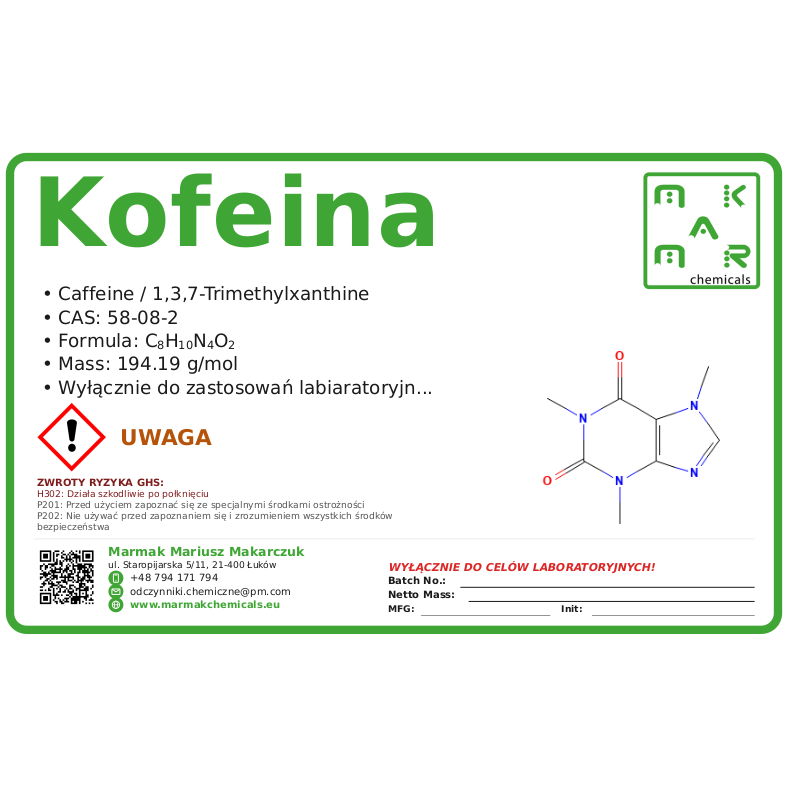


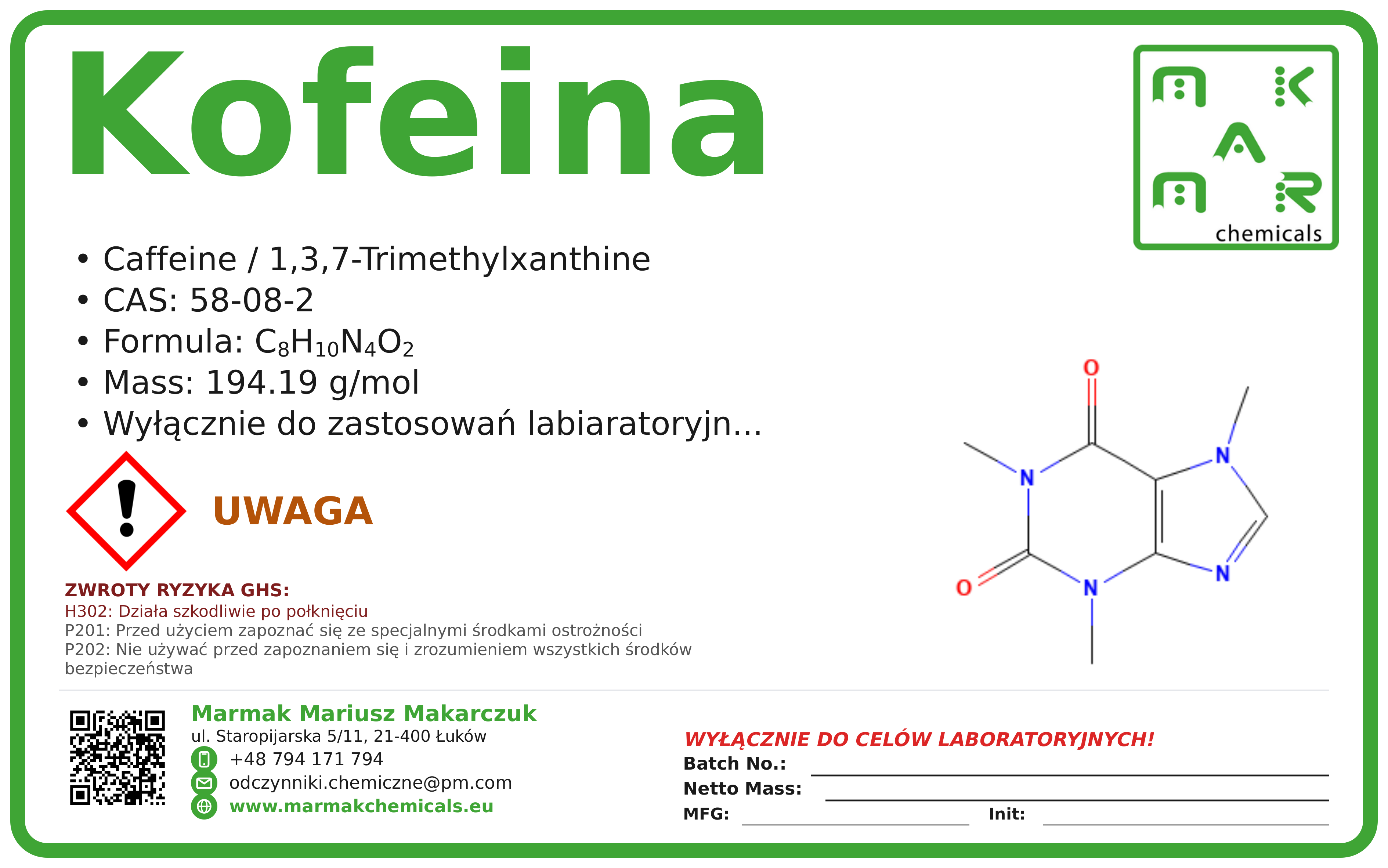
Reviews
There are no reviews yet.